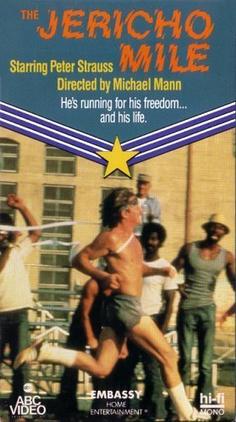
1979’s The Jericho Mile tells the story of Larry Murphy (Peter Strauss).
Larry is serving a life sentence at Folsom Prison, convicted a crime that he admits to having committed. Larry murdered his father, specifically to protect his stepsister from being raped. Larry feels no guilt for his crime and, at the same time, he’s willing to quietly serve his sentence. He’s a loner, avoiding the rival racial factions in the prison. (Brian Dennehy leads the Aryans while Roger E. Moseley leads the black prisoners and Miguel Pinero is the head of the Mexican Mafia.) Larry just wants to spend his time running around the prison yard.
When Dr. Bill Janowski (Geoffrey Lewis) sees how fast Larry can run, he arranges for a local track coach, Jerry Beloit (Ed Lauter), to come up to the prison with a few potential Olympians so that they can race Larry. Larry manages to outrun all of them. Jerry becomes convinced that Larry could qualify for the Olympics, if only he had a regulation track to run on. The Warden, knowing good publicity when he sees it, assigns the inmates to build the track but doing so means dealing with Folsom’s highly charged racial politics. No matter how fast Larry can run and no matter how inspiring it would be for Larry to go from serving a life sentence to competing in the Olympics, Folsom is still a prison and Larry is still a prisoner. And while the guards may have the guns and may be the only ones who are allowed to go home at the end of the game, it’s the prison gangs who have all the power. When the Aryans go on strike and refuse to work on the track, it puts Larry’s chances in jeopardy.
Of course, Larry’s chances are already in jeopardy just because of who he is. Larry is a prisoner who refuses to show remorse. While other prisoners embrace religion or politics and try to convince outsiders that they’ve either reformed or been wrongly convicted, Larry just wants to run. Running is when he’s free. (The film’s title refers to the Walls of Jericho coming down.) And, for the other inmates, watching Larry run is a reminder that there are many ways once can escape from the drudgery of being locked away.
The Jericho Mile is a tough and rather cynical prison film, one that manages to combine downbeat social drama with a uplifting sports story. You’ll want to cheer Larry while he’s running, even if you secretly suspect that he’s ultimately chasing something that will never happen. Making his directorial debut, Michael Mann shot the film on location at Folsom and the cast is full of actual prisoners, all of whom bring some much need authenticity to the film’s story. Mann never lets us forget that this is a film about people in a very dangerous situation and, even at its most inspiring, the film leaves you feeling as if violence could break out at any moment. Peter Strauss, who usually played somewhat more refined characters, is totally believable as the taciturn Larry and character actors like Dennehy and Mosely skillfully blend in with the actual prisoners in the cast. The Jericho Mile is a portrait of crime, punishment, and dreams. It’s a movie that will stay with you.
Welcome to Retro Television Reviews, a feature where we review some of our favorite and least favorite shows of the past! On Mondays, I will be reviewing Miami Vice, which ran on NBC from 1984 to 1989. The entire show is currently streaming on Tubi!
This week, the second season with a two-hour long premiere! Crockett and Tubbs are going to New York!
Episode 2.1 and 2.2 “The Prodigal Son”
(Dir by Paul Michael Glaser, originally aired on September 27th, 1985)
The second season premiere of Miami Vice opens with a series of set pieces.
In Panama, Crockett and Tubbs visit a secret military base in the jungle and are disgusted to learn how the Panamanian military gets information about drug smugglers. Tubbs and Crockett find one horribly tortured man in a tent. Tubbs gives him a drink of water and gets what information he can from the man. Crockett and Tubbs leave the tent. A gunshot rings out as the involuntary informant is executed. When the shot rings out, both Crockett and Tubbs turn back to the tent in slow motion, stunned by the brutality of their allies in the Drug War. Indeed, it’s hard not to compare the scene to the famous photograph of a South Vietnamese general executing a communist during the Vietnam War.
The Vietnam analogy continues with the next scene. In the Everglades, Crockett, Tubbs, and the entire Vice Squad work with the DEA to ambush the Revilla cousins as they bring drugs into the U.S. Sitting in the swamp, Crockett compares the experience to Vietnam, suggesting that the war on the drugs is just as futile and as costly. And indeed, it’s hard not to notice that every drug dealer that Crockett and Tubbs has taken down over the course of this show has immediately been replaced by another. The Revillas are just another in a long line of people getting rich off of other people’s addictions.
After the bust goes down, Crockett and Tubbs arrives at a celebratory party, just to discover that almost of all of the undercover DEA agents have been murdered and Gina has been seriously wounded. There is something very haunting about this scene, with Crockett and Tubbs rushing through a penthouse and seeing a dead body in almost every room.
At a meeting in a stark office, the head DEA agent explains that his agency has been compromised and all of his undercover agents have been unmasked. Someone has to go to New York and work undercover to take down the Revillas but it can’t be any of his people. Since the Revillas are smuggling their stuff in through Miami, Miami Vice has jurisdiction. Paging Crockett and Tubbs!
Working undercover as Burnett and Cooper, Crockett and Tubbs visit a low-level drug dealer (played by Gene Simmons) who lives on a yacht and who gives them the name of a connection in New York City.
From there, Miami Vice moves to New York City, where Crockett and Tubbs meet a low-level criminal named Jimmy Borges (played by an almost impossibly young Penn Jillette) and they try to infiltrate the Revilla organization. Along the way, Tubbs meets up with Valerie (Pam Grier) and discovers that she has apparently lost herself working undercover. Meanwhile, Crockett has a brief — and kind of weird — romance with a photographer named Margaret (Susan Hess).
(“I like guns,” she says when Crockett demands to know why she stole his.)
With Crockett and Tubbs leaving Miami for New York in order to get revenge for a colleague who was wounded during an operation, The Prodigal Son almost feels like the pilot in reverse. Also, much like the pilot, the exact details of The Prodigal Son‘s story are often less important than how the story is told. This episode is full of moody shots of our heroes walking through New York while songs like You Belong To The City play on the soundtrack. (There’s also a song from Phil Collins, undoubtedly included to bring back memories of the In The Air Tonight scene from the pilot.) It’s all very entertaining to watch, even if the story itself doesn’t always make total sense. Indeed, you really do have to wonder how all of these criminals keep falling for Sonny’s undercover identity as Sonny Burnett. You would think that someone would eventually notice that anyone who buys from Sonny Burnett seems to get busted the very next day.
Stylish as the storytelling may be, this episode actually does have something on its mind. Those lines comparing the War on Drugs to the Vietnam Conflict was not just throwaways. Towards the end of the episode, Crockett and Tubbs follow a lead to the offices of J.J. Johnston (Julian Beck, the ghost preacher from Poltergeist II). The skeletal Johnston is an investor of some sort. He has no problem admitting that he’s involved in the drug trade, presumably because he knows that there’s nothing Crockett and Tubbs can do to touch him. Upon meeting the two cops, he immediately tells them exactly how much money they have in their checking accounts. He points out that they’re poor and they’re fighting a losing war whereas he’s rich and he’s making money off of a losing war. Beck gives a wonderfully smug performance as Johnston and it should be noted that, of all of the episode’s villains, he’s the only one who is not brought to any sort of justice. Val almost loses herself. Tubbs and Crockett don’t even get a thank you for their hard work. The somewhat sympathetic Jimmy Borges ends up dead while the Revillas were undoubtedly been replaced by even more viscous dealers. Meanwhile, J.J. Johnston relaxes in his office and counts his money. This is the No Country For Old Men of Miami Vice episodes.
This episode is also full of familiar faces. Charles S. Dutton, Kevin Anderson, Anthony Heald, Miguel Pinero, James Russo, Bill Smtirovich, Zoe Tamerlis, Paul Calderon, and Louis Guzman, they all show up in small roles and add to show’s rather surreal atmosphere. This is Miami Vice at its most dream-like, full of people you think you might know despite the fact that they’re doing things of which you don’t want to be a part.
As for the title, The Prodigal Son is Tubbs and he is tempted to stay in New York City. But, in the end, he joins Crockett on that flight back to Miami. It’s his home.
Welcome to Retro Television Reviews, a feature where we review some of our favorite and least favorite shows of the past! On Mondays, I will be reviewing Miami Vice, which ran on NBC from 1984 to 1989. The entire show is currently streaming on Tubi!
This week, Crockett and Tubbs finally get their revenge on Calderone!
Episode 1.6 “Calderone’s Return Part 2: Calderone’s Demise”
(Dir by Paul Michael Glaser, originally aired on October 26th, 1984)
This episode of Miami Vice opens with Crockett and Tubbs interrogating an associate of the hitman who Calderone (Miguel Pinero) sent to kill Sonny during the previous episode. Crockett and Tubbs yell at the man and basically threatened to beat the crap out of him unless he tells them where Calderone is hiding in the Bahamas. They eventually get the information that they want but it’s hard not to compare their methods to the methods that the “bad” cops previously used to get a false confession from the Haitians in episode 4.
Of course, in this case, it’s personal for Crockett and Tubbs. Calderone killed Tubbs’s brother. Calderone’s assassin killed Lt. Rodriguez and nearly killed Sonny’s wife and son. And besides, how could any viewer spend too much time worrying about the ethics of how they got their information when it leads to an extended sequence of Crockett and Tubbs stoically standing in one of Crockett’s speed boats as they race across the ocean to the Bahamas?
Miami Vice has often been described as being the ultimate example of style over substance and, while I think that’s an oversimplification because Miami Vice definitely had something to say about greed and the war on drugs, it is true that this episode proves just how many illogical plot developments an audience is willing to accept as long as the story is told with a certain amount of visual fliar.
Because, seriously, at no point does Crockett and Tubbs’s plan make any sense.
Basically, Crockett and Tubbs are planning to work undercover on the island so that they can get close to Calderone. Here’s the thing, though — Calderone has seen both Crockett and Tubbs so it’s not like he’s not going to recognize them if he spots them. (Calderone even sent a hitman to kill Crockett.) As well, since neither Calderone nor anyone in his entourage actually met the hitman, Crockett is planning on pretending to be the hitman and demanding more money for his services. However, the hitman is from Argentina and there’s absolutely nothing about Don Johnson (or Sonny Crockett) that suggests that he could be from anywhere in South America. Finally, one has to be willing to accept that Calderone no longer has any contacts in Miami who could call him up and say, “Hey, your hitman’s dead and Sonny Crockett is still alive.”
Tubbs, meanwhile, pretends to be an art gallery owner so he can approach Angelina (Phanie Napoli), the artist who he believes to be Calderone’s mistress. It’s not until after Tubbs has slept with her that he discovers that she is actually Calderone’s daughter and she believes her father to be a legitimate businessman. Despite having known her for only a day, Tubbs tells Crockett that he’s falling in love with her.
By that point, Calderone has already figured out that Sonny and Tubbs are on the island and they’ve already been through one exciting car chase. Logic would suggest that Sonny and Tubbs should now leave the island but, instead, they decide to put on masks so that they can attend the carnival. The masks, however, don’t do fool anyone as they’re both grabbed by Calderone’s men and taken to Calderone’s mansion where Calderone ends up getting gunned down while Angelina screams, “NOOOOOO!” Needless to say, that’s pretty much the end of Angelina’s romance with Tubbs.
As I said, the plot doesn’t always make much sense. The whole storyline is dependent on Tubbs, Crockett, and Calderone almost always choosing to make the most illogical choices. Calderone could have easily killed Tubbs and Crockett at the carnival but, for some reason, he brought them to his home. Tubbs and Crockett could have arrested Calderone for jumping bail and taken him back to Miami but, instead, they came up with an undercover plan that was doomed to failure. It makes no sense but it’s so stylish that it doesn’t matter. The slow motion shootouts, the car chases, the masks, the beautiful island scenery, the spacey comedic relief provided by Sam McMurray in the role of a stoned resort manager, all of that comes together so nicely that the plot ultimately doesn’t matter. It’s pure style and both Johnson and Thomas are so charismatic as Crockett and Tubbs that they’re a pleasure to watch even when they’re doing stupid things.
Welcome to Retro Television Reviews, a feature where we review some of our favorite and least favorite shows of the past! On Mondays, I will be reviewing Miami Vice, which ran on NBC from 1984 to 1989. The entire show is currently streaming on Tubi!
This week, we learn who Tubbs really is and one scene changes television forever.
Episode 1.2 “Brother Keeper: Part Two”
(Directed by Thomas Carter, originally aired on September 16th, 1984)
The pilot for Miami Vice originally aired as a two-hour made-for-TV movie but, when it was released in syndication, it was split into two separate episodes. That’s the way it’s usually aired on the retro stations and that’s also the way that it’s featured on Tubi. And, as you can tell, that’s the way that I’ve decided to review it for this site.
Picking up where the first half ended, Brother’s Keeper: Part Two finds Sonny and Tubbs searching through the deceased Leon’s apartment. Calderone’s men obviously visited the place and ransacked it before Sonny and Tubbs arrived but Sonny still manages to find Leon’s collection of important phone numbers. Tubbs is surprised to discover that Leon lived in a very nice apartment but that’s the way things work in Miami. Cocaine means big money and any one willing to take the risk can live like a king. While the cops and the regular people go home to small apartments and houses that they can barely afford, the successful criminal lives a life of relative luxury. The question is less why so many people are dealing drugs as why so many people aren’t.
While searching the apartment, Tubbs suddenly realizes that Sonny Crockett used to be a football star with the University of Florida. (“You were a funky honky!” Tubbs exclaims.) Apparently, Sonny was one of the best but a series of injuries ended his NFL dreams and, instead of going pro, Sonny did two tours of duty in Vietnam. (The South Asian conference, Sonny calls it.) Myself, I’m wondering how a semi-famous former football player can also be an undercover detective, working under a false name. Wouldn’t he always be worried that a drug dealer would recognize him from the college days and figure out that Sonny Burnett was actually Sonny Crockett?
Sonny’s co-worker and girlfriend, Gina (Saundra Santiago), takes a break from working the undercover prostitution detail and lets Sonny know that she did a background check on Raphael Tubbs and he’s dead! Raphael was a New York cop who was killed in shootout weeks before the other Tubbs landed in Miami. When Sonny confronts him about this, Tubbs admits that he’s actually Ricardo, Raphael’s younger brother. Raphael was a decorated Brooklyn detective. Rico Tubbs, on the other hand, was a Bronx beat cop who forged a lot of documents in order to come down to Florida and convince Vice to allow him to work the Calderone case. Sonny isn’t happy about being lied to but he has a lot more to worry about because, the night before, he apparently rolled over to Gina and whispered his ex-wife’s name in her ear! Needless to say, things are a bit awkward between just about everyone.
Actually, awkward doesn’t even begin to describe what happens when Tubbs suggests that Lt. Rodriguez could be Calderone’s mole. Sonny refuses to consider it until he overhears Rodriguez talking about enrolling his son in a pricey private school. Fortunately, Rodriguez is innocent and the real mole’s number is found in Leon’s apartment. Unfortunately, that number belongs to Sonny’s former partner, Scott Wheeler (Bill Smitrovich)!
After getting Wheeler to confess and turning him over to Rodriguez, Sonny and Tubbs drive down the dark streets of Miami at night, heading towards a rendezvous with Calderone. They don’t say much. Tubbs loads his shotgun. Sonny stops and makes a call to his ex-wife, something that his former partner Eddie didn’t get to do before he was killed. The neon of Miami glows menacingly in the darkness. Meanwhile, in the background, Phil Collins sings In the Air Tonight….
And it’s an absolutely beautiful sequence. Between the surreal menace of Miami at night, the atmosphere of impending doom, and the moody song playing in the background, this sequence plays out like a surreal dream. Both Tubbs and Crockett know that they are quite possibly driving to their death but, at this point, they have no other choice. Too many people have died to turn back. Neither Sonny nor Tubbs has anything in their life at that moment, beyond arresting Calderone.
And they do manage to arrest Calderone, along with killing quite a few of his associates. However, Calderone is released by a crooked judge and flies away in a private airplane while Sonny and Tubbs can only stand on the runway and watch. Sonny says that Calderone will return eventually. Tubbs replies that he probably doesn’t have a job anymore. Sonny asks Tubbs if he’s interested in a “career in Southern law enforcement.”
The second part of the pilot was dominated by that one scene of Tubbs and Sonny driving down the street. And that scene was so strong and it made such an impression that it’s easy to ignore that the rest of Brother’s Keeper Part Two was not quite as exciting as Part One. If the first part of the pilot set up Miami as a hedonistic playground of the rich and corrupt, the second part felt a bit more conventional in its approach. Or, at least, it did until Phil Collins started to sing and play the drums. One cannot understate the importance of that one scene. That one scene, done with next to no dialogue, pretty much told the viewer everything that they needed to know about the show, about Miami, and about Crockett and Tubbs as partners. In that scene, the show reminded us that no one is guaranteed to get out alive.
Next week: Crockett and Tubbs infiltrate an undercover pornography ring and Ed O’Neill appears as an FBI agent who may have gone over to the dark side.
Welcome to Retro Television Reviews, a feature where we review some of our favorite and least favorite shows of the past! On Mondays, I will be reviewing Miami Vice, which ran on NBC from 1984 to 1989. The entire show is currently streaming on Tubi!
Legend has it that Miami Vice was originally pitched as being “MTV Cops.” That may or may not be true but what is known is that it was a show that, for many people, continues to epitomize the 80s. Its cynical and frequently surrealistic portrait of life in Miami continues to be influential to this day. With Florida currently being at the center of so many discussions, it just seemed like a natural pick for Retro Television Reviews.
(Up until a few days ago, the mayor of Miami was running for President and two other Florida residents are currently the front runners for one party’s presidential nomination. As I sit here writing this, national politics are often described as Florida vs California. Even more than in the past, America revolves around Florida.)
Though Miami Vice is often describe as being a Michael Mann production, the show itself was actually created by Anthony Yerkovich, who felt that Miami in the 80s had become the American equivalent of Casablanca during World War II. Mann served as executive producer and he played a big role in creating the show’s trademark visual style. And, of course, the theme song was provided by Jan Hammer:
Episode 1.1 “Brother’s Keeper, Part One”
(Dir by Thomas Carter, originally aired on September 16th, 1984)
Though the show is considered, to this day, to be the epitome of the Southern Florida aesthetic, Miami Vice actually begins in New York City.
On a dark and wet New York Street, a detective named Tubbs (Philip Michael Thomas) sits in his car. When a group of young men approach the car and demand that Tubbs give them some money, Tubb responds by coolly pointing a shotgun at them. The men take the message and leave.
Tubbs is staking out a Colombian drug dealer named Calderone (Miguel Pinero). Tubbs follows Calderone and his associates to a club, the type of place where even the neon lighting seem to be shadowy. When Tubbs gets into a fight with some of Calderone’s bodyguards, Calderone flees into the dark night.
The action moves to Miami, which is as bright and sunny as New York was cold and dark. Undercover vice cop Sonny Crockett (Don Johnson), wearing a white suit and a green t-shirt, gives advice to his partner, Eddie Rivera (a young and charismatic Jimmy Smits, making his television debut). Eddie talks about how his wife is nervous about him being a cop. Sonny tells Eddie to call her after they get finished dealing with a local drug dealer named Corky.
Corky knows Crockett as “Sonny Burnett” and he believes Eddie is a buyer from California. When Corky arrives, they drive out to an underpass. Corky and Eddie walk over to another car to check out Corky’s product. Sonny spots the bomb that’s been taped under car’s hood but he’s too late to keep it from blowing up both Corky and Eddie.
When Lt. Rodriguez (Gregory Sierra) arrives on the scene, he’s not amused to discover two of his detectives — Stan Switek (Michael Talbott) and Larry Zito (John Diehl) — joking about how the police dogs are going to get hooked on all of the cocaine residue. However, he’s even more annoyed with Sonny, who is quickly established as being the type of cop who does not “do it by the book!” Rodriguez also says that Sonny hasn’t changed since his “football days.” Sonny says that Eddie was killed by a mysterious dealer known as The Colombian. Rodriguez replies that Sonny can’t even prove that the Colombian exists. Rodriguez is particularly angered when Sonny says that there must be a mole working in the department.
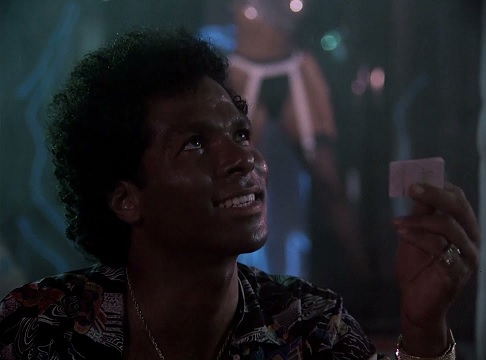
While Sonny tells Eddie’s wife the bad news and then heads over to his son’s birthday party (it’s established that Sonny is divorced), Tubbs lands in Miami. Hanging out at a strip club and doing an elaborate dance to Rockwell’s Somebody’s Watching Me, Tubbs is approached by a man named Scott Wheeler (Bill Smitrovich). Pretending to be a Jamaican named Teddy Prentiss, Tubbs arranges to meet a drug dealer that Wheeler claims to know.
What Tubbs doesn’t know is that Wheeler is an undercover DEA agent and that he’s also Sonny Crockett’s former partner. Sonny is the “dealer.” That night, Sonny and a real-life drug dealer, Leon (Mykelti Williamson) show up at the meeting with Wheeler and “Teddy.” Unfortunately, Zito and Switek show up earlier than expected and they end up arresting everyone before Leon can lead Sonny to the Colombian. Tubbs makes a run for it, jumps into the boat that Sonny drove to the meeting, and speeds away. Sonny jumps into his own car and chases the boat while the Miami Vice theme song plays in the background. (Trust me, it’s a supercool scene.)
Finally confronting Tubbs on a bridge, Sonny reveals that he’s a detective. Tubbs produces his own badge and introduces himself as Raphael Tubbs of the NYPD. He explains that he’s in Miami because he’s after a Colombian drug dealer named Calderone. Sonny explains that he’s too busy searching for the Colombian to worry about Tubbs’s search. Finally, Lt. Rodriguez shows up and helps them to understand that they’re both looking for the same guy. Rodriguez suggests that they work together but Sonny refuses.
The next morning, Tubbs tracks Sonny down on the houseboat on which he lives. It’s a tense meeting, with Sonny punching Tubbs for suggesting that he wasn’t a good enough cop to save Eddie’s life. Sonny apologizes afterwards and Tubbs accepts the apology and then punches Sonny so that they’ll be even. Sonny then introduces Tubbs to his pet alligator, Elvis. It’s male-bonding, 80s style!
Sonny and Scott head over to the courthouse so that they can be “arraigned,” along with Leon. I really liked the performance of Howard Bergman, who played the eccentric judge, Clarence Rupp. At one point, the lights went out in the courtroom and when they came back, everyone from the judge to the bailiffs to the court reporter had drawn a gun. After mentioning his appreciation of the second amendment, Judge Rupp announces that Leon is free to go without bail because he’s cooperating with the police. A panicked Leon yells that he’s not cooperating.
Later, a fearful Leon calls Rodriguez and offers to cooperate in return for protective custody. Leon is hiding out at the beach, where Tubbs is keeping an eye on him. When Sonny arrives, he’s not amused to see Tubbs there. Meanwhile, a hitman who has disguised himself as a woman shoots and kills Leon while Girls Just Want To Have Fun plays on the soundtrack.
And so ends part one of Brother’s Keeper. And you know what? Even after all this time, it’s still easy to see why Miami Vice took off and why it continue to inspire a slew of imitators. The pilot was genuinely exciting, with the perfect mix of music, visuals, and charismatic performances. Jimmy Smits broke my heart in his tiny role. Mykelti Williamson made Leon into an almost sympathetic character as he realized that the cops were willing to sacrifice him to get at his boss. From the start, Don Johnson’s gruff performance as Sonny feels like a perfect match for Philip Michael Thomas’s more earnest portrayal of Tubbs. If Sonny is a cynic, Tubbs seems to feel that he can make a difference by taking down men like Calderone. We’ll have to see how long that lasts.
Next week, we’ll finish up the pilot with part two of Brother’s Keeper!
Last night, fully intent on just viewing one movie before going to bed, I decided to watch the 1977 film, Short Eyes.
Why I thought that was a good idea, I’m not sure. Even though I didn’t know much about the film, I did know that it was a gritty prison drama that was written by an ex-con, filmed in an actual New York prison, and that a few prisoners appeared in small roles in the film. So, I really can’t claim that I didn’t realize that I was about to watch something that probably wasn’t going to be deal with particularly pleasant subject matter. I think my main reason for watching it, to be honest, was just that it had been sitting there on my Prime watchlist for nearly a year. My main motivation can be summed up as “If not now, when?” Of course, if I had know that “Short Eyes’ was apparently prison slang for someone who is a pedophile, I might have thought twice about watching.
The Short Eyes of the title is Clark Davis (Bruce Davison), a young man from a vaguely wealthy background who is being held on charges of raping a young girl. Clark is one of only three white men being housed in his cell block. As Clark soon discovers, everything in prison is determined by your race and what you’re accused of doing. As a white man, he’s already in the minority and, because he’s a “short eyes,” he soon discovers that not even the other whites are willing to watch his back. The only person who is vaguely sympathetic to Clark is Juan (Jose Perez), a longtime prisoner who is determined to not allow prison to turn him into an animal. Juan tells Clark that he needs to get a transfer to protective custody but it soon becomes apparent that’s not going to happen. The prison guards feel no obligation to protect Clark and Clark himself almost seems to have a death wish.
As Clark explains to Juan, he’s not sure whether he’s guilty or not. He says that he blacks out and sometimes, he’s not sure what he did. Clark thinks he’s innocent but, at the same time, he also confessed to Juan that he has molested other girls. Juan knows that Clark’s a dead man if he doesn’t get out of prison but he also know that, even if Clark is innocent this time, he won’t be in the future. When the other prisoners decide to kill Clark, Juan has to decide whether to let it happen or to risk his safety by trying to stop it.
Short Eyes is one of the most thoroughly unpleasant films that I’ve ever watched but that obviously was the point. This is a film about the reality of prison, that it’s a dirty, brutal, and inhumane place where the weak are targeted and anyone who goes against the system — whether it’s the system enforced by the guards or the even more important system created by the prisoners — will be punished. It’s not at all fun to watch but, if anyone wants to know why incarceration tends to just create hardened criminals as opposed to rehabilitating them, they should find some answers in the film’s portrait of prison life.
The film is based on a play and, in many scenes, it’s a bit too theatrical for its own good. Clark delivers a lengthy monologue about his previous actions and, while it’s well-delivered by Davison, it also goes on and on and you never quite understand why he’s opening up to Juan in the first place. (Juan, himself, angrily responds that he never asked to be Clark’s father confessor.) The scenes of the prisoners just hanging out and talking are also well-acted but again, they tend to drag on for a bit too long. Musicians Curtis Mayfield and Freddy Fender both appear as anonymous prisoners and both sing songs, which brings the film’s already uneven narrative momentum to a complete halt. Just as the inmates will never be able to escape prison, the film never escapes its theatrical origins. While the decision to film Short Eyes in an actual operating prison brings a good deal of authenticity to the production, the production’s staginess ultimately works against it.
At its best, this is a well-acted portrait of people trapped in a man-made Hell. Jose Perez gives an excellent performance and Bruce Davison will make your skin crawl as Clark, a character about whom most viewers will have very mixed feelings. Nathan George and Joseph Carberry are both properly intimidating as the heads of, respectively, the black prisoners and the whites.
This is definitely not a film to watch late at night, unless you’re actively trying to generate nightmares. (Of course, if that’s your goal, have it!) As for me, I stayed up an extra two and a half hours just so I could watch another movie after Short Eyes. As a result, I spent all of Saturday tired but I still think I made the right decision.




 Through the Shattered Lens