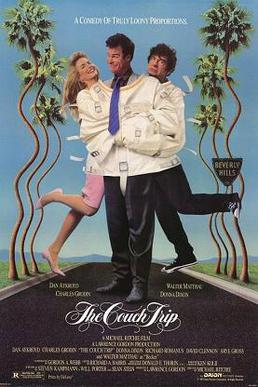
The Couch Trip (1988, directed by Michael Ritchie)


When renowned radio psychiatrist George Matlin (Charles Grodin) has a nervous breakdown, he takes a trip to Europe with his wife (Mary Gross) to both recover and also work on his marriage.  (Matlin’s breakdown was the result of an extramarital affair.)  Needing someone to host Dr. Matlin’s radio show, his producers call Dr. Lawrence Baird (David Clennon), who oversees a mental facility in Chicago.  They assume that Dr. Baird is just dumb enough that they won’t have to worry about him overshadowing Dr. Matlin while he’s guest-hosting.  However, when they call, Dr. Baird is out of his office and the phone is answered by John Burns (Dan Aykroyd), a con artist who has been pretending to be insane so that he can avoid serving time in prison.  Pretending to be Baird, Burns accepts their offer and then escapes from the asylum and heads to Beverly Hills.  The real Dr. Baird, not knowing about the offer, goes on vacation in Europe.  Though Burns had originally only been planning on doing the radio job long enough to get paid enough money to head to Mexico, he soon becomes a celebrity with his non-nonsense, blunt advice.

There’s a lot of talented people in The Couch Trip, including Walter Matthau as a former priest-turned-kleptomaniac and Aykryod’s wife, Donna Dixon, as Matlin’s colleague and Burns’s eventual love interest.  Director Michael Ritchie was responsible for some of the best films of the 70s and radio psychiatry is certainly a ripe subject for satire.  Why, then does, The Couch Trip fall flat?  Some of it is because the movie never seems to know if it wants to be wacky farce or a dramedy about a criminal who finds a new life helping people.  The other big problem is that the talented Dan Aykroyd is miscast as the type of unapologetic smartass that Bill Murray could play in his sleep.  (In a version where Murray played John Burns, Aykroyd would have been perfect casting as George Matlin.)

Aykroyd was one of the most talented members of the original Not Ready For Prime Time Players.  (His impersonations of Nixon and Jimmy Carter were second-to-none.)  Sadly, Hollywood has never figured out what to do with his off-center talent.  The Couch Trip is a prime example of that.
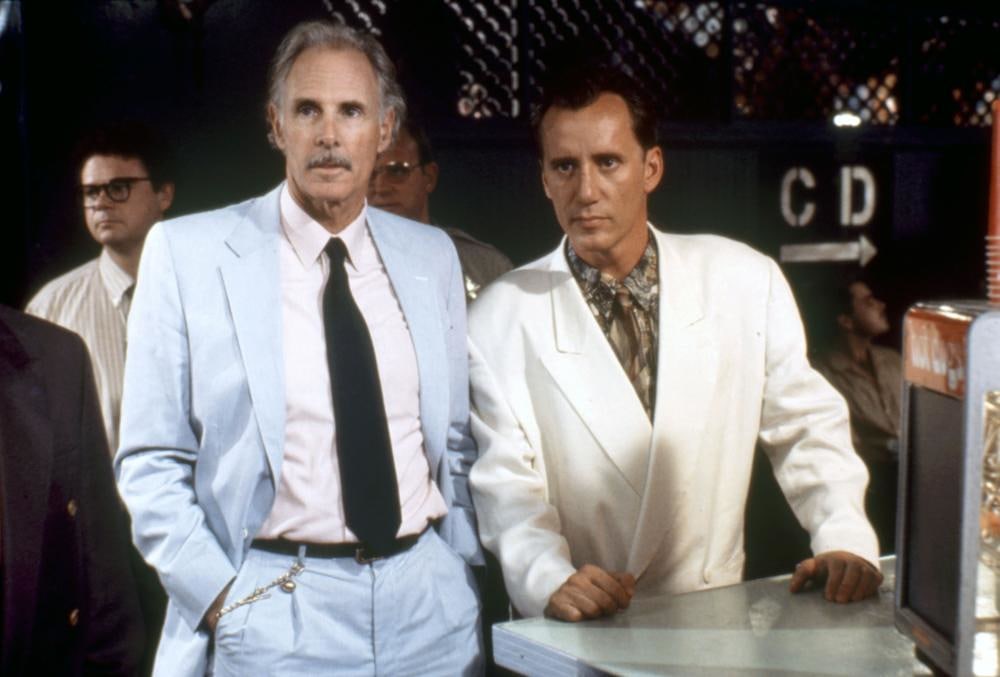
 

Brad reviews DIGGSTOWN (1992), starring James Woods, Lou Gossett Jr. and Bruce Dern!


Gabriel Caine (James Woods) is a fast-talking con man fresh out of prison who’s already set up his next big scam. Along with his partner Fitz (Oliver Platt), Caine is targeting Diggstown, a small, boxing-obsessed community ruled over by the corrupt John Gillon (Bruce Dern). Gillon controls the town because he rigged a fight that left local boxing legend Charles Macum Diggs (Wilhelm von Homburg) completely brain-damaged. The scam involves getting Gillon to take a $100,000 bet that 48 year old “Honey” Roy Palmer (Louis Gossett Jr.) can defeat any ten Diggstown fighters in one 24-hour period. Once the fights start, you can bet that both sides will have lots of surprises up their sleeves, but the question is who will be standing when the final bell rings?!! 

Since today is Bruce Dern’s 89th birthday, I decided to watch DIGGSTOWN, one of my favorite movies featuring the birthday boy. A box office flop when it was released in 1992, making less than $5 million at the box office, the reputation for the film seems to have gotten stronger over the years. The film has an excellent cast! James Woods exudes cockiness and intelligence as conman, Gabriel Caine. He somehow pulls off the feat of being both sleazy and very likable, which is a testament to Woods’ skills as an actor. Louis Gossett Jr. is great as “Honey” Roy Palmer. I remember when I first saw the trailer for DIGGSTOWN, I thought he was too old for the role. After watching it though, he’s able to make the boxing scenes work, especially when you consider some of the help he’s given as part of the con. With the huge personalities of Woods and Bruce Dern surrounding him, Gossett’s more grounded performance anchors the film. Bruce Dern is perfectly cast as the villainous scuzzbucket, Gillon. He’s the type of guy you really want to see get his comeuppance at the end. Now that I think about it, Gillon is such an A-hole, Caine can’t help but seem likable in comparison! Finally, I did want to give a shout out to Oliver Platt, who’s extremely funny in his role as Caine’s partner in con. It’s one of the first movies I remember seeing Platt in, and he’s great!

For DIGGSTOWN to really work though, the boxing scenes need to work and the con needs to be smart. Director Michael Ritchie (THE BAD NEWS BEARS) does a good job setting up both. The boxing sequences are well choreographed by Benny “The Jet” Urquidez, and you can’t help but root for the old guy as his opponents keep on coming. Of the 10 fights, some are funny, some are quick, and some are very intense depending on the situation. Ritchie is able to keep the stakes high enough during the boxing scenes to make sure we remain invested in the story. It’s a nice balancing act as the con plays out in the background of each fight. And what a con it is! I won’t spoil it for you, but it’s a stroke of genius that resulted in a massive amount of satisfaction for this audience member! 

Overall, DIGGSTOWN is one of those movies I’m sure to watch every few years. With its great cast, punchy sense of humor, and genius triple-twist of an ending, I can’t imagine anyone leaving disappointed. I highly recommend it! 

The trailer is included below:

Cops and Robbersons (1994, directed by Michael Ritchie)


Chevy Chase is Norman Robberson, a hen-pecked suburban dad who likes to watch cop shows.  When he is informed that his next door neighbor, Horace Obsborn (Robert Davi), is suspected of being a Mafia hitman, he agrees to allow Detectives Jake Stone (Jack Palance) and Tony Moore (David Barry Gray) to use his house as their stakeout location.

Cops and Robbersons is just as terrible as its title.  Norman is basically Clark Griswold without the excuse of a vacation or the holidays to explain away his stupidity.  Jack Palance growls and looks annoyed but without the same comedic flair that he brought to City Slickers.  Dianne Wiest is wasted as Norman’s wife.  Of course, Norman’s daughter develops a crush on Tony while Norman’s son dressed up like Dracula and tries to put the bite on Stone.  Norman keeps getting in the way of the two cops and trying to conduct an investigation on his own.  There has to be an easier way to capture a hitman.  The only thing that really works is Robert Davi’s performance as the hitman.  Davi doesn’t try to be funny, which actually brings out the best in Chase whenever they share a scene.  Chase’s goofy dad shtick works best when he’s dealing with someone who isn’t trying to score laughs of his own.

How did the great Michael Ritchie end up directing movies like this?  Whoever let that happen should be ashamed.


4 Shots From 4 Films: Special Lee Marvin Edition


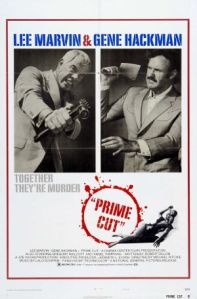
Prime Cut (1972, directed by Michael Ritchie)

4 Shots From 4 Films is just what it says it is, 4 shots from 4 of our favorite films. As opposed to the reviews and recaps that we usually post, 4 Shots From 4 Films lets the visuals do the talking!

96 years ago, Lee Marvin was born in New York City.  After getting kicked out of several prestigious prep schools for “bad behavior,” 18 year-old Lee Marvin enlisted in the Marin Corps, was briefly a corporal before getting demoted back to private (again, because of “bad behavior”), and was wounded in action during the Battle of Saipan.  (Marvin was one of the few members of his unit to survive the battle.)  After he was discharged from the Marines, he worked as a plumber’s assistant at a local community theater and, after being asked to temporarily replace an actor who had fallen ill, Marvin decided to pursue a career as an actor.

Marvin became one of Hollywood’s premier tough guys.  He played his share of gangsters, cops, and cowboys but, because of his background, he was a natural for playing military men.  Whether it was The Dirty Dozen, The Big Red One, or The Delta Force, Lee Marvin was a natural leader and brought authenticity to every military role the played.  His final film was The Delta Force, which just happens to be the greatest film ever made.

In honor of Lee Marvin’s birthday, here are:

4 Shots From 4 Films

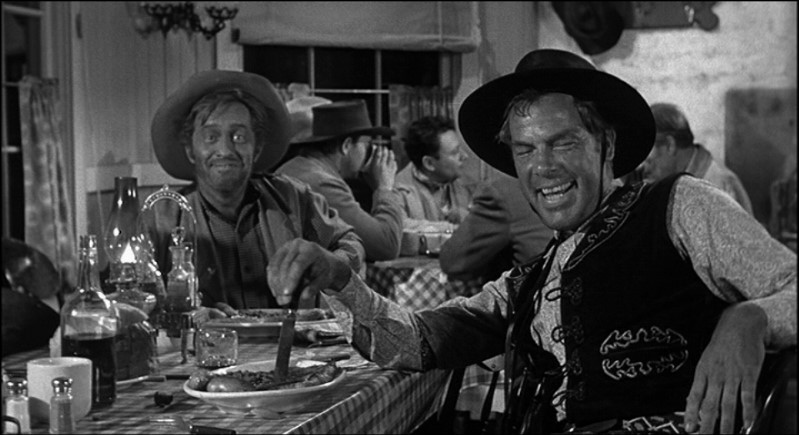
The Man Who Shot Liberty Valance (1962, directed by John Ford)

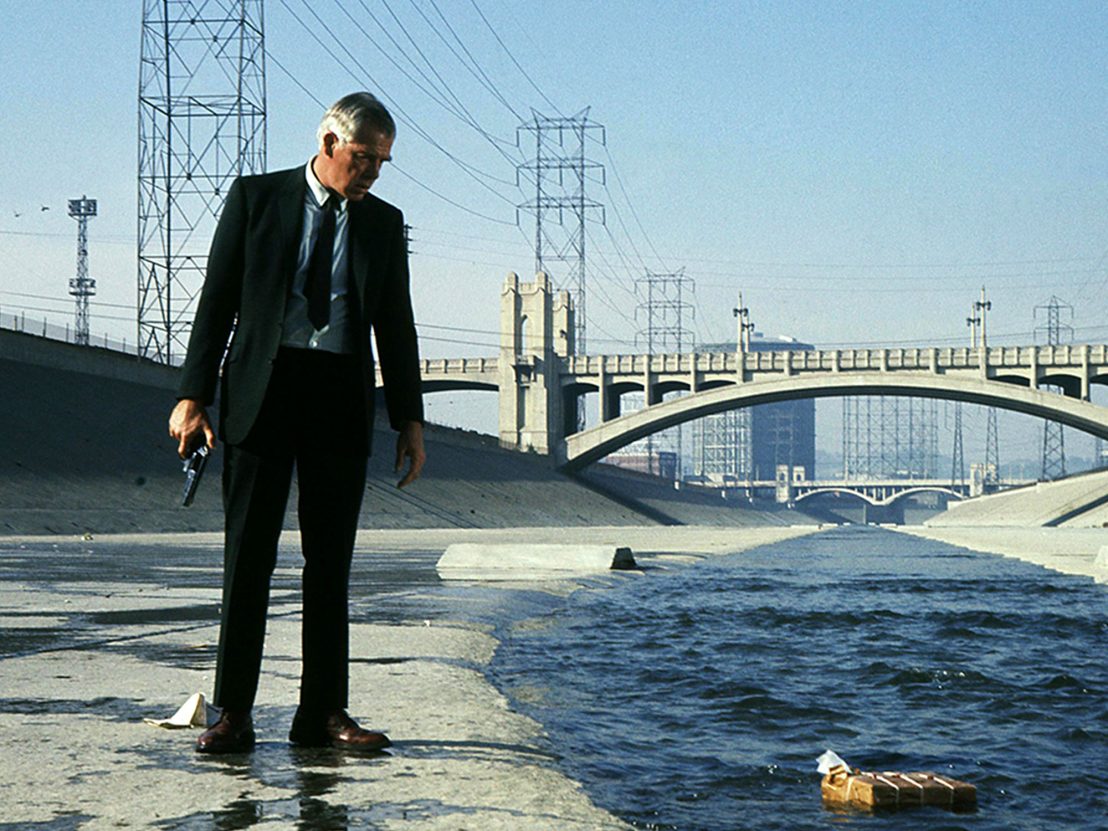
Point Blank (1967, directed by John Boorman)’

The Big Red One (1980, directed by Sam Fuller)

The Delta Force (1986, directed by Menahem Golan)

Film Review: The Island (dir by Michael Ritchie)


Last night, after I watched Cutthroat Island, I continued to prepare for Talk Like A Pirate Day by watching The Island, a pirate movie from 1980.

Michael Caine has appeared in some truly bizarre films over the course of his long career but The Island may be the strangest.  (According to the imdb, it’s also one of the few films that he refuses to discuss in interviews, which is kind of amazing when you consider some of the films that Caine will discuss.)  In The Island, Caine is plays Blair Maynard, a cynical New York journalist who happens to have a cockney accent.  Looking to do a story about the Bermuda Triangle, Maynard heads down to Florida.  He takes along his 12 year-old son, Justin (Jeffrey Frank), because what father wouldn’t unnecessarily put his only child’s life in danger?  Of course, Justin isn’t happy when he finds out that his father lied about visiting Disney World but all is forgiven after Maynard buys him a gun.  Justin does love to shoot guns, which will become a plot point soon enough.

Anyway, Maynard and Justin soon discover that the reason people are disappearing in the Bermuda Triangle is because they’re being kidnapped by … wait for it … PIRATES!

David Warner and the Pirates

That’s right, real-life pirates!  Apparently, centuries ago, a group of French pirates set up a colony on an uncharted island in the Caribbean.  Now, under the leadership of the savage Nau (played by the very British and not very savage David Warner), these pirates spend their time attacking boats, murdering people, and speaking in an odd combination of English, French, and Portuguese.  However, centuries of in-breeding have weakened the bloodline.  So, while Nau brainwashes Justin and turns him into a little buccaneer, Maynard is given to Beth (Angela Punch McGregor) and told to “thrust thrust.”

Yes, that’s right.  This is a film in which a middle-aged Michael Caine — complete with his trademark glasses and his “what the bloody Hell?” attitude — is turned into a sex slave.  (Again, this is one of the few films that Caine apparently refuses to discuss.)  The scene in which Beth strips the chained Maynard naked and then starts to rub Vaseline on him would be strange regardless of who played the main role but when it’s Michael Caine, it goes beyond the merely strange to becoming almost a work of outsider art.

Anyway, the movie only gets stranger from there as Justin grows to love the pirate life style and, eventually, both he and his father even get to take part in a raid on a schooner.  It’s during this raid that, from out of nowhere, a guy in extremely tight shorts pops up and starts doing all sorts of elaborate kung fu moves.  (He also makes all of the expected kung fu sounds while David Warner has a good laugh.)  It’s also during this raid that the pirates come across several packets of white powder.

“It’s a drug called cocaine,” Maynard says.

“What does it cure?” Beth asks.

“Insecurity,” Maynard answers.

It all leads to not only an impromptu wedding ceremony but also to the sight of Michael Caine screaming his head off while firing a machine gun.  I think we’re supposed to feel that the ordeal has driven Maynard somewhat mad but it’s hard to tell.  Caine has always been open about the fact that, for many years, he basically just accepted any role that was offered to him and The Island would appear to be a perfect example.  Maynard may have been trying to rescue his son but Caine’s main concern was obviously getting his paycheck and moving on to the next role.

Michael Caine in The Island

The Island is one of those movies that’s so odd that it really doesn’t matter whether it’s any good or not.  Between the strange plot and Michael Caine’s almost comically detached performance, this one of those films that, once you start watching, you really can’t look away from it.  In the end, The Island is so weird and misjudged that it becomes brilliant despite itself.

An Olympic Film Review: Downhill Racer (dir by Michael Ritchie)


For the past few days, like all good people, I have been totally obsessed with the Winter Olympics!  Last week, I asked my friends to suggest some Winter Olympic-themed movies that I could watch and review.  More than a few of them immediately recommended that I check out a film called Downhill Racer.

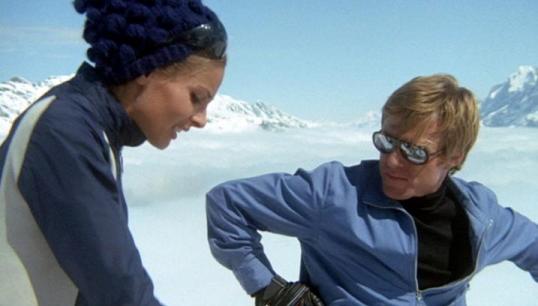
First released in 1969, Downhill Racer tells the story of David Chappellet (a very young and very handsome Robert Redford).  When we first meet David, he’s just arrived in Switzerland.  An alternate to the U.S. ski team, David has been summoned by Coach Eugene Claire (Gene Hackman) to replace an injured skier.  From the minute that David arrives, it’s obvious that he’s not interested in being anyone’s friend.  He’s upset that he was an alternate.  He’s upset that he’s going to be skiing so late in the competition.  He’s upset about … well, almost everything.  Unlike the rest of his teammates, he’s a loner and he rarely has much to say.  He cares about one thing: winning championships and being recognized as the best.  David is not a particularly likable character.  However, the fact that he doesn’t seem to care what anyone thinks about him is one of the things that makes him compelling.  Add to that, David quickly proves himself to be one of the best.  He may be arrogant but, more often than not, he can back up his pride.

Why is David so driven?  We get some clues when David returns to his hometown in Idaho.  Even though everyone in the town knows him and he doesn’t have any trouble convincing a former girlfriend to go off with him, David still seems out-of-place.  When he visits his father, the taciturn man is not impressed by David’s success.  As his father puts it, the world is full of champions.  Why should David deserve any more praise than anyone else?

Standing in contrast to the reservered David is Coach Claire.  Whereas David is reserved, Claire is passionate.  Whereas David is an unapologetic loner, Claire is willing to fight for every member of his team.  Whereas David reacts to a crash by refusing to accept that he made a mistake, Coach Claire is always brutally honest.  David couldn’t be a champion without Claire’s help but, in the end, the Coach is destined to remain in the background while David signs lucrative sponsorship deals and becomes a hero to television viewers everywhere.

It’s a familiar story, though perhaps it wasn’t as familiar in 1969 as it is today.  Today, we’ve grown accustomed to the idea that celebrities can be jerks and that “heroes” are often just manufactured idols.  (Downhill Racer has a good deal of fun with the shallowness of the media’s coverage of David Chappellett’s career.)  That said, familiar or not, there’s a good deal of authenticity to be found in the performances of both Redford and Hackman.  It takes a bit of courage to play a character who is as narcissistic and arrogant as David Chappellett but, even more so, it takes talent to make that character compelling.  As for Hackman, he’s the ideal coach.  He knows both how to get the best out of Chappellett but also when to call him out on his crap.  From the minute we meet the Coach, we knows that he cares but we also know that he’s seen a lot of David Chappelletts come and go over the years.

Of course, the main reason to watch Downhill Racer is because of the racing scenes, many of which were filmed as a point-of-view shot, putting you in the skis as the frozen landscape flies past you.  They are amazing to watch.  I’ve never been skiing, which is probably a good thing when you consider that I’m a bit accident-prone.  But the skiing sequences in Downhill Racer left me breathless, shaken, and exhilarated.

Downhill Racer is definitely one to watch, during the Olympics or any other time.

http://www.youtube.com/watch?v=Qg3zdWb8LGc

A Movie A Day #39: Prime Cut (1972, directed by Michael Ritchie)


primecutNick Devlin (Lee Marvin) is a veteran enforcer for the Chicago mob.  His latest assignment has taken him out of the city and sent him to the farmlands of Kansas.  Nick is the third enforcer to be sent to Kansas, all to collect a $500,000 debt from a local crime boss named Mary Ann (Gene Hackman).  The first one ended up floating face down in the Missouri River.  The second was chopped up into sausages at the local slaughterhouse.  Nick might have better luck because he once had an affair with Mary Ann’s wife, Clarabelle (Angel Tompkins).
When Nick tracks down Mary Ann to demand the money, he discovers that Mary Ann and his brother Weenie (Gregory Walcott, best remembered for his starring role in Plan 9 From Outer Space) are running a white slavery ring.  Kidnapping girls from a nearby orphanage, Mary Ann and Weenie keep them naked and doped up in a barn.  One of the girls, Poppy (Sissy Spacek, in her film debut), looks up at Nick and says, “Help me.”  Nick takes Poppy with him, claiming that he’s holding her for collateral until he gets the money.

The main attraction here is to see two iconic tough guys — Lee Marvin and Gene Hackman — fighting over Sissy Spacek, who is only slightly less spacey here than in her breakthrough role in Badlands.  In Prime Cut, the ruthless Chicago mobster turns out to have more of a conscience than the rural good old boys who work for Mary Ann and Weenie.  Nothing sums up Prime Cut better than the scene where Lee Marvin, wearing a black suit, and Sissy Spacek are pursued through a wheat field by a thrasher that’s being driven by a roly-poly farmer wearing overalls.  Prime Cut is both an exciting crime film and a trenchant satire of both the American heartland and the type of gangster movies that made Lee Marvin famous.

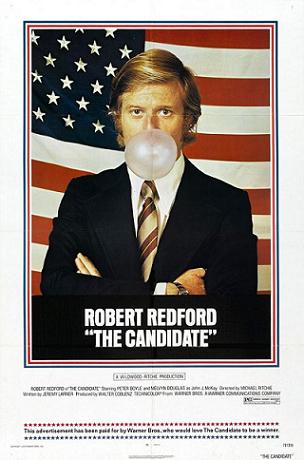
Shattered Politics #30: The Candidate (dir by Michael Ritchie)


Candidateposter

“What do we do now?” — Democratic senate candidate Bill McKay (Robert Redford) in The Candidate (1972)

When I reviewed Advise & Consent, I mentioned that if anyone could prevent billionaire Tom Steyer from winning the Democratic nomination to run in the 2016 California U.S. Senate election, it would be Betty White.  Well, earlier today, Tom Steyer announced that he would NOT be a candidate.  You can guess what that means.  Betty White has obviously already started to set up her campaign organization in California and, realizing that there was no way that he could possibly beat her, Tom Steyer obviously decided to step aside.

So, congratulations to Betty White!  (I would probably never vote for her but I don’t live in California so it doesn’t matter.)  As future U.S. Senator Betty White prepares for the next phase of her career, it would probably be a good idea for her to watch a few movies about what it takes to win political office in the United States.

For example: 1972’s The Candidate.

The Candidate would especially be a good pick for the nascent Betty White senate campaign because the film is actually about a senate election in California!  California’s  U.S. Sen. Crocker Jarmon (Don Porter) is a Republican who everyone assumes cannot be defeated for reelection.  Democratic strategist Marvin Lucas (a heavily bearded Peter Boyle) is tasked with finding a sacrificial candidate.

The one that Marvin comes up with is Bill McKay (Robert Redford, before his face got all leathery), a 34 year-old lawyer who also happens to be the estranged son of former Governor John J. McKay (Melvyn Douglas, whose wife Helen ran for one of California’s senate seats in 1950).  As opposed to his pragmatic and ruthless father, Bill is idealistic and the only reason that he agrees to run for the Senate is because Marvin promises him that he’ll be able to say whatever he wants.  Marvin assures Bill that Jarmon cannot be beaten but if Bill runs a credible campaign, he’ll be able to run for another office in the future.

However, Jarmon turns out to be a weaker candidate than everyone assumed.  As the charismatic Bill starts to close the gap between himself and Jarmon, he also starts to lose control of his campaign.  He soon finds himself moderating his positions and worrying more about alienating potential voters than stating his true opinions.  (In one of the film’s best scenes, Bill scornfully mutters his standard and generic campaign speech to himself, obviously disgusted with the vapid words that he has to utter in order to be elected.)  The film ends on a properly downbeat note, one that reminds you that the film was made in the 70s but also remains just as relevant and thought-provoking in 2015.

Written by a former political speech writer and directed, in a semi-documentary style, by Michael Ritchie, The Candidate is an excellent film that answer the question as to why all political campaigns and politicians seem to be the same.  The Candidate is full of small details that give the film an air of authenticity even when a familiar face like Robert Redford is on screen.

Whenever I watch The Candidate, I find myself wondering what happened to Bill McKay after the film’s iconic final scene.  Did he ever regain his idealism or did he continue on the path to just becoming another politician.  As much as we’d all like to think that the former is true, it’s actually probably the latter.

That just seems to be the way that things go.

Hopefully, Betty White will learn from Bill McKay’s example.

http://www.youtube.com/watch?v=thSY0g22j8Y

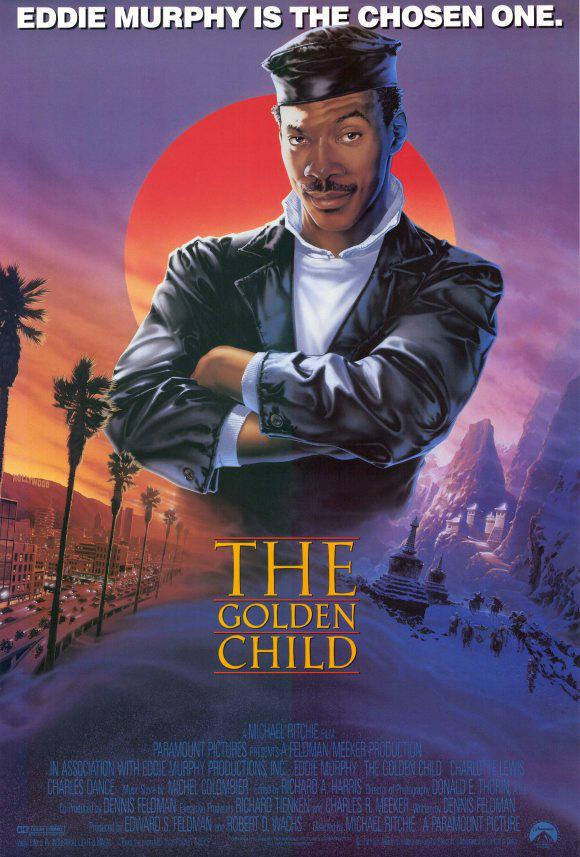
Guilty Pleasure No. 6: The Golden Child


TheGoldenChild

During the 80’s there were three names who earned the title of megastars. There was Sylvester Stallone with his Rocky and Rambo films. There was also Arnold Schwarzenneger who was pretty much the biggest action star of the decade. Then there’s Eddie Murphy who pretty much redefined the role of comedic action star. Yes, Murphy was an action star in his own right.

Once Murphy made a huge hit with the odd couple action comedy 48 Hours he began making one action comedy after the next. They all made money and to certain degree they were actually pretty good. There was one Murphy action comedy vehicle that was initially well-received by many when it came out in December of 1986, but has since seen a revisionist take from those who originally hyped up the film. I’m talking about The Golden Child.

Many who seem to have enjoyed and loved this film when it first came out has since backtracked to calling it one of the worst films of the 80’s. A film that indulges the ego of it’s star. While I agree with everything people have said about this film with each passing year I still can’t keep myself from enjoying it whenever it comes on cable (been awhile since it has). It was a fun flick when I first saw it as a 13 year-old and it continues to be fun.

Yes, it hasn’t aged well, but I think how it encompasses the kitchy-style of the 80’s not to mention the egocentricity of Murphy at the height of his stardom makes this one of my guilty pleasures. It even has a much y ounger, but still badass, Tywin Lannister playing the role of the main villain Sardo Numpsa aka Brother Numpsy.

Scenes That I Love: The Candidate


(SPOILER WARNING)

It’s election day!  Today is the day that American citizens select the person that they’ll be angry with for the next four years.  Have you voted yet?  I did and, after I turned in my ballot, this guy at the polling place told me that I was the prettiest voter that he had seen all day.  Awwwwww!

Today’s scene that I love is particularly appropriate for Election Day.  In The Candidate (1972), Bill McKay (played by Robert Redford) runs for the U.S. Senate.  Directed in a documentary fashion by Michael Ritchie, The Candidate features excellent supporting performances from Melvyn Douglas and Peter Boyle and it’s one of the best films ever made about the American political system.

The scene below takes place at the end of the film, after the votes have been counted.  And, of course, the entire scene is a spoiler so don’t watch it if you haven’t seen The Candidate.