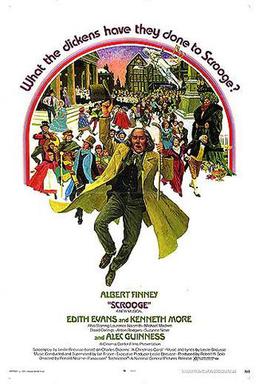
A Christmas Film Review: Scrooge (dir by Ronald Neame)


There have been many good film versions of the Charles Dickens novella, A Christmas Carol.  Several of them could even be called classics.  Everyone from Bill Murray to James Earl Jones to Tori Spelling to Fredric March has taken a turn at playing a version of the famous miser who, after being visited by three ghosts on Christmas Eve, changes his ways and becomes the most generous man in London.  This holiday season, I watched quite a few old TV shows and I was somewhat surprised to discover just how many sitcoms have featured an episode where one of the characters has A Christmas Carol-like experience.

Though actually, I shouldn’t have been surprised.  A Christmas Carol is a universal tale and it’s one that continues to be appealing 174 years after it was originally written.  You don’t have to be rich, British, greedy, or even a man to relate to what Ebenezer Scrooge goes through.  We’ve all be haunted by the past.  We’ve all wondered what we’re missing out on in the present.  And we all fear how we’ll be remembered in the future.  In fact, I would say that A Christmas Carol is probably as close to perfect you can get.  The only problem is that Bob Cratchit’s son is named Tiny Tim and any work of fiction that features a character named Tiny has to be docked a few points.

With all that said, my favorite film version of A Christmas Carol is the 1970 musical, Scrooge.

http://www.youtube.com/watch?v=g7xb1uSDxZ4

Scrooge sticks to the original details of the story.  Ebenezer Scrooge is played by Albert Finney.  (Finney was only 34 when he made Scrooge but was made up so that he looked closer to 120.)  The men, women, and spirits in Scrooge’s life are all played by a collection of distinguished British thespians.  Edith Evans is the stately Ghost of Christmas Past.  Kenneth More is the Ghost of Christmas Present, a decadent figure who drinks wine and travels around with two frightening-looking children.  Alec Guinness is a heavily chained Jacob Marley and he plays the role with just the right combination of sarcasm and concern.  (“No one else wanted to come,” Marley says when he greets Scrooge at the entrance of Hell.)  An actor named Paddy Stone is credited as playing the silent and shrouded Ghost of Christmas Future.  Let me just say that the Ghost of Christmas Future always scares me to death whenever I watch Scrooge.  I imagine little children in the 70s were traumatized by his skeletal visage.

What sets Scrooge apart is that it has singing and dancing!  That’s right, this is a musical version of A Christmas Carol, featuring songs composed by Leslie Bricusse.  Now, the overall quality of the songs is open to debate.  There’s 11 of them and really, only three of the songs are particularly memorable.  (Those songs are: I Like Life, I Hate People, and the Oscar-nominated Thank You Very Much.)  But, honestly, who cares?  The cast performs them with so much energy and enthusiasm that it’s impossible not to get swept up in it all.

(Admittedly, Albert Finney doesn’t really sing.  He just kinda growls the lyrics.  But that’s appropriate for the character of Scrooge.)

Scrooge is an outstanding production of a timeless tale.  It came on TV at least four different times this holiday season and I watched each time.  And I’ll do the same next year!

And as Tiny Tim, who did not die, said, “A Merry Christmas to all!  God Bless us, everyone!”

Lisa Reviews An Oscar Nominee: The Longest Day (dir by Ken Annakin, Andrew Marton, Bernhard Wicki, Gerd Oswald, and Darryl F. Zanuck)


As my sister has already pointed out, today is the 73rd anniversary of D-Day.  With that in mind, and as a part of my ongoing mission to see and review every single film ever nominated for best picture, I decided to watch the 1962 film, The Longest Day!

The Longest Day is a pain-staking and meticulous recreation of invasion of Normandy, much of it filmed on location.  It was reportedly something of a dream project for the head of the 20th Century Fox, Darryl F. Zanuck.  Zanuck set out to make both the ultimate tribute to the Allied forces and the greatest war movie ever.  Based on a best seller, The Longest Day has five credited screenwriters and three credited directors.  (Ken Annakin was credited with “British and French exteriors,” Andrew Marton did “American exteriors,” and the German scenes were credited to Bernhard Wicki.  Oddly, Gerd Oswald was not credited for his work on the parachuting scenes, even though those were some of the strongest scenes in the film.)  Even though he was not credited as either a screenwriter or a director, it is generally agreed that the film ultimately reflected the vision of Darryl F. Zanuck.  Zanuck not only rewrote the script but he also directed a few scenes as well.  The film had a budget of 7.75 million dollars, which was a huge amount in 1962.  (Until Steven Spielberg’s Schindler’s List, The Longest Day was the most expensive black-and-white film ever made.)  Not only did the film tell an epic story, but it also had an epic length.  Clocking in at 3 hours, The Longest Day was also one of the longest movies to ever be nominated for best picture.

The Longest Day also had an epic cast.  Zanuck assembled an all-star cast for his recreation of D-Day.  If you’re like me and you love watching old movies on TCM, you’ll see a lot of familiar faces go rushing by during the course of The Longest Day.  American generals were played by actors like Robert Mitchum, Robert Ryan, Henry Fonda, and John Wayne.  Peter Lawford, then the brother-in-law of the President of the United States, had a memorable role as the Scottish Lord Lovat, who marched through D-Day to the sounds of bagpipes.  When the Allied troops storm the beach, everyone from Roddy McDowall to Sal Mineo to Robert Wagner to singer Paul Anka can be seen dodging bullets.  Sean Connery pops up, speaking in his Scottish accent and providing comic relief.  When a group of paratroopers parachute into an occupied village, comedian Red Buttons ends up hanging from the steeple of a church.  When Richard Beymer (who is currently playing Ben Horne on Twin Peaks) gets separated from his squad, he stumbles across Richard Burton.  Among those representing the French are Arletty and Christian Marquand.  (Ironically, after World War II, Arletty was convicted of collaborating with the Germans and spent 18 months under house arrest.  Her crime was having a romantic relationship with a German soldier.  It is said that, in response to the charges, Arletty said, “My heart is French but my ass is international.”)  Meanwhile, among the Germans, one can find three future Bond villains: Gert Frobe, Curt Jurgens, and Walter Gotell.

It’s a big film and, to be honest, it’s too big.  It’s hard to keep track of everyone and, even though the battle scenes are probably about an intense as one could get away with in 1962 (though it’s nowhere near as effective as the famous opening of Saving Private Ryan, I still felt bad when Jeffrey Hunter and Eddie Albert were gunned down), their effectiveness is compromised by the film’s all-star approach.  Often times, the action threatens to come to a halt so that everyone can get their close-up.  Unfortunately, most of those famous faces don’t really get much of a chance to make an impression.  Even as the battle rages, you keep getting distracted by questions like, “Was that guy famous or was he just an extra?”

Among the big stars, most of them play to their personas.  John Wayne, for instance, may have been cast as General Benjamin Vandervoort but there’s never any doubt that he’s playing John Wayne.  When he tells his troops to “send them to Hell,” it’s not Vandervoort giving orders.  It’s John Wayne representing America.  Henry Fonda may be identified as being General Theodore Roosevelt II but, ultimately, you react to him because he’s Henry Fonda, a symbol of middle-American decency.  Neither Wayne nor Fonda gives a bad performance but you never forget that you’re watching Fonda and Wayne.

Throughout this huge film, there are bits and pieces that work so well that you wish the film had just concentrated on them as opposed to trying to tell every single story that occurred during D-Day.  I liked Robert Mitchum as a tough but caring general who, in the midst of battle, gives a speech that inspires his troops to keep fighting.  The scenes of Peter Lawford marching with a bagpiper at his side were nicely surreal.  Finally, there’s Richard Beymer, wandering around the French countryside and going through the entire day without firing his gun once.  Beymer gets the best line of the film when he says, “I wonder if we won.”  It’s such a modest line but it’s probably the most powerful line in the film.  I wish The Longest Day had more scenes like that.

The Longest Day was nominated for best picture of 1962 but it lost to an even longer film, Lawrence of Arabia.