Miniseries Review: Death by Lightning (dir by Matt Ross)


Death by Lightning, a four-episode miniseries that recently dropped on Netflix, tells the story of two “forgotten men,” as the show itself puts it.

Michael Shannon plays James A. Garfield, the Ohio farmer and former Congressman who, despite attending the 1880 Republican convention solely to give the nominating speech for Secretary of Treasury John Sherman (Alistair Petrie), found himself nominated for President after the convention found itself deadlocked between supporters of Former President Grant (Wayne Brett) and Senator James Blaine (Bradley Whitford).  Garfield did not want to run for President and he certainly did not want to run with Chester A. Arthur (Nick Offerman), an associate of New York political boss, Roscoe Conkling (Shea Whigham).  However, in November of 1880, James Garfield was narrowly elected the 20th President of the United States.

Matthew MacFayden plays Charles J. Guiteau, a failed lawyer and self-proclaimed newspaper publisher who felt that a stump speech he had given at a small rally was responsible for Garfield’s victory.  Guiteau expected to be appointed to a position in the Garfield administration, perhaps as Consul to France.  In those days of no Secret Service protection and an open White House, Guiteau was one of the many random office seekers who managed to get a face-to-face meeting with Garfield.  What Guiteau did not get was a job.  While Guiteau may have deluded himself into thinking that he was an inside player, everyone else viewed him as being a pesky and disreputable character.  On July 2nd, 1881, Guiteau shot Garfield in the back.  After Garfield died in September, Guiteau was convinced that he would be pardoned by the newly sworn-in President Arthur.  Instead, Guiteau was hanged on June 30th, 1882.

(It’s now generally agreed that Guiteau was such a bad shot that Garfield would have survived his wounds if not for the incompetence of his doctors, who probed his wounds with their bare hands in an effort to extract the bullet.  Garfield died as a result of multiple infections caused by his medical treatment.)

Again, Death by Lightning describes Garfield and Guiteau as both being forgotten men.  That’s not quite true.  I knew who both of them were before I watched the miniseries but then again, I’m also a history nerd.  As much as I don’t want to admit it, it is true that the majority of today’s Americans don’t know either Garfield or Guiteau.  And yet, in 1881, America revolved around them and their fate.  Everyone checked every day for news on Garfield’s health and Guiteau’s trial was heavily covered by the press.  That’s something to remember whenever you hear people talking about how “history will remember” whatever may be happening in the news today.  History may remember but people are quick to forget.

As for Death by Lightning, it does a good job of telling not only the stories of Garfield and Guiteau but also Chester Arthur as well.  The miniseries takes place at a time when political machines dominated American politics and also at a time when the Spoils system and the widespread corruption that it engendered were both accepted as immutable political realities.  Guiteau, having spent his life seeing other people receive jobs for supporting the right candidate, felt that he was naturally entitled to whatever position he requested.  Guiteau’s actions actually did lead to reformation of the Spoils system, with President Arthur emerging an unlikely reformer.  Never again would a random office seeker by allowed through the front doors of the White House and never again would a President casually walk around Washington D.C. without some sort of guard.  With a smart script, good performances, and even a few moments of unexpected cringe humor, Death by Lighting recreates that moment in American history and it pays tribute to James A. Garfield, who was universally described by his contemporaries as being a decent man who was struck down before he could reach his full potential.

How historically accurate is Death by Lightning?  That’s a fair question.  Death by Lightning sticks to the established facts about Garfield and Guiteau but a scene in which Garfield’s daughter argues with him about immigration is undoubtedly meant to be more of a commentary on 2025 than 1880.  I think it can be argued that no film or series can be 100% historically accurate because those who actually witnessed the events in question are no longer with us.  Inevitably, the past is always viewed and recreated through the filter of the present.  And indeed, it is tempting to compares Garfield and Guiteau to our modern-day politicians and activists.  Guiteau, with his constant excuses for his own dumb decisions and his ranting and raving about how he speaks for the people, was a particularly familiar character.  As for the modest and honest Garfield, it’s sadly difficult to think of any modern-day politicians from the same mold.

As a final note, my favorite part of this miniseries occurred during the first episode.  The recreation of the 1880 Republican Convention is wonderfully entertaining.  It’s amazing to think that, in the days before television coverage required political conventions to become carefully choreographed and tightly controlled, there actually was legitimate suspense about who would end up being nominated.  Sadly, those days seem to be over.
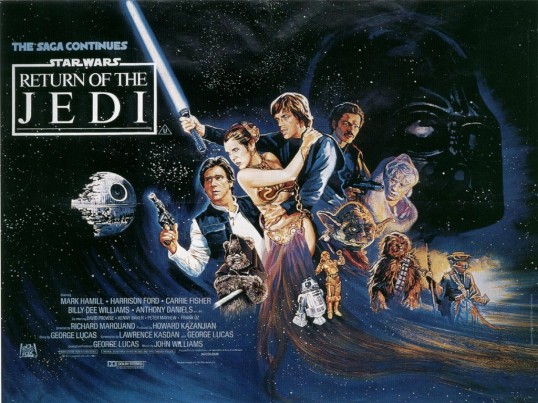
Sci-Fi Film Review: Return of the Jedi (dir by Richard Marquand)


areturn1

As you’ve probably noticed, we’ve devoted this month to science fiction here at the Shattered Lens.  Gary Loggins reviewed THX-1138.  Valerie took a look at everything from The Star Wars Holiday Special to Turkish Star Wars to Return of the Ewok.  Ryan the Trashfilm Guru reviewed such Italian classics as Cosmos: War of Planets and War of the Robots.  Patrick Smith reviewed a terrifying Christmas movie about Santa. Myself, I’ve taken a look at such films as Contamination and 2019: After the Fall of New York.  

We’ve reviewed a lot of science fiction and we’ve got a lot more left to go.  (Keep an eye out for my reviews of Starcrash and The Humanoid over the upcoming few days.)  However, from the beginning, this month has always been centered around Star Wars.  You may have heard that there’s a little movie called Star Wars: The Force Awakens and it’s opening this week.  Apparently, a few people are excited about it.  Since we love reviewing little known art films here at the Shattered Lens, we decided why not review all of the previous Star Wars films during the week leading up to the release of The Force Awakens?  Jeff (a.k.a. the blogger known as Jedadiah Leland) started us off by reviewing The Phantom Menace.  Then Alexandre Rothier took a look at Attack of the Clones, followed by Jeff’s look at Revenge of the Sith.  Leonard Wilson was the next to step up to the plate, reviewing both A New Hope and The Empire Strike Back.

And now, it’s my turn to add my thoughts to this project.  It’s time to review the 1983 film, Return of the Jedi.  And I have to admit that, when I first thought about what I wanted to say in this review, I was totally intimidated.  Unlike my fellow writers here at the Shattered Lens, I’m hardly an expert when it comes to Star Wars.  Don’t get me wrong — I know the basics.  I know that Darth Vader is Luke’s father.  I know that Han Solo flies the Millennium Falcon and that Princess Leia is in love with him.  I know there’s an evil Empire and I know that there are rebels.  I’m not a virgin when it comes to Star Wars but, at the same time, I’m definitely not as experienced (with Star Wars) as most of my friends and fellow movie bloggers.

"Dang, Lisa, get over it!"

“Dang, Lisa, get over it!”

So, late this afternoon, when I sat down to watch Return of the Jedi, it was with more than a little trepidation.  My obvious panic and welling tears convinced Jeff to watch the movie with me and I was happy for that.  He loves Star Wars so I knew he could explain to me what was going on.

Finally, we watched Return of the Jedi and I discovered that I was panicking over nothing.  Return of the Jedi may be the third part of trilogy and I may not be an expert on the films that came before it.  But, even with all that in mind, Return of the Jedi is not a difficult film to figure out.  As opposed to the finales of Harry Potter, The Hobbit, and The Hunger Games, Return of the Jedi keeps things simple.  A good guy has been kidnapped by a bad guy.  The other good guys come to the rescue and then go to another planet so that they can fight an even bigger bad guy.  It’s not complicated.

As I watched Return of the Jedi and realized that I was having absolutely no problem following the film’s plot, I also realized that the Star Wars films are such a huge part of our culture that, regardless of how many of them we’ve actually sat through, everyone has absorbed them by osmosis.  Bits and pieces of it are everywhere, showing up in everything from TV sitcoms to political commentary.  (Remember how everyone used to compare Dick Cheney to Darth Vader?)  The Star Wars franchise is almost biblical in that respect.  At the same time, the fact that everyone knows about these movies makes them a little difficult to review.  You don’t so much watch a Star Wars film as you join in a universal experience.  As a reviewer, you definitely find yourself wondering what you can add to a conversation that everyone else has already had.

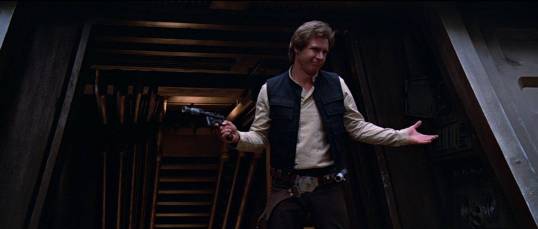
As a stand alone movie, Return of the Jedi is actually three separate films mixed together.  The first film deals with Luke Skywalker (Mark Hamill) showing up at Jabba the Hutt’s palace and rescuing Han Solo (Harrison Ford), Princess Leia (Carrie Fisher), Chewbacca (Peter Mayhew), and two robots from being tossed into a creature called the Sarlacc, which is basically a giant vagina out in the middle of the desert.  The second film deals with the rebels teaming up with a bunch of teddy bears and fighting the Empire on a jungle planet.  And the third film features Luke and Darth Vader (body of David Prowse, voice of James Earl Jones, face of either Sebastian Shaw and Hayden Christensen, depending on which version of the film you’re watching) dealing with their family issues while the Emperor (Ian McDiarmid) cackles in the background.  Some parts of the film work better than others.  The end result is entertaining but definitely uneven.

Star-Wars-Episode-VI-Return-Of-The-Jedi-Darth-Vader-darth-vader-18356239-1050-656

Jedi‘s heart belongs to that third film, the one dealing with Luke and Darth Vader.  I’ve read some pretty negative online comments about Mark Hamill’s performance in New Hope and Empire Strikes Back but, in Return of the Jedi, he brings an almost haunted intensity to the role of Luke.  In theory, it’s easy to be snarky about all the talk about the “Dark Side of the Force,” but, when you look in Hamill’s eyes, you totally understand what everyone’s going on about.  You see the fire and the anger but, even more importantly, you see the struggle between good and evil.  There’s a very poignant sadness to the scenes where he and his father prepare to meet the Emperor.

And speaking of the Emperor, he is pure nightmare fuel!  AGCK!

movies_star_wars_vi_return_of_the_jedi_1

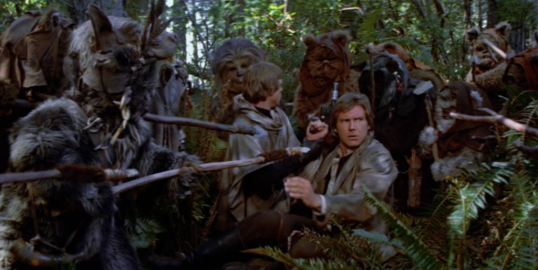
As for the other two films to found within Return of the Jedi, the jungles of Endor didn’t do much for me.  Don’t get me wrong.  I thought the action scenes were handled well and, unlike apparently everyone else in the world, I was not annoyed by the inclusion of the Ewoks, the killer teddy bears who helped to the Rebels to take down the Empire.  I thought the Ewoks were cute and I actually got pretty upset when one of them was killed in battle.  If I had been alive when Return of the Jedi had been released, I probably would have wanted a stuffed Ewok and, I imagine, that was the main reason they were included in the film.  (I also imagine that’s the main reason why a lot of people can’t stand them.)

Return-of-the-Jedi-Ewoks-1024x515

So, no, the Ewoks did not bother me.  What did bother me was that under-construction Death Star floating out in the middle of space.  It bothered me because I really couldn’t imagine any reason why — after the first Death Star was apparently such a colossal failure — the Empire would insist on trying to do the exact same thing all over again.  This, along with the fact that they were rather easily defeated by a bunch of teddy bears, leads me to wonder whether the effectiveness of the Empire was just a little overrated.  I mean, the Emperor was scary but otherwise, everyone involved with the Empire was pretty incompetent.

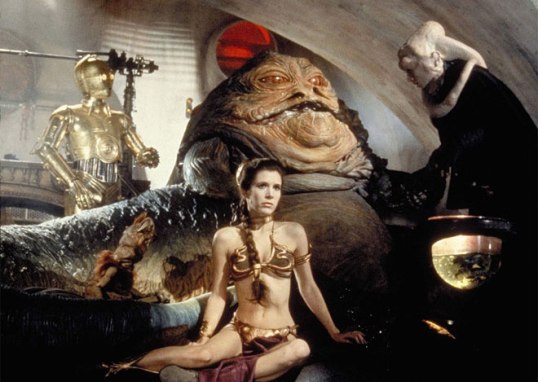
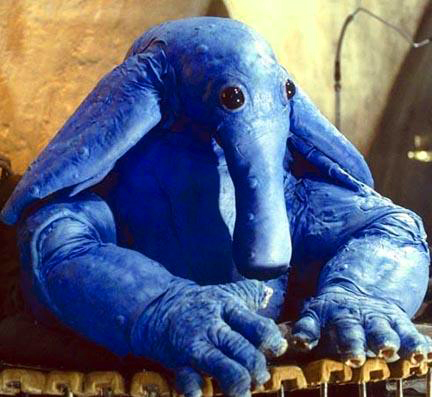
Far more impressive, as far as villains go, was Jabba the Hut.  In fact, Jabba and his decadent entourage were so memorable and colorful and evil and icky that they pretty much overshadowed almost everything else in the film.  I mean, Jabba even had a blue elephant playing music for him!  And I know that I’m supposed to be critical of the film for putting Leia in that gold bikini but you know what?  Leia may have been forced to wear a gold bikini but she never gave up her dignity or her defiance.  And when it came time to take out Jabba, Leia used the tools of her oppression to do so, strangling him with his own chains.  In that one scene, Leia proved herself to be a true rebel.

return01

There’s a lot that’s good about Return of the Jedi but, as I said earlier, it’s definitely an uneven film.  Richard Marquand’s direction is perhaps the epitome of workmanlike.  It’s efficient and it’s dependable and there’s absolutely nothing surprising or particularly challenging about it.

It’s interesting to note that, before Richard Marquand was selected as director, the job was offered to both David Lynch and David Cronenberg, two directors who are all about surprising and challenging the audience.  What would David Lynch’s Return of the Jedi been like?  Well, here’s one possibility:

As for David Cronenberg’s Return of the Jedi, it might have looked something like this:

For better or worse, the world got Richard Marquand’s Return of the Jedi, which I imagine was pretty close to what George Lucas wanted the film to be.

As I sit here finishing up this review and wondering just why exactly I was so intimidated earlier (seriously, this turned out to be one the easiest reviews that I’ve ever written), I estimate that 75% of the people that I know are currently sitting in a theater and watching The Force Awakens.  Keep an eye out for Arleigh’s review in the next few days!

And in closing, here’s that blue elephant that I mentioned earlier.  Dance!

Maxrebo