TV Review: Night Gallery 1.1 “The Dead Man/The Housekeeper” (dir by Douglas Heyes and John Meredyth Lucas)


As I wrote yesterday, I recently decided to sit down and watch every episode of the horror anthology series, Night Gallery.  Yesterday, I watched and reviewed the pilot movie.  Tonight, I watched the first episode of the weekly series.

Though the pilot originally aired in 1969, Night Gallery did not start to air as a regular series until December of 1970.  The first episode of season one was broadcast on December 16th, 1970.  As all of the episodes did, it stated with Rod Serling walking through a dimly lit museum and inviting the audience to look at a macabre painting.  Each painting was inspired by a different story.  Or were the stories inspired by the paintings?  To be honest, I don’t think the show ever made that clear.

The first episode featured two stories, both of which dealt with mad scientists.
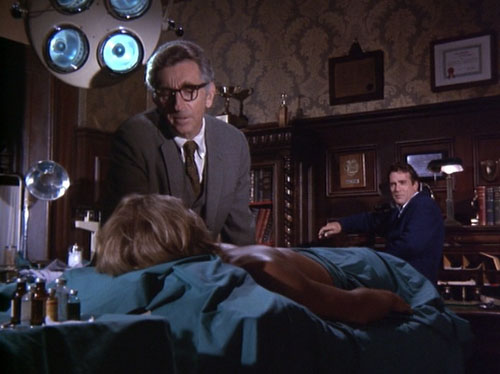
The Dead Man (written and directed by Douglas Heyes)

The first segment was The Dead Man, an enjoyably atmospheric if somewhat difficult-to-follow story about a scientist, a young man with an amazing ability, and the woman who is torn between the two of them.

Carl Betz plays Max Redford, a doctor who has discovered that, under hypnotic suggestion, John Michael Fearing (Michael Blodgett) can simulate any medical condition, no matter how severe.  When Max reveals his discovery to his associate, Dr. Talmadge (Jeff Corey), Talmadge is concerned that Fearing will suffer permanent damage as a result of Max’s experiments.  Nonsense! Max explains.  All he has to do is give Fearing the proper signal and he’ll pop right out of his condition, as good as new.

Max decides to put Fearing to the ultimate test by having him simulate death.  However, when Fearing goes under, he dies for real.  Was it just an accident or did Max — who suspects that Fearing was having an affair with his wife (Louise Sorel) — secretly mean for Fearing to die?

The Dead Man raises some intriguing questions about life, death, and medical ethics.  It also has a quartet of good performances with Carl Betz doing an especially good job as Max.  Michael Blodgett showed up in a lot of early 70s films and TV shows and he was always convincing as a decadent hedonist.  The entire segment is full of creepy atmosphere but the ending is a bit of a let down.  After a great set-up, the segment just kind of fizzles out.
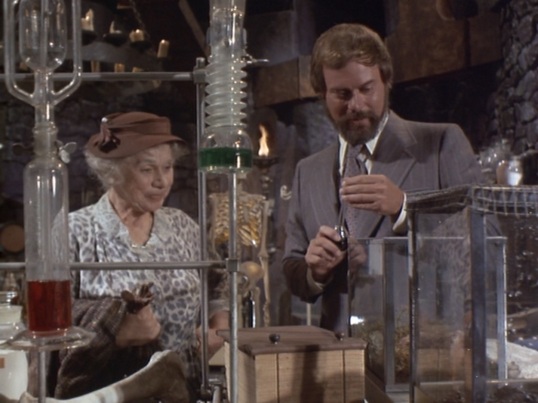
The Housekeeper (written by Heyes, directed by John Meredyth Lucas)

In the second segment, our mad scientist is named Cedric Acton (Larry Hagman).  Whereas Max Redford, in the previous segment, was misguided, Cedric Acton is just crazy.  Through the use of black magic (it involves a frog), Cedric has been experimenting with soul and brain transference.  (There’s an oinking chicken and a clucking pig in his laboratory, just in case anyone’s wondering how the experiments are going.)

Because Cedric loves his wife’s body but hates her personality, he wants to put the soul of his kindly housekeeper (Jeanette Nolan) into the body of his wife, Carlotta (Suzy Parker).  At first, the experiment is a success but things get complicated and …. well, I’m not really sure what it all leads to because this is one of those stories that just kind of ends without really offering up any type of resolution.

The Housekeeper is meant to be a comedy but it’s a bit too mean-spirited to really work.  This segment really calls out for karma to intervene and for Cedric’s soul to end up in something else’s body but instead it just ends with Cedric continuing his experiments.  It’s more than a little dissatisfying.  Larry Hagman does a good job playing Cedric, though.  He’s convincingly crazy.

Especially after the pilot, it’s hard not to be disappointed by the first episode of Night Gallery.  Both stories had potential but they were let down by weak endings.  Oh well.  Hopefully, tomorrow’s episode will be an improvement!
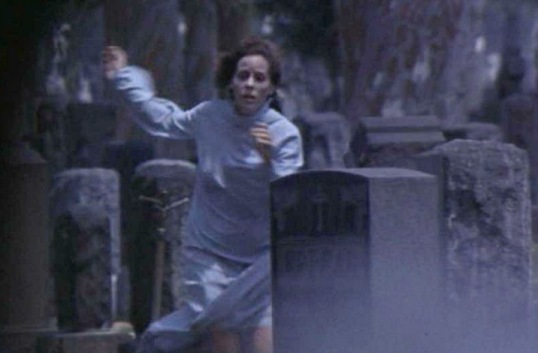
Lisa Cleans Out Her DVR: The Carey Treatment (dir by Blake Edwards)


(Lisa is currently in the process of cleaning out her DVR!  She has got over 170 movies on the DVR to watch and she’s trying to get it done before the start of the new year!  Can she get it done?  Probably not, but she’s going to try!  1972’s The Carey Treatment was recorded off of TCM on July 23rd.)

Dr. Peter Carey (James Coburn) is the epitome of 1970s cool.  He’s got hair long enough to cover the top half of ears.  He’s got a fast car.  He’s got a rebellious attitude and a girlfriend (Jennifer O’Neill) who rarely questions his decisions.  Though you don’t see it in the movie, Dr. Carey probably smokes weed when he’s back at his fashionably decorated apartment.  How do I know this?  Well, he’s played by James Coburn.  Even if some of them are nearly 50 years old, you can still get a contact high from watching any movie featuring James Coburn.

Anyway, what the Hell is The Carey Treatment about?  Dr. Carey has just recently moved to Boston, where he’s taken a job at a stodgy old hospital.  The hospital’s chief doctor, J.D. Randall (Dan O’Herlihy, of Halloween III: Season of The Witch fame), might want Dr. Carey to tone down his free-livin’, free-lovin’ California ways but no one tells Peter Carey what to do.  In fact, the entire city of Boston might be too stodgy and conventional for Dr. Carey.  You see, Dr. Carey not only heals people.  He also beats up people who try to stand in his way.  Peter Carey is a doctor who cares but he’s also a doctor who can kick ass.

And he’s going to have to kick a lot of ass because Dr. Randall’s daughter has just turned up dead.  The police say that she died as the result of a botched abortion and they’ve arrested Carey’s best friend, Dr. David Tao (James Hong).  (The Carey Treatment, it should be noted, was filmed before Roe v. Wade legalized abortion.)  The Boston establishment is determined to use Dr. Tao as a scapegoat but Dr. Carey is convinced that his friend is innocent.  In fact, he doesn’t think that the death was the result of an abortion at all.  Carey sets out to solve the case … HIS WAY!

If it seems like I’m going a little bit overboard with my emphasis on the Dr. Peter Carey character, that’s because this entire movie feels more like a pilot for a weekly Dr. Carey television series as opposed to an actual feature film.  It’s easy to image that each week, James Coburn would drive from hospital to hospital, solving medical mysteries and debating social issues with stuffy members of the Boston establishment.  Henry Mancini would provide the theme music and Don Murray would guest star as Dr. Carey’s brother, a priest who encourages the young men in his parish to burn their draft cards.

It might have eventually become an interesting TV show but it falls pretty flat as a movie.  James Coburn is in nearly every scene, which would usually be a good thing.  But in The Carey Treatment, he gives an incredibly indifferent performance.  He seems to be bored by the whole thing and, as a result, Dr. Peter Carey is less a cool rebel and more of a narcissistic jerk.  The mystery itself is handled rather haphazardly.  On the positive side, Michael Blodgett gives a wonderfully creepy performance as a duplicitous masseur but otherwise, The Carey Treatment is nothing special.

If you want to see a great James Coburn film, track down The President’s Analyst.

Film Review: There Was a Crooked Man… (1970, directed by Joseph L. Mankiewicz)


Crooked_manI first saw There Was A Crooked Man as a part of TCM’s tribute to the great actor Warren Oates.  Warren Oates was rarely cast in the lead but, as a character actor, he appeared in supporting roles in several great films.  Unfortunately, There Was A Crooked Man is not one of them.

Directed by Joseph L. Mankiewicz and written by the screenwriting team of Robert Benton and David Newman (best known for writing Bonnie and Clyde), There Was A Crooked Man is meant to be a comedic western.  Outlaw Paris Pittman (Kirk Douglas) is arrested while visiting a bordello.  Paris is sent to an Arizona prison, where everyone tries to get him to reveal where he has hidden the stash from a $500,000 robbery.  Pittman uses everyone’s greed to manipulate them into helping him attempt to escape.  Standing in Pittman’s way is the new warden, a liberal reformer played by Henry Fonda.

There Was A Crooked Man is a long movie that features a lot of familiar faces.  Burgess Meredith plays The Missouri Kid, who has been in prison for so long that he is now an old man.  Hume Cronyn and John Randolph play a bickering gay couple who eventually become a part of Pittman’s scheme to escape.  Even Alan Hale, the skipper from Gilligan’s Island, shows up as a guard named Tobaccy!  There Was A Crooked Man is a big movie but it’s also not a very good one.  It’s not serious enough to be a good drama but it’s not funny enough to be a good comedy either.

At least the movie has Warren Oates going for it.  Oates plays Harry Moon, a prisoner who is drafted into Pittman’s escape plot.  It is a typical Warren Oates supporting role but he steals every scene that he appears in.  Even in the smallest of roles, Warren Oates was worth watching and he’s the best thing about There Was A Crooked Man.

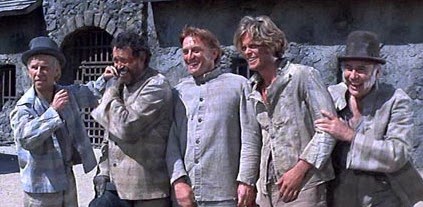
Hume Cronyn, Warren Oates, Kirk Douglas, Michael Blodgett, and John Randolph in There Was A Crooked Man

Hume Cronyn, Warren Oates, Kirk Douglas, Michael Blodgett, and John Randolph in There Was A Crooked Man

Embracing the Melodrama #26: Beyond the Valley of the Dolls (dir by Russ Meyer)


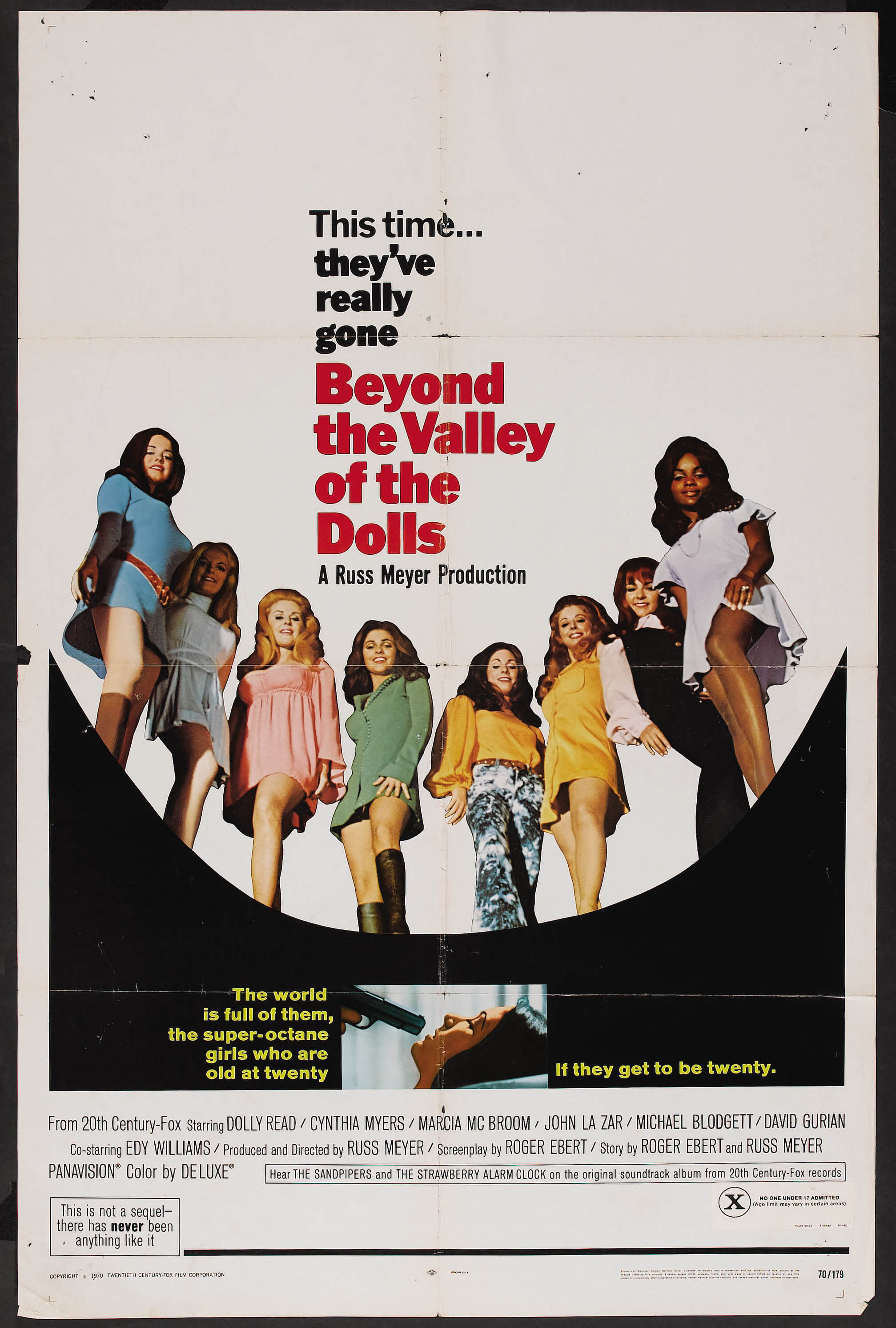
beyondposter

THE FILM YOU ARE ABOUT TO SEE IS NOT A SEQUEL TO “VALLEY OF THE DOLLS.” IT IS WHOLLY ORIGINAL AND BEARS NO RELATIONSHIP TO REAL PERSONS, LIVING OR DEAD. IT DOES, LIKE “VALLEY OF THE DOLLS” DEAL WITH THE OFT-TIMES NIGHTMARE WORLD OF SHOW BUSINESS BUT IN A DIFFERENT TIME AND CONTEXT. — Disclaimer at the beginning of Beyond The Valley of the Dolls (1970)

If I hadn’t reviewed it already, I would definitely have included 1967’s Valley of the Dolls in this series on film melodrama.  However, seeing as I have already reviewed it (and you can read that excellent review here!), I figured why not take this opportunity to review a film that was legally required to acknowledge that it was not a sequel to Valley of the Dolls.

I’m speaking of 1970’s Beyond the Valley of The Dolls, a satirical take on every Hollywood melodrama that had been made up until that point.  It was directed by notorious exploitation veteran Russ Meyer and written by film critic Roger Ebert.  The combination of Meyer’s unapologetic tawdriness and Ebert’s film school in jokes comes together to create a truly memorable film experience.

Okay, so what happens in Beyond the Valley of the Dolls?  Let’s see if I can keep all this straight because, in its clearly satirical way, BVD is a bit like the Game of Thrones of satiric Hollywood melodrama.  There are so many characters with so many subplots that it helps to have a flowchart to try to keep track of it all.

beyond-the-valley-of-the-dolls-05-1

Kelly (Dolly McNamara), Casey (Cynthia Myers), and Pet (Marcia McBroom) start a band and, after playing the high school graduation dance, they decide to head out to Los Angeles to become famous.  Accompanying them is their manager, Harris Allsworth (David Gurian), who is in love with Kelly and spends the entire film looking miserable.  As opposed to the three main characters in Valley of the Dolls, Kelly, Casey, and Pet do not arrive in Hollywood as wide-eyed innocents.  Instead, they’re already talking endlessly about their love of weed, pills, and sex but they do so in dialogue that is so deliberately over-the-top, so intentionally artificial, and so cheerfully delivered by the three girls that it’s impossible not to root for them.  More than that, though, these are three strong, independent women and, regardless of whether they’re appearing a film directed by a man best known for being obsessed with boobs, that’s still three more than you’ll find in most American films from both the 70s and today.

Fortunately, the girls already have a contact in Los Angeles.  Kelly’s rich aunt Susan (Phyllis Davis) knows all sorts of people and wants to share some of her fortune with Kelly.  Unfortunately, Susan’s lawyer is the evil Porter Hall (Duncan McLeod), who hates free spirits.  Porter tries to keep Kelly from getting the money but Kelly is willing to seduce Porter in order to get that money, even after she discovers that the uptight Porter wears his black socks to bed.  Obviously, Porter is a bad guy but who can help Aunt Susan realize this?  How about the wonderfully named man’s man, Baxter Wolfe (Charles Napier)?

ZMan

Through Aunt Susan’s influence, the girl’s end up at a party thrown by the legendary music promoter Z-Man (John Lazar).  Z-Man is one of those flamboyant 70s characters who simply has to be seen to be believed.  Z-Man speaks in some of the most florid dialogue ever heard and there are more than a few secrets hidden behind all of that eccentricity.  But, at the moment, what’s important is that Z-Man takes control of the girl’s group — now known as the Carrie Nations (which is actually a pretty good name for a band) — and makes them famous overnight.

Soon, Kelly is spending more and more time with notorious Hollywood gigolo Lance Rocke (Michael Blodgett, who gives a hilariously narcissistic performance) and ignoring poor Harris.  This drives Harris into the waiting arms of porn star Ashley St. Ives (Eddy Williams) who, with her unapologetic and non-neurotic approach to sex, is probably the most stable character in the entire film.

Beyond

Casey, feeling uncomfortable with the Hollywood jet set, is soon popping pills like they’re candy.  She finally starts to find some comfort and happiness with Roxanne (Erica Gavin).

And finally, Pet falls in love with Emerson Thorne (Harrison Page), a serious-minded law student.  However, as much as Pet and Emerson seem to be meant for each other (and they even get a slow-motion montage where they run through a green field), Pet is still tempted to stray by a punch drunk boxer (James Inglehart).

And finally, there’s Otto (Henry Rowland).  Otto is Z-Man’s butler.  Apparently, he’s also a Nazi war criminal.

And, not surprisingly, all of this lust and all of these secrets lead to a suicide attempt, renewed love, and finally a disturbingly violent massacre that leaves the surviving members of the cast feeling wiser and sadder but not necessarily older.  Fortunately, just in case we the viewers might be wondering how all of this could have happened, a somber-voiced narrator suddenly explains what every character did wrong and how those mistakes led to their fate.  Thanks, narrator guy!

So, obviously, Beyond the Valley of the Dolls is not meant to be taken seriously.  The film is a satire of all of the self-serious and hypocritically moralistic Hollywood melodramas that came before it .  Fortunately, the largely likable cast plays all of this absurd material with the straightest of faces and the end result is a film that is sordid and oddly likable.  This is one of those films that, if it offends you, you may be taking life too seriously.

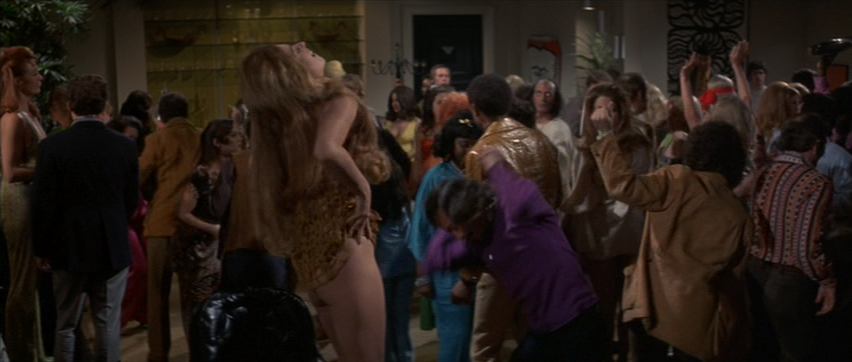
beyond the valley of the dolls party