Retro Television Review: Homicide: Life On The Street 2.4 “A Many Splendored Thing”


Welcome to Retro Television Reviews, a feature where we review some of our favorite and least favorite shows of the past!  On Sundays, I will be reviewing Homicide: Life On The Street, which aired from 1993 to 1999, on NBC!  It  can be viewed on Peacock.
This week, season 2 of Homicide comes to a close with an episode directed by John McNaughton, of Henry: Portrait of A Serial Killer fame.

Episode 2.4 “A Many Splendored Thing”

(Dir by John McNaughton, originally aired on January 27th, 1994)

The second season finale of Homicide opens with Bolander in a good mood and Munch feeling that life is pretty much pointless.  It’s a reversal from what we’ve seen over the last few episodes of Homicide and, as annoyed as I got with all the storylines about Bolander’s private life, I was still happy to see Bolander happy in this episode.  As an actor, Ned Beatty’s performance is a lot interesting when Bolander is looking forward to the future.  By that same token, Richard Belzer always seemed to be trying to hard whenever it came to playing Munch’s happiness.  Belzer was born to play a cynic and, in this episode, he delivers his lines with a bitterness that is both funny and authentic.

Bolander is dating Linda and I have to admit that, despite my initial weariness, I really like Ned Beatty and Julianna Margulies as a couple.  Bolander and Linda go on a double date with Kay and Danvers.  Awwww, two couples in love and having dinner together!  How sweet!  Uh-oh, here comes Munch….

While Munch is ruining Bolander’s date, Bayliss is getting in touch with his own dark side.  An investigation into the S&M-related death of a young woman leads to Bayliss and Pembleton arresting a man who killed her during rough (but consensual) sex.  Bayliss and Pembleton spend their investigation in Baltimore’s red light district.  Bayliss claims to be disgusted by the whole scene, leading to Pembleton calling him out for being judgmental.  Pembleton tells Bayliss that he can’t be a good detective unless he’s really in touch with every aspect of his existence.  After the murder is solved, the woman’s co-worker, Tanya, gives Bayliss the gift of a leather jacket.  Tanya is played, in a very good performance, by the actress Adrienne Shelley.  Tragically, Shelley herself would, 12 years later, be murdered in her New York apartment.  And while it’s tempting to write about the irony of Shelley appearing on a show like Homicide, I’d rather recommend that everyone see Waitress instead.  It was the second feature film that Shelley directed and it is very good.

Finally, Lewis investigates a man who committed murder because he felt someone had taken his favorite pen.  Lewis searches for a deeper motive but in the end, it really was all about a pen.  Lewis, I’ve noticed, always seems to get the cases that show just how random life and death can truly be.

The second season of Homicide ends with Lewis giving Felton a pen, Bayliss putting on his new leather jacket and walking the streets of Baltimore, and Munch, Bolander, and Linda watching fireworks explode over the harbor.  It’s a good way to end a season.  As dark as the show was (and as dark as this particular episode was), the season ends on a note of hope.  There is happiness out there for those willing to look for it.


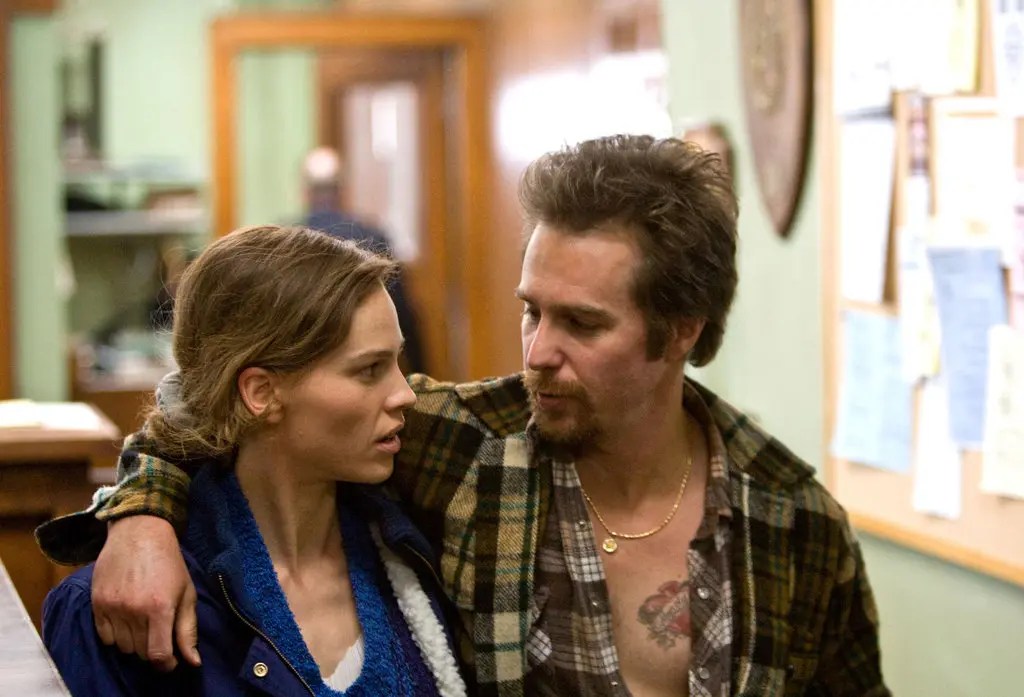
CONVICTION (2010) – Hilary Swank and Sam Rockwell star in the real-life story of a sister who saves her brother from a wrongful conviction!


My wife and I love movies based on real-life stories. We were looking for something to watch this afternoon on the MAX app and came across their “Real Life Dramas” section. One of the movies we saw listed was CONVICTION (2010) starring 2-time Oscar winner Hilary Swank. My wife loves Hilary Swank so we decided to give it a spin.

Betty Anne Waters (Hilary Swank) watches as her brother Kenny (Sam Rockwell) is convicted of the murder of Katherine Brow on May 21st, 1980 in Ayer, Massachusetts and sentenced to life in prison. Even though she knows he’s a troublemaker, Betty Anne is convinced that he’s not a murderer, so she gives up everything in her life to try to prove his innocence, especially after she learns that he tried to kill himself while in custody. Her husband (Loren Dean) divorces her and takes their kids with him. This doesn’t stop her. She goes back to school, eventually making her way to law school for the sole purpose of helping to exonerate her brother. In a positive turn of events, Betty Anne realizes that the new field of DNA testing could be the key to overturning her brother’s conviction. She contacts attorney Barry Scheck (Peter Gallagher) from the “Innocence Project” who assists those who believe DNA testing can help overturn previous convictions. Will Betty Anne finally be able to prove Kenny’s innocence, or will he have to spend the rest of his life in jail for a crime she doesn’t think he’s capable of committing?

Movies like CONVICTION are such an interesting watch for me, especially since we can know how these stories play out with a simple google search. When I see a movie is based on a real story, I purposefully avoid the facts of the actual events so I can see the events depicted on screen without my own internal bias taking front and center. I enjoyed watching how the events unfolded in CONVICTION. Hilary Swank and Sam Rockwell are such good actors, and I appreciate the work they put in here. I don’t pretend that everything depicted on screen is exactly how it was in real life, but I do believe that the actors portray the essence of truth, and I must admit to a tear in my eye when that truth is finally acknowledged for Kenny Waters at the end of the film. I also enjoyed telling my wife that the director of CONVICTION is Tony Goldwyn, the bad guy in the blockbuster film, GHOST. I just thought that was kind of cool, and so did she.

The real truth of Betty Anne Waters and Kenny Waters is ultimately bittersweet, but their story is both a testament to, and an indictment of, the American judicial system. As a person who truly loves our country, I think it’s important to realize that things aren’t always perfect, even in the United States of America!

See the trailer for CONVICTION below:

Retro Television Review: Homicide: Life on the Street 2.3 “Black and Blue”


Welcome to Retro Television Reviews, a feature where we review some of our favorite and least favorite shows of the past!  On Sundays, I will be reviewing Homicide: Life On The Street, which aired from 1993 to 1999, on NBC!  It  can be viewed on Peacock.

This week, Pembleton gets a confession.

Episode 2.3 “Black and Blue”

(Dir by Chris Menaul, originally aired on January 20th, 1994)

In this week’s episode, Pembleton manipulates a man into confessing to a murder that he didn’t commit.  Pembleton does it with the full knowledge that the man is innocent and that, if the man is indicted and goes to trial, he will undoubtedly be found guilty as a result of that coerced confession.  Pembleton does it to prove a point to Giardello.

The man is Lane Staley (Isaiah Washington), who has been identified (by his grandmother, who was just trying to be helpful) as an eyewitness to the shooting of Charles Courtland Cox.  Pembleton is convinced that Cox was shot by a policeman and he only wants to interrogate Staley as a witness.  Giardello, who feels that Pembleton is to obsessed with his cop theory and who, as a proud member of the police force, does not want Pembleton to be right, insists that Pembleton treat Staley as a suspect.  Pembleton responds by going into the Box and pretending to be sympathetic to Staley’s situation.  He and Staley talk about how they’re both expected to always be polite and careful about what they say around white detectives.  Pembleton jokes that he always has to be extra polite when he comes to work.

Staley starts to open up to Pembleton and eventually admits that he was present when Cox was shot.  That’s when Pembleton starts shouting at Staley, accusing him of being responsible and basically browbeating Staley until Staley is in tears.  Pembleton makes Staley feel guilty for not doing more to protect Cox and continues to yell at him until, eventually, Staley feels that Cox’s murder was his fault.  Staley finally signs a confession, even though it’s obvious that the sobbing man is not a murderer.  Pembleton hands Giardello the confession and reminds him that’s the way that the police have been getting confessions out of young black suspects for years.

It’s a powerful moment and one that took me totally by surprise.  Andre Braugher and Yaphet Kotto both gave excellent performances in this episode.  The dynamic between Pembleton and Giardello has always been one of the more interesting parts of the show.  The fact that both of them are black and both of them are portrayed as being fully aware of the racism surrounding them brings an extra edge to their debate as to whether or not the black Cox was shot by a white policeman. (At one point, Giardello snaps at Pembleton to speak to him as respectfully as he speaks to the white lieutenants and it’s the exact type of moment that most shows would never have the courage or insight to portray.)  Pembleton is a great detective because he’s laser-focused on getting a confession, to the exclusion of worrying about anything else.  Giardello is a great lieutenant because he’s enough of a pragmatist to understand that some battles are not worth the price of victory.  In the end, Giardello comes to realize that Pembleton is right about the shooting but one still has to wonder what would have happened in Giardello hadn’t torn up Staley’s confession.  The murder of Cox would have disappeared from the headlines but the innocent Staley would have disappeared into the system.

The scenes with Pembleton and Staley were so electrifying that it made up for the fact that this is yet another episode that features Bolander feeling sorry for himself after his divorce.  Fortunately, for Bolander, he meets and befriends a young waitress named Linda (Julianne Margulies) who mentions that she plays the violin.  Bolander reveals that he plays the cello — WHAT!?  Since when has Bolander, someone who has expressed no interest in art or creativity or even music during his entire time of the show, become a cello player?  The episode ends with Bolander and Linda playing their instruments together and it’s a sweet scene but it’s still a bit hard to buy that apparently every woman in Baltimore is instantly attracted to a middle-aged, balding cop who spends all of his time talking about his divorce.  Ned Beatty was one of the great character actors but it sometimes feels like Homicide wasn’t sure what to do with his character.

But, hey, maybe Bolander will finally stop being so whiny.  That’s my hope.  This episode found Munch breaking up with his girlfriend after he accidentally gave her a carnivorous fish that ate all of her other fish.  At one point, Munch says that he can’t accept the idea of Bolander being happier than him.  Seriously, Munch, don’t jinx this.  I’ve been listening to Bolander complain nonstop for 15 episodes.  If he’s happy now, let him have it!

Next week …. life on the street continues!

Retro Television Review: Homicide: Life on The Street 2.2 “See No Evil”


Welcome to Retro Television Reviews, a feature where we review some of our favorite and least favorite shows of the past!  On Sundays, I will be reviewing Homicide: Life On The Street, which aired from 1993 to 1999, on NBC!  It  can be viewed on Peacock.

This week, no one’s innocent.

Episode 2.2 “See No Evil”

(Dir by Christopher Menual, originally aired on January 13th, 1994)

Watch out!  Stanley Bolander’s whining about his divorce again!

Ned Beatty was one of the great character actors and he is certainly convincing in the role of Stanley Bolander, the veteran Baltimore homicide detective who has seen the worst that humanity has to offer and who spends most of his time annoyed with his partner, John Munch.  But, as good as Beatty is, I still groan whenever Bolander starts to talk about his ex-wife and his divorce.  His bitterness was a recurring theme during the first season.  It was annoying but it was understandable because the divorce was still recent.

But now, we’ve started the second season.  It’s time move on, Big Man!

This episode finds Bolander very reluctantly taking part in sensitivity training.  He avoids meeting with Dr. Carrie Weston (Jennifer Mendenhall) until Giardello threatens to suspend him without pay.  Bolander is stunned when Dr. Weston turns out to be sympathetic to his anger over his divorce.  Bolander ever tries to ask Dr. Weston out, just for Weston to inform him that she’s just gotten out of a bad relationship and that she believes “birds of a feather should flock together” and, speaking of birds, did you know that there are lesbian seagulls?  Bolander gets the hint.  Myself, I would probably lie about being a lesbian just to get out of having to spend any more time listening to him cry about his divorce.

Far more interesting than Bolander’s angst were the two cases at the center of this week’s episode.  Chuckie Prentice (Michael Chaban) shoots his dying father (played, in a powerful and intimidating performance, by Wilford Brimley) in the head.  Though Chuckie claims that his father committed suicide, Lewis has his doubts and takes Chuckie to the station for interrogation.  Detective Beau Felton just happens to be Chuckie’s best friend and, after Chuckie tells him that his father specifically asked to be put out of his misery, Felton tries to convince Lewis to say that the shooting actually was a suicide.  At first, Lewis refuses but eventually, he agrees to look the other way while Felton takes Chuckie to wash his hands and destroy any evidence of gunpowder residue on his skin.  Without any definite evidence proving the he fired the gun, Chuckie is free to go and his father’s death is ruled a suicide.

This was a powerful story and it was all the more effective because it refused to come down on one side or the other.  Both Felton and Lewis presented their positions well and the episode ended not on a note of triumph but on a note of weary resignation.  Chuckie is free to go on with his life and his father is no longer in pain but Lewis is going to be haunted by his decision to allow evidence to be destroyed.  Personally, I’m against assisted suicide and I felt it was selfish for Chuckie’s father to ask Chuckie to pull the trigger.  But, having spent the previous few months trying to come to terms with my own father’s passing, I could understand what Chuckie was feeling.  There really are no easy answers.

As for the other case, it involved the shooting of a drug dealer.  The dealer was shot in the back.  A patrolman claimed that he slipped and his gun accidentally fired during the pursuit of the dealer.  Pembleton had his doubts about whether the shooting was really an accident or a case of police brutality.  Even after Giardello warned him that pursuing the case would turn “brother against brother” in the police force, Pembleton insisted on asking every police officer on the scene to turn in their guns for testing.  “You son of a bitch, Pembleton,” Giardello muttered.

And again, this was a storyline that worked because it refused to present an easy solution.  The dead man was a criminal and he was shot while fleeing the cops.  Even though the cop that slipped was eventually cleared of having fired the shot that killed the dealer, it was obvious that the shot did come from a cop.  Pembleton, with his black-and-white view of his job, was determined to find the truth, regardless of the professional consequences.  Giardello, with years more experience than Pembleton, spoke from the heart when he told Pembleton that investigating the case would bring harm not just to the cop who shot the dealer but to every cop working the streets, regardless of whether they were involved or not.  Felton could convince Lewis to look the other way.  Pembleton was not willing to do the same thing.

It was a strong episode, even with all of Bolander’s nonsense.  Perfectly acted, morally ambiguous, and fiercely intelligent, this is an episode that I’ll be thinking about for a while.

Retro Television Review: Homicide: Life On The Street 2.1 “Bop Gun”


Welcome to Retro Television Reviews, a feature where we review some of our favorite and least favorite shows of the past!  On Sundays, I will be reviewing Homicide: Life On The Street, which aired from 1993 to 1999, on NBC!  It  can be viewed on Peacock.

This week, the second season begins with a special guest star.

Episode 2.1 “Bop Gun”

(Dir by Stephen Gyllenhaal, originally aired on January 6th, 1994)

The 2nd season of Homicide opens with a murder.  That’s not surprising, considering the name of the show and the fact that it’s taking place in Baltimore, which had (and has) one of the highest murder rates in the country.  However, this time, the victim is an innocent tourist from Iowa, gunned down because she and her family took a wrong turn and ended up in a neighborhood that was far from the wharf.  With the press in a feeding frenzy over how unsafe Baltimore is, the bosses want the shooter to be caught and sentenced quickly.

Detective Beau Felton, the primary on the case, is overjoyed.  Sitting in the squad room and joking about how the victim’s husband didn’t even know what type of gun was used in the robbery-turned-murder, Felton brags that he is going to be making so much overtime off of this case.

Unfortunately, the victim’s husband happens to be in the squad room and he overhears Felton.  Angry, tired, and still wearing a shirt stained with his wife’s blood, Robert Ellison (played by special guest star Robin Williams) demands that Felton be taken off the case.

Giardello takes Ellison into his office and explains that Felton is the primary and he can’t be replaced.  Giardello also lists all of the other murders that Felton has recently worked.  Felton deals with violent death every day.  Giardello says that Felton is going to solve the case but he’s not going to “feel” Mrs. Ellison’s death the same way that her family does.

It’s an interesting scene and undoubtedly, a realistic one.  From the very first episode, Homicide has emphasized the gallows humor that goes along with being a homicide detective in a big city.  This episode, though, marks the first time that we get to see how an outsider would react to that attitude.  Significantly, Felton never apologizes and, even after the shooter is arrested, Ellison never forgives Felton for his comments.  Whenever the two interact, it’s obvious that they don’t like each other.  But they’re forever linked by one act of violence.

Felton ends up arresting three men.  Two of them are accused of robbing the Ellison family and being accessories to the murder.  They end up with 30 years in prison.  The accused shooter is Vaughn Perkins (Lloyd Goodman), a teenager who has never had any trouble with the police and who not only tries to write Ellison a note of apology but who also pleads guilty and accepts a life sentence.  (Ellison, in another example of this show choosing realism over sentimentality, refuses to read the note.)

Kay Howard is convinced that Vaughn is covering for the other two men, saying that Vaughn just seems too quiet and meek to be a cold-blooded murderer.  At the end of the episode, she goes down to the prison and meets with Vaughn, who now goes by the name Abu Aziz.  Though he initially tries to act hard, the former Vaughn Perkins finally admits that he was holding the gun during the robbery because he thought he could “control” the situation and keep anyone from getting hurt.  But when Mrs. Ellison refused to give up a locket, he panicked and shot her.  He lost control and, in a split second, he changed the lives of everyone involved.  Feeling defeated by the sad reality of Baltimore, Kay leaves the prison and heads back to work.

When Homicide returned for a second season, it was only given a four-episode order.  With the show on the cusp of cancellation, Homicide only had four hours in which to prove itself.  Originally, Bop Gun was scheduled to be the second season finale.  NBC, wanting to take advantage of having Robin Williams as a guest star, instead decided to move the episode to the start of the season.  That was probably a good idea.  Bop Gun is a good episode that reintroduces us to squad room and also features an excellent performance from Robin Williams.  Williams could, to be honest, be a bit hit-and-miss when it came to dramatic roles but he does wonderful work here, perfectly capturing Ellison’s anger, sadness, and desperation.  He starts the episode as a stunned innocent but, by the end of it, he’s become a much more hardened individual, one who has no interest in Vaughn’s heartfelt but too little and too late apology.  Just Vaughn now has to act hard to survive in a physical prison, Ellison has had to shut off his feelings so that he can survive in his emotional prison.

(As a sidenote, Ellison’s son is played by a very young Jake Gyllenhaal, whose real-life father directed this episode.)

If the first season occasionally felt a bit too much like an insider’s view of the Homicide Department, this episode gives us the point of view of an outsider.  Through Ellison’s eyes, we are reintroduced to the detectives.  Felton may not be a great cop or even a likable human being but he gets the job done in this episode.  And while Felton will now move on to the next case, Robert Ellison will spend the rest of his life thinking about that one day in Baltimore.

Because of the holidays, this is my final Homicide review of 2024!  These reviews will return on January 5th!


Retro Television Review: Homicide: Life On The Street 1.9 “Smoke Gets In Your Eyes”


Welcome to Retro Television Reviews, a feature where we review some of our favorite and least favorite shows of the past!  On Sundays, I will be reviewing Homicide: Life On The Street, which aired from 1993 to 1999, on NBC!  It  can be viewed on Peacock.

This week, season one comes to a close.

Episode 1.9 “Smoke Gets In Your Eyes”

(Dir by Wayne Ewing, originally aired on March 24th, 1993)

It’s another day in Baltimore.

While the rain falls and the cold wind blows, Detectives Howard and Felton investigate another murder and, for once, it’s Detective Howard who is getting distracted and irritable.  Felton lights a cigarette.  The witnesses all light cigarettes.  The uniformed cops light cigarettes.  The medical examiner looks over a body and lights a cigarette.  Howard bites into a celery stick.  To his horror, Felton realizes that Howard is trying to quite smoking and, therefore, she is going to be Hell to work with until she eventually gives up.  Howard swears that she’s not going to give up,  She’s dating State’s Attorney Ed Danvers and he’s not a huge fan of smoking.  Howard later assures Pembleton that sex with Danvers is so mind-blowing that it’s worth giving up cigarettes.

Bayliss is trying to give up cigarettes as well.  He’s doing it for his health.  (Sorry, Danvers!)  His attempt to go smoke-free lasts for a day or two.  He gives in while on a stake-out with Howard, Pembleton, and Felton.  Bayliss is so desperate to bum a cigarette that detectives nearly miss capturing their suspect.

Meanwhile, Lt. Giardello is shocked to discover that the upper flood of the building, the floor right above his department, has been closed for asbestos removal.  No one bothered to tell the detectives that they were working in a toxic environment.  Actually, with all the cigarette smoke, I doubt they would have noticed.  As always, Yaphet Kotto’s performance was one of the highlights of this episode.  Both his outrage over the asbestos and his joy about having found something to hold over the head of Captain Barnfather were wonderful to watch.

Finally, Munch and Bolander investigate the death of a 14 year-old boy who was beaten to death as a part of a gang initiation.  Fortunately, the members of the gang are not very smart.  One suspect confesses all that he knows after Munch and Bolander hook him up to what they claim is an atomic-powered lie detector that causes sterility.  (It’s actually the xerox machine.)  The head of the gang turns out to be a snot-nosed, middle class kid who says that the murder was an act of kindness.  A disgusted Bolander ends the episode, sitting in a bar and talking about how American society destroyed Elvis.  The bartender is played by a bemused John Waters.

This episode was originally meant to be the final episode of season one.  NBC, not wanting to end the first season on such a downbeat note, instead decided that Night of the Dead Living should be the finale, despite the fact that moving the episodes around caused all sorts of continuity problems.  For the purpose of the site, I’m reviewing the episodes in the order that they were meant to be shown.  So, for us, this is indeed the season finale.

And what a dark way to end the season!  But it also feels like the right way to end season one.  In its first season, Homicide was not an optimistic series.  The murder of Adena Watson went unsolved.  Bolander is alone and still pining for his ex-wife.  No matter how many murders are solved, there’s always another one right around the corner.  The first season of Homicide would have been downright depressing if not for the sense of humor of the detectives.  It was gallows humor, of course.  But it was very much needed.

Season one featured some great episodes (Three Men and Adena, the pilot, Night of the Dead Living) but it faltered towards the end.  Bolander’s relationship with Carol was never as interesting as the show’s writers seemed to think and the whole plotline with Chris Thormann getting shot went for an at least one episode more than necessary.  But still, the first season was challenging and frequently compelling.  It was also very low-rated.  Homicide came close to being canceled after the first 9 episodes.  When it did return for a second season, it was only given four episodes in which to prove itself.

We’ll start looking at those four episodes next week.

Retro Television Review: Homicide: Life On The Street 1.8 “And the Rockets’ Dead Glare”


Welcome to Retro Television Reviews, a feature where we review some of our favorite and least favorite shows of the past!  On Sundays, I will be reviewing Homicide: Life On The Street, which aired from 1993 to 1999, on NBC!  It  can be viewed on Peacock.

This week, Detective Munch takes a stand!

Episode 1.8 “And the Rockets’ Dead Glare”

(Dir by Peter Markle, originally aired on March 17th, 1993)

Is John Munch a stoner?

That’s the question that Stanley Bolander finds himself considering during this week’s episode of Homicide: Life On The Street.  At a crime scene, Munch displays an encyclopedic knowledge of marijuana and later, while talking to a narcotics detective at the station house, both Munch and Bayliss argue that drugs should be legalized.  That night, as they wait to bust a man who earlier killed a drug currier, Bolander flat out asks Munch if he gets high.  Munch refuses to answer.

Of course, those of us watching already know.  Of course, John Munch gets high!  He’s played by Richard Belzer, the thin, middle-aged man who never takes off his sunglasses and who is continually rattling off trivial knowledge in a mellow tone of voice.  Munch not only gets high but he was probably high through this entire episode.  Whenever Munch appeared on another television show, he was probably high then.  And when he eventually ended up on Law & Order: SVU, he was probably so stoned that I’m surprised Stabler didn’t put him in a headlock and start yelling about how he didn’t want Munch serving as a bad example for the youth of New York City.

There’s no surprise that Munch would be in favor of legalizing drugs.  (It’s a bit more surprising that straight-laced Bayliss would agree but whatever.)  What was surprising, to me, was how I reacted to his argument.  There was a time when I was 100% enthusiastically in favor of legalizing all drugs, or at least leaving it up to individual states.  As I’ve gotten older, I’ve come to realize that it’s not that simple.  Legalizing drugs is not the societal cure-all that many of us assumed it would be.  Then again, weed is kind of boring now that it’s socially acceptable so maybe the best way to keep people off of drugs is to broadcast nonstop YouTube commercials featuring middle-aged suburbanites talking about how much they love their edibles.

(To be honest, Munch and Bayliss’s sudden advocacy for drug legalization reminded me of one of the things that always makes me laugh about Law & Order, i.e. the tendency to have blue-collar cops, who are not exactly the most liberal of constituencies, suddenly start talking like MSNBC pundits.)

While Munch argued for drug legalization, Pembleton considered whether or not to accept a promotion, Kay testified in a murder trial and accepted the offer of a dinner date from State’s Attorney Ed Danvers (Zeljko Ivanek), and Corsetti and Lewis drove to Washington D.C. to investigate the murder of a Chinese dissident.  Officially, they went to D.C. so that they could question the people at the Chinese embassy about the victim and the possibility that his murder was related to politics.  However, the real reason they went to D.C. was so that Crosetti could visit some historical sites and expound on his theories about who really killed Abraham Lincoln.  A somewhat sinister secret service agent (played by Ed Lauter) was happy to show them around in return for them not making trouble at the embassy.  Crosetti was excited.  Lewis was considerably less impressed.  I enjoyed the DC storyline, if just because I’m both a history and a conspiracy nerd and, when Jeff and I last went to our nation’s capital, I got excited about seeing some of the same locations that Crosetti got excited about.

This episode was a day-in-the-life episode, with all of the detectives getting their share of attention.  (Even Felton, who accompanied Kay to the courthouse, got a few moments to shine.)  If the episode didn’t have the emotional impact of Night of the Dead Living, it still did a good job of portraying the comradery of a group of people who are linked by their knowledge of what it’s like to see others at their worst.  In the end, Pembleton turns down the promotion and finally, joins his fellow detectives for an after-work drink.  I’m glad he did.  They’re good company.


Retro Television Review: Homicide: Life on The Street 1.7 “A Dog and Pony Show”


Welcome to Retro Television Reviews, a feature where we review some of our favorite and least favorite shows of the past!  On Sundays, I will be reviewing Homicide: Life On The Street, which aired from 1993 to 1999, on NBC!  It  can be viewed on Peacock.

This week, everyone gets something to do!

Episode 1.7 “A Dog and Pony Show”

(Dir by Alan Taylor, originally aired on March 10th, 1993)

Still struggling to accept their failure to get the arraber to confess to the murder of Adena Watson, Bayliss and Pembleton find themselves investigating another mysterious death.  Jake, a healthy and apparently beloved member of the Baltimore police, has been found dead in a park.  No one is sure about the cause of death but Pembleton suspects that Jake may have been poisoned.  When Pembleton asks Jake’s partner (played by Nick Olcott) if Jake had any enemies, he replies, “Maybe just the Pekingese next door.”

Pembleton is determined to solve the mystery of Jake’s death.  Bayliss is less concerned with the case, largely because Jake was a dog.  Of course, as a member of a K-9 unit, Jake was also a member of the force.  Because Jake was a member of law enforcement, the Homicide unit is required to investigate his death.  Bayliss thinks that Pembleton’s interest in the case is just trying to show Bayliss up in front of Giardello but Pembleton claims that his only concer is seeing that justice is done.  Add to that, Pembleton just happens to like dogs.

And Pembleton does solve the case.  It turns out that Jake got loose and was picked up by an overworked animal control officer (Joy Ehrlich) who, back at the pound, mixed Jake up with another dog who was scheduled to be put down.  She only realized her mistake after Jake died.  In a panic, she dumped Jake’s body in the park.  Having solved Jake’s death, Pembleton and Bayliss attend his funeral.  As Jake’s partner dumps Jake’s ashes into a lake, Bayliss suddenly gets emotional.  He explains that he’s thinking about Adena.  Pembleton, for once, shows some sympathy for Bayliss.  It looks like the two are finally starting to bond and become true partners.  All it took was the death of one dog.  (I’m getting teary-eyed just writing that sentence.)

Meanwhile, Bolander continues to stress out about his relationship with Carol, which is a subplot that I find less and less interesting with each episode in which it is featured.  This time, Bolander and Munch take Carol’s teenage son, Danny (Stivi Paskoski), on a ride-along.  Bolander is disturbed at just how excited Danny gets about seeing a dead body.  When Danny says that he’d love to commit a murder and get away with it, Bolander decides that the kid is mentally disturbed.  He also lets Carol know that he thinks Danny is a bit sick in the head.  I get the feeling this relationship is not going to last much longer and that’s fine with me because Bolander’s love life (or lack thereof) is honestly the least interesting part of this show so far.

While all of that is going on, Crosetti tries to comfort the now blind Chris Thormann, who does not react well to the news that his wife (played by Edie Falco) is pregnant.  I’m not really a huge fan of the Thormann storyline, largely because I find it to be almost unbearably depressing.  But I do have to say that Jon Polito, Lee Tergesen, and Edie Falco all really gave great performance in this episode.

Howard and Felton investigate the murder of a drug dealer’s girlfriend.  This storyline was pretty typical of what you’d expect to see on a cop show.  The most interesting thing about it was the presence of Lawrence Gilliard, Jr. as an associate of the suspect.  Years later, Gilliard would play the tragic D’Angelo Barksdale on the first two seasons of The Wire, a show that feels like a direct descendant of Homicide.  (And, indeed, Richard Belzer did have a cameo as John Munch during The Wire‘s final season so the two shows do take place in the same universe, though it should be made clear that Gilliard is not playing D’Angelo in this episode.)

Finally, a retiring shift commander (played by Michael Constantine) warned Giardello that the bosses want to force out all of the veteran commanders so that they can be replaced by younger men.  As usual, Kotto shined in the role of Giardello, playing him as being the ideal boss.  In a police force where almost everyone else seems to be looking out for themselves, Giardello genuinely cares about the people working under him.

After the emotional intensity of the previous episode, A Dog and Pony Show feels a bit more like a traditional crime show.  It’s definitely an ensemble piece, with everyone getting something to do.  (Even Lewis gets to help out Felton and Howard while his usual partner, Crosetti, tends to Thormann.)  Though this episode doesn’t grab the viewer in the same way as the previous few episodes, it still gives the cast a chance to show off their strengths and it still features enough unexpected moments of mordant wit to keep things from getting too bleak.  (It’s hard not to smile at Bayliss and Pembleton bickering over dogs or at Yaphet Kotto’s delivery of the line, “I’m starting to dislike both of you.”)  This episode shows that, even with a somewhat conventional episode, Homicide could still get the job done without sacrificing its own unique identity.

Retro Television Review: Homicide: Life On The Street 1.6 “Three Men And Adena”


Welcome to Retro Television Reviews, a feature where we review some of our favorite and least favorite shows of the past!  On Sundays, I will be reviewing Homicide: Life On The Street, which aired from 1993 to 1999, on NBC!  It  can be viewed on Peacock.

This week, we finally meet the arraber.

Episode 1.6 “Three Men and Adena”

(Dir by Martin Campbell, originally aired on March 3rd, 1995)

This week’s episode opens with Tim Bayliss and Frank Pembleton preparing to interrogate Risley Tucker (Moses Gunn).  Tucker is the arraber who Bayliss believes is responsible for murdering Adena Watson.  Adena used to work for Tucker, helping him take care of his horse before her mother told Adena that she didn’t want her spending so much time with Tucker.  As Tucker himself puts it, people tend to view arrabers (men who sell fruits and vegetables from a horse-drawn carriage) as being nomads.  As Tucker himself is a recovering alcoholic who was previously charged with (but not convicted of) statutory rape, it’s understandable why Adena’s mother didn’t want her spending time alone with him.  It’s also easy to understand why Bayliss is convinced that Tucker is guilty.  Pembleton, meanwhile,  is not as convinced.

Bayliss and Pembleton have already brought Tucker down to the station three times and interrogated him.  Giardello also points out that Tucker has been interviewed a total of 10 times about the case and, if he’s not charged after his latest interrogation, he’ll have grounds for a harassment suit.  Bayliss and Pembleton have fourteen hours to interrogate Tucker one final time and try to get a confession out of him.  After fourteen hours, they have to either arrest Tucker or send him home.  Giardello says that regardless of what happens, Bayliss has to go back into the regular rotation after this interrogation.  Bayliss’s time of exclusively investigating the Watson case is coming to an end.

Tucker arrives at the station and Bayliss and Pembleton get to work, trying to manipulate him into slipping up and confessing.

Considering how much they initially disliked each other, it’s interesting to watch how smoothly Bayliss and Pembleton work together in this episode.  Bayliss takes on the role of the “bad cop,” flat out accusing Tucker of killing Adena and shoving what little evidence they have in Tucker’s face.  At first, Pembleton plays the “good cop,” asking Tucker about what it’s like to be an arraber before moving on to discussing Tucker’s alcoholism.  Tucker says that he hasn’t had a drink in sixteen months.  Even when Pembleton asks if it’s possible that he slipped up and had a drink and blacked out on the night that Adena died, Tucker insists that he hasn’t touched a drop in sixteen months.

Bayliss and Pembleton work well together but Tucker remains adamant that he did not kill Adena.  Even when Bayliss threatens to press Tucker’s face against a hot pipe, Tucker swears he didn’t kill Adena.  Even when Pembleton gets Tucker to admit that he had feelings for Adena, Tucker says he didn’t kill Adena.  Tucker defiantly demands to take a polygraph and he passes it.  Bayliss, knowing that polygraphs are inadmissible in court and are hardly reliable arbiters of the truth, tells him that he failed.  At one point, the emotionally exhausted Tucker says that he’s not even sure if he’s innocent or not anymore.  That’s as close as Tucker comes to confessing.

As the interrogation wears on, Tucker starts to fight back and it’s somewhat jolting to realize that he’s been aware of how Bayliss and Pembleton have been manipulating him from the start.  He accuses Pembleton of thinking that he’s better than other black people.  He accuses Bayliss of having a dark side, pointing out that Bayliss was prepared to torture him to get a confession to a crime that Tucker insists he didn’t do.  It’s obvious that, in both cases, Tucker has correctly read both men.  Pembleton and Bayliss react by ganging up on Tucker, bombarding him with questions.  Tucker breaks down and starts to cry but, as time runs out, he continues to insist that he didn’t kill Adena Watson.

In the end, Tucker ends up sitting in the break room, watching television and waiting for someone to take him home.  Bayliss packs up all of the evidence in the Watson case, knowing that he failed to get the confession that he needed.  Despite not getting the confession, Bayliss has finally won Pembleton’s respect.  Pembleton tells Bayliss that he now believes Tucker is guilty.  Bayliss admits that he’s no longer as sure as he once was.

It says something about the strength of this episode that I’m not fully convinced of Tucker’s guilt as well.  When the episode started, I was sure that the arraber was guilty.  By the time it ended, my feelings were a bit more mixed.  For all of the emotional turmoil that Tucker went through over the course of the interrogation, he remained adamant that he didn’t kill Adena Watson.  Tucker confessed to being an alcoholic.  He confessed to having gotten into fights in the past.  He confessed to having pedophiliac feelings towards Adena.  But the only time he even slightley wavered in his claim that he didn’t kill Adena was when he was so exhausted that he barely knew what he was saying.  As well, the evidence against him was almost entirely circumstantial.  Evidence was found that Adena had been in Tucker’s barn but there was no way to prove that she was there the night she died.  Tucker’s barn did mysteriously burn down after Adena’s murder but there was no way to prove that Tucker burned it down to hide evidence.  I suspect Risley Tucker probably was guilty.  But if I was on a jury, I’d probably have to say that, without a confession, there was too much reasonable doubt.

By the end of the interrogation, all three men are exhausted.  The viewer is exhausted too!  This is an intense episode, one that plays out like a particularly kinetic, three-person play.  Kyle Secor and Andre Braugher continue to prove themselves to be a brilliant team but, in this episode, they’re equally matched by Moses Gunn, who keeps you guessing as far as Risley Tucker’s guilt or innocence is concerned.  Gunn, who died a few months after this episode aired, gives a performance that leaves you feeling as conflicted about Tucker as the two detectives.  If Tucker is guilty, then he’s a soulless monster who has gotten away with murder.  If Tucker is innocent, then we’ve just spent 50 minutes watching an elderly, recovering alcoholic go through a truly Hellish experience.  As the episode ends, the viewer is aware that all three of the men will be changed forever as a result of the 14 hours they spent in the box.

This was an outstanding episode, one that ended on a note of sadness.  Adena Watson’s killer will never be caught.  If Tucker did it, he got away with it.  If Tucker didn’t do it, Bayliss and Pembleton’s obsessive pursuit of him means that the real killer is probably already far away from Baltimore.  Not every case gets solved and not everyone gets justice.  To quote Casino’s Ace Rothstein, “And that’s that.”


Retro Television Review: Homicide: Life On The Street 1.5 “A Shot In The Dark”


Welcome to Retro Television Reviews, a feature where we review some of our favorite and least favorite shows of the past!  On Sundays, I will be reviewing Homicide: Life On The Street, which aired from 1993 to 1999, on NBC!  It  can be viewed on Peacock.

This week, the murders continue and two detectives continue to obsess.

Episode 1.5 “A Shot In The Dark”

(Dir by Bruce Paltrow, originally aired on February 24th, 1993)

As I watched this week’s episode of Homicide, it occurred to me that I really don’t care about Stanley Bolander’s relationship with Dr. Carol Blythe.

Seriously, I really did try to give this storyline a chance.  Bolander is played by the great character actor Ned Beatty.  Dr.  Blythe is played by Wendy Hughes.  Both Beatty and Hughes are no longer with us but they were both very good actors and I’m always in favor of giving good actors a plotline.  But, my God — Bolander is so whiny!  I mean, I get it.  He’s newly divorced and he’s unsure of himself and he’s a lot more comfortable investigating death than actually living life.  However, Dr. Blythe obviously likes him and Bolander had a fairly good date with her during the previous episode so why did he spend this episode afraid to talk to her on the phone?  During this episode, Bolander and Munch were investigating the murder of a drug dealer.  The only witness was a high-class prostitute who ended up hitting on Bolander, largely because she wanted him to buy her some food.  It was an interesting-enough case but instead of focusing on that, the whole thing was Munch telling Bolander to call Blythe and Bolander getting mad as a result.  It got old.

While Bolander whined about his relationship issues, Lewis and Crosetti continued to investigate the shooting of Officer Thormann.  Crosetti was convinced that Thormann had been shot by Alfred Smith (Mojo Gentry), largely because a man named Charles Flavin (Larry Hull) fingered Smith as being the shooter.  Lewis thought that Flavin was a more likely suspect, especially after Flavin failed a lie detector.  In the end, it was not superior police work that led to the arrest of Charles Flavin but instead his girlfriend telling Crosetti and Lewis that Flavin shot Thormann because he had a headache.  When confronted, Flavin immediately confessed and then started complaining about his migraine.

(As for Officer Thormann, he survives being shot in the head but he is now blind.)

Everyone is happy that Thormann’s shooter has been arrested but Crosetti finds himself wracked with guilt and self-doubt over the fact that he nearly arrested the wrong man.  In a wonderfully-acted moment, Crosetti tells Lewis that Giardello was right.  Crosetti was too close to Thormann to work the case.

Speaking of getting too involved in a case, Bayliss continues to obsess over the Adena Watson case.  After the incompetent Captain Barnfather (Clayton LeBouef) goes to a community meeting and reveals that a pipe was used to kill Adeena (and, in the process, ruins Bayliss’s plan to interrogate the man who he suspects is the murderer), Bayliss calls Barnfather and calls him a — cover your ears, if you’re young — “butthead.”  Barnfather is so offended that he comes to the station to demand that Bayliss be taken off the case.  Giardello tells Bayliss that he can either apologize or he can find another job.  Giardello also acknowledges that Barnfather’s an idiot and Bayliss has every reason to be upset.  Bayliss, who has a cold and is running a fever, apologizes and then tells Giardello that he’s willing to step down as primary and let Pembleton have the case.  Giardello, who really is the perfect boss, tells Bayliss to go home and get some sleep.

While Bayliss is losing his temper, Felton and Pembleton are investigating a man who lived in the neighborhood where Adeena’s body was found.  Felton’s theory is that the man killed Adeena and then kept her body in the trunk of his car before dumping her in the back yard where she was found.  The man’s car has subsequently been repossessed and Pembleton and Felton spend a night searching for the car on various impound lots.  When they finally find the car, they also find no evidence linking it to the Watson murder.  The focus of these scenes was less on the search for the car and more on listening to Pembleton and Felton bicker.  The two men sincerely dislike each other and Homicide deserves a lot of credit for acknowledging that working with someone is not the same thing as respecting them.  Pembleton views Felton as being a racist.  Felton views Pembleton as being a snob.  As they look for the car, they argue about everything, from the renaming of a street after Martin Luther King to Felton’s belief that Pembleton takes everything too personally.  Their argument is fascinating to listen to, largely because of the obvious disdain that each man has for the other.  Neither man is portrayed as having a monopoly on the truth.  Pembleton may be right about Felton’s prejudices but Felton is equally correct when he suggests that Pembleon is more concerned with showing up Bayliss than with investigating the case.  It’s the type of thing that you would never hear on television today.

In the end, the neighbor and his car prove to be a dead end.  But lab results come in that suggest that Bayliss’s suspicion that Adeena was killed by the local arabber may be correct.  While the rest of the squad celebrates the arrest of Charles Flavin, Pembleton and Bayliss prepare to bring in the arabber.

(According to Wikipedia, an arabber is a street vendor who sells fruits and vegetables from a horse-drawn cart.  Apparently, they’re a Northeastern thing and specifically a Baltimore thing.  Having grown up in the Southwest, I have to admit that I had never even heard the term before watching Homicide.)

All of the Bolander nonsense aside, this was a good episode that took a look at the mental strain involved in being a homicide detective.  Crosetti allowed himself to become so obsessed that he nearly arrested the wrong guy.  Bayliss allowed himself to become so obsessed that he nearly lost his job as a result.  Interestingly enough, Thormann’s shooter is captured because his girlfriend turned him in and not because of any superior policework.  Meanwhile, it’s easy to laugh at Pembleton and Felton spending an entire day chasing down a false lead but, in doing so, they eliminate the neighbor as a viable suspect and help to make the case against the arabber even stronger.  In the end, it’s a thankless job but this episode makes the viewer glad that someone’s doing it.

Next week, we finally meet the arabber!