For today’s horror on the Shattered Lens, we have 1980’s Without Warning.
In this horror/sci-fi hybrid, humans are hunted by an alien hunter who uses a variety of weapons and … what was that? No, we’re not watching Predator. We’re watching Without Warning. For the record, Without Warning and Predator may have almost exactly the same plot but Without Warning came out long before Predator.
(Interestingly enough, Kevin Peter Hall played the intergalactic hunter in both films.)
Anyway, Without Warning is probably the best film that Greydon Clark ever directed. Some would say that’s not saying much but seriously, Without Warning is a surprisingly effective film. It also has a large cast of guest stars, the majority of whom are killed off within minutes of their first appearance. That alien takes no prisoners! (I especially feel sorry for the cub scouts.)
Of course, the main characters are four teenagers. One of them is played by David Caruso, which I have to admit amuses me to no end.
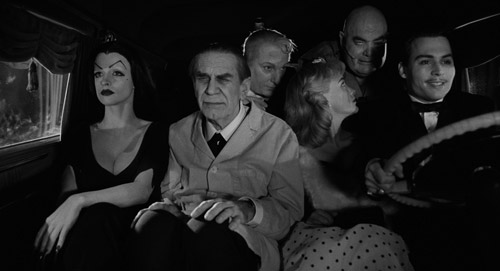
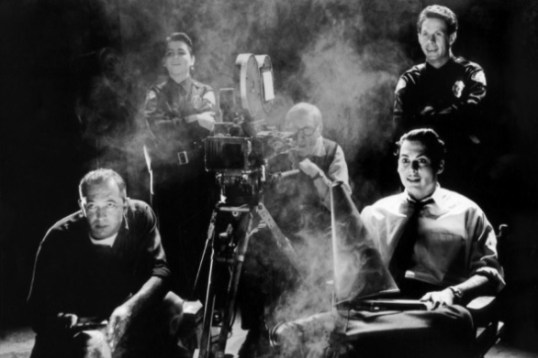
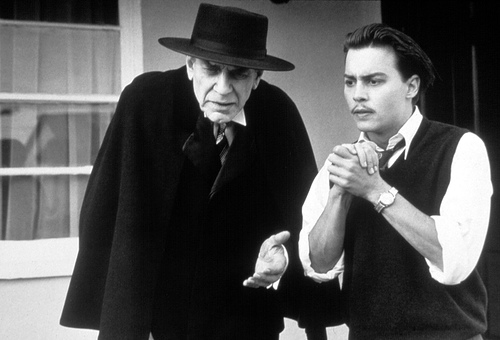
From start to end, the 1994 film Ed Wood is a nearly perfect film.
Consider the opening sequence. In glorious black-and-white, we are presented with a house sitting in the middle of a storm. As Howard Shore’s melodramatic and spooky score plays in the background, the camera zooms towards the house. A window flies open to reveal a coffin sitting in the middle of a dark room. A man dressed in a tuxedo (played to snarky and eccentric perfection by Jeffrey Jones) sits up in the coffin. Later, we learn that the man is an infamously inaccurate psychic named Criswell. Criswell greets us and says that we are interested in the unknown. “Can your heart handle the shocking facts of the true story of Edward D. Wood, Jr!?”
As streaks of lightning flash across the sky, the opening credits appear and disappear on the screen. The camera zooms by tombstones featuring the names of the cast. Cheap-looking flying saucers, dangling on string, fly through the night sky. The camera even goes underwater, revealing a giant octopus…
It’s a brilliant opening, especially if you’re already a fan of Ed Wood’s. If you’re familiar with Wood’sfilms, you know that Criswell’s appearance in the coffin is a reference to Orgy of the Dead and that his opening monologue was a tribute to his opening lines fromPlan 9 From Outer Space. If you’re already a fan of Ed Wood then you’ll immediately recognize the flying saucers. You’ll look at that octopus and you’ll say, “Bride of the Monster!”
And if you’re not an Ed Wood fan, fear not. The opening credits will pull you in, even if you don’t know the difference between Plan 9 and Plan 10. Between the music and the gorgeous black-and-white, Ed Wood is irresistible from the start.
Those opening credits also announce that we’re about to see an extremely stylized biopic. In the real world, Ed Wood was a screenwriter and director who spent most of his life on the fringes of Hollywood, occasionally working with reputable or, at the very least, well-known actors like Lyle Talbot and Bela Lugosi. He directed a few TV shows. He wrote several scripts and directed a handful of low-budget exploitation films. He also wrote a lot of paperbacks, some of which were semi-pornographic. Most famously, he was a cross-dresser, who served in the army in World War II and was wearing a bra under his uniform when he charged the beaches of Normandy. Apparently, the stories of his love for angora were not exaggerated. Sadly, Wood was also an alcoholic who drank himself to death at the age of 54.
Every fan of Ed Wood has seen this picture of him, taken when he first arrived in Hollywood and looked like he had the potential to be a dashing leading man:
What people are less familiar with is how Ed looked after spending two decades on the fringes of the film business:
My point is that the true story of Ed Wood was not necessarily a happy one. However, one wouldn’t know that from watching the film based on his life. As directed by Tim Burton, Johnny Depp plays Ed Wood as being endlessly positive and enthusiastic. When it comes to determination, nothing can stop the film’s Ed Wood. It doesn’t matter what problems may arise during the shooting of any of his films, Wood finds a way to make it work.
A major star dies and leaves behind only a few minutes of usable footage? Just bring in a stand-in. The stand-in looks nothing like the star? Just hide the guy’s face.
Wrestler Tor Johnson (played by wrestler George “The Animal” Steele), accidentally walks into a wall while trying to squeeze through a door? Shrug it off by saying that it adds to the scene. Point out that the character that Tor is playing would probably run into that wall on a regular basis.
Your fake octopus doesn’t work? Just have the actors roll around in the water.
The establishment won’t take you seriously? Then work outside the establishment, with a cast and crew of fellow outcasts.
You’re struggling to raise money for your film? Ask the local Baptist church. Ask a rich poultry rancher. Promise a big star. Promise to include a nuclear explosion. Promise anything just to get the film made.
You’re struggling to maintain your artistic vision? Just go down to a nearby bar and wait for Orson Welles (Vincent D’Onofrio) to show up.
Personally, I’m of the opinion that Ed Wood is Tim Burton’s best film. It’s certainly one of the few Burton films that actually holds up after repeat viewings. Watching the film, it’s obvious that Wood and Burton shared a passionate love for the movies and that Burton related to Wood and his crew of misfits. It’s an unabashedly affectionate film, with none of the condescension that can sometimes be found in Burton’s other film. Burton celebrates not just the hopes and dreams of Ed Wood, Bela Lugosi, Tor Johnson and Criswell but also of all the other members of the Wood stock company, from Vampira (Lisa Marie) to Bunny Breckenridge (Bill Murray), all the way down to Paul Marco (Max Casella) and Loretta King (Juliet Landau). Though Ed Wood may center around the character of Wood and the actor who plays him, it’s a true ensemble piece. Landau won the Oscar but really, the entire cast is brilliant. Along with those already mentioned, Ed Wood features memorable performances from Sarah Jessica Parker and Patricia Arquette (one playing Wood’s girlfriend and the other playing his future wife), G. D. Spradlin (as a minister who ends up producing one of Wood’s films), and Mike Starr (playing a producer who is definitely not a minister).
For me, Ed Wood is defined by a moment very early on in the film. Wood watches some stock footage and talks about how he could make an entire movie out of it. It would start with aliens arriving and “upsetting the buffaloes.” The army is called in. Deep delivers the line with such enthusiasm and with so much positive energy that it’s impossible not get caught up in Wood’s vision. For a few seconds, you think to yourself, “Maybe that could be a good movie…” Of course, you know it wouldn’t be. But you want it to be because Ed wants it to be and Ed is just do damn likable.
As I said before, Ed Wood is a highly stylized film. It focuses on the good parts of the Ed Wood story, like his friendship with Bela Lugosi and his refusal to hide the fact that he’s a cross-dresser who loves angora. The bad parts of his story are left out and I’m glad that they were. Ed Wood is a film that celebrates dreamers and it gives Wood the happy ending that he deserved. The scenes of Plan 9 From Outer Space getting a raptorous reception may not have happened but can you prove that they didn’t?
I suppose now would be the time that most reviewers would reflect on the irony of one of the worst directors of all time being the subject of one of the best films ever made about the movies. However, I’ll save that angle for whenever I get a chance to review The Disaster Artist. Of course, I personally don’t think that Ed Wood was the worst director of all time. He made low-budget movies but he did what he could with what he had available. If anything, Ed Wood the film is quite correct to celebrate Ed Wood the director’s determination. Glen or Glenda has moments of audacious surrealism. Lugosi is surprisingly good in Bride of the Monster. As for Plan 9 From Outer Space, what other film has a plot as unapologetically bizarre as the plot of Plan 9? For a few thousand dollars, Wood made a sci-fi epic that it still watched today. Does that sound like something the worst director of all time could do?
Needless to say, Ed Wood is not a horror film but it’s definitely an October film. Much as how Christmas is the perfect time for It’s A Wonderful Life, Halloween is the perfect time for Ed Wood.
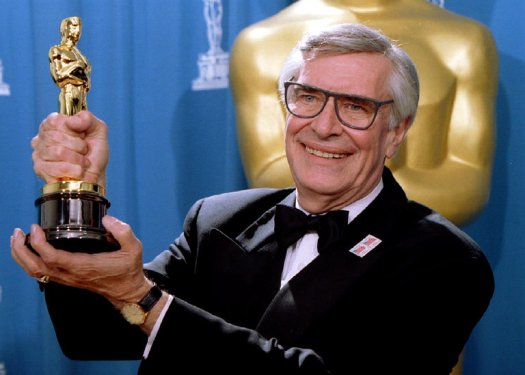
If he had only played Bela Lugosi in the marvelous Tim Burton film ED WOOD and nothing else, Martin Landau would hold a special place in the hearts of film lovers everywhere. But Landau, who passed away July 15 at age 89, was so much more than a one-note actor, leaving behind a body of work that saw him putting his personal stamp on every role he took. He worked with some of the giants of cinema, and slummed it with dreck like THE HARLEM GLOBETROTTERS ON GILLIGAN’S ISLAND. Mostly, he worked at what he loved best, the craft of acting.
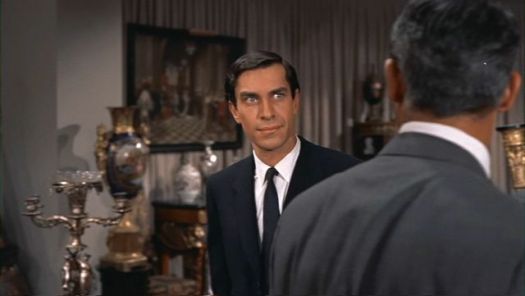
In Hitchcock’s North by Northwest (1959)
Landau’s breakout role was in the Hitchcock classic NORTH BY NORTHWEST (1959), as the sinister sidekick of foreign spy James Mason, menacing stars Cary Grant and Eva Marie Saint. Hollywood directors certainly took notice of his talents and cast Landau in some great films…
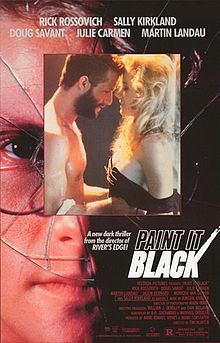
This month, since the site is currently reviewing every episode of Twin Peaks, each entry in Move A Day is going to have a Twin Peaks connection. Paint In Black was directed by Tim Hunter, who directed three episodes of Twin Peaks, including the one that I reviewed earlier today.
Jonathan Dunbar (Rick Rossovich) should have it all. He is an acclaimed sculptor but he’s being cheated financially by his dealer and sometimes girlfriend, Marion Easton (Sally Kirkland). Things start to look up for Jonathan after he has a minor traffic accident with Gina (Julie Carmen). Not only are he and Gina immediately attracted to each other but it turns out that Gina is the daughter of Daniel Lambert (Martin Landau), who owns the most prestigious art gallery in Santa Barbara. It appears that Jonathan is finally going to get the big show that he has always dreamed of, but only if he can escape from Marion’s management.
One night, Jonathan helps out a man who was apparently mugged outside of an art gallery. The man, Eric (Doug Savant), says that he’s an art collector and that he is a big fan of Jonathan’s work. When Jonathan opens up about his problems with Marion, Eric decides to return Jonathan’s favor by killing Marion and anyone else who he feels is standing in the way of Jonathan’s success. Because of the way that Eric artistically stages the murders, the police suspect that Jonathan is the murderer.
Depending on the source, Paint It Black’s original director was either fired or walked off the project and Tim Hunter was brought in to hastily take his place. According to Hunter, he spent the production “shooting all day and rewriting all night.” Paint it Black is a standard late 80s, direct to video thriller but it is interesting as a tribute to Alfred Hitchcock. Hunter taught a class on Hitchcock at the University of California at Santa Cruz and Paint it Black is full of shout outs to the master of suspense. Marion’s murder is staged similarly to a murder in Frenzy. There are frequent close-ups of scissors, a reference to Dial M For Murder. Probably the most obvious homage is the character of Eric, who appears to be based on Robert Walker, Jr’s character from Strangers on a Train.
Rick Rossovich was best known for playing cops, firemen, and soldiers in movies like Top Gun, Navy SEALS, and Roxanne. He’s not bad in Paint it Black but he is still not the most convincing artistic genius. Doug Savant and Sally Kirkland were better cast and more enjoyable to watch. In fact, Kirkland is killed off too early. The movie loses a lot of its spark once she is gone.
Paint It Black may not live up to being named after one of the best songs that the Rolling Stones ever recorded but Tim Hunter took unpromising material and shaped it into something that is far more watchable than anyone might expect.
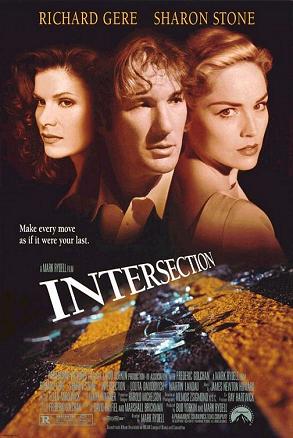
Vincent Eastman (Richard Gere) and his wife, Sally (Sharon Stone), own an architectural firm. Vincent is supposed to be creative and passionate but mostly he’s just Richard Gere in mom jeans. Sally is a brilliant businesswoman but she is also emotionally repressed to the point of being frigid. Vincent eventually starts having an affair with a travel writer named Olivia (Lolita Davidovich), who is everything that Sally is not. Despite Martin Landau telling him that he has to make a decision because, and I quote, “Keep everything under one roof. That’s a basic rule of architecture,” Vincent cannot choose between his hateful wife and his loving mistress. First he writes a letter to Olivia, telling her that he can not leave his wife. Then, he sees a little girl who, like Olivia, has curly red hair and he takes that as a sign that he should leave his wife. He calls Olivia and leaves a gushing message on her machine, telling her that he’s leaving Sally. But before the letter is sent or the message is heard, Vincent is in a car crash that leaves him in a coma. As both his wife and his mistress wait outside his hotel room, Vincent has visions of his two lovers swimming by him and struggles to decide who to follow. Even in a coma, Vincent is an indecisive prick.
Intersection was on HBO while I was sick. I watched it and it just made me feel worse. Intersection was made during a weird period of time when Richard Gere was a romantic star and Sharon Stone was trying to prove that she was a serious actress. Stone lobbied to be cast against type as Sally but she plays the role as so hard and bitchy that there’s never any question as to whether or not Vincent should leave her for Olivia. Lolitia Davidovich (whatever happened to her?) does what she can with Olivia but the character never has any existence beyond her relationship with Vincent. As for Richard Gere, when he starts hyperventilating about seeing a little girl who looks like his mistress, you’ll want to report him to social services.
Sadly, Intersection was directed by Mark Rydell and written by Marshall Brickman, two people who did great work before Intersection and have done very little since.
American-International Pictures had gotten pretty fancy-schmancy by the late 70’s. The studio was leaving their exploitation roots behind and branching out to bigger budgeted films like FORCE TEN FROM NAVARONE, LOVE AT FIRST BITE, and THE AMITYVILLE HORROR, with bigger name stars for marquee allure. Toward the end of 1979 they released METEOR, a $16 million dollar, star-studded, special-effects laden, sci-fi/ disaster film spectacle that bombed at the box-office and contributed to the company’s demise.
Coming at the tail end of the disaster cycle, METEOR is formulaic as hell. Take a group of well-known stars (Sean Connery, Natalie Wood , Karl Malden , Brian Keith , Martin Landau, Henry Fonda ), give them a disastrous menace to combat (in this case a five-mile wide meteor hurtling toward Earth), add some conflict (US/USSR Cold War relations), and some scenes of destruction, and voila! instant disaster movie! Unfortunately, by 1979 audiences had already grown tired…
“There are no crazy people, doctor. We’re all just on vacation.”
— Frank Hawkes in Alone In The Dark (1982)
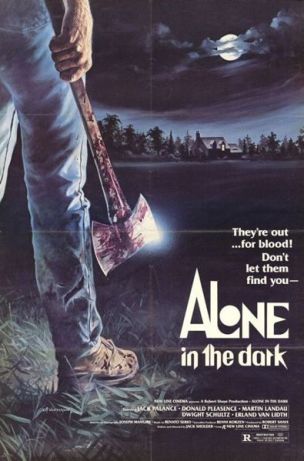
What is the difference between being crazy and being sane? Why are some forms of delusion considered to be socially acceptable while others are condemned? Who is the ultimate authority on what is normal and what is abnormal? These are just some of the issues that are raised by the gleefully subversive 1982 horror film, Alone In The Dark.
We know that there’s something off about Dr. Leo Bain (Donald Pleasence) from the minute we meet him. His smile is a little too nervous and his constant patter of positive words sound a little bit too rehearsed and convenient. When he greets another doctor, he insists on hugging him but it’s an awkward hug. Dr. Bain seems to be trying just a little bit too hard. (In many ways, Pleasence seems to be poking fun at his best-known role, Halloween‘s intense and dramatic Dr. Loomis.)
Dr. Bain is in charge of a psychiatric hospital. He doesn’t believe in conventional therapy. Instead, his hospital is perhaps the most oppressively positive place in the world, a place where every delusion is treated as being perfectly normal and where the patients are treated very leniently.
In fact, security is only present on the third floor of the hospital. That’s because the third floor is home to four inmates who are criminally insane. Frank Hawkes (Jack Palance) is a former POW who suffers from paranoia and gets mad whenever he hears anyone curse. Bryon “Preacher” Sutcliffe (Martin Landau) is a pyromaniac. Ronald Estler (Erland van Lidth) is a gigantic child molester. And finally, there’s The Bleeder, who always hides his face. The Bleeder is a serial killer who is called the Bleeder because, whenever he kills, his nose starts to bleed.
Dr. Bain scoffs at the idea that these four even need security but, as he explains it, the state requires it. However, one night, the power goes out and the four of them manage to escape. As they make their way into the nearby town, they rather easily blend into the mob of “normal” people who are using the blackout as an excuse to go looting.
However, these four patients are on a very specific mission. They had all grown to trust their psychiatrist, Dr. Merton. However, Dr. Merton was eventually hired away by another hospital. Frank is convinced — and has convinced the others — that Dr. Merton was murdered by their new psychiatrist, Dr. Dan Potter (Dwight Schultz). They’re goal now is to track down Dr. Potter and kill him and his family.
Meanwhile, Dr. Potter has issues of his own to deal with. He’s a nice guy but he’s also a bit too uptight and rational for his own good. (Early on in the film, he gets upset when his wife tries to get him to go see a band called the Sic Fucks.) His younger sister, Toni (Lee Taylor-Allan), is visiting while she recovers from a nervous breakdown of her own. She manages to get arrested while protesting a nuclear power plant and, when she gets out of jail, she insists on bringing another protester, Tom (Phillip Clark), home with her.
It all leads to one long night, during which the inmates lay siege to Dan’s house. And, all the while, Dr. Bain worries about whether or not they’re all mad at him…
Alone in the Dark may come disguised as a slasher movie but actually, it’s a pitch black comedy, with a lot of the humor coming from the contrast between Dan’s rationality, Bain’s nonstop optimism, and the fact that every one else in the film is literally batshit insane. The final siege is a masterpiece of suspense and Palance, van Lidth, and especially Martin Landau are memorably frightening in their menacing roles. The film’s final scene deserves to be iconic.
Alone in the Dark is one of those horror films that definitely deserves to be better known. Do NOT mistake it for the Uwe Boll film.
On tonight’s episode of The Twilight Zone, Al Denton (Dan Duryea) used to be a notorious old west gunfighter. Now, haunted as the result of killing a teenage boy, Mr. Denton is just the town drunk. However, a salesman subtly named Henry J. Fate (Malcolm Atterbury) comes into town and gives Denton the chance to once again be great. Of course, it all comes with a price and a lesson.
Originally aired on October 16th, 1959, Mr. Denton on Doomsday is one of the earlier episodes of The Twilight Zone. Today, it’s perhaps most interesting for its message of anti-violence. Myself,I just like it because I went to college in Denton, Texas.
While watching the 1963 best picture nominee, Cleopatra, I had many thoughts. The film lasts over 4 hours so I had a lot of time to think.
For instance, I often found myself impressed by the sheer size of the production. I marveled at the recreation of ancient Greece and Rome. I loved looking at the ornate costumes. I loved feeling as if I was taking a look back at what Rome may have actually looked like at the height of the Roman Empire. Making it all the more impressive was that this film was made in the days before CGI. When the film’s Romans walked through the streets of Rome, they weren’t just actors standing in front of a green screen. They were walking down real streets and surrounded by real buildings. It reminded me of the awe and wonder that I felt when I was in Italy and I was visiting the ruins of ancient Rome.
(I don’t know if any of the cast accidentally flashed everyone like I did when I visited during Pompeii on a windy day but considering how short some of the skirts on the men were, it wouldn’t surprise me if they did!)
And, as I marveled at the recreation of Rome, I also thought to myself, “How long is this freaking movie?” Because, seriously, Cleopatra is an amazingly long movie. It’s not just the film is over four hours long. It’s that the film feels even longer. Gone With The Wind, The Godfathers Part One and Part Two, Once Upon A Time In America; these are all long films but, because they’re so great, you never find yourself checking the time while watching. Cleopatra is the opposite of that. Cleopatra is a film that, at its slowest, will make you very much aware of how many seconds are in a minute.
I found myself marveling at the lack of chemistry between Elizabeth Taylor and Richard Burton. If anything, this is the most shocking thing about Cleopatra. If Cleopatra is famous for anything, it’s famous for being the film where Elizabeth Taylor (cast in the role of Cleopatra) first met Richard Burton (who was playing Mark Antony). Their affair dominated the gossip headlines. (If TMZ and YouTube had been around back then, there would be daily videos of Richard Burton punching out paparazzi.) Cleopatra was the first of many big-budgeted, overproduced films that Taylor and Burton co-starred in.
(Then again, they also starred in Who’s Afraid of Virginia Woolf, a film that is almost the exact opposite of Cleopatra.)
In the role of Mark Antony, Burton spends most of the film looking absolutely miserable. Elizabeth Taylor, meanwhile, seems to be having a lot more fun. It’s almost as if she understood what Cleopatra was going to become so she went out of her way to give the type of over-the-top performance that the film deserved. The same can also be said about Rex Harrison, who plays Julius Caesar and who, perhaps because he appears to have shared her attitude, actually does have some chemistry with Taylor.
Actually, if anyone gives a truly great performance in Cleopatra, it’s Roddy McDowall. McDowall plays the future Emperor Augustus with a mesmerizing intensity. Again, McDowall’s performance is not exactly subtle but Cleopatra is not a film that demands subtlety.
As the film finally neared its end, I found myself wondering how Joseph L. Mankiewicz went from directing two close to perfect films, A Letter To Three Wives and All About Eve, to directing this. Even more amazing, Mankiewicz had previously directed one of the best Roman Empire films ever, 1953’s Julius Caesar. (When compared to Cleopatra, the low-key and thoughtful Julius Caesar appears to have been filmed on an entirely different planet.) Well, in Mankiewicz’s defense, he was not the original director. He was brought in to replace Rouben Mamoulian, who had previously attempted to make the film with Joan Collins, Ben-Hur‘s Stephen Boyd, and Peter Finch. When Mankiewicz was brought in, the cast was replaced with Taylor, Burton, and Harrison. Between the expensive stars, the troubled production, and all of the offscreen romantic melodrama, Mankiewicz probably did the best that he could.
Today, Cleopatra is mostly interesting as an example of a film from the “Only Gigantic Productions Will Save Us From Television!” era of Hollywood filmmaking. Cleopatra started out as a $2,000,000 production and ended up costing $31,000,000. It was the number one film at the 1963 box office and it still nearly bankrupted 20th Century Fox. While the film does have some kitsch appeal, the critics hated it and it’s easy to see why.
And yes, it was nominated for best picture of the year, a tribute to the size of the production and the determination of 20th Century Fox to get something — anything — in return for their money.
Cleopatra is a bit of a chore to sit through but it can be fun if you’re in a snarky mood. It’ll do until the inevitable Angelina Jolie remake comes along.



 This month, since the site is currently reviewing every episode of Twin Peaks, each entry in Move A Day is going to have a Twin Peaks connection. Paint In Black was directed by Tim Hunter, who directed three episodes of Twin Peaks,
 This one is just dumb.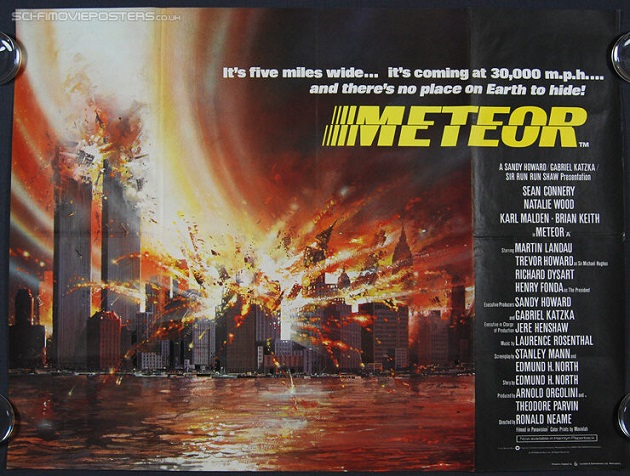



 Through the Shattered Lens