Welcome to method actor Hell!
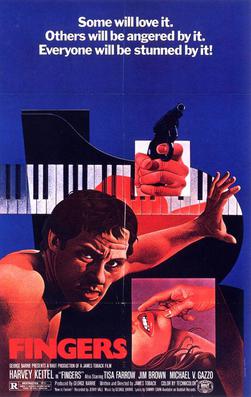
The 1978 film, Fingers, tell the story of Jimmy “Fingers” Angelilli (Harvey Keitel). Jimmy is a creep who works as a debt collector for his father, a small-time loan shark named Ben (Michael V. Gazzo). Jimmy is violent and brutal and often wanders around with a disturbingly blank-look on his face but we’re supposed to like him because he’s a talented pianist and he’s got a recital interview coming up at Carnegie Hall. Jimmy carries a radio with him wherever he goes and he’s obsessed with the song Summertime. He’s the type who will sit in a crowded restaurant and play the song and then get upset when someone tells him to turn off his radio. By the end of the movie, I was really hoping that someone would take Jimmy’s radio and smash into a hundred pieces.
Jimmy is in love with Carol (Tisa Farrow, who was a far better actress than her sister Mia and who would later appear in Lucio Fulci’s classic, Zombi 2), who doesn’t really seem to all that into him. Despite being in love with Carol, Jimmy still hits on every woman that he meets and, because this is a 70s films, he’s constantly getting laid despite being kind of a charmless putz.
Jimmy meets a former boxer named Dreems (Jim Brown). Carol is apparently one of Dreems’s mistresses. Jimmy silently watched while Dreems knocks two women’s heads together. Jimmy stands there with his little radio and a blank expression on his face. Is anything going on inside of Jimmy’s head? It’s hard to say.
Eventually, Jimmy finds out that a gangster (Tony Sirico) owes his father money but is refusing to pay. It all leads to violence.
As a film, Fingers is pretty much full of shit but that shouldn’t come as a surprise because it was the directorial debut of James Toback and there’s no American filmmaker who has been as consistently full of shit as James Toback. Fingers has all of Toback’s trademarks — gambling, crime, guilt, classical music, and a juvenile view of sexuality that suggests that James Toback’s personal development came to a halt when he was 16 years old. It’s a pretentious film that really doesn’t add up too much. Again, you know what you’re getting into when James Toback directs a film. Don’t forget, this is the same director who made a documentary where he was apparently shocked to discover that no one wanted to finance a politically-charged remake of Last Tango in Paris starring Alec Baldwin and Neve Campbell.
Fingers is a bit of an annoying film and yet it’s not a total loss. For one thing, if you’re a history nerd like I am, there’s no way that you can’t appreciate the fact that the film was shot on location in some of New York’s grimiest neighborhoods in the 70s. While I imagine it was more of a happy accident than anything intentional on Toback’s part (because, trust me, I’ve seen Harvard Man), Fingers does do a good job of creating an off-center, dream-like atmosphere where the world constantly seems to be closing in on its lead character. Jimmy is trying to balance his life as violent mobster with being a sensitive artist and the world around him is saying, “No, don’t count on it, you schmuck.”
As well, Harvey Keitel gives a …. well, I don’t know if I would necessarily say that it’s a good performance. In fact, it’s a fairly annoying performance and that’s a problem when a film is trying to make you feel sympathy for a character who is pretty unsympathetic. That said, there’s never a moment in the film where Keitel is boring. In Fingers, Keitel takes the method to its logical end point and, as a result, you actually get anxious just watching him simply look out of a window or sit in a corner. Even though Jimmy eyes rarely shows a hint of emotion, his fingers are always moving and, just watching the way that he’s constantly twitching and fidgeting, you get the feeling that Jimmy’s always on the verge of giving out a howl of pain and fury. It doesn’t really make Jimmy someone who you would want to hang out with. In fact, I spent the entire movie hoping someone would just totally kick his ass and put him in the hospital for a few weeks. But it’s still a performance that you simply cannot look away from. Watching Keitel’s performance, you come to realize that Fingers is essentially a personal invitation to visit a Hell that is exclusively populated by method actors who have gone too far.
Anyway, my feelings about Fingers were mixed. Can you tell? It’s an interesting movie. I’ll probably never watch it again.

 Through the Shattered Lens