Today, a lot of people have traveled to New Orleans to celebrate Mardi Gras. Here’s hoping that they have a better time in the city than Billy (Dennis Hopper) and Wyatt (Peter Fonda) had in the 1969 film, Easy Rider.
The scenes below, featuring Hopper, Fonda, Karen Black, and the legendary Toni Basil were actually filmed at Mardi Gras in 1968. These were among the first scenes that Hopper (making his directorial debut) shot for the film and reportedly, filming was so chaotic that they were also nearly the last scenes to be filmed. As those who have seen Easy Rider know, Billy and Wyatt spend the entire movie trying to get to New Orleans so that they can visit a famous brothel. Once they get there, they discover that absolutely nothing lives up to the legend. The brothel is a sleazy mess. Mardi Gras is full of bad vibes. Wyatt has an amazingly bad LSD trip. (Hopper convinced Fonda to really drop acid before filming the scene, which led some harrowing footage.) After they leave New Orleans, Fonda and Hopper cross the border into Texas and promptly end up getting blown away by two rednecks in a pickup truck.
Welcome to the sixties!
In the scene below, we get actual footage of 1968’s Mardi Gras. Just watch all the celebrants who stop to stare at the camera.
And here is the infamous cemetery scene. Fonda resisted doing it and the end result is not easy to watch but it’s also one of the most powerful moments in the entire film:
But Lisa, just because the song is called Mardi Gras that doesn’t mean that it’s about our Mardi Gras…
Okay, you got a point. But here’s my point: today is Mardi Gras. And this song is called Mardi Gras. And I like it. It’s a fun song to listen to while you’re stuck in traffic.
Besides, if you’re complaining about stuff like that today that means that you’re totally missing the point of Mardi Gras.
Ike (Glynn Turman) is a nice guy. He’s a law student living in New Orleans. When not studying, he makes money driving a taxi cab. He has a beautiful and loving wife named Christella (Joan Pringle). He has a nice but modest apartment. When we first see Ike, he is calmly and rationally breaking up a fight. Perhaps the only real complain that can be made about Ike is that he’s actually too nice. There’s nothing dangerous about Ike. He works hard. He studies. That’s about it.
When Christella and their friends tell him that he needs to take a night off from studying, Ike is reluctant. However, he finally agrees to go out with them. They start out at a strip club in the French Quarter and eventually, they end up watching a hypnotist. Ike is one of the men randomly selected to go up on stage. Amazingly, rational and mild Ike is easily hypnotized. The audience loves watching as Ike and the other men all reacts to hypnotic suggestion. What they don’t know is that, while in his trance, Ike has been … possessed!
That’s right! The ghost of J.D. Walker has entered Ike. Who is J.D. Walker? As we learn from a series of gauzy flashbacks, J.D. Walker was a gangster in the 1940s. He wore a fedora. He wore nice suits. He was every bit as flamboyant as Ike is mild. But then, one day, J.D. was killed, gunned down by his former business partner, Theotis Bliss (Fred Pinkard).
Soon, Ike starts to act … well, not like himself. Suddenly, Ike is using 1940s slang. He’s wearing 1940s clothes. He’s gambling. He mugs an old lady who gets in his cab and then abandons her on the wharf. When his wife asks him why he’s acting like a 1940s gangster, he gets violent. Soon, Ike is speaking in a different voice and dancing.
What does J.D. want? He wants revenge against not only the man who shot him but also Theotis’s younger brother, a popular preacher named Elijah (Lou Gossett, Jr.). As wild as the possessed Ike may be, he’s got nothing on Elijah. Elijah was a boxer before he became a man of God and he’s still liable to throw a punch or two during his sermons. Elijah, however, is also rather naive and has no hesitation about inviting J.D. to become a member of his congregation. Theotis, who is now Elijah’s manager, is a bit more suspicious…
An oddly paced film that never quite escapes the lengthy shadows of all of the horror films that inspired it, J.D.’s Revenge is worth seeing for the performances Glynn Thurman and Lou Gossett, Jr. Gossett is all energetic charisma in the role of the reverend, giving a performance that features just enough ambiguity that you’re never sure whether you should trust Elijah or not. Meanwhile, Thurman is very good as the mild-mannered Ike but he seems to be having an absolute blast whenever he gets to play the psychotic J.D. During the final confrontation between Ike/J.D. and the Bliss Brothers, Thurman’s performance is so bizarre and over the top that you simply cannot stop watching him.
J.D.’s Revenge was filmed in New Orleans, which add a little bit of gothic atmosphere to the film. As I write this, a lot of our readers may currently be in New Orleans for Mardi Gras. I wish them all well but I hope they’ll remember the lesson of J.D.’s Revenge. Just say no to hypnosis!
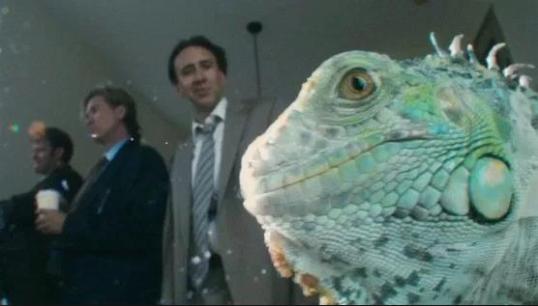
If you’re in New Orleans for Mardi Gras, please be sure to keep an eye out for the iguanas.
Ever since Werner Herzog’s Bad Lieutenant: Port of Call New Orleans was first released, people have debated the symbolism of the iguanas on the coffee table. Are they just a sign that Nicolas Cage’s bad lieutenant is totally high or do they have a deeper meaning? Myself, I’m not even going to try to guess. All I know is that the lieutenant eventually came to appreciate their presence.
Seeing as how tomorrow is, depending on where you live, either Fat or Shrove Tuesday, I decided why not share a music video about New Orleans?
It probably says something about the way I view the world that, whenever I see this video, I’m always expecting that it’s going to turn out that our group of friends is trying to cover up a murder or something. The whole video gives off a “We accidentally killed a guy, let’s have a good time before we have to find a place to bury him,” vibe. Of course, that’s not necessarily a bad thing.
This video was directed by Michael Fierstein. Steven Andrew Garcia was the director of photography.
With this being Mari Gras weekend, I imagine that thousands of people are currently flooding into New Orleans and hoping to have a good time. In honor of their commitment, I have been reviewing Mardi Gras-themed films. Today’s film is low-budget 1978 “shocker” called Mardi Gras Massacre.
A serial killer is stalking New Orleans and…
Wait a minute. Does this sound familiar? Hmmm … okay, sorry, let’s continue.
…the police are powerless to stop him…
Okay, I swear, I think I’ve described this situation before. But, anyway, to continue with Mardi Gras Massacre:
…despite being the most obvious serial killer in history, the murderer is able to move undetected through the Big Easy. His motive? Human sacrifices to an evil power…
OKAY, STOP! I just realized that I’m basically rewriting my earlier review of Mardi Gras For The Devil. Despite the fact that there’s a 15-year age difference between the two films, both Mardi Gras Massacre and Mardi Gras For The Devil have the same basic plot. A psycho wanders around New Orleans and commits occult-themed murders while an intense cop tries to stop him. Eventually, the cop’s lover is targeted by the killer…
I mean, it’s the exact same plot! The only real difference is that Mardi Gras For The Devil starred recognizable actors like Michael Ironside and Robert Davi while Mardi Gras Massacre was a low-budget obscurity starring no one that you have ever heard of.
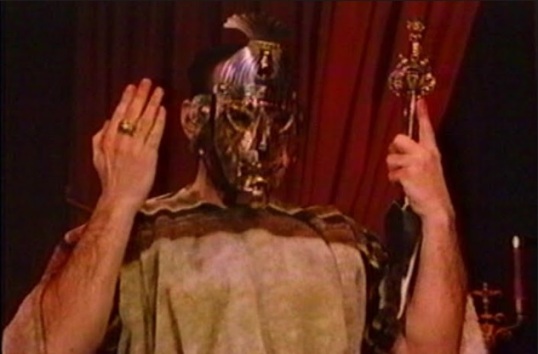
In Mardi Gras Massacre, the killer’s name is John and he’s played by an actor named William Metzo. John spends all of his time looking for prostitutes and strippers who he can sacrifice to an Aztec God. John has an altar in his apartment. The altar, of course, is surrounded by red curtains. As I watched the film, I wondered where he got the altar. Even more importantly, I wondered how he could fit that huge altar into what appeared to be a pretty small apartment.
John manages to sacrifice quite a few women without anyone becoming overly suspicious of him. This is despite the fact that John spends almost the entire movie wearing a three-piece suit and glaring at everyone he meets. When John steps into a bar, the first thing that he asks the bartender is where he can find the “evilest” prostitute. No one seems to find that strange. Then again, New Orleans is a very forgiving town.
Anyway, Sergeant Frank Herbert (Curt Dawson) is in charge of the investigation and, as soon as he shows up with his porn stache and his hairy chest, we know that we’re watching a movie from the 70s. Sgt. Herbert falls in love with a prostitute named Sherry (Gwen Arment). Halfway through the film, we get an extended falling in love montage. New Orleans looks really pretty in the montage but, at the same time, the film has just spent 45 minutes establishing it as a city where a serial killer can ask for the “evilest” prostitute without raising any suspicion. So, romantic montage outside, I have hard time believing that Mardi Gras Massacre did much for New Orleans tourism.
I should point out that, much as with the case of Mardi Gras For The Devil, there’s not really a whole lot of Mardi Gras to be found in Mardi Gras Massacre. Towards the end of the movie, we get a chase through a Mardi Gras parade. It’s obvious that the filmmakers filmed the chase during the actual parade so, from a historical point of view, it’s interesting to see how Mardi Gras was celebrated in the 70s. At the same time, throughout the entire scene, drunk people are waving at the camera. (One person even tries to grab the lens as they walk by.)
On a positive note, Mardi Gras Massacre features one of the best trashy disco scenes ever . As well, the version that I watched had Spanish subtitles and I’m happy to say that my Spanish is apparently getting pretty good! As for the rest of the film, it’s a movie that will be best appreciated by grindhouse aficionados. It’s a low-budget, poorly acted, thoroughly silly film and its obviously fake gore managed to get the film banned in the UK. It’s a historical oddity and, like many grindhouse films, its appeal mostly comes from watching it and saying, “Someone actually made this and managed to get it into theaters.” At the very least, it will hopefully remind you to not admit to being the “evilest” anything during Mardi Gras.
If any of our readers are in New Orleans for Madi Gras weekend, a word of caution.
If you see a funeral procession, don’t ask who the funeral is for.
Seriously.
This scene is from 1973’s Live and Let Die. It’s a scene of many emotions. It may start out with the sond of a sad tune but everyone’s pretty happy by the end of it.
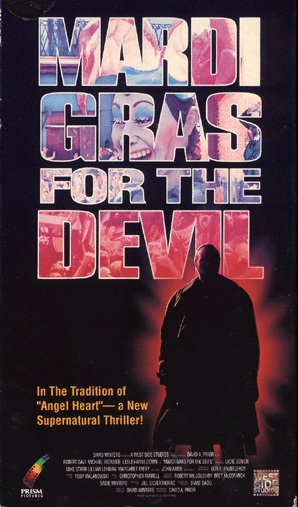
A maniac is holding New Orleans hostage! He’s committed a series of savage, Satanically-influenced homicides and the police cannot seem to even slow him down! The entire city is terrified!
Well, actually … New Orleans doesn’t seem to be scared at all. In fact, no one in this movie seems to be all that disturbed by all of the brutal murders that are happening around them. Some people would probably say that’s because this film takes place during Mardi Gras and everyone’s too drunk to notice. Why worry about being murdered when all you have to do to get a bunch of cheap beads is flash a boob? Add to that, this is New Orleans. New Orleans is a very forgiving city.
Anyway, regardless of whether people care or not, there’s a Satanic murderer prowling through the city. Who is the killer? Could he possibly be that guy who always dresses in black, who has a perfectly trimmed beard, and who is always throwing back his head and laughing before doing something evil? The guy’s name is Bishop and he’s played by everyone’s favorite Canadian character actor, Michael Ironside. As far as Michael Ironside villains are concerned, Bishop is pretty frightening though he’s nowhere near as a frightening as Darryl Revok. I mean, he does a lot of evil stuff but he doesn’t actually make anyone’s head explode.
Detective Mike Turner (Robert Davi) is obsessed with stopping Bishop. Unfortunately, Detective Turner doesn’t appear to be very good at his job. I mean, everyone he knows he keeps getting seriously injured. His first partner dies. His second partner gets run over by a bus. His ex-wife (Lesley-Anne Down) ends up trapped in a pool. His girlfriend (Lydie Denier) ends up getting tied up in a barn while a time bomb ticks down across from her. Fortunately, a few of these people do manage to survive. Turner may not be a very good cop but, fortunately, Bishop isn’t that good of a serial killer.
It soon becomes apparent that Bishop has a motive for all of his murders, one that goes beyond the usual serial killer weirdness. It turns out that Bishop’s murders are actually sacrifices and he has given his soul to Satan. Giving your soul to the devil apparently gives you the power to do whatever the script needs you to do at any particular moment in the movie. Fortunately, it also leaves you with a weakness that can be exploited whenever the movie decides to come to an end.
Am I saying that Mardi Gras For the Devil makes no sense? I most definitely am! However, that’s actually the film’s charm. The film was made with so little concern for continuity and narrative logic that it plays out like a fever dream. The cast is surprisingly good for a film like this, which means that everyone delivers the strangest of lines with the utmost sincerity. Michael Ironside plays his role without a hint of subtlety, which is exactly the type of bad guy that a film like this requires. Meanwhile, Robert Davi brings a weary cynicism to his role. You can just hear him thinking, “Satanic serial killers? I’m too old for this shit.” Combine that with a fiery ending that doesn’t even try to make sense and you have a movie that, perhaps through no intention of the film’s director, manages to create and sustain a very surreal atmosphere. The film may not be any good but it’s hard to look away from.
Though the film takes place at Mardi Gras and was released, in some countries, as both Mardi Gras For The Devil and Mardi Gras Nightmare, it actually has very little do with Mardi Gras. The opening scenes were shot during a Mardi Gras parade but that’s about it. The film was also released under the title Night Trap, which is a woefully generic title. You can find the movie on YouTube.
I’m pretty sure that I’ve shared this scene before but, since it’s Mardi Gras weekend, it feels like a good time to share it again!
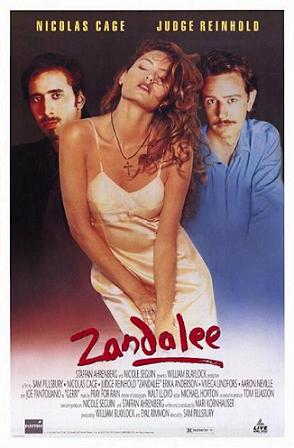
In this scene from the 1991 New Orleans-set melodrama, Zandalee, Judge Reinhold and Nicolas Cage share a dance on a bayou dock. Reinhold knows that Cage has been sleeping with his wife. Cage knows that Reinhold knows. So, they decided to have an impromptu dance-off.
It sounds like a good to idea to me and, with everyone flooding into Louisiana this weekend, it seems like a good pick for today’s scene that I love!
It’s Mardi Gras weekend so I’m going to guess right now that people are flooding into Louisiana.
I’ve always loved Louisiana. My family lived in Shreveport for nearly two years, from December of ’96 to May of ’98. It was the last state that we lived in before returning to Texas and it’s a place that I’ve visited a few times since. (Shreveport, I might add, also celebrates Mardi Gras. It’s just that it tends to be a little bit more sedate in Shreveport than in New Orleans.) Louisiana is a state that is full of atmosphere and eccentric historical oddities. If you ever think your political leaders are crazy, do a google search on “Edwin Edwards” or “Earl Long.” If you ever think there’s never been a stranger moment in history than now, read T. Harry Williams’s biography of Huey Long.
Anyway, today’s music video of the day is all about Louisiana. Radney Foster’s Louisiana Blue has a nice mellow mood to it. Consider it to be the calm before the storm.



 Through the Shattered Lens