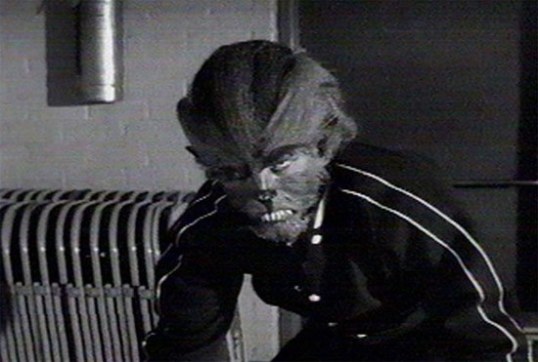
Horror on the Lens: How To Make A Monster (dir by Herbert L. Strock)


You’ve seen I Was A Teenage Werewolf….

You’ve watched I Was A Teenage Frankenstein….

Now, it’s time to watch How To Make A Monster!

Released in 1958, How To Make A Monster is a clever little horror satire from American International Pictures in which the stars of Teenage Werewolf and Teenage Frankenstein are hypnotized into believing that they actually are the monsters that they played!  The main culprit is a movie makeup artist (Robert H. Harris) who has been deemed obsolete by the new bosses at AIP.

Be sure to watch for the finale, which features cameo appearances from several other AIP monsters!  And read my full review of the film by clicking here!

Bonus Horror On The Lens: I Was A Teenage Werewolf (dir by Gene Fowler, Jr.)


1957’s I Was A Teenage Werewolf combines two genres that were very popular in the late 50s.

On the one hand, it’s a film about a teenage rebel.  Tony Rivers (Michael Landon) is a teenager that means well but he keeps losing his temper.  If he can’t learn to control his anger, he could very well be looking at a life behind bars.

On the other hand, it’s also a horror film.  When Tony visits a hypnotist (Whit Bissell), the end result is Tony turning into a werewolf and going on a rampage, all while still wearing his letterman jacket.

All in all, this is a pretty fun little movie.  You can check out my review of it by clicking here.

And you can watch the movie below!

An Offer You Can’t Refuse: Dragnet (dir by Jack Webb)


1954’s Dragnet opens with a gangland slaying.  We watch as a man is brutally gunned down in a field in Los Angeles.  The rest of the film deals with the efforts of the LAPD to track down and arrest the killers.

Based on the televisions show that gave birth to the whole “cop show” format, Dragnet features Jack Webb as Sgt. Joe Friday, calmly and efficiently investigating the slaying.  Working with Friday is Officer Frank Smith (Ben Alexander) but the film (just like the show) is ultimately about how the whole criminal justice system works together as a machine designed to protect the citizenry and to punish crime.

Or, at least, that’s the way it’s supposed to work.  Especially if you’re only familiar with Dragnet from its late 60s incarnation and the countless parodies that followed, the 1954 Dragnet can seem surprisingly cynical and rough-edged.  The killings are violent, the criminals are ruthless, and the cops are often frustrated in their attempts to solve crimes.  In this film, at least, justice is not guaranteed.

The shooting victim is identified as a low-level gangster named Miller Starkie and Friday and Smith immediately suspect that he was killed on the orders of West Coast mob boss Max Troy (Stacy Harris).  Friday and Smith know that Troy is guilty and they even figure out who worked with Troy to kill Starkie.  But, throughout the film, they struggle to get any sort of concrete evidence tying Max to the crime.  Dragnet is a police procedural that follows every bit of the investigation, including the attempts to convince a grand jury to indict Max.  One of the more interesting moments in the film is when Friday gives his grand jury testimony and it becomes obvious that the district attorney was right to be skeptical about trying to bring charges.  Friday really doesn’t have enough evidence to justify arresting Max for the crime that everyone knows he committed.  To the film’s credit, it doesn’t attack the grand jury system or suggest that the system is unfairly rigged for the criminals.  Friday may be frustrated but he understands that the system has to protect the rights accused first.  One has to be presumed innocent until proven guilty even when everyone knows that person is guilty.

That said, Friday and Smith and the entire LAPD end up harassing Max Troy in a way that would probably not fly if the film were made today.  At one point, a line of police cars park in front of Max’s house and then all shine their lights into his windows.  Friday and Smith end up following Max everywhere that they he goes, stopping him and randomly frisking him before ordering him to empty his pockets.  Today, I imagine this would lead to lawsuit.  Even in the film, it doesn’t exactly pay off.

What does pay off is sending a police woman (played by Ann Robinson) into Max’s nightclub undercover, with a recording device.  This whole sequence is interesting because it’s apparent that the idea of a tiny recording devices — something that we take for granted nowadays — was apparently a new and exciting concept in 1954.  (Indeed, the one used in this film actually looks a bit bulky.)  For a few minutes, the action stops so Dragnet can show off the LAPD’s latest toy.

I liked Dragnet.  It’s an nicely-paced time capsule and, despite its docudrama style and television origins, director Jack Webb manages to come up with a few memorable visuals.  As someone who has binged the late 60s version of Dragnet, it was interesting to see a tougher and much more cynical version of the series.  While Webb was hardly an expressive actor, his dour demeanor serves him well as Joe Friday and Stacy Harris is appropriately sleazy as the crime boss.  Despite all of Friday’s frustrations, the case eventually comes to a conclusion in the 1954 film, even if it’s not the one that Friday and his bosses wanted.  Max may be able to escape the police but he can’t escape his own health.  Friday and Smith move on to investigate the next case.  As always, the names will be changed to protect the innocent.

Horror on the Lens: How To Make A Monster (dir by Herbert L. Strock)


You’ve seen I Was A Teenage Werewolf….

You’ve watched I Was A Teenage Frankenstein….

Now, it’s time to watch How To Make A Monster!

Released in 1958, How To Make A Monster is a clever little horror satire from American International Pictures in which the stars of Teenage Werewolf and Teenage Frankenstein are hypnotized into believing that they actually are the monsters that they played!  The main culprit is a movie makeup artist (Robert H. Harris) who has been deemed obsolete by the new bosses at AIP.

Be sure to watch for the finale, which features cameo appearances from several other AIP monsters!  And read my full review of the film by clicking here!

Horror On The Lens: I Was A Teenage Werewolf (dir by Gene Fowler, Jr.)


1957’s I Was A Teenage Werewolf combines two genres that were very popular in the late 50s.

On the one hand, it’s a film about a teenage rebel.  Tony Rivers (Michael Landon) is a teenager that means well but he keeps losing his temper.  If he can’t learn to control his anger, he could very well be looking at a life behind bars.

On the other hand, it’s also a horror film.  When Tony visits a hypnotist (Whit Bissell), the end result is Tony turning into a werewolf and going on a rampage, all while still wearing his letterman jacket.

All in all, this is a pretty fun little movie.  You can check out my review of it by clicking here.

And you can watch the movie below!

The TSL’s Horror Grindhouse: I Was A Teenage Werewolf (dir by Gene Fowler, Jr.)


Tony Rivers (Michael Landon), the lead character in 1957’s I Was A Teenage Werewolf, is a teenager.  You probably already guessed that from the film’s title but, as we all know, titles can be misleading.  Teenagers were very popular in the 50s, after all.

But no, Tony is actually a teenager.  In fact, he’s one of those troubled teenagers that were all the rage in the late 50s.  He lives for kicks and spends too much combing his hair.  He skips school.  He stays out late.  He gets into fights with other teenagers.  He’s not dumb, mind you.  He has plenty of friends and a girlfriend (Yvonne Lime) who only wants the best for him.  He just has a hard time controlling his temper and his father (Malcolm Atterbury) isn’t sure what to do with him.

However, Detective Donavon (Barry Phillips) has a possible solution!  After the police are called to break up one of Tony’s fights, Donavon suggests that maybe Tony should seek professional counseling.  In fact, maybe he could go see Dr. Brandon (Whit Bissell)!  Dr. Brandon is a widely respected hypnotherapist and he has an office right next to the local airplane factory.  Only the best therapists are allowed to practice next to the airplane factory.  Everyone knows that.

Even though he doesn’t want to, Tony finally agrees to see Dr. Brandon.  Even if he doesn’t say it, you can tell that Tony is thinking, “This is totally squaresville.  Really melvin, maaaaaan….” the whole time.  But Brandon gets results!

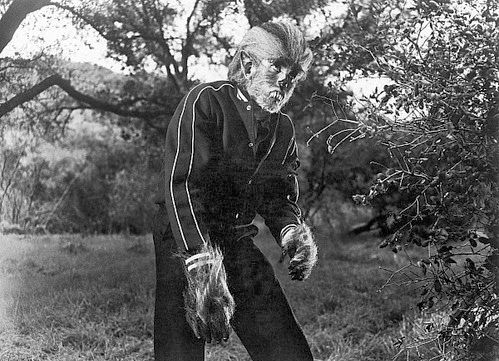
In fact, you could argue that he gets too many results.  After twice hypnotizing Tony and telling him to think of himself as being a wild animal, Tony becomes just that!  That’s right, Tony turns into a werewolf and he’s soon running around town — in his letterman jacket! — and killing anyone that he comes across.

Whenever Tony transforms back into a human, he regrets what he’s done.  Unfortunately, it turns out that almost anything can cause Tony to turn back into a wolfman.  Most werewolves need a full moon.  All Tony needs is to hear the sound of the school bell….

To be honest, I imagine that most people who watch this film do so because they want to see a werewolf creating chaos while wearing a high school letterman jacket.  Considering that this was a low-budget film made to play as half of a double feature, the werewolf makeup is actually fairly impressive and that letterman jacket adds just the right touch of weirdness to the whole affair.

Make no mistake, it’s an entertaining and deeply silly film but, at the same time, it does have an interesting subtext.  One could argue that Tony’s transformation into a werewolf serves as a metaphor for his struggle to grow up.  Neither werewolves nor juvenile delinquents can control themselves and Michael Landon gives a performance that’s just sensitive enough to justify calling this one Werewolf Without A Cause.

That said, the main appeal of this film is definitely the chance to see a werewolf in a letterman jacket.
Horror on the Lens: How To Make A Monster (dir by Herbert L. Strock)


You’ve seen I Was A Teenage Werewolf….

You’ve watched I Was A Teenage Frankenstein….

Now, it’s time to watch How To Make A Monster!

Released in 1958, How To Make A Monster is a clever little horror satire from American International Pictures in which the stars of Teenage Werewolf and Teenage Frankenstein are hypnotized into believing that they actually are the monsters that they played!  The main culprit is a movie makeup artist (Robert H. Harris) who has been deemed obsolete by the new bosses at AIP.

Be sure to watch for the finale, which features cameo appearances from several other AIP monsters!  And read my full review of the film by clicking here!

Horror On The Lens: I Was A Teenage Werewolf (dir by Gene Fowler, Jr.)


1957’s I Was A Teenage Werewolf combines two genres that were very popular in the late 50s.

On the one hand, it’s a film about a teenage rebel.  Tony Rivers (Michael Landon) is a teenager that means well but he keeps losing his temper.  If he can’t learn to control his anger, he could very well be looking at a life behind bars.

On the other hand, it’s also a horror film.  When Tony visits a hypnotist (Whit Bissell), the end result is Tony turning into a werewolf and going on a rampage, all while still wearing his letterman jacket.

All in all, this is a pretty fun little movie.  You can check out my review of it by clicking here.

And you can watch the movie below!


Horror on the Lens: How To Make A Monster (dir by Herbert L. Strock)


You’ve seen I Was A Teenage Werewolf….

You’ve watched I Was A Teenage Frankenstein….

Now, it’s time to watch How To Make A Monster!

Released in 1958, How To Make A Monster is a clever little horror satire from American International Pictures in which the stars of Teenage Werewolf and Teenage Frankenstein are hypnotized into believing that they actually are the monsters that they played!  The main culprit is a movie makeup artist (Robert H. Harris) who has been deemed obsolete by the new bosses at AIP.

Be sure to watch for the finale, which features cameo appearances from several other AIP monsters!  And read my full review of the film by clicking here!

Horror On The Lens: I Was A Teenage Werewolf (dir by Gene Fowler, Jr.)


1957’s I Was A Teenage Werewolf combines two genres that were very popular in the late 50s.

On the one hand, it’s a film about a teenage rebel.  Tony Rivers (Michael Landon) is a teenager that means well but he keeps losing his temper.  If he can’t learn to control his anger, he could very well be looking at a life behind bars.

On the other hand, it’s also a horror film.  When Tony visits a hypnotist (Whit Bissell), the end result is Tony turning into a werewolf and going on a rampage, all while still wearing his letterman jacket.

All in all, this is a pretty fun little movie.  You can check out my review of it by clicking here.

And you can watch the movie below!