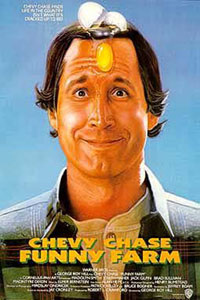
Funny Farm (1988, directed by George Roy Hill)


Andy Farmer (Chevy Chase) is a New York sports writer who leaves the city and moves to the small town of Rosebud, Vermont so that he can work on his novel.  He and his wife, Elizabeth (Madolyn Smith), struggle to adjust to living in a small town.  The delivery of their furniture is delayed by the collapse of a covered bridge.  When they try to make a phone call from inside their own house, the local operator tells them to deposit ten cents.  They were expecting a Norman Rockwell-type town and instead, they find themselves having to pay for the funeral of a man who was buried on their property long before they moved in.  When Elizabeth makes more progress writing a children’s book than Andy does with his heist novel, their marriage starts to feel the strain.

Chevy Chase is now so much better known for the stories of his unprofessional and diva-like behavior on film and television sets that it’s easy to forget that he was, at his peak, a very funny actor.  Chase may be playing a variation of his put-upon everyman but, compared to the first two Vacation movies, most of the humor in Funny Farm is very mild.  George Roy Hill was a classy director who had been making movies since the 50s and Funny Farm feels like a throwback to the type of family-friendly comedies that Disney would make in the 60s.  That I laughed as much as I did was largely due to Chase’s performance.  Whether he was tripping over a Dutch door, reacting to his wife’s dislike of the first few chapters of his new novel, or offering to pay the townspeople $50 to pretend to be nice for a weekend, Chase was consistently funny and even likable.  I don’t know if this is the type of performance that Chevy Chase could give today.  There’s a bitterness that’s now integral to screen persona and it’s made him into someone who audience want to laugh at instead of with.  It’s too bad because Funny Farm is a reminder of the type of comedic actor that Chevy Chase used to be and who he probably still could be if not for the failed talk show and the infamous Friar’s Club roast.

As for Funny Farm, it’s an amusing and likable comedy and it still holds up well today.  Chase is the key to the film’s success but he’s not the only reason that the film works.  I liked the scene where Mike Starr and Glenn Plummer, as the two movers, watch as the bridge they tried to drive over collapses.  I even liked the running joke about the two ducks who refused to leave the Farmers’s property.  Funny Farm may not have been a hit when it was first released but it’s since built up a cult following.  There will always be a place for a funny comedy that leaves you in a good mood.
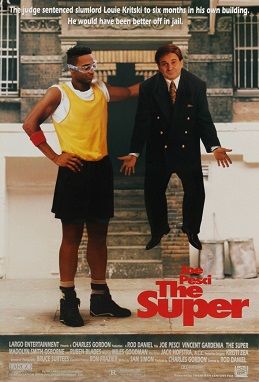
The Super (1991, directed by Ron Daniel)


You’ve just won a Best Supporting Actor Oscar for playing a psychotic gangster and you’re worried that it’s going to lead to you getting typecast as a villain.  What do you do?

If you’re Joe Pesci, you follow-up playing Tommy DeVito in Goodfellas by agreeing to play Louie Kritski, Jr. in The Super.  Louie is the son of a slumlord (Vincent Gardenia) and he’s eager to follow his old man into the family business.  But when Louie is arrested for failing to keep his buildings up to code, he’s sentenced to actually live in one of them.  Louie has to stay in a rat-infested apartment.  He has to repair the rest of the building and will not be allowed to do any work on his apartment until everyone else’s apartment is up to code.  Louie thinks that his father will use his influence to get his son out of this mess.  It turns out that Big Lou just wants to set the building on fire and be done with it.  Louie isn’t down with that.  He may be a loud-mouthed slumlord but he has his standards.

Louie becomes a better person as a result of living in a slum.  All of the tenants, from Marlon (Ruben Blades) to Tito (Kenny Blank), come to respect him.  He even plays basketball with them.  Louie finds a new girlfriend (Madolyn Smith) in the court officer who is sent to check on his progress.  Louie is still Joe Pesci, though.  He’s still a loud mouth who is quick to lose his temper and there’s always a feeling that Louie is about to snap and blow the entire building away.  Joe Pesci was always a good actor and skilled at comedy but The Super doesn’t make good use of his talents in the way that My Cousin Vinny did.  My Cousin Vinny worked because it put Joe Pesci in a place where you wouldn’t expect to find Joe Pesci, the genteel South.  The Super is a New York movie and Pesci’s wiseguy intensity means that his sudden redemption doesn’t feel true.

The Super was a box office flop and briefly derailed Pesci’s attempts to show his range.  Luckily, My Cousin Vinny was right around the corner.

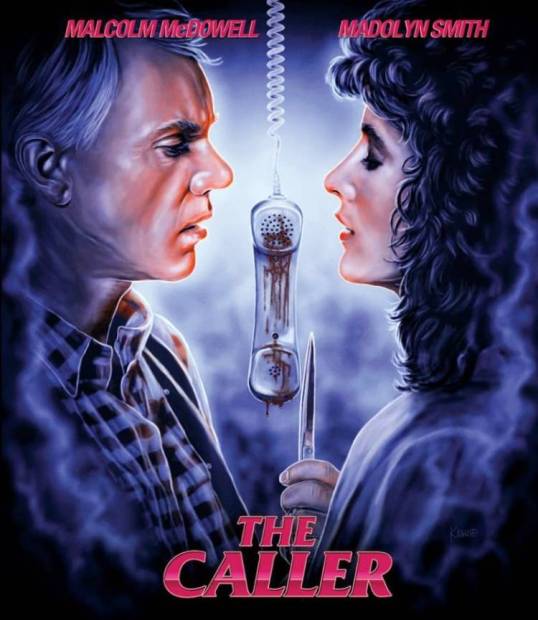
Horror Film Review: The Caller (dir by Arthur Allan Seidelman)


The Caller is a odd little film from 1987.

How odd is it?

It’s so odd that it’s difficult to know how to even describe it. On the surface, it’s a film about two people in a house. The Girl (Madolyn Smith) — and that’s how she’s credited at the end of the film — is staying in a secluded house in the woods. There’s a nearby town but, when the Girl stops there to get some gas, it’s impossible not to notice that there aren’t any other people around. When the Girl reaches the house, she makes a phone call and asks to speak to her daughter. From what we hear of her say to her daughter, it sounds as if The Girl is recovering from some sort of trauma.

After the Girl hangs up the phone, the Caller (played by Malcolm McDowell) knocks on her front door. The Caller seems to be a polite Englishman. He says that he’s recently had some car trouble and he asks if he can come in the house to use the Girl’s phone. The Girl lets him in but, as soon as The Caller enters, it becomes apparent that he was lying about having car trouble.

The Girl and the Caller talk. In fact, they spend several days talking. Sometimes, they’re friendly to each other and other times, they’re not. Their stories keep changing. At one point, the Caller claims that he’s a police detective and that he’s investigating a murder in the area. At another point, the Girl claims that she was responsible for the Caller’s car not working. We start to get the feeling that the Girl and the Caller might know each other and that each knows that the other is lying. Things get stranger as the night turns into day and then night again. The Caller appears to be leave but, just as mysteriously, he shows up again. The Caller tries to enter one particular room in the house. The Girl fights to keep him from doing so. The two of them taunt each other. Sometimes, they threaten each other. At times, they seem to be almost dependent on each other and you wonder if the Girl really wants the Caller to leave. They start keeping track of who is collecting the most points as they play a game that only the two of them seem to understand.

And it just keeps going and going. As many times as the Girl and the Caller both say that they’re done with conversation or that they’re leaving, neither can seem to abandon they other. Instead, they keep circling each other, like two trapped animals continually challenging one another for control. It all leads to a twist, one that you probably won’t see coming. Admittedly, the twist itself does seem to come out of nowhere but, because the film has been so weird up until that moment, the bizarre randomness of it all seems totally appropriate.

At times, The Caller can feel like a bit of an endurance test. McDowell and Smith are the only two people in the film and they spend the entire movie engaging in cryptic conversations that only seem to make sense to themselves. It’s not always easy to follow them as they go from one topic to another. Fortunately, both Smith and McDowell give excellent performances, ones that keep us guessing as to their true motivations and which also keep us interested in their enigmatic characters. You become invested in their drama, even if you don’t always understand it. The Caller is not a film for everyone but horror fans looking to take a chance on something a little different will be well-rewarded.

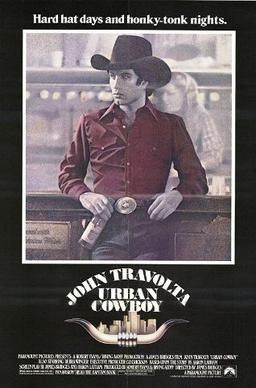
Cleaning Out The DVR: Urban Cowboy (dir by James Bridges)


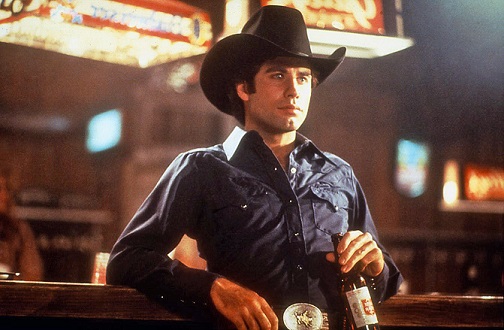
Last night, I watched the 1980 film, Urban Cowboy.  This was a film that had been sitting on my DVR for over a year.  For some reason, I had never actually gotten around to watching it.  There were many times when I started to watch it but I always ended up stopping after a few minutes.  I was never quite sure why as everything that I had heard about the film was positive.  Having finally watched it last night, I think I hesitated because I instinctively knew that John Travolta would look silly wearing a cowboy hat.

And let’s just be honest.  He does.  I mean, Travolta actually gives a fairly good performance in Urban Cowboy.  He plays Bud, a kid from West Texas who moves to Houston so that he can work on an oil rig with his uncle, Bob (Barry Corbin).  At first, he only wants to stay in Houston long enough to raise the money to buy some land back home.  But, he soon falls in love with the Houston nightlife and the local country-western bar.  (He’s Travolta so, of course, he can dance.)  He also falls in love with and eventually marries Sissy (Debra Winger).

Travolta is believable as an impulsive young adult who might not be particularly smart but who makes up for it with a lot of determination.  And he even does an okay job when it comes to capturing the country accent of West Texas.  But that said, whenever he puts on that cowboy hat, the viewer is immediately reminded that Travolta is actually from New Jersey and probably never even attended a rodeo until he was cast in Urban Cowboy.  The hat feels like an affectation, an attempt by a city boy to be more country as opposed to a country boy trying to hold onto his identity in the city.  Ironically, the term “urban cowboy” has come to mean someone who, despite having never left the city, dresses like they’re heading out to herd the cattle and rope some steers.  However, in the film itself, the hat is meant to be a natural part of Bud’s persona but it never quite feels that way.

Far more credible as a cowboy is a youngish Scott Glenn, who plays Wes Hightower.  After Bud’s chauvinistic and abusive behavior drives Sissy away, she ends up with Wes.  Wes teaches Sissy how to ride a mechanical bull, which is something Bud tried to forbid her from doing.  Wes is confident and dangerously sexy and he can even make the fact that he lives in a run-down trailer work for him.  Unfortunately, Wes also turns out to be even more controlling and abusive than Bud.  Even though Bud still loves Sissy and Sissy still loves him, Bud soon hooks up with Pam (Madolyn Smith), the daughter of a wealthy oilman.

Many more complications follow and, of course, there’s one big tragedy that causes Bud to reexamine his life.  Not surprisingly, the film’s conclusion all comes down to who can stay on that mechanical bull for the longest….

The best thing that Urban Cowboy has going for it is not Travolta or Glenn but instead, it’s Debra Winger, who gives a believable and relatable performance as Sissy, playing her as someone who may not have much but who refuses to surrender her pride.  She knows that she deserves better than both Bud and Wes, even if she is hopelessly in love with one of them.  Winger has chemistry with both Travolta and Scott Glenn, which makes the film’s love triangle feel like something more than just a typical story about a girl who can’t resist a bad boy.  She grounds the film in reality and, as such, there are real stakes to the film’s story.  Thanks to Winger, Urban Cowboy becomes about something more than just a fight over a mechanical bull.

The second best thing that Urban Cowboy has going for it is that it does manage to capture the atmosphere of a good country-and-western bar.  It’s place where people go to relax after a hard day’s work.  Unlike the discotheques  that Travolta frequented in Saturday Night Fever, the bars in Urban Cowboy eschew glamour and artifice.  Instead, they’re all about proving yourself not on the dance floor but on the back of a mechanical bull.  For Sissy, the bull symbolizes freedom.  For men like Bud and Wes, it symbolizes survival.  Myself, I’m not a drinker so my bar experience is limited.  And, though I may be from Texas and I spent a lot of time in the country while I was growing up, I’ve never been a fan of country music.  That said, I’ve danced to a few country songs and I’ve certainly stopped by a few bars, even if I was usually the one who annoyed my family and friends by just asking for a glass of water.  I’ve been to the rodeo and I’ve seen people get trampled.  I’ve also seen a few people get tossed off a mechanical bull.  I’ve never been on a mechanical bull myself but I did buy one for my Sims.  (They loved it but, sadly, I had to get rid of it because they spent so much time riding it, they kept missing work and getting fired.)  From my limited experience, I can say that Urban Cowboy got most of the details right.  Even though it was made 42 years ago, it still feels authentic.

That said, Travolta still looks odd wearing a cowboy hat.