Horror On The Lens: Dementia 13 (dir by Francis Ford Coppola)


1963’s Dementia 13 is a significant film for another reasons.

For one, it’s the mainstream feature film debut of Francis Ford Coppola.  (Coppola has said that he directed two softcore films before Dementia 13 but they’ve been lost to history.)  Both Coppola’s screenplay and his direction were heavily influenced by the early giallo films that were coming out of Italy.  One could argue that this is the first American film to pay homage to Mario Bava.

Dementia 13 is also the first film on which Coppola ever went overbudget.  This film is literally the start of an era.

Coppola himself has been critical of Dementia 13.  Producer Roger Corman was not happy with the first cut of the film and added a few scenes that took away from Coppola’s pacing.  That said, it’s still an atmospheric and creepy forerunner to the American slasher film.  The scene in which Launa Anders goes for a swim has been duplicated in numerous other films and it’s still effective in the way that it chops away at the audience’s sense of security.  It certainly freaks me out.  Of course, I’m not much of a swimmer.  I’m a good drowner, though.

Here is today’s Horror on The Lens, Dementia 13!


The Last Detail (1973, directed by Hal Ashby)


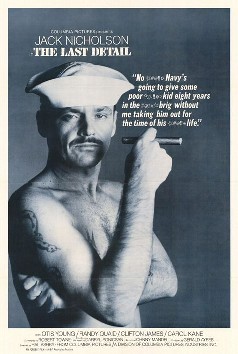
Billy “Badass” Buddusky (Jack Nicholson) and Richard Mulhall (Otis Young) are two Navy lifers stationed in Virginia.  On shore patrol, they’ve been assigned to transport a 18 year-old seaman to a Naval prison in Maine.  The kid has been dishonorably discharged and sentenced to eight years in the brig for trying to steal $40 from a charity box.  (The charity was a favorite of the wife of his commanding officer.)  Buddusky and Mulhall are expecting to find a hardened punk but instead, they end up escorting Larry Meadows (Randy Quaid), a timid teenager who suffers from kleptomania and who doesn’t seem to understand just how bad things are going to be for him for the rest of his life.  Not only is he going to do eight years in the brig, surrounded by hardened criminals, but his dishonorable discharge is going to follow him for the rest of his life.

Resenting having to take Meadows to prison and also feeling that he’s getting a raw deal, Buddusky and Mulhall decide to make a few stops on their way to Maine, so that Larry can enjoy what little time he has left and hopefully lose his virginity before being locked up.  In between brawling with Marines, visiting a brothel (where a young Carol Kane plays one of the prostitutes), and hanging out with a group of hippies (one of whom is played by Gilda Radner), Meadows comes to think of Buddusky and Mulhall as being his best friends.  Unfortunately, for Meadows, both Buddusky and Mulhall have their job to do.

Hal Ashby’s road picture is a character study of three men who are all lifers, even if they don’t realize that.  Both Buddusky and Mulhall hate the Navy but they also can’t relate to anyone who isn’t a member of the service.  Meadows’s entire future has been pre-determined because he tried to steal $40 but he doesn’t realize it until its too late.  When the film came out, it was controversial due to its “colorful” language.  In an interview, screenwriter Robert Towne defended the frequent profanity because, as he put it, when you’re in a situation you hate, “that’s what you do.  You bitch.”  Hal Ashby’s loose direction captures the road trip feel as the three leads reluctantly head to their ultimate destination.

The Last Detail features one of Jack Nicholson’s best performances.  Buddusky is cynical and doesn’t trust anyone other than Mulhall but even he knows that Larry Meadows deserves better than to spend eight years in the brig.  Along with lending his star power to the film and standing by director Hal Ashby when Ashby was arrested for marijuana possession, Nicholson also played a big role in the casting of Randy Quaid as Larry Meadows.  (The other final contender for the role was John Travolta but Nicholson insisted on Quaid).  The 6’5 Quaid towers of Nicholson and Young, making him look as if he could escape any time that he wants.  But Larry is so naive that he doesn’t want to make any trouble for his “friends.”  Though this wasn’t his first film, The Last Detail is the film that made Quaid one of the busiest character actors of the 70s and 80s and it also, at least temporarily, made him a part of the Jack Nicholson stock company.

Both sad and funny, The Last Detail is one of the best films of the 70s and features Jack Nicholson at his most unforgettable.

Horror On TV: One Step Beyond 1. 16 “The Burning Girl” (dir by John Newland)


The 16th episode of One Step Beyond was called The Burning Girl and it dealt with a teenage girl (Luana Anders, who would later star in Dementia 13 and appear as a hippie in Easy Rider) who, whenever she got upset, could apparently cause fires to spontaneously erupt.  It was written by Catherine Turney and directed by host John Newland himself.

It was originally broadcast on May 5th, 1959 — presumably long before Stephen King even had the idea to write about a girl named Carrie.

Can you prove this didn’t happen!?

Horror Film Review: The Pit and the Pendulum (dir by Roger Corman)


The second of Roger Corman’s Edgar Allan Poe adaptations, 1961’s The Pit and The Pendulum opens in much the same way as The Fall of the House of Usher.  A young Englishman (played by John Kerr) rides a horse across a colorful but desolate landscape.  A castle sits in the distance.

Of course, as opposed to  the 19th Century British setting of The Fall of the House of Usher, The Pit and the Pendulum takes place in 16th Century Spain, at a time when the country was still scarred by the horrors of the Inquisition.  And Francis Barnard is not traveling to the castle to see his fiancée but instead, he’s searching for information about the disappearance of his sister, Elizabeth (played by the one and only, Barbara Steele).  At the castle, Francis meets Elizabeth’s husband, Nicholas (Vincent Price) and Nicholas’s sister, Catherine (Luana Anders).  Nicholas explains that Elizabeth died under mysterious circumstances, while suffering from a rare blood disorder that seemed to quickly sap away her will to live.  Nicholas’s best friend, Dr. Leon (Anthony Carbone), explains that Elizabeth died of fright after she locked herself in one of the iron maidens in the castle’s torture chamber….

Oh yes, the castle has a torture chamber.  Nicholas’s father was a leader of the Inquisition and he used the castle as a place to conduct his business.  Nicholas’s father was a madman who suspected that his wife was cheating on him.  One day, while young Nicholas was exploring the torture chamber, he witnessed his father murder both his wife and his brother.  Nicholas watched as his mother was entombed alive and ever since, he’s been terrified of the idea of premature burial.  In fact, his fear that he may have buried alive Elizabeth while she was still alive is driving him mad.  The sudden arrival of the suspicious Francis doesn’t help matters….

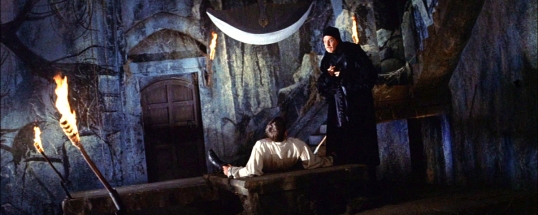
The Pit and the Pendulum opens with splashes of color spreading across the screen, a sign that Corman was once again in a pop art state of mind when he directed this film.  The Pit and The Pendulum takes everything that worked (and didn’t work) about The Fall of the House of Usher and it turns it all up by a notch or two.  The castle is even more gothic.  Vincent Price’s Nicholas is even more mentally fragile than his Roderick Usher, though Nicholas is also a quite a bit more sympathetic.  If Roderick was a control freak who used his family’s curse as an excuse to embrace his own authoritarian tendencies, Nicholas is just a frail man suffering from PTSD.  He’s definitely more of a victim than a victimizer … or, at least, he is at first.  Much like Mark Damon is The Fall of the House of the Usher, John Kerr is a bit of a stiff in the role of Francis but it doesn’t matter.  Vincent Price is the main attraction here and Corman’s direction shows that he understood that.

And then there’s the Pendulum.  It takes a while for the Pendulum and its swinging blade to make an appearance but when it does, it lives up to the hype.  The Pendulum swings and Corman goes all out, zooming into Price’s crazed eyes while the Pendulum comes closer and closer to its latest victim.  The images are tinted red and green and the Pendulum itself seems to swing in a slow motion, the cinematic equivalent of a nightmare come to life.

The Pit and the Pendulum is a wonderful work of gothic pop art.  Featuring Vincent Price at his most wonderfully unhinged, this is a film we should all watch this Halloween.

Pit and the Pendulum (1961, dir by Roger Corman, DP: Floyd Crosby)


Horror on the Lens: Dementia 13 (dir by Francis Ford Coppola)


(I originally shared this film back in 2011, 2019, 2022, and 2023 — can you believe we’ve been doing this for that long? — but the YouTube upload keeps getting taken down!  So, I’m resharing it today!)

For today’s excursion into the world of public domain horror, I offer up the film debut of Francis Ford Coppola.  Before Coppola directed the Godfather and Apocalypse Now, he directed a low-budget, black-and-white thriller that was called Dementia 13.  In a possible sign of things to come, producer Roger Corman and Coppola ended up disagreeing on the film’s final cut and Corman reportedly brought in director Jack Hill to film and, in some cases, re-film additional scenes.

Regardless of whether the credit should go to Coppola, Corman, or Hill, Dementia 13 is a brutally effective little film that is full of moody photography and which clearly served as an influence on the slasher films that would follow it in the future.  Speaking of influence, Dementia 13 itself is obviously influenced by the Italian giallo films that, in 1963, were just now starting to make their way into the drive-ins and grindhouses of America.

Speaking of giallo films, keep an eye out for Patrick Magee, who gave a memorable performance in Lucio Fulci’s The Black Cat.  Luana Anders, who plays the duplicitous wife in this film, showed up in just about every other exploitation film made in the 60s and yes, the scene where she’s swimming freaks me out to no end.  Other films featuring Luana Anders include Night Tide and Easy Rider, in which she played one of the hippies who unsuccessfully enticed Peter Fonda and Dennis Hopper to stay at the commune.

As for Francis Ford Coppola, well, he’s gone on to have quite a career, hasn’t he?  It’s been quite a journey from Dementia 13 to Megalopolis!

Horror on the Lens: Dementia 13 (dir by Francis Ford Coppola)


(I originally shared this film back in 2011, 2019, and 2022 — can you believe we’ve been doing this for that long? — but the YouTube upload keeps getting taken down!  So, I’m resharing it today!)

For today’s excursion into the world of public domain horror, I offer up the film debut of Francis Ford Coppola.  Before Coppola directed the Godfather and Apocalypse Now, he directed a low-budget, black-and-white thriller that was called Dementia 13.  In a possible sign of things to come, producer Roger Corman and Coppola ended up disagreeing on the film’s final cut and Corman reportedly brought in director Jack Hill to film and, in some cases, re-film additional scenes.

Regardless of whether the credit should go to Coppola, Corman, or Hill, Dementia 13 is a brutally effective little film that is full of moody photography and which clearly served as an influence on the slasher films that would follow it in the future.  Speaking of influence, Dementia 13 itself is obviously influenced by the Italian giallo films that, in 1963, were just now starting to make their way into the drive-ins and grindhouses of America.

Speaking of giallo films, keep an eye out for Patrick Magee, who gave a memorable performance in Lucio Fulci’s The Black Cat.  Luana Anders, who plays the duplicitous wife in this film, showed up in just about every other exploitation film made in the 60s and yes, the scene where she’s swimming freaks me out to no end.  Other films featuring Luana Anders include Night Tide and Easy Rider, in which she played one of the hippies who unsuccessfully enticed Peter Fonda and Dennis Hopper to stay at the commune.

As for Francis Ford Coppola, his career has had its up and downs but he’s a beloved figured on the pop cultural landscape and a director whose best films continue to inspire and influence.  He is currently filming Megalopolis.

Horror on the Lens: Dementia 13 (dir by Francis Ford Coppola)


(I originally shared this film back in 2011 and 2019 — can you believe we’ve been doing this for that long? — but the YouTube vid was taken down both times!  So, I’m resharing it today!)

For today’s excursion into the world of public domain horror, I offer up the film debut of Francis Ford Coppola.  Before Coppola directed the Godfather and Apocalypse Now, he directed a low-budget, black-and-white thriller that was called Dementia 13.  (Though, in a sign of things to come, producer Roger Corman and Coppola ended up disagreeing on the film’s final cut and Corman reportedly brought in director Jack Hill to film and, in some cases, re-film additional scenes.)

Regardless of whether the credit should go to Coppola, Corman, or Hill, Dementia 13 is a brutally effective little film that is full of moody photography and which clearly served as an influence on the slasher films that would follow it in the future.  Speaking of influence,Dementia 13 itself is obviously influenced by the Italian giallo films that, in 1963, were just now starting to make their way into the drive-ins and grindhouses of America.

In the cast, keep an eye out for Patrick Magee, who later appeared as Mr. Alexander in A Clockwork Orange as well as giving a memorable performance in Lucio Fulci’s The Black Cat.  Luana Anders, who plays the duplicitous wife in this film, showed up in just about every other exploitation film made in the 60s and yes, the scene where she’s swimming freaks me out to no end.

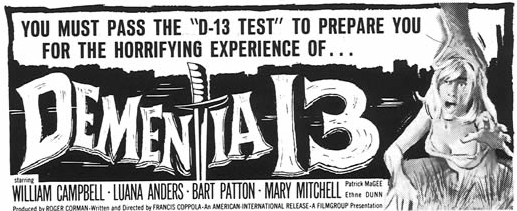
Horror Film Review: Dementia 13 (dir by Francis Ford Coppola)


So, imagine that the year is 1963 and you are the legendary producer/director Roger Corman. You’ve just finished shooting your latest film and it turns out that you didn’t spend all of the money that you had allocated to make it! You’ve got an Irish castle at your disposal and some extra cash. Why not assign your ambitious assistant to make a quick little movie that’s specifically designed to cash-in on the success of Psycho and it’s numerous imitators?

And that, of course, is how Francis Ford Coppola came to direct his first film. Today, of course, Coppola is best known for directing three of the best American films of all time, The Godfather, The Conversation, and The Godfather Part II. (Some people would include Apocalypse Now in that list, as well.) In 1963, he was just another aspiring filmmaker making his debut under the watchful eye of Roger Corman.

Coppola both wrote and directed Dementia 13. The film’s a pretty nifty little horror/mystery. Of course, the plot doesn’t make much sense if you give it too much thought but any fan of the Roger Corman-style of film making should be used to that by now.

Luana Anders plays Louise Haloran, the film’s greedy femme fatale. When we first meet her, she’s calmly watching her husband drop dead of a heart attack. After learning that she’s not going to be receiving any sort of inheritance because her husband died before his mother, Louise decides to invite herself to the Haloran family castle, where her mother-in-law, Lady Haloran (Eithne Dunne), is about to take part in an annual ceremony that is meant to pay tribute to Haloran’s dead daughter, Kathleen. Looking for a way to try to trick Lady Haloran into making Louise her heir, Louise tries to fool Lady Haloran into believing that Kathleen is trying to contact her from beyond the grave.

Got all that? Because I’m not going to try to type it out again.

Anyway, I don’t want to spoil the rest of the plot but let’s just say that it all leads to a midnight swim and a shocking axe murder. Who could be the killer be? Could it be one of Louise’s two brother-in-laws, Richard (William Campell) and Billy (Bart Patton)? Could it be the local doctor, Justin Caleb (Patrick Magee?) Or how about Richard’s fiancee, the oddly named Kane (Mary Mitchell?” Or how about Simon (Karl Schnazer), the local poacher? Or maybe Kathleen really has risen from the dead? Or how about….

Well, look, it could be a lot of people. Dementia 13 has a labyrinth plot and it’s got a few twists that you probably shouldn’t spend too much time thinking about. It’s very much a young director’s film but, at the same time, that’s also the film’s greatest strength. Coppola reportedly got in trouble when the film went overbudget (which is something that had never previously happened on a Corman film) but the end result is a film that features several spooky visuals, an ominous atmosphere, and one very shocking murder. You wouldn’t necessarily watch a film like Dementia 13 and think that the director would go on to make something as great as The Godfather. But Coppola’s talent, even if it’s a bit unformed, is still very much noticeable while watching his directorial debut.

Speaking of watching the film, it’s in the public domain so it’s very easy to watch! Pick up a Mill Creek 50-DVD box set and there’s a good chance you’ll find Dementia 13 included within. Or, you can just go over to YouTube and watch it for free!

Enjoy!

Goin’ South (1978, directed by Jack Nicholson)


Jack Nicholson was not an overnight success.

Nicholson was 17 years old when he first came to Hollywood in 1954.  Looking to become an actor, Nicholson toiled as an office worker at the MGM cartoon studio, took acting classes, and went to auditions.  It would be four years before he even landed his first role, the lead in the Roger Corman-produced The Cry Baby Killer.  When that film failed to become a hit, Nicholson spent the next ten years doing minor roles and occasionally starring in a B-picture.  He auditioned for some big parts, like Benjamin Braddock in The Graduate, Buck Barrow in Bonnie and Clyde, and Guy Woodhouse in Rosemary’s Baby, but his big break continued to allude him.  By 1969, Nicholson was so disillusioned with acting that he was planning to instead pursue a career as a director.  However, before Nicholson officially retired from the acting game, he received a call from the set of Easy Rider.  Depending on who you ask, Rip Torn, who had previously been cast in the role of alcoholic George Hanson, had either quit or been fired.  Bruce Dern, the first choice to replace Torn, was busy filming They Shoot Horses, Don’t They?  Nicholson agreed to step into the role and the rest is history.

Easy Rider may have made Jack Nicholson one of the world’s biggest film stars but he never lost his ambition to direct.  In 1971, he made his directorial debut with Drive, He Said, a film about campus unrest.  At the time, the film flopped at both the box office and with critics and quickly sunk into obscurity.  (It has subsequently been rediscovered and, in some cases, positively reevaluated.)  After the failure of Drive, He Said, it would be another seven years before Nicholson again got a chance to direct.

Nicholson’s second film as a director, Goin’ South, is a comedic western.  Nicholson plays Henry Lloyd Moon, an unsuccessful outlaw who used to ride with Quantrill’s Raiders.  When Moon is captured in Longhorn, Texas, he is sentenced to be hanged.  Fortunately, for Moon, Longhorn has a special ordinance.  Any man condemned for any crime other than murder can be saved from the gallows if a local woman agrees to marry him and take responsibility for his good behavior.  As a result of this ordinance, Longhorn is populated almost exclusively by single women and reformed outlaws.

While standing on the gallows, the cocky Moon is stunned to discover that none of the women want to marry him.  Finally, an old woman emerges from the crowd and announces that she’ll become Moon’s wife.  When Moon hops off the gallows and thanks her, the woman drops dead.  Fortunately, another, younger woman, Julia Tate (Mary Steenburgen, making her film debut), steps forward.

Once they’re married, the lecherous Moon discovers that Julia is a virgin and that the only reason she married him was so she could force him to work in the secret gold mine that’s hidden underneath her property.  The railroad will soon be taking over the land and Julia wants to get all of the gold before she leaves town for Philadelphia.  Though Julia, at first, wants nothing to do with Moon, he eventually wears her down through sheer persistence and the two fall in love.

Complicating matters is Deputy Towfield (Christopher Lloyd), who is upset because he feels that Julia was meant to be his wife.  Also, the members of Moon’s former gang (including Danny DeVito and Veronica Cartwright) show up at Julia’s house and discover the truth about the mine.
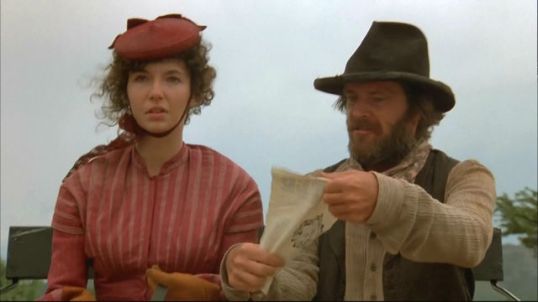
Goin’ South gets off to a good start.  The scene on the gallows, where Moon waits for someone to marry him and save his life, is genuinely funny and Nicholson and Steenburgen have a playful chemistry for the first hour of the movie.  Nicholson leers even more than usual in this film but the script is written so that the joke is always on Moon.  Much of the film’s humor comes from Moon always overestimating both his charm and his cleverness.  However, once Moon and Julia finally consummate their marriage, the movie loses whatever narrative momentum it may have had and gets bogged down with the subplots about Towfield and Moon’s gang.  There are funny moments throughout but the story gets away from Nicholson and the film is reduced to a series of set pieces, none of which build up to much.

Not surprisingly, Nicholson gets good performances from his cast, which is largely made up by the members of his 1970s entourage.  Along with Danny DeVito and Christopher Lloyd, longtime Nicholson associates like Tracey Walter, Ed Begley Jr., Richard Bradford, Jeff Morris, and Luana Anders all appear in small roles.  John Belushi plays the tiny role of Deputy Hector.  (Goin’ South was actually the first film in which Belushi was cast, though production didn’t actually begin until after Belushi had finished working on National Lampoon’s Animal House.)  Unfortunately, despite all of the good performances, the script doesn’t do much to develop any of the characters.  Belushi especially feels underused.  (Because Belushi had moved on to Animal House by the time the film went into post-production, Nicholson ended up dubbing several of Belushi’s lines himself.)

Drive, He Said was largely considered to have failed at the box office because Nicholson remained behind the camera so he took the opposite approach with Goin’ South.  Nicholson is in nearly every scene and he gives one of his broadest performances.  It works for the first half of the film, when Moon is constantly trying to get laid and failing every time.  But, during the second half of the movie, Nicholson’s failure to reign in his performance works to the film’s detriment.  When the movie needs Nicholson to be romantic, he’s still behaving like a horny cartoon. Whenever he looks at Mary Steenburgen, it seems as if his eyes should be popping out of his head, Tex Avery-style.  He’s an entertaining cartoon, but a cartoon nonetheless.  As a result, Goin’ South is often funny but it still feels very inconsequential.

Like Drive, He Said, Goin’ South was both a critical and a box office flop and it temporarily turned Nicholson off of directing.  It would be another 12 years before he would once again step behind the camera.  In 1990, Nicholson directed The Two Jakes, the sequel to one of his best films, Chinatown That would be Nicholson’s last film as a director.  Nicholson acted for another 20 years, following the release of The Two Jakes.  To date, he made his final screen appearance in 2010, with a supporting role in James L. Brooks’s How Do You Know.  Nicholson has disputed claims that he’s officially retired, saying that he’s instead just being more selective about his roles.  Even though it’s been ten years since we last saw him on screen, Jack Nicholson remains an American icon and a living legend.

Horror on the Lens: Dementia 13 (dir by Francis Ford Coppola)


(I originally shared this film back in 2011 — can you believe we’ve been doing this for that long? — but the YouTube vid was taken down.  So, I’m resharing it today!)

For today’s excursion into the world of public domain horror, I offer up the film debut of Francis Ford Coppola.  Before Coppola directed the Godfathers and Apocalypse Now, he directed a low-budget, black-and-white thriller that was called Dementia 13.  (Though, in a sign of things to come, producer Roger Corman and Coppola ended up disagreeing on the film’s final cut and Corman reportedly brought in director Jack Hill to film and, in some cases, re-film additional scenes.)

Regardless of whether the credit should go to Coppola, Corman, or Hill, Dementia 13 is a brutally effective little film that is full of moody photography and which clearly served as an influence on the slasher films that would follow it in the future.  Speaking of influence,Dementia 13 itself is obviously influenced by the Italian giallo films that, in 1963, were just now starting to make their way into the drive-ins and grindhouses of America.

In the cast, keep an eye out for Patrick Magee, who later appeared as Mr. Alexander in A Clockwork Orange as well as giving a memorable performance in Lucio Fulci’s The Black Cat.  Luana Anders, who plays the duplicitous wife in this film, showed up in just about every other exploitation film made in the 60s and yes, the scene where she’s swimming freaks me out to no end.

(One final note: I just love the title Dementia 13.  Seriously, is that a great one or what?)

http://www.youtube.com/watch?v=v4jGHmplB0s