A Horror Blast From The Past: The Wave (dir by Alexander Grasshoff)


First broadcast in 1981, The Wave stars Bruce Davison as Ben Ross, a high school social studies teacher who conducts a social experiment.

Frustrated by the fact that he can’t answer his students questions of how the German people could have allowed the Holocaust to occur, Ben decides to teach his students a lesson.  He starts by introducing a bunch of seemingly arbitrary rules to his classroom, concerning the proper way for students to sit at their desks and to address the teacher.  Ben is somewhat surprised to see how quickly his students adapt to the new rules, even taking pleasure in showing how quickly and efficiently they can follow orders.  The next day, Ben tells his students that they are now members of The Wave, a national youth organization with membership cards and a secret salute.

And that is when all Hell breaks loose.  Ben only meant to show his students what it’s like to be a member of a mass movement but the students take The Wave far more seriously than Ben was expecting.  Soon, other students are joining The Wave.  When the popular football players announce that they are a part of The Wave, others are quick to flock to the organization.  The formerly likable David turns into a fanatic about bringing people into the organization.  Robert, a formerly unpopular student, revels in his new job of reporting anyone who deviates from the rules of The Wave.  When a student reporter writes an article that is critical of the organization, she and the school paper are targeted.  Has Ben’s social experiment spiraled out of control?

42 years after it was originally produced, The Wave remains a powerful and sobering look at how people can be manipulated into doing things as a mob that they would never do as an individual.  If anything, the film feels more relevant today than it probably did in 1981.  The character of Robert, in particular, is a familiar one.  He’s someone with no self-esteem who latches onto a movement and finds his identity by taking down others and accusing them of failing to follow the rules.  One can find people like Robert all over social media, searching through old posts for any example of wrongthink that they can broadcast all through their social world.  It’s tempting to smirk at how quickly the members of The Wave sacrificed their freedom and their ability to think for themselves but it’s no different from what we see happening in the real world every day.  (Indeed, if the film had been made just two or three years ago, The Wave would probably be the people policing whether or not the rest of us were observing quarantine and wearing our facemasks correctly.)  People like to feel that they belong to something, even if that means sacrificing their humanity in the process.

Featuring a good performance from Bruce Davison as the well-meaning teacher who is both fascinated and terrified by the experiment that he’s set in motion, The Wave can be viewed below:
October Hacks: The Prey (dir by Edwin Brown)


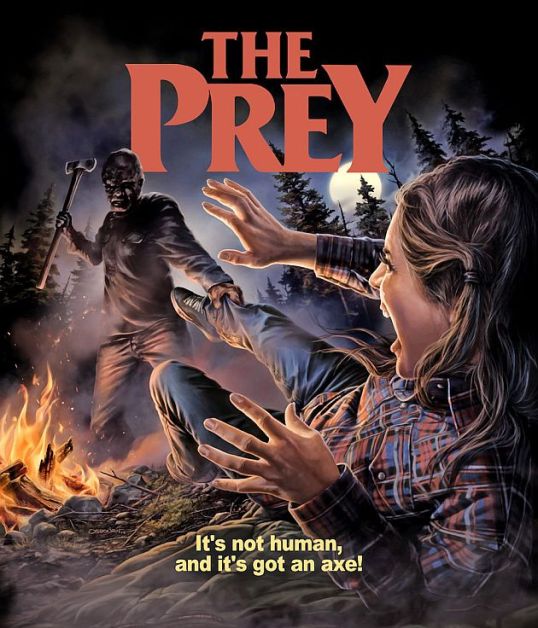
The 1983 slasher film, The Prey, opens with a wildfire raging through the Rocky Mountains, destroying a community of people who lived in a cave.  32 years later, the only survivor of the fire (played by Carel Struycken, who would later be memorably cast on Twin Peaks as the “It is happening again” giant), wanders through the forest.  When he spots a middle-aged couple camping and tending to a campfire, the survivor snaps and kills them both.

The next morning, a van drives through the national park.  Inside the van are three young couples, Nancy (Debbie Thureson) and Joel (Steve Bond), Bobbie (Lori Lethin) and Skip (Robert Wald), and Gail (Gayle Gannes) and Greg (Philip Wenckus).  They are looking forward to a nice weekend of camping, sex, and mountain climbing.  The girls are especially happy when they meet the handsome local parker ranger, Mark O’Brien (Jackson Bostwick).  The couples head into wilderness, little realizing that they are being followed and watched by the murderous survivor.

Watching The Prey, I was reminded of why I don’t go camping.  I mean, I like looking at nature.  I like handsome park rangers.  There’s a sweet scene where Mark tells an extremely corny joke to a baby deer and it made me go, “Awwwwww!”  But seriously, I would never want to spend my night sitting around a campfire or sleeping on the ground.  Not only is the wilderness full of bugs but there’s always the danger of getting trapped in a sudden storm or some other natural disaster.  And I have to admit that I’m just not a fan of the way that people act while camping.  My fear is that, if I ever did go camping, I would end up with people shouting, “Go!  Go!  Go!’ at me.  If my camping companions insist on going mountain climbing, am I obligated to accompany them?  If one of them falls off the side of the mountain, that’s really going to ruin my weekend.

As for The Prey as a film, the plot is standard slasher stuff.  Attractive young people end up stranded out in the middle of nowhere and they are picked off, one at a time, by a monster who seems to take issue with anyone trying to have any fun.  That said, The Prey has enough strange moments to make it memorable.  With an 80-minute running time, The Prey is an oddly paced film.  (And yes, oddly paced does often translate to boring.)  The majority of the film is just made up with footage of the three couples walking through the forest and having conversations that were reportedly improvised by the cast.  (Gayle laughs as she talks about a time that she nearly drowned.)  The film is full of skewed camera angles that give the entire proceedings an off-balance feel and occasionally the action cuts away from the main characters to Mark playing a banjo or another park ranger (played by former Charlie Chaplin co-star Jackie Coogan) having a tense conversation with a policeman who calls to ask about the missing middle-aged couple.  The survivor doesn’t really go after the main couples until the film’s final 15 minutes and the pace suddenly quickens as if to mirror the relentless violence of the film’s killer.  The strange pacing and the weird details gives The Prey a dream-like feel and the ending, in which the survivor reveals that he has interests outside of killing, is fascinating in just how unexpectedly bizarre it is.

The Prey was undoubtedly made to take advantage of the popularity of other wilderness slasher films but it’s just weird enough to establish an identity of its own.

Retro Television Reviews: The Master 1.2 “Out-of-Time Step”


Welcome to Retro Television Reviews, a new feature where we review some of our favorite and least favorite shows of the past! On Fridays, I will be reviewing The Master, which ran on NBC from January to August of 1984. Almost all nine of the show’s episodes can be found on Tubi!

The adventures of John Peter McAllister and Max Keller continue!

That’s right, the search for McAllister’s daughter is still on and Max is still learning how to be a ninja.  But, before we get to their latest adventure, it’s time to enjoy the opening credits!

Episode 1.2 “Out-of-Time Step”

(Dir by Ray Austin, originally aired on January 27th, 1984)

“Hi, I’m Max Keller and this is how I spend my mornings….” Max Keller tells us in voice over as we watch footage of Max (Timothy Van Patten) balancing on a rope that’s been tied between two trees.  Yes, Max is still our narrator and John Peter McAllister (Lee Van Cleef) is still training him to become a ninja.  Max is also still traveling in his van and with his hamster.

At the end of the previous episode, Max and McAllister were heading down to Atlanta to search for McAllister’s daughter.  At the start of this episode, we discover that they are in San Francisco, investigating a lead that McAllister’s daughter may have danced at a club called Truffles.  So, did they go to Atlanta or did they just change their mind and decide to stick around California?  More to the point, did NBC say, “Hey, we’re not paying for you people to go out of state?”

Anyway, Truffles turns out to be a club that’s owned by Charlie Patterson (Charles Collins), a former film star who has fallen on hard times.  (Charles Collins was a real-life dancer and when Patterson watches footage of a screen test that his character supposedly did for a Hollywood production, the footage is actually of Collins performing in a 1936 film called Dancing Pirate.)  Patterson has two daughters.  Kelly (Shanna Reed) is a dancer who thrills the club’s patrons every time she steps out onto the stage.  The other, Jill (Lori Lethin), uses a wheelchair.  Jill tells Charlie that he’s “an ex-hoofer with two daughters, one who wheels and one who does cartwheels.”

Upon arriving at Truffles, Max and McAllister discover that Charlie is being intimidated by Chinatown gangster, Johnny Chan (Brian Toshi) and Chan’s main enforcer, Mr. Lika (Soon-Tek Oh).  Mr. Lika spots McAllister’s medallion and realizes that McAllister is a trained ninja.  McAllister spots Mr. Lika’s ring and realizes that Mr. Lika is a member of the Yakuza.   This establishes a mutual respect between the two of them, one that inevitably leads to a final battle between Soon-Tek Oh and Lee Van Cleef’s stunt double.

Of course, McAllister does more than just fight Mr. Lika.  He also encourages Jill to stand up from her wheelchair and take a few steps.  And when Johnny Chan has Kelly kidnapped, he and Max rescue her.  (But not before Johnny shouts at her, “You’re a dancer!  DANCE!”)  It leads to a lot of action scenes but it doesn’t bring them any closer to McAllister’s daughter.

This episode wasn’t bad, largely because Soon-Tek Oh and Lee Van Cleef got a chance to face off.  Even if all of the actual fighting was done by Van Cleef’s stunt double, it’s still undeniably fun to watch these two icons glare at each other and exchange tough guy dialogue.  Plus, there was a lot of dancing!  I always appreciate any show that finds room for more than one dance number, even if they are obviously lifted from Flashdance.

As I mentioned earlier, this episode ended with McAllister and Max nowhere close to finding McAllister’s daughter.  But Max promised that they could keep looking.  I’m sure they’ll find her.  It’s not like America is that big.

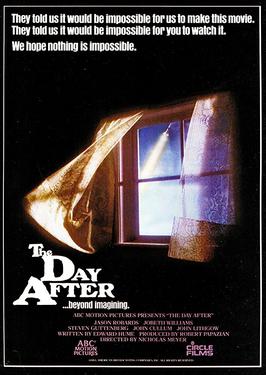
Film Review: The Day After (dir by Nicholas Meyer)


“This is Lawrence. This is Lawrence, Kansas. Is anybody there? Anybody at all?”

The words of Joe Huxley (John Lithgow) hang over the ending of The Day After, a 1983 film that imagines what the aftermath of a nuclear war would be like not on the East or the West Coasts but instead in the rural heartland of America.  Huxley is a professor at the University of Kansas and, as he explains early on in the film, Kansas would be an automatic target in any nuclear war because it houses a number of missile silos.  When he explains that, it’s in an almost joking tone, largely because the missiles haven’t been launched yet.  Instead, the only thing we’ve heard are a few barely noticed news stories about growing tensions between America and Russia.  About halfway through The Day After, the bombs go off and there are suddenly no more jokes to be made.

When the bombs drop over Kansas, we watch as cities and field and people burst into flames.  In a matter of minutes, several thousands are killed.  I’m almost ashamed to admit that I was probably more upset by the image of a horse being vaporized than I was by the death of poor Bruce Gallatin (Jeff East), the college student who was planning on marrying Denise Dahlberg (Lori Lethin).  I guess it’s because horses — really, all animals — have nothing to do with the conflicts between nations.  Humans are the ones who take the time to build bigger and better weapons and The Day After is one of the few films about war that’s willing to acknowledge that, when humans fight, it’s not just humans that die.

The bombing sequence is lengthy and I have to admit that I was a bit distracted by the fact that I recognized some of the footage from other movies.  A scene of panicked people running through a building was taken from Two-Minute Warning.  A scene of a building exploding and a construction worker being consumed by flames was lifted from Meteor.  As well, there’s some stock footage which should be familiar to anyone who has ever seen a documentary about the early days of the Cold War.  Still, despite that, it’s an effective sequence simply because it’s so relentless.  Some of the film’s most likable characters are vaporized before our eyes.  Steve Guttenberg, of all people, is seen ducking into a store.

Guttenberg plays Stephen Klein, a pre-med student who manages to survive the initial attack and takes shelter with the Dahlberg family at their ranch.  At first, it’s a bit distracting to see Steve Guttenberg in a very serious and very grim film about the nuclear apocalypse but he does a good job.  The sight of him losing both his teeth and his hair carries a punch precisely because he is reliably goofy Steve Guttenberg.

If the film has a star, it’s probably Jason Robards, the doctor who witnesses the initial blast from the safety of his car and then treats the dying in Lawrence, Kansas.  He does so, despite the fact that he doesn’t know if his wife, son, and daughter are even still alive.  He continues to do so until he also falls ill with radiation poisoning.  Knowing that he’s dying, he heads home just to discover that there is no home to return to.

Home is reccuring theme throughout The Day After.  Everyone wants to return to their home but everyone’s home has been wiped out.  “This is my home,” Jim Dahlberg (John Cullum) tries to explain before he’s attacked by a group of feral nomads.  Home no longer exists and trying to pretend like life can go back to the way it once was is an often fatal mistake.

Real happy film, right?  Yeah, this isn’t exactly a film that you watch for fun.  I have to admit that I made a joke about how I wouldn’t want to die while wearing the unfortunate blue jumpsuit that Jason Robards’s daughter chooses to wear on the day of the nuclear attack and I felt guilty immediately.  (Well, not that guilty.  Seriously, it was a terrible fashion choice.)  The Day After is a film that gives audiences zero hope by design.  It was made at a time when it was generally assumed that nuclear was inevitable and it was designed to scare the Hell out of everyone watching.  And while I can’t attest to how audience may have reacted in 1983, I can say that, in 2020, it’s still a powerful and disturbing film.

“Is anybody there? Anybody at all?” Joe Huxley asks and by the end of the film, the answer doesn’t matter.  The damage has already been done.

Under the Sea: Goliath Awaits (1981, directed by Kevin Connor)


1939.  War is breaking out across Europe.  The British luxury liner Goliath is torpedoed by a German U-boat.  Presumed to be lost with the ship are a swashbuckling film star, Ronald Bentley (John Carradine), and U.S. Senator Oliver Barthowlemew (John McIntire), who may have been carrying a forged letter from Hitler to Roosevelt when the boat went down.

1981.  Oceanographer Peter Cabot (Mark Harmon, with a mustache) comes across the sunken wreck of the Goliath.  When he dives to check out his discovery, he is shocked to hear big band music coming from inside the ship.  He also thinks that he can hear someone tapping out an S.O.S. signal.  When he looks into a porthole, he is stunned to discover a beautiful young woman (Emma Samms) staring back at him.

Under the command of Admiral Sloan (Eddie Albert), who wants to retrieve the forged letter before it does any damage to the NATO alliance, Cabot and Command Jeff Selkirk (Robert Forster) are assigned to head an expedition to explore Goliath.  What they discover is that, for 40 years, the passengers and crew have survived within an air bubble.  Under the leadership of Captain John McKenzie (Christopher Lee), they have created a new, apparently perfect society within the sunken ship.  Cabot discovers that the woman that he saw was McKenzie’s daughter, Lea.

McKenzie is friendly to Cabot and his crew, explaining to them the scientific developments that have allowed the passengers and crew to not only survive but thrive underwater.  The only problems are a group of outcasts — the Bow People — who refuse to follow McKenzie’s orders and Palmer’s Disease, an infection that only seems to infect people who are no longer strong enough to perform the daily tasks necessary to keep McKenzie’s utopia functioning.   Even when people on the boat die, they continue to play their part by being cremated in Goliath’s engine room and helping to power the ship.

Everything seems perfect until Cabot announces that he has come to rescue the survivors of the Goliath.  Even though Goliath is starting to decay and will soon no longer be safe, McKenzie is not ready to give up the perfect society that he’s created.  McKenzie sets out to prevent anyone from escaping the Goliath.

Goliath Awaits is a massive, 3-hour production that was made for television and originally aired over two nights.  (The entire 200-minute production has been uploaded to YouTube.  Avoid the heavily edited, 91-minute version that was released on VHS in the 90s.)  It’s surprisingly good for a made-for-TV movie.  Because a large portion of the film was shot on the RMS Queen Mary, a retired cruise ship that was moored in Long Beach, California, Goliath looks luxurious enough that you understand why some of the passengers might want to stay there instead of returning to the surface.  Beyond that, Goliath Awaits takes the time to fully explore the society that McKenzie has created and what it’s like to live on the ship.  McKenzie may not be as benevolent as he first appears to be but neither is he a one-dimensional villain.

Mark Harmon is a dull lead but Robert Forster is just as cool as always and Christopher Lee is perfect for the role of misguided Capt. McKenzie.  The movie is really stolen by Frank Gorshin, who is coldly sinister as Dan Wesker, the Goliath’s head of security.  McKenzie may by Goliath’s leader but Wesker is the one who does the dirty work necessary to keep the society running.

Goliath Awaits also features several character actors in small roles, with John Carradine, Duncan Regehr, Jean Marsh, John McIntire, Jeanette Nolan, Alex Cord, Emma Samms, and John Ratzenberger all getting to make a good impression.  (Ignore, if you can, a very young Kirk Cameron as one of the children born on the Goliath.)

Goliath Awaits is far better than your average made-for-TV movie from the 80s.  With any luck, it will someday get the home video release that it deserves.