That may seem like an obvious statement but I think it’s important to sometimes reiterate these things. That’s especially true with someone like Richard Ramirez. Ramirez murdered at least 15 people in California in 1984 and 1985 and, to this day, no one is sure why. The press gave Ramirez a cool nickname, christening him “The Night Stalker.” When he was captured, the press covered his claims of being a Satanist. Because he was a dark-haired bad boy with intense eyes, a large number of true crime groupies attended his trial and later claimed to be in love with him. (That will always be strange to me as Ramirez was also described as having rotten teeth and rancid breath. That would be a definite turn-off for me. Well, that and all of the raping and murdering.) Even when he was sent to Death Row, Ramirez’s admirers continued to send him money and gifts in the mail. For a select group of people, he was an icon.
That’s why I think it’s important to make a few things clear about Richard Ramirez.
He was a drug addict who reportedly struggled with impotence.
He was barely literate.
He specifically targeted women and the elderly because he knew he could overpower them.
He was captured because he was too much of a dumbass to realize that his picture was in every newspaper. He ended up getting his ass kicked by several angry citizens and he probably would have been killed by them if the police hadn’t shown up.
He was a Satanist, which is one of most boring things that you can be.
He said “See you in Disneyland,” after he was sentenced to death. He could have just gone to Disneyland on his own without killing people beforehand.
He had terrible personal hygiene. The long dark hair? There’s no way it wasn’t full of lice.
When he died, no one claimed his body so the prison just set him on fire and today, they probably use his ashes to help soak up spills.
In short, the dude was a loser and certainly not worthy of being played by Lou Diamond Phillips.
1989’s Manhunt: The Search For The Night Stalker deals with the search for the Night Stalker while not making the mistake of glamorizing him. We see Ramirez’s crimes but the film doesn’t waste much time trying to figure out what makes Ramirez tick. Instead, Ramirez remains a shadow of evil, descending on Los Angeles and reminding us all the lock our doors. The emphasis is instead on the two detectives (Richard Jordan and A Martinez) who are investigating the crimes and the journalists who often sensationalized the murders but who also played an important role in getting the uncaptured Ramirez’s face in front of everyone in California. The film itself delves into all of the true crime made-for-TV movie cliches but Jordan and Martinez both give good performances, the film does a good job of capturing the paranoia of a city under siege, and, most importantly, the film reminds us that Richard Ramirez was, above all else, a total and complete loser.
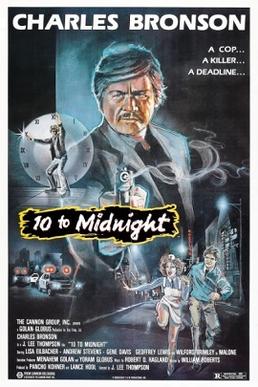
Charles Bronson is Leo Kessler, a veteran detective who’s seen it all and has grown sick of a system of justice that he thinks favors criminals over their victims. When girls start getting murdered, he immediately suspects the arrogant Warren Stacy, played by Gene Davis in the best role of his career. When Kessler and his partner Paul McCann (Andrew Stevens) start putting the pressure on Stacy, the killer responds by going after Kessler’s daughter Laurie (Lisa Eilbacher). Needless to say, our hero will do anything to stop the madman, ANYTHING!
10 TO MIDNIGHT is a special movie in my house because it’s my wife’s favorite Charles Bronson film, even when she didn’t have any overall appreciation for Bronson as an actor. Luckily for her, she had me to introduce her to the rest of the iconic actor’s voluminous catalog of movies. I saw 10 TO MIDNIGHT myself when I was pretty young, probably 13 or so. I remember being scared that first night after I watched the movie when I was trying to go to sleep. My wife and I watched it today on my old VHS tape that I’ve owned going back to the late 1980’s.
There are several elements that elevate 10 TO MIDNIGHT above the average cop / slasher thrillers of the 1980’s. First, it’s Charles Bronson in the lead role. Bronson has such a strong presence on screen that his presence alone elevates almost any material. He looks great in the film, and the role gives him some good opportunities, as both a mentor to the young cop, and even more importantly, as a dad who wants to do better for his daughter. It’s a solid role that seems to fit Bronson like a glove. Second, we know from the very beginning of the movie that Warren Stacy is in fact the killer. We also know that the law seems to be working in his favor. And because of that, we’re on Kessler’s side as he goes to extreme lengths to stop his reign of terror. Finally, the script and director J. Lee Thompson go all in on the sex and violence. Examples include Stacy killing his often naked victims while he himself is in the nude. There is much talk in the film about items of a sexual nature and Stacy even has a sexual release device that almost has to be seen to be believed. It definitely adds a decadent and voyeuristic feel to the proceedings. And I haven’t even mentioned yet that it has one of the very best endings of any Bronson film, second only to THE MECHANIC, in my humble opinion.
I highly recommend 10 TO MIDNIGHT!
For a more detailed review of 10 TO MIDNIGHT, check out Lisa’s review from a couple of years back below:
We all know the story. Eddie Murphy is Axel Foley, a streetsmart detective in Detroit whose childhood friend, Mickey (James Russo), is murdered because of something that he saw while working as a security guard in Beverly Hills. Axel plays by his own rules and gets results even as he gives his boss, Inspector Todd (Gil Hill), heartburn. Todd refuses to allow Foley to investigate Mickey’s death so Axel puts in for some vacation time and catches the first plane to Beverly Hills.
In Beverly Hills, he meets up with another childhood friend, Jenny (Lisa Eilbacher). Axel thinks that Mickey’s murder was ordered by a shady businessman named Victor Maitland (Steven Berkoff). The Beverly Hills Police Department orders Axel to leave Maitland alone and to return to Detroit. Axel won’t go until he gets justice for Mickey. Lt. Bogomil (Ronny Cox) assigns Taggart (John Ashton) and Rosewood (Judge Reinhold) to follow Axel in Beverly Hills.
Like 48 Hrs., the story is serious but the comedy comes from how the well-drawn characters interact with each other and from seeing how Axel reacts to the strange and wealthy world of Beverly Hills. Axel has the same reactions that we would have but, because he’s played by Eddie Murphy, he always has the perfect response to everything that he sees, whether it’s dealing with a snooty hotel clerk or with someone like Serge (Bronson Pichot), Jenny’s co-worker who speaks with an unidentifiable accent. Even more so than in 48 Hrs or Trading Places, Murphy reveals himself to be a natural star here. One reason why we like Axel is because he’s not just funny but he’s also the type of confident hero that we all wish we could be. He’s not intimidated by Beverly Hills for a second.
It’s now impossible to picture anyone else in the role of Axel Foley but, when the film’s script was first being shopped around, it was originally offered to Sylvester Stallone, who said the story had potential but was missing something. He rewrote the script and took out all of the humor, turning it into a grim and serious action film. (It is rumored that Stallone later turned his version of the script into Cobra.) Fortunately, Stallone eventually dropped out of Beverly Hills Cop so that he could co-star with Dolly Parton in Rhinestone. Producers Don Simpson and Jerry Bruckheimer, then at the start of their producing careers, then offered the role to Eddie Murphy, who took Stallone’s script and added back all of the humor. Murphy also ended up ad-libbing several of the film’s best one-liners, improvising the hotel lobby scene and the meeting with Serge on the spot.
Beverly Hills Cop was a huge success, cementing Murphy’s status as a star and proving that Murphy could carry a movie on his own. The film still holds up, certainly better than any of the sequels that followed. Even though Murphy was clearly the main attraction, the movie also gave actors like John Ashton, Judge Reinhold, Ronny Cox, Bronson Pinchot, and even Paul Reiser a chance to shine. The villainous performances of Steven Berkoff and Jonathan Banks would serve as a model for countless bad guys through the 80s and 90s. Beverly Hills Cop is a movie that makes you happy that Sylvester Stallone didn’t have a better sense of humor.
The scene below is a major spoiler for the film 10 to Midnight so don’t watch if you haven’t seen the film yet. And, to be honest, you probably shouldn’t even read the rest of this post, as the post itself is probably a spoiler as well. There’s no way to truly talk about this film without talking about the ending. 10 to Midnight is a film that’s been on my mind a lot this year, largely because Charles Bronson plays a character who reminds me of my Dad. Bronson’s relationship with his daughter (played by Lisa Eilbacher) also reminds me of my own relationship with my Dad. I doubt there’s many people who get sentimental over a relatively unheralded vigilante horror film from 1983 but, as I’m still processing losing my Dad earlier this year, I am one of those people.
If you have seen the film, you know that this is one of the best endings that Charles Bronson ever filmed. Indeed, in today’s chaotic world, there’s some very satisfying about both Bronson’s final line and his no-nonsense style of dealing with problems. And indeed, with all the bad vibes that seem to have been unleashed on the world over the past few years, this scene feels like an exorcism of sorts.
Serial killer Warren Stacy (Gene Davis) thought he could game the system. He thought he had everything figured out. He smugly assumed no one could stop his reign of terror.
Well, Bronson disagrees.
And with that one wonderful final line, Charles Bronson brings this year’s Horrorthon to a close.
The 1983 film, 10 to Midnight, opens with LAPD detective Leo Kessler (played by legendary tough guy Charles Bronson) sitting at his desk in a police station. He’s typing up a report and taking his time about it. A reporter who is in search of a story starts to bother Leo.
“Jerry,” Leo tells him, “I’m not a nice person. I’m a mean, selfish son-of-a-bitch. I know you want a story but I want a killer and what I want comes first.”
It’s a classic opening, even if Leo isn’t being totally honest. Yes, he can be a little bit selfish but he’s really not as mean as he pretends to be. He may not know how to talk to his daughter Laurie (Lisa Eilbacher) but he is also very protective of her and he wants to be a better father than he’s been in the past. He may roll his eyes when he discovers that Detective Paul McAnn (Andrew Stevens) is the son of a sociology professor but he still tries to act as a mentor to his younger partner. Leo may complain that the criminal justice system “protects those maggots like they’re an endangered species” but that’s just because he’s seen some truly disturbing things during his time on the force and, let’s face it, Leo has a point. When one of Laurie’s friends is murdered, Leo is convinced that Warren Stacy (Gene Davis) is the murderer and he’s determined to do whatever he has to do to get Warren off the streets. “All those girls,” Leo snarls when he sees Warren, his tone letting us know that his mission to stop Warren is about more than just doing his job.
Warren Stacy is handsome, athletic, and he has good taste in movies. (He’s especially a fan of Butch Cassidy and the Sundance Kid. Just don’t try to trick him by saying Steve McQueen played the Sundance Kid.) Warren is also a total creep, the type of guy who complains that a murder victim “wasn’t a good person,” because she trashed him in her diary. When Leo takes a look around Warren’s apartment, he finds not only porn but also a penis pump. (“It’s for jacking off!” Leo yells at Warren, enunciating the line as only Charles Bronson could.) Warren is also a murderer but he’s a clever murderer, the type who sets himself up with an alibi by acting obnoxiously in a movie theater. Warren strips nude before killing his victims, in order to make sure that he doesn’t leave behind any evidence. (This film was made in the days before DNA testing.)
Leo knows that Warren is guilty but, as both his gruff-but-fair captain (Wilford Brimley, naturally) and the D.A. (Robert F. Lyons) point out, he has no way to prove it. When Warren starts to stalk Laurie and her friends (including Kelly Preston), Leo decides that he has no choice but to frame Warren. But when Warren’s amoral attorney, Dave Dante (Geoffrey Lewis, giving a wonderfully sleazy performance), threatens to call McAnn to the stand, McAnn has to decide whether to tell the truth or to join Leo in framing a guilty man.
10 to Midnight is a violent, vulgar, and undoubtedly exploitive film, one that features a ham-fisted message about how the justice system is more concerned with protecting the rights of the accused as opposed to lives of the innocent. And yet, in its gloriously pulpy way, this is also one of Bronson’s best films. It’s certainly my personal favorite of the films that he made for Cannon.
Director J. Lee Thompson and Charles Bronson were frequent collaborators and Thompson obviously knew how to get the best out of the notoriously reserved actor. Bronson was not known for his tremendous range but he still gives one of his strongest performances in 10 to Midnight, playing Leo as being not just a determined cop but also as an aging man who is confused by the way the world is changing around him. Stopping Warren isn’t just about justice. It’s also about fighting back against the the type of world that would create a Warren Stacy and then allow him to remain on the streets in the first place. Interestingly, though Leo doesn’t hesitate when it comes to framing Warren, he is also sympathetic to McAnn’s objections. Unlike other Bronson characters, Leo doesn’t hold a grudge when his partner questions his methods. Instead, he simply know that McAnn hasn’t spent enough time in the real world to understand what’s at stake. McAnn hasn’t given into cynicism. He hasn’t decided that the best way to deal with his job is to be a “mean son of a bitch.” Bronson and Andrew Stevens, who had worked together in the past, have a believable dynamic. McAnn looks up to Leo but is also conflicted by his actions. Leo may be annoyed by McAnn’s reluctance but he also respects him for trying to be an honest cop. Their partnership feels real in a way that sets 10 to Midnight apart from so many other films about an older cop having to deal with an idealistic partner.
One of the most interesting things about the film is Leo’s relationship with his daughter, Laurie. Over the course of the film, Leo and Laurie go from barely speaking to bonding over liquor and their shared regrets about the state of the justice system. When McAnn first meets Laurie, she’s offended when McAnn suggests that she takes after her father. But, as the film progresses, she comes to realize that she and Leo have much in common. (To be honest, I related quite a bit to Laurie, especially as I’ve recently come to better appreciate how much of my own independent nature was inherited from my father.) Lisa Eilbacher and Charles Bronson are believable as father-and-daughter and they play off of each other well. The scenes between Laurie and Leo give 10 to Midnight a bit more depth than one might otherwise expect from a Bronson Cannon film. Leo isn’t just trying to protect his daughter and her roommates from a serial killer. He’s also trying to be the father who he wishes he had been when she was younger. He’s trying to make up for lost time, even as he also tries to keep Warren Stacy away from his family.
As played by Gene Davis, Warren Stacy is one of the most loathsome cinematic villains of all time. Warren’s crimes are disturbing enough. (Indeed, the surreal sight of a naked and blood-covered Warren Stacy stalking through a dark apartment is pure nightmare fuel.) What makes Warren particularly frightening is that we’ve all had to deal with a Warren Stacy at some point in our life. He’s the sarcastic and easily offended incel who thought he was entitled to a phone number or a date or perhaps even more. As I rewatched this movie last night, I wondered how many Warrens I had met in my life. How many potential serial killers have any of us unknowingly had to deal with? Warren tries to strut through life, smirking and going out of his way to let everyone know that he knows more than they do but the minute that Leo turns the table on him, Warren starts whining about he’s being treated unfairly. During his final, disturbing rampage, Warren yells that his victims aren’t being honest with him, blaming them for his actions. The film deserves a lot of credit for not turning Warren into some sort of diabolical and erudite supervillain. He’s not Hannibal Lecter. Instead, like all real-life serial killers, he’s a loser who is looking for power over those to whom he feels inferior and for revenge on a world that he feels owes him something. He’s a realistic monster and that makes him all the more frightening and the film all the more powerful. Warren is the type of killer who, even as I sit here typing this, could be walking down anyone’s street. He’s such a complete monster that it’s undeniably cathartic whenever Leo goes after him.
How delusional is Warren Stacy? He’s delusional enough to actually taunt Charles Bronson! At one point, Warren informs Leo that he can’t be punished for being sick. Warren announces that, when he’s arrested, he might go away for a while but he’ll be back and there’s nothing Leo can do about it. (The suggestion, of course, is that Warren will be back because he committed his crimes in California and all the judges were appointed by a bunch of bleeding heart governors. Warren may not say that out loud but we all know that is the film’s subtext. Some people may agree with the film, some people may disagree. Myself, I’m against the death penalty because I think it’s a prime example of government overreach but I still cheered the first time that I heard Clint Eastwood say, “Well, I’m all torn up about his rights,” in Dirty Harry.) How does Leo react to Warren’s taunts? I can’t spoil the film’s best moment but I can tell you that 10 to Midnight features one of Bronson’s greatest (and, after what we’ve just seen Warren do, most emotionally satisfying) one-lines.
The title has nothing to do with anything that happens in the film. In typical Cannon fashion, the film’s producers came up with a snappy title (and 10 to Midnight is a good one) and then slapped it onto a script that was previously called Bloody Sunday. Fortunately, as long as Bronson is doing what he does best, it doesn’t matter if the title makes sense. And make no mistake. 10 to Midnight is Bronson at his best.
Almost everyone knows that one scene from the 1982 film, An Officer and a Gentleman. You can probably guess which scene it is that I’m talking about. It’s been parodied and imitated in so many other shows and movies that it’s one of those pop cultural moments that everyone has “seen” even they haven’t actually watched it. It’s the scene where….
I AIN’T GOT NOWHERE ELSE TO GO!
What?
I AIN’T GOT NOWHERE ELSE TO GO!
I know, Mayo, I’m getting to that! Let me tell everyone about the iconic factory scene first, okay?
I AIN’T GOT NOWHERE ELSE TO GO!
Uhmmm …. right. Where was I? Oh yeah, it’s the scene where Debra Winger is working in a factory and a youngish Richard Gere suddenly shows up and he’s wearing a white uniform and he picks her up and carries her out of the factory while all of her coworkers cheer. Meanwhile, that Up Where We Belong song starts to play on the soundtrack. Even though, up until recently, I had never actually sat down and watched An Officer and a Gentleman, I certainly knew that scene.
Last Friday, I noticed that I had An Officer and a Gentleman saved on the DVR and I thought to myself, “Well, I might as well go ahead and watch it and find out what else happens in the movie.” Add to that, I only had three hours of recording space left on the DVR so I figured I could watch the movie and then delete it and free up some space….
I AIN’T GOT NOWHERE ELSE TO GO!
Goddammit, Mayo, be quiet! I’m getting to it!
Anyway, I watched the film and I discovered that it’s actually about a lot more than just Richard Gere getting Debra Winger fired from her job at the factory. It’s also about how Zack Mayo (the character played by Richard Gere) hopes to make something of himself by graduating from Aviation Officer Candidate School so that he can become not only a Navy pilot but also an officer and a gentleman. His father (Robert Loggia) is an alcoholic, his mother committed suicide when Mayo was a child and Mayo …. well, I’ll let him tell you himself.
I AIN’T GOT NOWHERE ELSE TO GO!
That’s right. Mayo has not got anywhere else to go.
I AIN’T GOT NOWHERE ELSE TO GO!
Ain’t is not a word, Mayo.
As you may have already guessed, we know that Mayo doesn’t have anywhere else to go because there’s a scene where he continually yells, “I ain’t got nowhere else to go!” over and over again. He yells it after being forced to do a thousand push-ups and sit-ups by his drill sergeant, Foley (Louis Gossett, Jr.) Foley thinks that Mayo doesn’t have the right attitude to be either an officer or a gentleman. Mayo is determined to prove him wrong.
I AIN’T GOT–
Oh give it a rest, Mayo!
Debra Winger plays Paula. Paula is a townie. She lives in a dilapidated house with her parents. Her friend, Lynette (Lisa Blount), dreams of marrying a Naval officer and getting to travel the world. Lynette gets involved with Mayo’s friend, Sid Worley (David Keith). Foley warns both Sid and Mayo to stay away from the townie girls because they’re not to be trusted. That turns out to be true in Lynette’s case but Paula’s love provides Mayo with the strength that he needs to believe in something more than just himself.
I AIN’T–
Yes, you do have some place to go, Mayo! That’s the point of the whole goddamn movie!
Anyway, watching An Officer and a Gentleman, I was kind of surprised to discover that it’s actually two movies in one. It’s a traditional army training film, one in which Richard Gere is whipped into shape by a tough drill sergeant. It’s also a film about life in an economically depressed small town, where the only hope of escape comes from marrying the right aviation officer candidate. As a military film it’s predictable if occasionally effective. As a film about small town life, it’s surprisingly poignant. An Officer And A Gentleman doesn’t pull any punches when it comes to depicting just how little life in the town has to offer to people like Paula and Lynette. They have spent their entire lives being told they can either work in a factory for minimum wage and get drunk on the weekend or they can land a man who will hopefully take them away from all that and give them something more to look forward to than cirrhosis of the liver. Lynette has accepted that as being her only option. While Paula dreams of escape, she dreams of escaping on her terms. She may fall in love with Mayo but she’s not going to pretend to be someone that she’s not just to keep him around.
Though he’s evolved into a good character actor, Richard Gere was remarkably blank-faced when he was younger and his performance as Mayo alternates between being bland and shrill. However, Debra Winger brings a welcome edge to her role. She plays Paula as someone who knows she’s stuck in a dead end existence. She’s not happy about it but, at the same time, she’s not going to surrender her principles in order to escape. She holds onto her ideals, even though she appears to be stuck in a crappy situation and that’s something that Mayo learns from her. In the end, Paula saves Mayo just as surely as the Navy does. And, just as Paula saves Mayo, Winger saves the movie.
I AIN’T GOT NOWHERE ELSE TO GO!
Oh, shut the Hell up, Mayo. Go pick up Paula and carry her off to a better life….
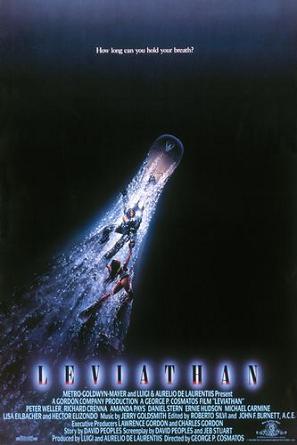
A group of miners are sent into a dangerous environment by an evil corporation. When they explore an abandoned ship, they unknowingly bring a hostile creature onto their own vessel. One of the crewman is killed when the creature mutates inside of his body. The rest of the crew includes a scientist, one strong woman, one woman who cries, and a strong, silent captain.
Sound familiar?
No, it’s not Alien.
Instead, it’s Leviathan, which could best be described as being Alien underwater with a dash of The Thing tossed in. The main difference between Leviathan and the films that inspired it is that people are still watching Alien and The Thing while Leviathan is one of the most forgettable films that I have ever seen. Peter Weller is the captain. Richard Crenna is the scientist. Amanda Pays has the Ripley role and Ernie Hudson fills in for Yaphet Kotto. Daniel Stern plays Sixpack, who turns into a monster after he drinks contaminated Russian vodka. (It happens to the best of us.) Meg Foster, with her translucent eyes, represents the corporation.
That’s a good cast and the script was written by David Peoples (who also wrote Blade Runner, Unforgiven, and 12 Monkeys) and Jeb Stuart (who wrote Die Hard and The Fugitive). The above average special effects were designed by Stan Winston. Why, with all of these talented people involved in the production, is Leviathan so by the numbers and forgettable? It probably had something to do with the presence of George Pan Cosmatos in the directing chair. Cosmatos is also credited with directing Rambo: First Blood II, Cobra, and Tombstone. The first two films starred Sylvester Stallone, who was known for directing all of his 80s films in every way but name only and everyone knows that Kurt Russell was in charge on Tombstone.
If you want to see Alien underwater done right, watch Deepstar Six.



 A group of miners are sent into a dangerous environment by an evil corporation. When they explore an abandoned ship, they unknowingly bring a hostile creature onto their own vessel. One of the crewman is killed when the creature mutates inside of his body. The rest of the crew includes a scientist, one strong woman, one woman who cries, and a strong, silent captain.
 Through the Shattered Lens