On tonight’s episode of Ghost Story, Pamela Franklin plays two roles. She plays both Christina Burgess and Lisa (hey!), the twin sister who Christina has never met. When Lisa mysteriously dies (boooo!), Christina finds herself haunted by her sister’s ghost. But is the ghost benevolent or is the ghost seeking revenge?
Co-written by Richard Matheson, this episode originally aired on November 3rd, 1972.
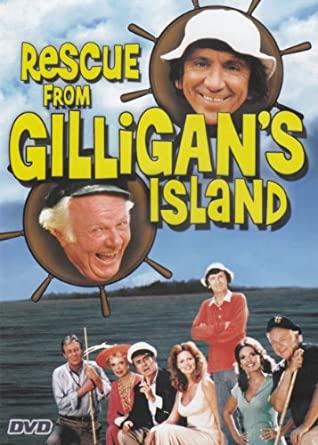
I know that this is going to shock some people but Rescue From Gilligan’s Island is dumb. In fact, it is not just dumb. Instead, it is very, very, very dumb. It’s just about the dumbest goddamn thing I’ve ever seen.
The first TV movie sequel to the 60s television show about a group of castaways on an uncharted isle, Rescue From Gilligan’s Island picks up ten years after the final episode of Gilligan’s Island. The castaways are still living on the island and trying to figure out how to get back home. There’s the Skipper (Alan Hale, Jr.) and Gilligan (Bob Denver). There’s Mary Ann (Dawn Wells), the Howells (Jim Backus and Natalie Schaefer), and the Professor (Russell Johnson). Ginger is also there but there’s something different about her. Tina Louise refused to return to the role because she always said appearing on Gilligan’s Island ruined her career. Ginger is now played by Judith Baldwin, who looks glamorous but who also plays her role distressingly straight, as if she was the only person unaware that nothing about Gilligan’s Island should have been taken seriously.
After ten years of being stranded, the professor finally figures out how to get the castaways off the island! You’ll never believe the plan he comes up with. He decides that the castaways should build, get this … a raft! Ten years on the island and it never occurred to them to just make a raft? The castways do get some help from a tsunami, which pushes them out to the ocean. And then when Gilligan sets the raft on fire, they’re saved by the Coast Guard.
(How did they spend ten years on the island without killing Gilligan?)
Despite having been away from ten years, everyone settles back into their old routines but it’s not just the same. The Professor tries to teach but the students just want to hear about what it was like to be marooned on an island. Ginger returns to acting but is expected to now appear in PG-rated films! Mary Ann agrees to marry her old boyfriend, Herbert, despite not loving him. The Howells go right back to their old lives because the Howells are just as weird as on the mainland as they were on the island.
As for Gilligan and Skipper, they try to convince their insurance company to pay to fix the Minnow so that they can go back to giving three-hour tours but to do that, they have to convince all of the castaways to sign a form swearing that the Skipper was not liable for what happened during that last tour. (But, even if they could fix up the Minnow, why would anyone want to take a tour with the Skipper and Gilligan when the entire world probably knows that doing so mean risking having to spend ten years on a deserted island? There’s a reason why no one wanted to fly with George Kennedy after the fourth Airport movie.) So, Gilligan and the Skipper travel the country and visit old friends while being pursued by two Russian agents (Vincent Shiavelli and Art LeFleur) who want to steal a metal disc that Gilligan found on the island.
I told you it was dumb.
Dumb it may have been but it was also the highest rated show for the week that it aired. While this didn’t lead to a new series, it did lead to two more made-for-TV movies. In the first one, the castaways opened a resort. In the second one, they teamed up with a group of sports superstars and kept Martin Landau from exploiting the island’s natural resources. Dumb as this movie may be, it was necessary steps towards teaming the Skipper up with the Harlem Globetrotters.
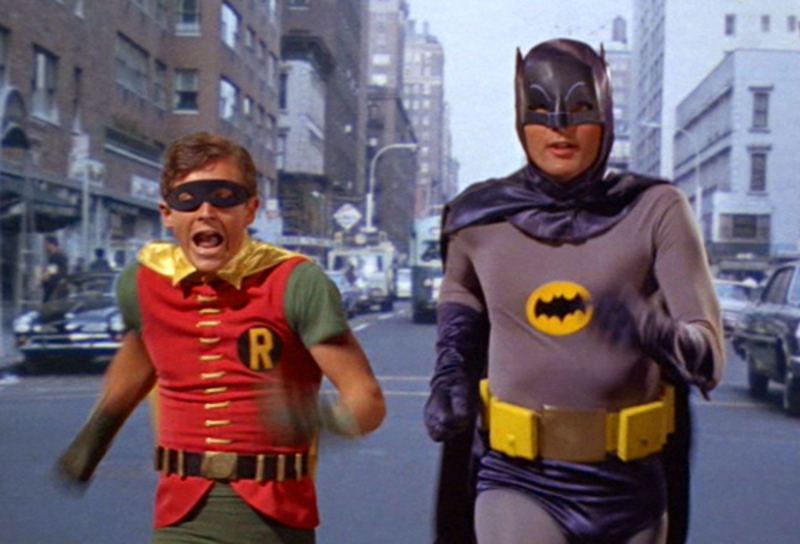
One day, while defending Gotham City, Batman (Adam West) and Robin (Burt Ward) learn that there is a plot to abduct Commodore Schmidlap from his yacht. Quick! To the batcopter! Flying over the ocean, they locate the yacht but it turns out that the whole kidnapping plot was a ruse for a shark to attack Batman!
“Holy sardine!” Robin exclaims!
With the help of porpoise who bravely sacrifices its life to protect the Caped Crusader, Batman manages to escape. Back at police headquarters, Batman, Robin, Commissioner Gordon (Neil Hamilton), and Chief O’Hara (Stafford Repp) wonder which member of Batman’s rogue’s gallery of villainy could have been responsible for the ruse.
Batman says that it was pretty “fishy” what happened and that could possibly mean The Penguin (Burgess Meredith) was involved!
Robin points out that it happened “at sea” and C stands for Catwoman (Lee Meriweather)!
Batman then says that the shark was “pulling my leg” and that might mean it was working for The Joker (Cesar Romero)!
Chief O’Hara says that it all adds up to “a sinister riddle,” which can only mean one thing: The Riddler (Frank Gorshin)!
“The four of them,” Batman says, “working together…”
“Holy nightmare!” Robin exclaims!
As you can probably guess, the tone of 1966’s Batman: The Movie is far different from the tone of more recent Batman films. That’s because Batman: The Movie was based on the light-hearted 60s TV show that made Batman a household name even while transforming the character from being a shadowy vigilante to being a comedic straight arrow, a proud square who regularly lectured the citizens of Gotham about respecting the forces of law and order.
Batman: The Movie was released after the conclusion of the first season of the Batman televisions series and it featured nearly the entire cast of the show. (Lee Meriweather replaced Julie Newman in the role of the purring Catwoman.) The movie feels like an extended episode of the show, still using the same famous music and featuring scenes of Batman and Robin running in place with a street scene projected behind them. The attitude is one of affectionate parody, as opposed to the more cynical campiness of Joel Schumacher’s infamous films from the 90s. Adam West expertly deadpans his way through the main role while the underrated Burt Ward energetically plays the naïve and easily amazed Robin. Of the villains, Lee Meriweather is a sexier Catwoman than Anne Hathaway and there’s never been a better Riddler than Frank Gorshin. (Of the many actors who played Batman’s villains on the TV series, Gorshin was always the only one who seemed to understand that he was supposed to be playing someone dangerous.) At 104 minutes, Batman: The Movie runs out of steam before it ends but there’s still much here to entertain fans of the television show.
Of course, when I was growing up in the 90s, there was no easier way to lose credibility with most diehard Batman films than to admit to liking anything about the television series. The Batman TV series was widely blamed for people thinking that comic books were only meant for kids. Tim Burton was a hero for treating Batman seriously. Joel Schumacher was hated for taking the opposite approach. Batman and Robin was criticized for being too much like the TV show, right down to George Clooney doing a poor man’s Adam West impersonation in the main role. Despite the acclaim that greeted Batman: The Animated Series, It wasn’t until Christopher Nolan took control of the character that the cinematic Batman truly returned to his grim roots.
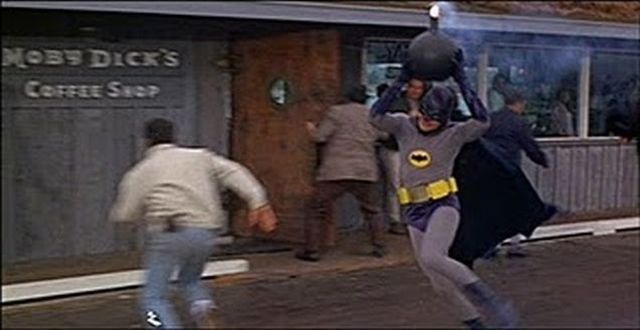
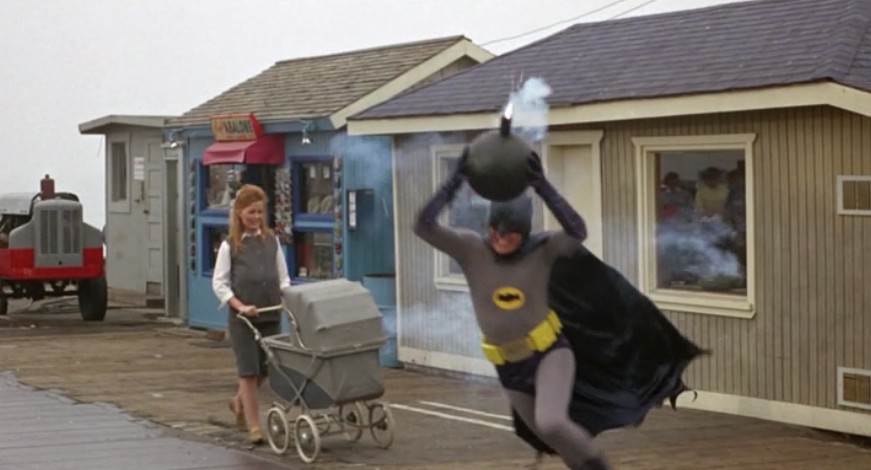
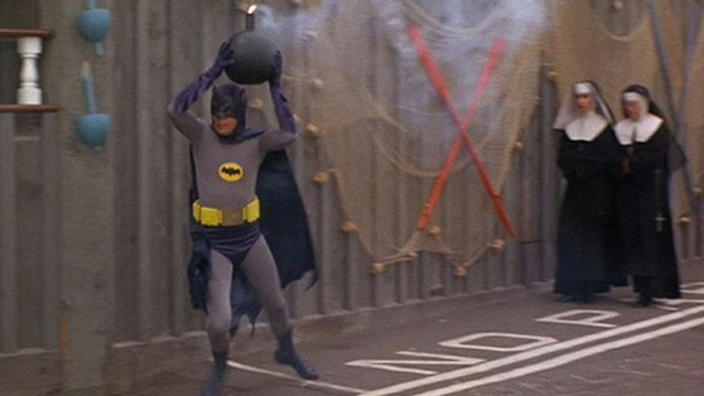
Since the conclusion of Nolan’s Dark Knight trilogy, there have been several versions of Batman. Ben Affleck took over the role for two films. Young Bruce Wayne and his doomed parents briefly appeared in Joker. Robert Pattinson is set to take over the role in The Batman. Now that everyone knows Batman as a grim avenger and countless actors have bragged about how they prepared for their roles in the Batverse by reading either The Killing Joke or The Dark Knight Returns, it’s easier to appreciate the more light-hearted approach of something like Batman: The Movie. After two decades of grim and serious Batmans being used as a metaphor for everything from PTSD to the surveillance state, the sight of a paunchy Adam West trying to find a place to safely dispose of a ridiculously oversized bomb can be a relief.
“Sometimes,” Batman says, “you just can’t get rid of a bomb!”
4 Shots From 4 Films is just what it says it is, 4 shots from 4 of our favorite films. As opposed to the reviews and recaps that we usually post, 4 Shots From 4 Films lets the visuals do the talking!
Today, we wish a happy birthday to the one and only Raquel Welch!
4 Shots From 4 Films
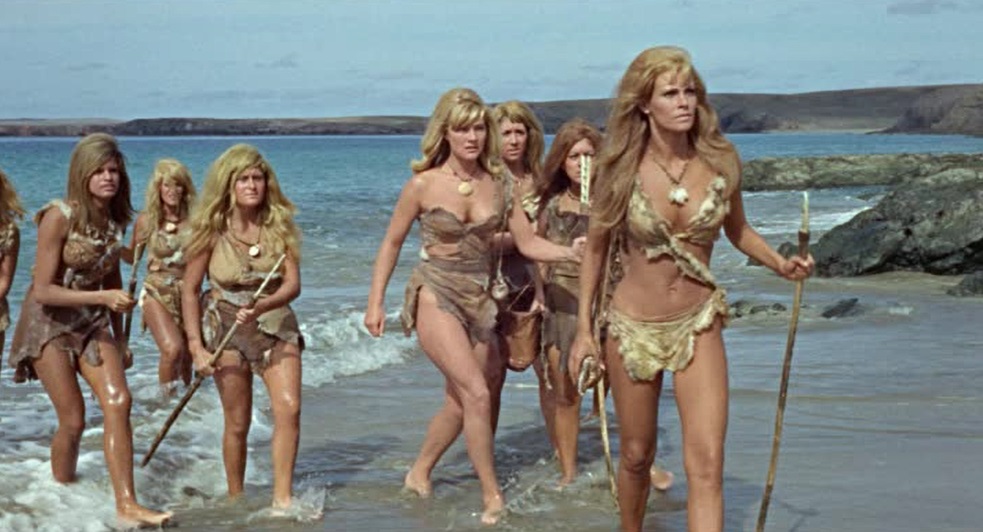
One Million B.C. (1967, directed by Don Chaffey)
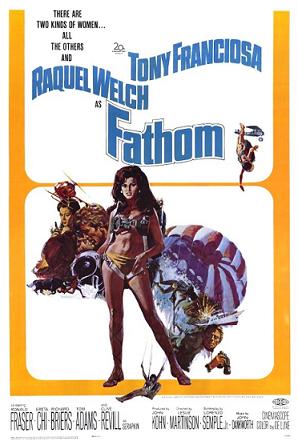
Fathom (1967, directed by Leslie H. Martinson)
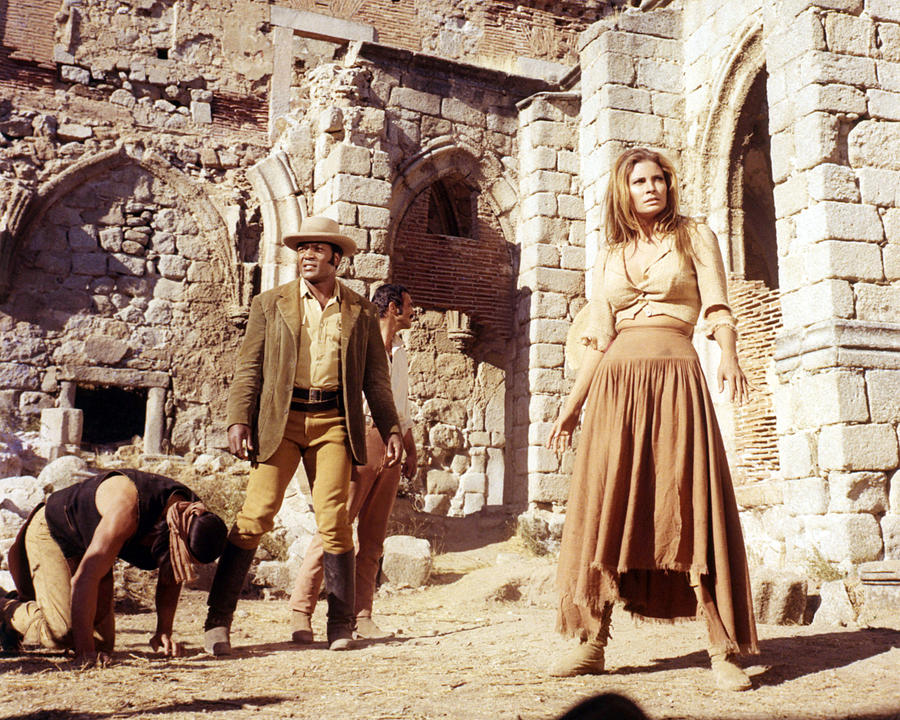
100 Rifles (1969, directed by Tom Gries)
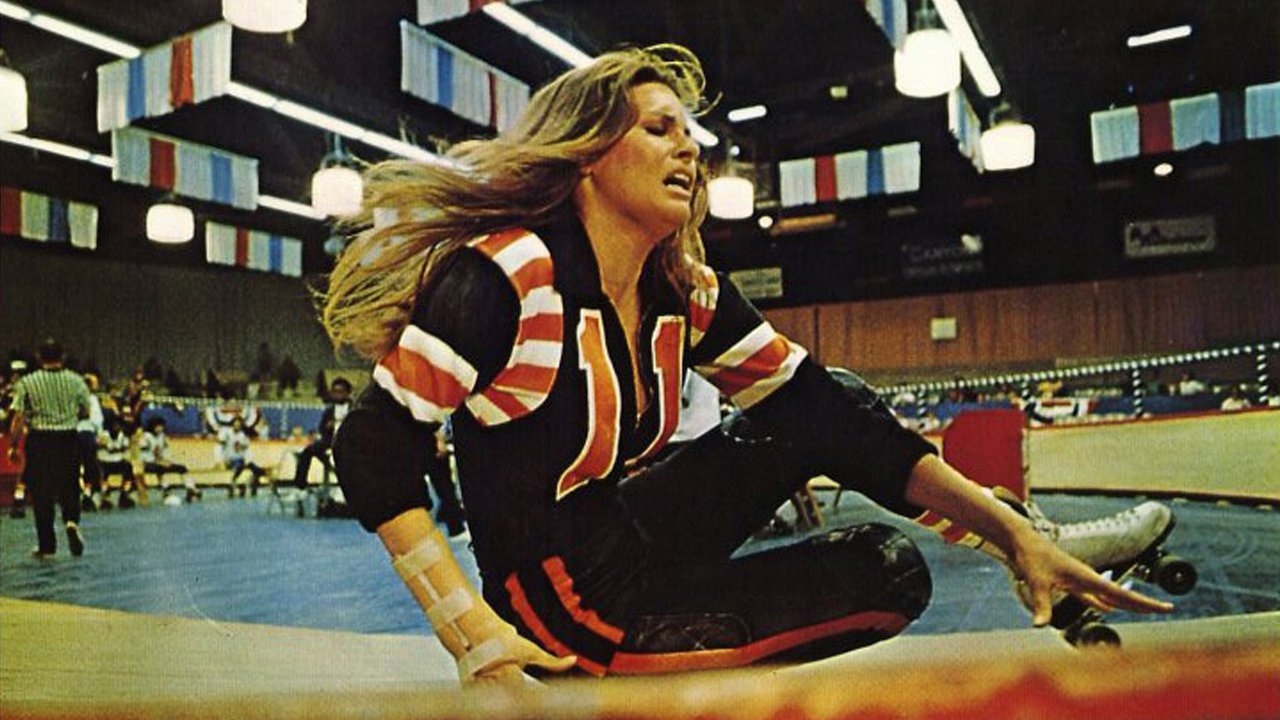
Kansas City Bomber (1972, directed by Jerrold Freedman)
(Lisa is currently in the process of cleaning out her DVR! It’s going to take her forever but, with the help of Dexedrine and energy drinks, she is determined to get it done! She recorded 1967’s Fathom off of FXM on April 3rd of this year!)
Fathom is a spy spoof, one that was made the height of the initial James Bond craze. It’s very much a late 60s film, in everything from the way the film looks to the overly complicated storyline to the film’s cultural attitudes. This is one of those films that you know was probably considered to be “naughty” when it was released but, seen today, it’s all rather quaint. There’s no nudity, there’s no cursing, and there’s very little violence. However, it does feature in Raquel Welch in a lime green bikini and you just know that, when this film came out, there were probably people bemoaning it as the end of civilization. “What happened to the movies that you could take the entire family too!?” they probably wailed. That’s the way history works. What was once daring now seems remarkably innocent.
I watched the film last night but I’d be lying if I said I could follow the plot. I think that was intentional on the part of the filmmakers. Fathom satirizes the spy films of the late 60s by taking all of their familiar elements to their logical extreme. Spy thrillers feature unexpected twists and turns. Fathom has a new twist every 10 minutes or so. Spy thrillers feature sudden betrayal and double agents. With the exception of Raquel Welch, literally no one in Fathom is who they initially claim to be. It becomes exhausting to try to keep up. In many ways, Fathom plays out like an old serial. Every few minutes or so, there’s another cliffhanger. Oh no, Raquel Welch is on an out-of-control motorboat! Oh no, the bad guys have got Raquel Welch on an airplane! Oh no, Raquel Welch is being chased by a bull and she’s wearing a red dress! ¡Olé!
Raquel plays Fathom Harvill, who works as a dental hygienist except for when she’s touring Europe as a member of the U.S. parachute team. She’s recruited by some spies to help track down a nuclear triggering mechanism, one that is being hidden somewhere in Spain. The Scottish secret service just wants her to parachute into a villa owned by a mysterious American named Peter Meriweather (Anthony Franciosa) and plant a recording device. Things don’t go quite as smoothly as they should and soon, Fathom’s going from one extreme situation to another.
(Even though Peter is supposed to be a suave, James Bond-type, Franciosa gives such an oddly intense performance that it feels like a dry run for his later work in Dario Argento’s Tenebrae. Interestingly enough, in Argento’s film, Franciosa’s character is named Peter Neal. Is it possible that Peter Meriweather changed his last name?)
But really, the entire plot is just an excuse to get Raquel into that lime green bikini and she totally owns the moment. Raquel Welch is one of my favorite of the old film stars because she never apologized for who she was. She had the body, she was sexy, she knew it, and she used it to her advantage. Of course, when seen today, it’s disappointing that Fathom spends the entire movie being rescued by men but then again, I imagine that just the idea of a woman being a secret agent was revolutionary in 1967. Actually allowing her to get out of situations on her own might have made heads explode. If Fathom were made today, Fathom would at least get one scene where she gets to kick some ass, Angelina Jolie-style.
Anyway, Fathom is an enjoyably silly spy film. Don’t worry about trying to follow the plot and, instead, just enjoy it as an over-the-top time capsule. It doesn’t get more 1967 than Fathom.