Paper Lion (1968, directed by Alex March)


Writer George Plimpton (Alan Alda) is a Park Avenue sophisticate who practices “participatory” journalism.  He has already written about pitching in an exhibition all-star game and getting knocked out by Sugar Ray Robinson.  He is having trouble coming up with his next stunt until he goes to Central Park and plays a touch football game with his girlfriend Kate (Lauren Hutton) and his editor, Oscar (David Doyle).  Oscar sees George throwing the ball and decides that George should write about going to a professional football team’s training camp as a player.

George, who fantasizes about throwing the game-winning touchdown, is enthusiastic.  Most of the teams that George approaches are less enthusiastic but finally, the Detroit Lions agree to sign him as a quarterback.  Once the other players realize that George is a writer and not a professional athlete, there’s a lot of resentment.  As Guard John Gordy (playing himself) puts it, he could easily get injured while protecting an inexperienced quarterback like George.  George can always go back to Park Avenue but, for the rest of the players, the game is their life and they don’t like the idea of some outsider coming in and treating it all like a joke.  At first, only the fearsome defender Alex Karras (also playing himself) is willing to support George but eventually, George’s refusal to give up wins over the rest of the team.  They even let him score a touchdown during practice.

When the preseason begins, George waits for his opportunity to take the field.  How many yards can he lose in three plays?

Paper Lion is based on a true story.  In 1963, George Plimpton did attending training camp and play a scrimmage for the Lions and he later wrote a book about the experience.  The movie changes the time period from ’63 to ’67 so that all of the then-members of the Lions could play themselves.  (Though Karras was a friend of Plimpton’s, he was actually suspended during the 1963 season and, unlike in the movie, never joined Plimpton on the practice field.)  The film plays Plimpton’s football career largely for laughs, celebrating every guy’s fantasy of being a sports star while also showing why it’s probably best to leave the actual game to the professionals.  Alan Alda doesn’t imitate Plimpton’s famous Mid-Atlantic accent but he does capture the excitement of a man getting to live out his fantasy.

Paper Lion was made with the full cooperation of the NFL and a good deal of the film’s final third is made up footage that was shot for an actual game.  Seen today, it’s interesting to see how positively Paper Lion portrays both the game and its players and to contrast it with how the game is usually portrayed today.  There’s no talk of steroids or fears of multiple concussions.  All of the players are clean-cut, friendly, witty, and helpful.  Even the training camp hazing is all done is good fun.  Paper Lion introduces us to the nicest people in the world and they’re all football players!
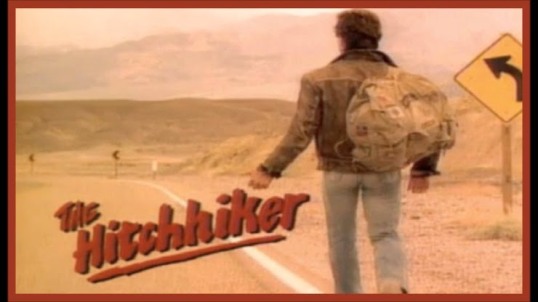
Horror On TV: The Hitchhiker 6.3 “Riding the Nightmare” (dir by Christian Duguay)


On tonight’s episode of The Hitchhiker, a woman who is having an affair with her sister’s husband (uh-oh, don’t do that) starts having surreal and increasingly frightening nightmares about a white horse.  Is she being warned of her impending death?

This episode originally aired on October 5th, 1990.

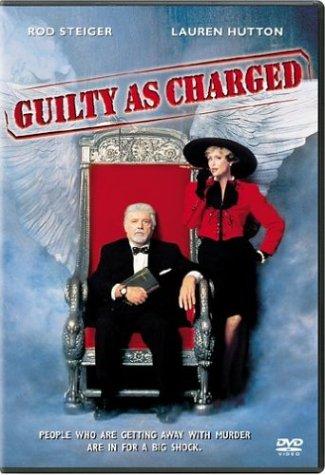
Guilty As Charged (1991, directed by Sam Irvin)


Stop me if you’ve heard this one before.

Kalin (Rod Steiger) is a crazy old religious fanatic who is rich enough to own a meatpacking plant and hire goons to work for him.  Underneath the meatpacking plant, he has a secret prison and an electric chair that he uses to electrocute people who he feels have escaped justice.  Helping out Kalin is a crazy preacher, played by Isaac Hayes (!), who waxes philosophically about how much he loves the smell of burning flesh.

While Kalin and the gang are executing people below ground, parole officer Kimberly (Heather Graham) is above ground and wondering why so many ex-cons are mysteriously vanishing.  Kimberly is worried that someone may be executing them but then she gets distracted by a politician named Stanford (Lyman Ward).  Stanford wants Kimberly to work on his campaign because she looks like Heather Graham and he’s a sleazy politico.

Meanwhile, a man named Hamilton (Michael Beach) has escaped from prison.  Hamilton claims that he was framed for a murder that he didn’t commit but no one is willing to believe him.  However, Hamilton is telling the truth and the murder was actually committed by Stanford!  The only people who know that Stanford is the murderer are Stanford, his wife (Lauren Hutton!!), and his maid (Zelda Rubinstein!!!).

It all leads to one question: How did all of these talented people all end up in this crappy film!?

The strange thing about Guilty As Charged is that, even though the film is centered around the death penalty, the film itself doesn’t seem to have any opinion on the issue.  Kalin and his followers are crazy religious fanatics who claim that they’re doing God’s work by executing people and Hamilton is an innocent man who has been marked for death so you would think that the movie is against the death penalty.  But then, in a twist that makes no sense, Kalin reveals that he knows that Hamilton is innocent and he’s only using him to get to Stanford and suddenly, the film is for the death penalty.  Kimberly is worried that someone is targeting ex-cons but, by the end of the movie, she’s targeting ex-cons herself even though nothing’s happened that should have made her change her mind.

Guilty as Charged is technically a comedy, though most of the jokes are too thuddingly obvious to provoke even the slightest of a smile.  Hayes wins some laughs, just because he seems like he’s having fun.  Rod Steiger bellows as if he’s getting paid by the decibel and doesn’t seem to be having any fun at all.  Guilty as Charged isn’t funny and it’s not thought-provoking but at least it’s got Isaac Hayes.

18 Days of Paranoia #6: Scandal Sheet (dir by David Lowell Rich)


“So be it,” journalist Helen Grant dramatically announces as she lifts up her camera and starts snapping pictures of a body in a casket, “I’m …. a ….. WHORE!”

That is just one of the many wonderfully, over-the-top moments that can be found in the 1985 film, Scandal Sheet.  Directed by David Lowell Rich, Scandal Sheet stars Burt Lancaster as Harold Fallen.  If this movie were being made today, Fallen would be in charge of a TMZ-style website.  Since this movie was made in the 80s, Fallen is the publisher and editor of a sleazy tabloid magazine.  He specializes in stories about aliens and ghosts.  When someone brings him in a story about the ghost of Grace Kelly haunting the beaches of Malibu, he announces, “Front page!”  When someone else tells him about a woman who wants to marry a man from outer space but who can’t find anyone to perform the ceremony, Fallen arranges to get the woman a lawyer.

When Fallen isn’t tracking down ghosts and arranging for interplanetary marriages, he’s trying to destroy celebrities.  When the film begins, he’s obsessed with taking down Ben Rowan (Robert Urich).  We’re told that Ben Rowan is one of the world’s top movie star.  (It’s important that we’re told this because there’s nothing about Urich’s bland performance that would lead us to suspect that to be the case.)  Ben’s career is in trouble because he’s got a drinking problem.  He just got out of rehab but no insurance company is willing to insure him.  His wife, Meg North (Lauren Hutton), is demanding that Ben be cast in her latest movie.  Everyone in Hollywood is like, “No way.”

It has the potential to be a big story and Fallen wants to be the first to break it.  But to do so, he’s going to need an inside source.  That’s where Helen Grant (Pamela Reed) comes in.  Helen was Meg’s college roommate and she’s still friends with both her and Ben.  Fallen decides to hire Helen to work for his magazine.  The only problem is that Helen is a serious journalist.  She writes stories about homeless children.  She has no desire to work for a tabloid.

“I’ll pay you more than you’re making right now,” Fallen tells her.

Helen’s not interested.

“I’ll pay you $80,000 a year.”

Helen’s interested.

Against her better judgment, Helen accepts Fallen’s offer.  At first, things seem okay.  She’s a bit annoyed with having to work with a sleazy photographer named Simon (Peter Jurasik, giving a wonderfully reptilian performance) but she’s got a nice house and her son is going to a good school and she gets to use the company credit card and she even gets a housekeeper out of the deal!

Then Fallen tells her that her next assignment is to write about Meg and Ben.  Helen refuses but she soon discovers that Howard Fallen is not an easy person to refuse.  Not when he’s got people watching your every move, along with paying your housekeeper to spy on you.  When her former boss (Max Wright) angrily tells her that no reputable magazine will ever work with her again, Helen is left with only two options: Become a whore or starve.

Scandal Sheet is a lot of fun.  Just the fact that the main bad guy is named Howard Fallen should tell you almost everything you need to know about this movie.  He’s Fallen — as in a fallen angel.  At the end of the movie, he even wears all black with a white tie, which we all know is the typical modern-day costume of demons pretending to be human.  (At one point, Fallen even says that he’s going to make someone an offer that they can’t refuse, giving us all a chance to see what The Godfather would have been like if Burt Lancaster had played Don Vito.)  Lancaster gives a charismatic performance and he’s so effortlessly manipulative that it’s hard not to enjoy watching him, even if he is destroying innocent people.  The rest of the cast is okay.  As I said earlier, Robert Urich was a bit too bland to be a convincing film star but Pamela Reed does a good job of capturing Helen’s struggle to decide whether to side with good or evil and Lauren Hutton tears into the scenery with just the type of ferocity that a film like this requires.  Late in the film, when she spits in Helen’s face, it’s the most dramatic spitting that you’ll probably ever see.

Scandal Sheet is an enjoyably over-the-top, anti-press melodrama.  Watch it with someone who you would be willing to sell out for $80,000 a year.

Other Entries In The 18 Days Of Paranoia:

  1. The Flight That Disappeared
  2. The Humanity Bureau
  3. The Private Files of J. Edgar Hoover
  4. The Falcon and the Snowman
  5. New World Order

Viva Knievel (1977, directed by Gordon Douglas)


Last night, I watched one of the greatest movies of all time, Viva Knievel!

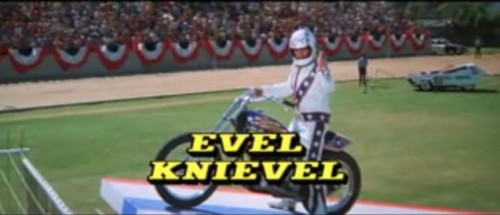
Viva Knievel! starts with the real-life, motorcycle-riding daredevil Evel Knievel breaking into an orphanage in the middle of the night, waking up all the children, and giving each of them their own Evel Knievel action figure.  When one of the kids says, “You actually came!,” Evel replies that he always keeps his word.  Another one of the orphans then throws away his crutches as he announced that he can walk again!

From there, Viva Knievel! only gets better as Evel preaches against drug use, helps his alcoholic mechanic (Gene Kelly) bond with his son, and flirts with a glamorous photojournalist (Lauren Hutton).  Evel was married at the time that Viva Knievel! was produced but his wife and family go unmentioned as Evel, Kelly, and Hutton travel through Mexico, jumping over fire pits, and battling drug dealers.

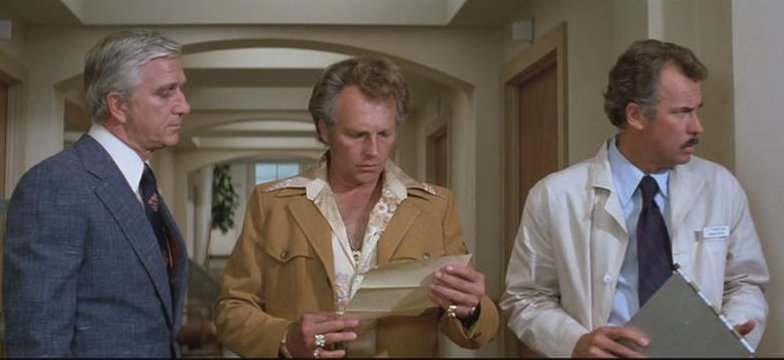
Evel’s former protegee, Jessie (former child evangelist Marjoe Gortner), has fallen in with a bad crowd and gotten messed up on the same drugs that Evel spends the entire movie preaching against.  An evil drug trafficker (Leslie Nielsen, a few years before Airplane! and The Naked Gun) pressures Jessie to convince Evel to do a dangerous stunt.  The plot is to replace Evel’s trusted mechanic with a crooked mechanic (Cameron Mitchell) who will sabotage the jump.  When Evel dies, he will be shipped back to the U.S. in a coffin and, hidden within the walls of the coffin, will be several kilos of cocaine.  Oh, the irony!  Evel Knievel, America’s number one spokesman against drugs, will be responsible for bringing them into the United States!  Can Evel thwart the nefarious plans of Leslie Nielsen while still finding time to fall in love with Lauren Hutton and break Gene Kelly out of a psychiatric ward?  If anyone can do it, Evel can.

Even Dabney Coleman’s in this movie!

From the start, Viva Knievel! is a vanity project but in the best, most loony and entertaining way possible.  There are many well-known actors in this film and all of them take a backseat to Evel Knievel, whom they all speak of as if he’s a cross between Gary Cooper and Jesus Christ.  Watching this movie, you learn three things: 1) Evel Knievel was high on life but not dope, 2) Evel Knievel always kept his word, and 3) Evel Knievel always wore his helmet.  He even makes sure that Lauren Hutton is wearing one before he takes her for a spin on his motorcycle.  You also learn that Evel Knievel liked to get paid.  He nearly beats up his manager (Red Buttons) when he thinks that he’s been cheated but they’re still friends afterwards because how could anyone turn down a chance to be in Evel’s presence?

There are plenty of stunts and jumps to be seen in Viva Knievel!, though watching Leslie Nielsen play a villain is almost as fun as watching Evel jump over a fire pit.  Judging from his performance here, Evel Knievel probably could have had a film career.  He had a natural screen presence and delivered even the worst dialogue with sincerity.   Unfortunately, three months after Viva Knievel! opened in the United States, Evel attacked a promoter with an aluminum baseball bat and ended up doing 6 months in jail.  Evel said it was because the promoter was spreading lies about him but, regardless, Evel lost most of his sponsorships and his toyline was discontinued.  Viva Knievel! sunk into an obscurity from which it has only recently reemerged.  Viva Knievel! is cheesy fun, a relic of a bygone era.  Watch it, think about whatever problems you may be dealing with in your own life, and then ask yourself, “What would Evel do?”


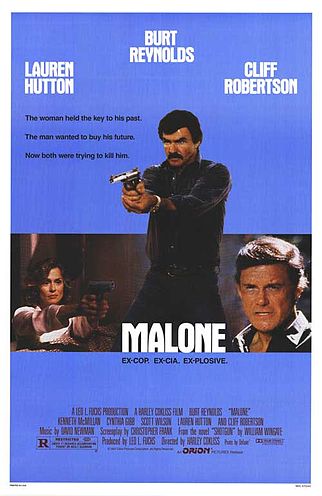
A Movie A Day #169: Malone (1987, directed by Harley Cokeliss)


It’s Burt Reynolds vs. Cliff Robertson.  Cliff has got the money but Burt’s got the mustache and the toupee.
Robertson plays Charles Delaney, a wealthy businessman who, with the help of a mercenary army, has bought nearly all the land in a small Oregon town.  Only the owner of a local gas station, Paul Barlow (Scott Wilson), has refused to sell.  Delaney and his men think that they can intimidate Paul into selling but what they do not realize is that Paul has a houseguest.  Richard Malone (Burt Reynolds) was driving through town when his car broke down.  While waiting for it to get fixed, he has been staying with Paul and his teenage daughter, Jo (Cynthia Gibb).  What no one knows is that Malone used to be an assassin for the CIA.

If ever there was a film that demanded the talents of Charles Bronson, it is Malone.  The tough and ruthless title character would have been a perfect Bronson role, especially if Malone had been made twenty years earlier.  Instead, the role went to Burt Reynolds, who was on the downside of his career as an action hero.  Sometimes, Burt tries to play the role as serious and emotionally guarded.  Then, in other scenes, Burt will suddenly smile and wink at the camera as he briefly turns back into the Bandit.  This is not one of Burt’s better performances.  He gets good support from the entire cast, including Lauren Hutton as his CIA handler, but, in most of his scenes, Burt comes across as being tired and his toupee makes him look like The Brady Bunch‘s Robert Reed.  Burt was 51 when he made Malone and he looked like he was at least ten years older, making the scenes where Jo comes onto him even more improbable.

Where Malone succeeds is in the action scenes.  Along with Burt’s final assault on Delaney’s compound, there is also a classic showdown in a barbershop.  Malone had a budget of ten million dollars.  How many blood squibs did that buy?  Pay close attention to the scene where two hitmen attempt to surprise Malone in his room and find out.

Malone is may not feature Burt at his best but it is still a damn sight better than some of the other films that awaited Burt once his starpower started to diminish.  Mad Dog Time, anyone?

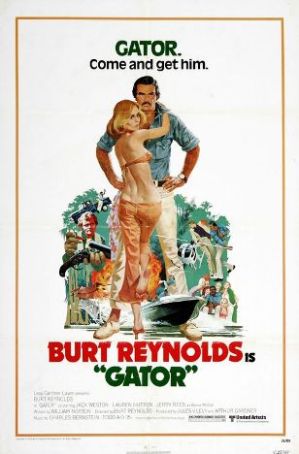
A Movie A Day #9: Gator (1976, directed by Burt Reynolds)


gatorposterGator McClusky is back!

Since the events in White Lightning, Gator (Burt Reynolds) has been released from prison and he’s now living in the Okefenokee Swamp.  Other than running moonshine, Gator is laying low and keeping to himself.  Gator may be done with the feds but the feds are not done with him.

Gator’s old friend, Bama McCall (Jerry Reed), is now unofficial boss of Dunston County and both the Department of Justice and the Governor of Georgia (played by talk show host Mike Douglas) are determined to take him down.  Federal agent Irving Greenfield (Jack Weston) is convinced that he can get Bama on charges of tax evasion.  But Irving’s from New York and he does not know how to talk to the good ol’ boys.  He needs someone on the inside and that’s where Gator comes in.

Gator not only starred Burt Reynolds but it was his directorial debut as well.  Though it’s a sequel to White Lightning, Gator feels like a very different movie.  Whereas Joseph Sargent kept White Lightning relatively serious, Reynolds take a more jokey approach with Gator.  Reynolds has his famous mustache and his hairpiece in Gator and the self-amused attitude that went along with them.  Gator is full of car chases, fist fights, willing women, and corny jokes.  It also has Lauren Hutton, playing a familiar character who would appear in all of Reynolds’s movies, the sophisticate who cannot resist Burt’s good ol’ boy, country charm.  In the 1970s, audiences couldn’t resist Burt’s good old boy charm, either.  Critics hated Gator but it made a lot of money.

Gator is dumb but fun.  The most interesting part of the movie is seeing Jerry Reed playing a ruthless villain.  Reed is thoroughly convincing as a Dixie Mafia crime boss, the type of redneck who earlier inspired Buford Pusser to pick up a baseball bat and destroy pool halls.  One year later, Jerry would play Burt Reynolds’s best friend in Smoky and the Bandit so it’s interesting to see them playing deadly rivals in Gator.

For tomorrow’s movie a day, Burt’s a football player in jail in The Longest Yard.

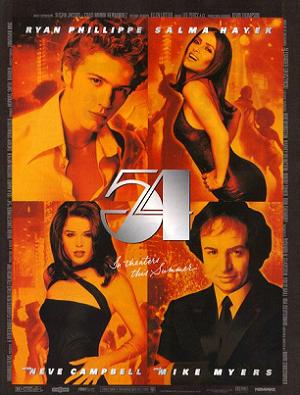
Embracing the Melodrama Part II #95: 54 (dir by Mark Christopher)


54_poster

“A guy named Steve Rubell had a dream: To throw the best damned party the world had ever seen and to make it last forever. He built a world where fantasy was put up as reality and where an 80-year-old disco queen could dance till dawn. Where models mingled with mechanics, plumbers danced with princes. It was a place where all labels were left behind. A place where there were no rules.”

— Shane O’Shea (Ryan Phillippe) in 54 (1998)

So, did you actually read that quote at the beginning of the review?  I don’t blame if you didn’t because not only is it ludicrous overwritten but it just goes on and on.  It’s one of those quotes that you read in a script and you think to yourself, “They better get absolutely the best actor in the world to deliver these lines,” and then you realize Ryan Phillippe has been cast in the role.

Except, of course, I doubt that any of those lines were found in the original script for 54.  54 is one of those films where, as you watch it, you can literally imagine the chaos that must have been going on during the editing process.  Subplots are raised and then dropped and the mysteriously pop up again.  Characters change both their personalities and their motives in between scenes.  Huge dramatic moment happen almost at random but don’t seem to actually have anything to do with anything else happening in the film.

In short, 54 is a mess but it’s a mess that’s held together by incredibly clunky narration.  Shane O’Shea, who spent the waning days of the 1970s working at Studio 54, narrates the film.  And, despite the fact that Shane is presented as being kinda dumb (think of Saturday Night Fever‘s Tony Manero, without the sexy dance moves), his narration is extremely verbose and reflective. It’s almost as if the narration was written at the last-minute by someone desperately trying to save a collapsing film.

I watched 54 on cable because I saw that it was about the 70s and I figured it would feature a lot of outrageous costumes, danceable music, and cocaine-fueled melodrama.  And it turns out that I was right about the cocaine-fueled melodrama but still, 54 is no Boogie Nights.  It’s not even Bright Lights, Big City.

54 does have an interesting cast, which makes it all the more unfortunate that nobody really gets to do anything interesting.  Poor Ryan Phillippe looks totally lost and, in the film’s worst scene, he actually has to stand in the middle of a dance floor and, after the death of elderly Disco Dottie (that’s the character’s name!), yell at all the decadent club goers.  Breckin Meyer is cute as Phillippe’s co-worker and Salma Hayek gets to sing.  Neve Campbell plays a soap opera actress who Phillippe has a crush on and…oh, who cares?  Seriously, writing about this film is almost as annoying as watching it.

Mike Myers — yes, that Mike Myers — plays the owner of the club, Steve Rubell.  The role means that Myers gets to snort cocaine, hit on Breckin Meyer, and vomit on the silk sheets of his bed.  I think that Myers gives a good performance but I’m not really sure.  It could have just been the shock of seeing Mike Myers snorting cocaine, hitting on Breckin Meyer, and vomiting on the silk sheets of his bed.

If you want to enjoy some 70s decadence, avoid 54 and rewatch either Boogie Nights or American Hustle.

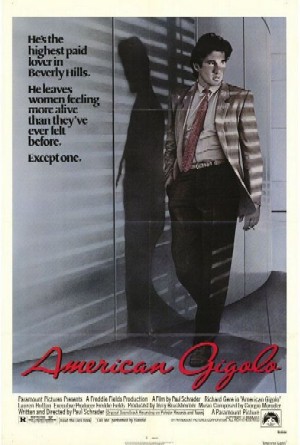
Embracing the Melodrama Part II #63: American Gigolo (dir by Paul Schrader)


American_gigolo_postWell, here we are!  A month and two days ago, I announced the start of Embracing the Melodrama Part II, a 126-film series of reviews.  At the time, I somewhat foolishly declared that I would manage to review all of these films in just three weeks!  Four weeks later and we have finally reached the halfway point.

So yeah…

Anyway!  We started this series of reviews with 1927’s Sunrise and we have worked our way through the films of the 30s, the 40s, the 50s, the 60s, and the 70s.  And now, as we hit the halfway point, it’s appropriate that we start a new cinematic decade.

In other words, welcome to the 80s!

Let’s start the 80s off with the 1980 film, American Gigolo.  Directed by Paul Schrader, American Gigolo is — much like Schrader’s Hardcore and The Canyons — a look at the sleazier side of life in California.  Julian Kaye (Richard Gere) is the most successful male escort in Los Angeles.  He’s handsome, he’s confident, he speaks multiple languages, and he maintains a proper emotional distance from … well, from everyone.  He’s got a fast car, expensive clothes, a great apartment, and — because it is the 80s after all — a small mirror that is perpetually coated in cocaine residue.

We don’t really learn much about Julian’s past.  We don’t know much about who he was before he became the American Gigolo.  (If this movie were made today, American Gigolo would be a part of the MCU and would end up joining The Avengers.)  However, the film is littered with clues.  For instance, we know that he used to work exclusively for Anne (Nina Van Pallandt) but he’s become so successful that Anne has lost her hold over him.  Before Julian worked for Anne, he worked for Leon (Bill Duke), a gay pimp.

Julian’s sexuality is a big question mark throughout the entire film.  Though all of his current clients are female and Julian brags about his ability to leave a woman feeling sexually satisifed, the film leaves it ambiguous as to whether or not he actually likes women.  (It’s suggested — though never explicitly stated — that Julian slept with men while he was working for Leon.)  Ultimately, for someone who has sex for a living, Julian seems oddly asexual.  It’s hard not to feel that Julian is only truly capable of desiring his own carefully constructed image.

Is Julian capable of love?  That’s the question that Michelle Stratton (Lauren Hutton) has to consider.  Michelle is unhappily married to a member of the U.S. Senate but she’s having an affair with Julian.

Michelle’s relationship with Julian is tested when Julian is accused of murdering one of his clients.  While Julian begs both his clients and his business associated to provide him with an alibi, he discovers that he’s basically alone.  Convinced that someone’s trying to frame him, Julian destroys his apartment and his car searching for clues.  As he grows more and more paranoid, his perfect image starts to crack and Michelle has to decide whether or not to sacrifice her marriage to protect him.

American Gigolo is technically a murder mystery but the murder doesn’t really matter.  Instead, it’s a character study of a man who is empty inside until, in Job-like fashion, he loses everything.  It’s also a very watchable exercise in pure, sleek, and probably cocaine-fueled style.  Richard Gere has always been an oddly hollow actor (and that’s not necessarily meant as a criticism) and that suggestion of inner emptiness makes him the perfect choice for the role of Julian Kaye.

American Gigolo is making the premium cable rounds right now.  Keep an eye out for it and don’t be surprised if you find yourself singing Call Me afterwards.