When I went to The Hunger Games on Friday, the last trailer shown before the film started was a 50-second teaser for The Twilight Saga: Breaking Dawn Part 2, which, by the way, is like one of the most awkward-sounded movie titles ever. Not that it matters since everyone’s just going to call it Twilight anyway…
Anyway, with this trailer, the Twilight series continues to equate losing one’s virginity to being turned into a supernatural creature. Despite the fact that the Hunger Games and Twilight are petty much designed to appeal to the same audiences, this trailer actually inspired some pretty derisive laughter from my audience. Most of that laughter was directed at poor Kristen Stewart hunting that deer but Edward’s comment regarding both he and Bella being the same temperature also got a reaction.
But you know what? Everyone laughs at Twilight and then they sneak off and wait in line for 24 hours to see the next movie*. As for me, I love my freaky, mismatched eyes but I still think it would be fun to have at least one red vampire eye…
————-
* That’s right. I said “wait in line…to see the next movie.” Deal with it, yankee.
Here’s the trailer for the film that will probably end up dominated my twitter timeline when it’s eventually released. I follow a lot of big Kerouac fans (and I think Big Sur is one of the great American novels) and I’ll be interested to see what they think of the long-delayed film version of On The Road. For now, I’ll just say that it’s rarely a good sign when the film version of an iconic novel is full of star cameos and I have a hard time imagining the dependably dull Garrett Hedlund as Dean Moriarty.
(Already, I can hear people complaining about the prominence of Kristen Stewart in the film’s trailer….)
“Harry Potter is about confronting fears, finding inner strength and doing what is right in the face of adversity. Twilight is about how important it is to have a boyfriend.” – Stephen King
I have a problem with the notion that says you have to have someone in your life in order for your life to be considered perfect or grand. I’m of the mind that you step into the world alone and leave it the same same way. Even if you are surrounded by your nearest and dearest friends when you pass, you’re still the only one making that trip. And while I love the notion of Romance, I don’t believe it needs to translate to “Omigod, if you’re not near me, I’m going to jump off this building, I swear it because I can’t talk about you without stammering.” or the other obsessive notions that Twilight seems to bring up. This doesn’t mean I outright hate everything that Twilight is, but I’m not totally fond of the overall message it conveys. Perhaps I’m just emotionally cold that way.
And yet, I may know more about Twilight than any other guy in the known universe. It’s an enigma, I know.
A little background on why I, a guy, am writing a review for The Twilight Saga: Breaking Dawn, which is pretty much geared for girls. Note that I’ll refer to the film just as Breaking Dawn, because I really don’t see Twilight as a Saga by any means.
In the early 90’s, I hit a “Vampire Phase”. Between playing games of Vampire: The Masquerade and reading every Vampire Chronicle novel that Anne Rice wrote up until Tale of the Body Thief, I was pretty involved. I grew up with Vampires that were monsters to be feared (and sometimes admired), and dodged the sun more or less. I even owned two vampire encyclopedias. Somewhere between Mark Danielewski’s “House of Leaves” (a book I still haven’t finished) and Andrew Davidson’s “The Gargoyle”, I picked up a hardcover copy of Stephenie Meyer’s “Twilight” from Barnes & Noble. I didn’t think much of the books, save that they were quick reads. Meyer and her vampires were far from Rice and her universe lacked the erotic flair of Laurell K. Hamilton’s earlier books in the Anita Blake series. They were more or less books for teens, but they had vampires in them, so I pretty much inhaled all four books (Twilight, New Moon, Eclipse, and Breaking Dawn) twice in Hardcover. I even went so far to read Meyer’s “The Host” and have seen all of the other Twilight films in the theatre. While they all seem to be really close to the source material, there’s something strange in the translation. What made sense on paper really didn’t on screen (Sparkling Vampires jump to mind), but I guess that’s for an Editorial.
So, when it came to reviewing Breaking Dawn, we at the Shattered Lens drew straws. While we hold to the tenet that any movie can be reviewed by anyone even if the movie was previously reviewed by anyone else (for alternate viewpoints), this was a film that was pretty much off our collective radars. I think we all secretly wanted Lisa or Erin to take it, but both Lisa and my cousin gave the argument that I could probably give a different perspective on the film than all of the girls who planned to see it, most of whom would sprout something like the following:
“I love Edward so much, and that he took his time with Bella was just so heartfelt that I wanted to cry. I felt so bad for Jacob that he could haven’t have her. He deserves better than that!! If anyone doesn’t like what I’m saying, then I will come to their houses and stab them with rusty blades in their beds because no one – I mean no one – gets in the way of my Twilight Love!! You haters could suck it! Team Edward/Jacob Forever!!!!”
So, here I am, writing this. Let’s see what becomes of it, shall we?
For those of you who managed to avoid the Twilight books and movies like they were Sutter Cane novels, here’s everything you’ll ever need to know.
Twilight is the story of Isabella Swan (Kristen Stewart) who moves from Arizona (where Meyer lives) to Forks, Washington to live with her Sheriff father, Charlie (Billy Burke). While in school, she meets an interesting but strange fellow in Edward Cullen (Robert Pattinson). After being saved from a near fatal car crash in an impossible fashion by Edward, Bella becomes intrigued with who and what he may be. A little big of Googling and book buying leads her to discover that Edward is in fact, a Vampire. He explains he’s dangerous. She doesn’t care. He states he’s a killing machine. She loves the danger. He steps into the sunlight to show he doesn’t burn, he just sparkles. She’s just mesmerized.
The original Twilight was Bella’s introduction to The Cullens (who are more or less Vegetarians in that they don’t go after humans, but animals instead):
Carlyle (Peter Facinelli) – Father figure and Doctor. He recruited the rest of the family.
Esmee (Elizabeth Reaser) – Carlyle’s Wife and Mother Figure.
Emmett (Kellan Lutz) – The Muscle of the Family and companion to Rosalie.
Rosalie (Nikki Reed) – Emmett’s Companion and is pretty much opposed to Bella up until Breaking Dawn, for reasons she explains in Eclipse.
Alice (Ashley Greene) – Companion to Jasper and has the ability to see the decisions that others make before they make them.
Jasper (Jackson Rathbone) -The newest vampire of the group and companion to Alice. Has the ability to manipulate the emotional tides of others.
In Twilight, Bella and the Family run into a trio of vampires, one of which decides he has to hunt down and kill Bella (because she’s food). The family is able to kill the vampire and get on with their undead lives, not before a final parting shot showing the vampire’s girlfriend and her desire to kill Bella in return. Bella decides it’s in her best interests to become a vampire and tries to persuade Edward to change her, but he refuses, citing she has many years ahead of her worth living.
In New Moon, Edward decides to celebrate Bella’s birthday at his place. After an accident occurs that leaves her bleeding, Jasper loses it and attacks her. The family is able to save her, but this convinces Edward that it just won’t work out and the entire family leaves town. Left on her own, Bella spends the next four months crying and screaming in her sleep over Edward until her father convinces her to hang out with her friends. She ends up spending more time with Jacob Black (Taylor Lautner), a friend who lives on a nearby reservation that clued her into what the Cullens really were. They get closer as friends and eventually, she discovers that Jacob and his family are actually Werewolves. While cool, she also learns that the Werewolves don’t get along with Vampires and despise the Cullens. They haven’t killed the vampires because of a Treaty that was enacted long ago. Werewolves stay on their side, Cullens on the other and no humans get hurt. Victoria (the girlfriend of that dead vampire in Twilight) returns to town to kill Bella, but she’s protected by the Wolves. She ends up doing a little cliff diving, which catches Alice’s attention and she manages to reunite with the family, though learns that Edward plans to kill himself. Edward believes she died when she jumped off the cliff, volunteering himself to death by the Vampire Congress known as the Volturri.
Alice and Bella fly to Italy and intercede, rescuing Edward from his fate and meeting the Volturri. As Bella knows too much, the Volturri leader demands that within a year she has to becomes a vampire. This of course, excites Bella and annoys Edward, who throws in a “Let’s get Married First” clause into the works. The idea of this is to help give closure to all the humans in Bella’s life. She reluctantly agrees to it. Jacob catches wind of this and spends the next book & film, Eclipse, trying to convince Bella that she should live and that he’s the better choice of a love interest.
Okay, Eclipse. Victoria knows that she can’t get to Bella on her own without dealing with both the Werewolves and the Vampires. She finds a resident of Forks in Seattle named Riley Biers and changes him to a Vampire, convincing him that the Cullens are bad and killed her friend. He builds an army and they attack the Cullens en masse, but somewhere along the line, Victoria forgot to mention there may be giant dogs in the area. The Cullens and Werewolves join forces and defeat the newborns with ease. In the process, Bella learns more about the Wolves and their ability to “Imprint”, meaning they basically obsess over one person for the rest of their lives (much like whales, I suppose). Luckily, Jacob hasn’t Imprinted on Bella yet. Edward eventually dispatches Riley and Victoria, leaving the romance to continue. In Eclipse, the Cullens explain to Bella how they came to be, partially to help her what she has to look forward to, positive or negative.
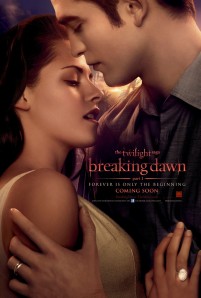
And all that brings us to Breaking Dawn, Part I.
Of the Twilight movies, I still feel Eclipse was the strongest one. Breaking Dawn covers everything the 1st half of the book does and manages to do it without stepping past the PG-13 bounds it created. The film starts off with Edward and Bella’s Wedding, with different reactions from everyone. Jacob hates it, wolfs out and runs to Canada. The Cullens are ecstatic. Charlie manages to deal with it. The wedding ceremony is done well, and gives some screen time to all of the high school friends (who we won’t be seeing after the wedding). Stephenie Meyer herself even has a cameo here (and eerily looks like my mother). Even the honeymoon is done better than I thought it would. Anyone expecting Bella and Edward’s honeymoon to look like something out of a late night Cinemax series may be disappointed, but the romance is nice to see and there were some laughs in the audience. Again, it’s Twilight. I’m not expecting Jane Eyre or Sense & Sensibility romance levels. At least, that’s what the snoring mother sitting next to me who brought her kids felt, I think.
After the married couple’s wild honeymoon, Bella discovers she’s miraculously pregnant and even worse, the unborn child is sucking the very life from her. The wolves find out about this and feel that she needs to be eliminated, along with the rest of the Cullens, as it breaks the Treaty. Bella is rushed home while the Cullens try to find a way to save both the baby and the mother. Will Bella make it? Will the Wolves pounce on the vampires? Those are some of the questions brought to the table.
Jacob finds himself taking sides with the Cullens, which causes him to recall his Alpha Status in his wolf pack and stand alone (or nearly alone) against his family. In the book, this was done pretty well, but translated to the screen the scene with wolves telepathically yelling at one another seemed a little cartoonish. Just change back to people and talk it over. I guess it was done that way to show how animals have the whole Alpha / Omega relationship, and remains one embarrassing moment in a sea of scenes that were okay.
Visually, Eclipse was a serious step up from both Twilight and New Moon. Breaking Dawn seemingly returns to the look and feel of the original Twilight, right down to Carter Burwell’s score. With the exception of the Bella’s Lullaby theme (which worked incredibly well, especially at the last two minutes of the film), the music felt a little weak to me. I actually preferred Howard Shore’s score to Eclipse. Don’t get me wrong, the movie goes where it’s supposed to, but you’d expect things to look a little better as it goes along. It would be nice if they improved on that.
One other thing I’ll give this (and that’s all of the Twilight mess) is the audience. I live for seeing audiences react to what they’re seeing on the screen, and I can’t remember a more reactive audience set since Captain America. Some of the girls who go to see this really go wild over it, and some of the guys grumble loudly. My theatre was packed, right down to the front seats where you have to crane your neck up to see everything. It’s the closest to a Midnight Movie experience you could have at a Matinee.
The big problem Breaking Dawn Part II will have will be trying to be exciting, because there isn’t a lot that occurs in the second half of the story that’s worthy of stretching it out to nearly two hours. It’ll be interesting to see what they do with that.
Overall, Breaking Dawn doesn’t really break any new ground in Vampire myths or anything like that. For anyone unfamiliar with the Twilight movies or books, it may feel slow and even a little boring at times. For it’s target audience (readers of the book), it gives them just about everything they wanted.
Last weekend, I went down to one of my favorite movie theaters, the wonderful Plano Angelika, and I saw one of the best — if unheralded — independent films of 2010, Welcome To The Rileys.
Kristen Stewart plays Alison, a 16 year-old runaway who, as the movie opens, is working as a stripper and prostitute in New Orleans. One day, while at work, she meets a middle-aged businessman named Doug Riley (James Gandolfini). Doug is in New Orleans attending a convention and he reluctantly accepts Alison’s offer of a private dance. As soon as they’re alone together, Alison immediately offers to have sex with Doug for money. Doug turns her down, Alison angrily accuses him of being an undercover cop, and a flustered Doug leaves the club. Later that night, Doug happens to run into Alison again and, looking to make amends with her, he gives her a ride back to her “home,” which turns out to be an apparently abandoned and condemned row house. Doug ends up sleeping over at the house (though again, he refuses to have sex with Alison). The next day, Doug offers to pay Alison a hundred dollars a day if he can stay in her house while he’s in New Orleans. Alison, who is always on the look out for extra money, agrees. After a rough start, Doug and Alison settle into a bizarre sort of domesticity with the paternalistic Doug teaching Alison how to make a bed and Alison calling on Doug when one of her clients refuses to pay her for her services.
What Alison doesn’t know is that Doug has a wife in Indiana. Lois Riley (played by Melissa Leo) hasn’t stepped outside of their suburban home in years. Ever since the tragic death of their 16 year-old daughter, Lois has cut herself off from the world and her husband (even to the extent of tolerating Doug’s affair with a local waitress). However, when Doug calls her from New Orleans and announces that he won’t be coming home for a while, Lois forces herself to leave the house. While Doug is busy trying to escape from reality, Lois is driving down to New Orleans to try to bring him back.
When Lois reaches New Orleans, Doug introduces her to Alison and, to his surprise, the two of them almost immediately start to bond. Lois tells Alison about how their daughter and Alison responds by telling the story (which, the film hints, might not be true) of how her own mother also died in a car accident. Soon, both Doug and Lois have — for all intents and purposes — adopted Lois as their own daughter. However, what neither has considered is that Alison might not want to a part of the Riley family…
Welcome To The Rileys is ultimately a touching and low-key exploration of grief, guilt, and the struggle to accept the occasionally unpleasant realities of life. It’s also a portrait of three lost souls struggling to connect with the existence around them. Jake (son of Ridley) Scott’s direction is properly low-key and manages to be affecting without indulging in any of the obvious tricks that one might expect to see in a film like this. However, what makes this film ultimately work is a strong trio of lead performances from Gandolfini, Leo, and Stewart.
Playing Doug (a character that both I and the film had mixed feelings about), James Gandolfini gives a performance that’s so good that I never once found myself tempted to make any “Soproano”-related asides under my breath. Though his Southern accent comes and goes, Gandolfini brings the perfect combination of warmth, concern, self-pity, and stubbornness to his role and he makes Doug an understandable and sympathetic — if not always likable — character. A part of me feels that the film’s screenplay is a bit too quick to let Doug off the hook for some of his actions but, as an actor, Gandolfini never makes the same mistake.
Playing Alison, Kristen Stewart proves that it’s time to forgive her for starring in Twilight. Her performances in Into The Wild and The Runaways provided hints that she’s actually a very talented actress but her performance here proves it. She not only captures Alison’s sadness but, even more importantly, she doesn’t shy away from the anger that feeds off that sadness. She never sentimentalizes her performance, there’s no moment where she pauses to let the audience know that she’s a good girl at heart. Instead, she dares us to reject her while revealing just enough of her inner pain to make it impossible for us to do so.
However, for me, the film really belongs to Melissa Leo. Whether she’s struggling to figure out how to drive her husband’s car or primly introducing herself to Alison (who, at the time, is dressed for work), Leo is simply amazing. When Lois first appeared in the film, I was worried because it felt as if the filmmakers were using her agorophobia to justify Doug’s adultery. However, Melissa Leo subtly and surely starts to peel away the layers of Lois’ outward repression until, by the end of the movie, Lois is the most vibrant character in the film. Just check out the scene where Lois responds to a flirtatious man in a truck stop with a combination of pride, amusement, and surprise and you’ll see what great acting is all about.
When Lois finally ends up in New Orleans, she seems to bring a whole new life to the movie. What previously seemed to simply be a meditation on loss and sadness is instead revealed to be a celebration of life and love. For a film that originally seemed to be about an errant husband and an angry runaway, Welcome To The Rileys eventually turns out to be a tribute to one woman who turns out to be far stronger than anyone gave her credit for.
With all the current Oscar hype surrounding films like The Social Network and The Kids Are All Right, Welcome To The Rileys is the type of low-key, subtle movie that will probably be forgotten in the rush to jump on all the more obvious bandwagons. That’s a shame because it’s one of the best films of 2010 and one that deserves to be seen over the years to come.
Have I mentioned how much I loved The Girl With The Dragon Tattoo? Have I suggested that the late Stieg Larsson, in the Millenium Trilogy, did for Europe what James Ellroy did for America with the American Tabloid trilogy? Have I gone into the fact I think Noomi Rapace’s performance as Lisbeth in both the original film and its sequels will probably be remembered as one of the greatest film performances of all time? Have I explained that I think, even beyond Rapace’s performance, Lisbeth herself is one of the best characters in the history of film? For that matter, have I talked about the hours that I’ve spent standing with my back to a mirror and looking over my shoulder and debating on which shoulder-blade a dragon would look most appropriate? Personally, I think my left shoulder-blade is a bit nicer than my right but last night, my friend Jeff was telling me that…
Sorry, I’m losing focus here. Okay, getting the ADD under control. Anyway, the point of the matter is that I love The Girl With The Dragon Tattoo.
That’s why I feel a lot of caution about the upcoming, David Fincher-helmed remake. First off, quite frankly, I really don’t see what can be improved on the original films. It’s not as if the original film version of the Girl With The Dragon Tattoo failed to do justice to the book (if anything, the book fails to do justice to the film that eventually made from it). I suppose a remake would give people who can’t handle subtitles the chance to see the story but honestly, who cares about those losers? Speaking of the story, the rumors I hear seem to indicate that this remake is going to be an “Americanized” version of The Girl With The Dragon Tattoo, which I’m not really sure can be done as the entire book is basically meant to act as a metaphor for Swedish society. Of course, it is possible that the remake is going to be set in Sweden as well but if that’s the case, what’s the point of the remake?
I know the usual argument to these concerns is that, as a director, Fincher will not allow the film to be Hollywoodized. At one point that may have been true but, judging from The Curious Case of Benjamin Button, Fincher’s got more Hollywood in him than most people want to admit. The fact that he’s also teamed up with Aaron Sorkin (an establishment figure if there ever was one) to direct a movie about Facebook doesn’t exactly fill me with confidence but I’ll hold off on judging until the Social Network actually shows up in theaters.
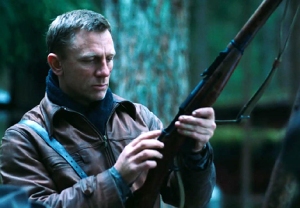
However, I am encouraged by the news (announced yesterday) that Fincher has cast Daniel Craig as the male lead, Mikael Blomkvist (or whatever his name is going to be in the Hollywood version). Craig’s name had been mentioned for the role ever since the remake was first announced but there were also reports that the role would go to Brad Pitt (who, of course, has already made 3 films with Fincher). Nothing against Brad Pitt (who I think is a truly underrated actor) but it’s hard to think of a worst choice for the role of Mikael. Mikael’s defining characteristic is just how ineffectual he is. He’s the ultimate well-meaning intellectual, the type of guy who wants to fight injustice but is to insulated from the harsh realities of life to effectively do so. (That’s why he needs Lisbeth, she represents everything he wishes he could do but can’t.) In short, Mikael is a hero by default and casting an actor like Brad Pitt would throw the entire movie off-balance.
Mikael is not a role for a star. Mikael is a role for a character actor and, James Bond aside, that’s exactly what Daniel Craig is. (That’s one reason why Craig’s Bond is dull, regardless of how good a performance Craig gives in the role.) Not only is Craig the right age, he projects just the right amount of idealistic weariness for the role. Admittedly, it helps that Craig bears a passable physical resemblance to the original Mikael, Michael Nyqvist which, if nothing else, will make it easier for fans of the original film — like me — to accept him.
(For the record, my personal choice for Mikael would have been Tim Roth.)
Of course, the question now is who will win the role of Lisbeth and why would they want it? For me, Noomi Rapace is Lisbeth. She is the girl with dragon tattoo. It’s hard to think of single mainstream actress in her 20s or early 30s who could hope to match Rapace’s performance. (Perhaps a young Angelina Jolie could have though physically, Jolie is all wrong for the part.) However, even beyond what Rapace did with the character, Lisbeth is one of the most vivid and memorable characters in recent literary history. Even without having to worry about the shadow of Rapace’s previous performance, the role is not an easy one.
Originally, rumor had it that Kristen Stewart was a lock for the role. At the risk of being burned at the stake as a heretic, I’m going to say that I think Stewart could have been an adequate (though not a great) Lisbeth except for the fact that she’s about ten years too young. (While Lisbeth is described as looking like a teenager, she also projects a worldliness of someone much older. Physical appearance can be faked but life experience can not.) Carey Mulligan, star of An Education (the best film of 2009, by the way), was another actress who was frequently mentioned.
Well, according to Entertainment Weekly, neither Stewart nor Mulligan will play Lisbeth Salander. Neither will Natalie Portman who, according to EW, was offered the role but turned it down. The offer to Portman makes sense as she’s physcially right for the role and she’s an undeniably talented actress. However, much as Pitt could never have been convincing as Mikael, Portman would have been miscast as Lisbeth. Portman may be a talented actress but she’s also a rather passive one. Even in her previous “action” roles (Leon, V For Vendetta), Portman essentially played a lost, damaged character (much like Lisbeth) who needed an older male figure to serve as her mentor (which, needless to say, is nothing like Lisbeth).
Again, according to EW, the role of Lisbeth has been narrowed down to four actresses: Rooney Mara, Lea Seydoux, Sarah Snook, and Sophie Lowe. It’s probably a good sign that none of these actresses are household names exactly. Competing with the shadow of Noomi Rapace’s Lisbeth is going to be difficult enough without also having to deal with the shadow of their own previous performances. (For instance, even if Stewart gave a brilliant performance as Lisbeth, it would still be impossible for me to get through the remake without making at least one Twilight joke.)
For me, the real question is not who is going to be cast as Libseth but if Fincher and his producers are going to give us the real Lisbeth — this would be the unapologetically lesbian Lisbeth who can only befriend Mikael once she’s sure that she doesn’t any sort of sexual attraction towards him — or if we’re going to get a more mainstream, Hollywood version of Lisbeth. Are we going to get the real Lisbeth who needs no one or are we going to get another version of what Hollywood claims to be a strong woman, one who can fight up until the final 30 minutes of the film at which point she’s suddenly rendered helpless by the demands of Mainstream Filmmaking 101.
More than anything, that will be the test that Fincher’s Girl With The Dragon Tattoo will have to pass if it wants to be anything more than an unneeded imitation of the original.
(Incidentally, the perfect Lisebth Salander would be Jena Malone. End of story.)
 Through the Shattered Lens