Lisa Reviews An Oscar Nominee: A Streetcar Named Desire (dir by Elia Kazan)


Poor, tragic Blanche DuBois.

In 1951’s A Streetcar Named Desire, the emotionally fragile Blanche (played by Vivien Leigh) has come to New Orleans to live with her younger sister, Stella (Kim Hunter).  From an old and formerly wealthy Southern family, Blanche has recently lost both her job as a teacher and the plantation where she and Stella grew up.  Even before that, she lost her husband to suicide.  And now Blanche has been reduced to living with Stella in the run-down apartment that she shares with her brutish husband, Stanley Kowalksi (Marlon Brando).

Stanley is tough and blue-collar, an earthy gambler whose bad manners stand in sharp contrast to Blanche’s attempts to present herself as being an elegant Southern belle.  Stanley, who is convinced that Blanche has money that she’s hiding from her sister, goes out of his way torment Blanche.  Stella, who is pregnant, tries to keep the peace between her sister and the man who claims to love her, his family, and the Napoleonic code.  (“Stella!” Stanley yells at one point, the cry of a wounded animal who desperately needs his mate.)  Blanche ends up going on a tentative date with Mitch (Karl Malden), one of Stanley’s co-workers,  Stanley, who sees Blanche as a threat to the life that he’s created for himself, goes out of his way to destroy even that relationship.  Blanche has secrets of her own and Stanley is determined to dig them up and use them to his own advantage.  When Blanche refuses to allow Stanley to destroy the fantasy world that she’s created for herself, Stanley commits an act of unspeakable violence.

Based on the play by Tennessee Williams, A Streetcar Named Desire is a recreation of the film’s legendary Broadway production.  Elia Kazan, who directed the theatrical production, does the same for the film.  Marlon Brando, Kim Hunter, and Karl Malden recreate their stage roles and many of the minor characters are also played by the same actors who played them on stage.  The only major change to the cast is Vivien Leigh, who replaces Jessica Tandy in the role of Blanche.  Tandy had won a Tony for playing the role of Blanche but the film’s producer insisted on an actress who had more box office appeal.  After both Bette Davis and Olivia de Havilland (both of whom would have had too strong of a personality to be believably pushed around by Stanley) declined the role, Vivien Leigh was cast.  Leigh has played Blanche on the London stage and, perhaps even more importantly, her own fragile mental health mirrored much of what Blanche had gone through before moving to New Orleans.

A few changes were made to the play.  In the play, it’s made clear that Blanche’s husband committed suicide after he was caught having an affair with another man.  In the film, Blanche simply says that her husband was too sensitive.  The film also includes a few scenes that are set outside of the apartment in an attempt to open up the play.  (That said, the film still comes across as being rather stagey.)  In the play, it’s made clear what Stanley does to Blanche while Stella is at the hospital.  The film leaves it ambiguous, though still providing enough hints for the audience to figure it out on their own.  Finally, the film ends with a suggestion that Stanley will ultimately suffer for his bad behavior.  It’s hardly a happy ending but it’s still not as dark as what happens in the play.

The film definitely retains its theatrical origins.  It’s very much a filmed play and again, it can feel rather stagey.  But the performance are so strong that it really doesn’t matter.  A Streetcar Named Desire was the first film to win three of the acting awards, with Oscars going to Hunter, Malden, and Leigh.  Marlon Brando was nominated for Best Actor but did not win, largely because he was competing against Humphrey Bogart who, himself, had never won an Oscar.  (The Brando snub would be rectified when he later won for On The Waterfront.)  Brando’s performance as Stanley still holds up today.  He’s so ferociously charismatic that it’s actually a bit scary to watch him.  One can see what drew Stella to him, even though Stanley is very much not a good man.  It’s a performance that will definitely take by surprise anyone who knows Brando only from his later years, when he was known for his weight and his oft-stated boredom with acting.  A Streetcar Named Desire shows just how brilliant an actor Marlon Brando was at the start of his career.  The intensity of Brando’s method acting matches up perfectly with Vivien Leigh’s more traditional style of acting and the film becomes not just the story of a domineering brute and a fragile houseguest but also a metaphor for the death of the antebellum South.  If Blanche represents a genteel past that may have never existed, Stanley represents the brutality of the 20th Century.

Along with the similarly dark A Place In The Sun, A Streetcar named Desire was considered to be a front runner for the 1951 Best Picture Oscar.  In the end, though, the voters went for the much less depressing An American In Paris.

A Streetcar Named Desire (1951, dir by Elia Kazan, DP: Harry Stradling)
Made-For-Television Movie Review: Skokie (dir by Herbert Wise)


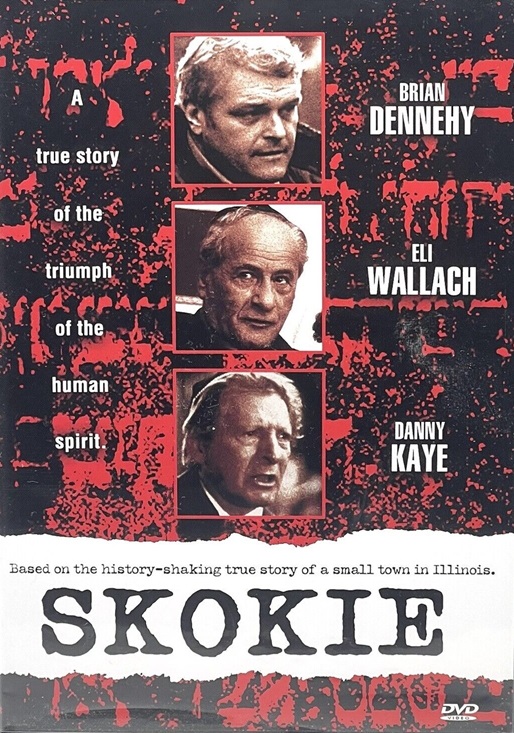
Skokie, a 1981 made-for-television movies, opens in a shabby Chicago office.

A group of men, all wearing brownshirts and swastika armbands, listen to their leader, Frank Collin (George Dzundza).  Collin says that they will be holding their next rally in the town of Skokie.  Collin explains that Skokie has a large Jewish population, many of whom came to the United States after World War II.  Collin wants to march through their town on Hitler’s birthday.

If not for the swastika and the brownshirt, the overweight Collin could easily pass for a middle-aged insurance salesman, someone with a nice house in the suburbs and an office job in the city.  However, Frank Collin is the head of the American National Socialist Party. a small but very loud group of Nazis who specialize in marching through towns with large Jewish populations and getting fee media attention as a result of people confronting them.  Making Frank Collin all the more disturbing is that he isn’t just a character in a made-for-television movie.  Frank Collin is a real person and Skokie is based on a true story.

The Mayor (Ed Flanders) and the police chief (Brian Dennehy) of Skokie are, needless to say, not happy about the idea of modern-day Nazis marching through their city.  Though they inform Collin that he will have to pay for insurance before he and his people will be allowed to hold their rally, they know that the courts have been striking down the insurance requirement as being a violation of the First Amendment.  While the mayor and the police chief worry about the political fallout of the rally, the Jewish citizens of Skokie debate amongst themselves how to deal with the Nazis.  Bert Silverman (Eli Wallach) and Abbot Rosen (Carl Reiner) argue that the best way to deal with Collin and his Nazis is to refuse to acknowledge them, to “quarantine” them.  As Rosen explains it, Collin is only marching to get the free publicity that comes with being confronted.  If he’s not confronted, he won’t make the evening news and his rally will have been for nothing.  However, many citizens of Skokie — including Holocaust survivor Max Feldman (Danny Kaye) — are tired to turning their back on and ignoring the Nazis.  They demand that the Nazis be kept out and that, if they do enter the city, they be confronted.

With the support of the ACLU, Collin sues for his right to march through Skokie.  The ACLU is represented by Herb Lewishon (John Rubinstein), a Jewish attorney who hates Collin and everything that he stands for but who also feels that the First Amendment must be respected no matter what.  When Lewishon is asked how he, as a Jew, can accept a Nazi as a client, Lewishon relies that his client is the U.S. Constitution.

Skokie is a thought-provoking film, all the more so today when there’s so much debate about who should and should not be allowed a platform online.  (Indeed, Collin and his Nazis would have loved social media.)  Lewishon argues that taking away any group’s First Amendment rights, regardless of how terrible that group may be, will lead to slippery slope and soon everyone’s First Amendment rights will be at risk.  Max Feldman, and others argue that the issue isn’t free speech.  Instead, the issue is standing up to and defeating evil.  The film gives both sides their say while, at the same time, making it clear that Frank Collin and his Nazis are a bunch of fascist losers.  It’s a well-acted and intelligently written movie, one that rejects easy answers.  Needless to say, at a time when so many people feel free to be openly anti-Semitic, it’s a film that’s still very relevant.

As for the real Frank Collin, he would eventually be charged with and convicted of child molestation.  After three years in prison, he changed his name to Frank Joseph and became a writer a New Age literature.  He’s looking for Atlantis but I doubt they’d want him either.

The Film of Dario Argento: Two Evil Eyes


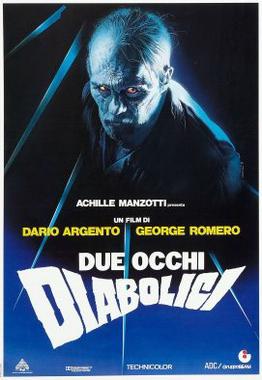
In 1990, long-time friends George Romero and Dario Argento collaborated on Two Evil Eyes, anthology film that was based on the writings of Edgar Allan Poe.  An Italian-American co-production, Two Evil Eyes featured two stories.  The first was directed by George Romero, while the second was directed by Argento.

The Facts In The Case of Mr. Valdemar

(Dir by George Romero)

The first story is Romero’s, a modernized version of The Facts In The Case of M. Valdemar.

Jessica Valdemar (Adrienne Barbeau) is the 40 year-old wife of 65 year-old, Ernest Valdemar (Bingo O’Malley).  Jessica only married Ernest for her money and, now that he’s on his death bed, she and her lover, Dr. Robert Hoffman (Ramy Zada), have hypnotized to him to do and say whatever they tell him to say and do.  Even though Ernest is essentially comatose, the hypnosis allows them to force Ernest to sign his name to legal documents and to tell his suspicious attorney (E.G. Marshall) that he indeed wants to leave all of his money to Jessica.

When Ernest dies while under the influence of hypnosis, Jessica and Robert attempt hide his body in the basement.  But is Ernest really dead?  Jessica is convinced that she hears groaning from the basement and she wonders if the hypnosis has somehow left Ernest in limbo, between life and death.  Robert thinks that Jessica is being foolish but it turns out that she’s not.  After much paranoia and betrayal, one conspirator is dead and the other is a part of the living dead.

Usually, I like Romero’s work but this one didn’t work for me.  From the flat cinematography to the shallow performances, this film felt more like an episode of a television show than anything else.  Perhaps if it had been a stand-alone film, Romero could have found a way to make the material a bit more cinematic.  (The story’s final shot, of blood dripping on a hundred dollar bill, is the film’s strongest moment and the part that feels the most Romeroesque.)  But as a shortened chapter of an anthology film, it fell flat.

The Black Cat

(Dir by Dario Argento)

The Dario Argento segment is based on several different Poe stories.  While the majority of the story is taken from The Black Cat, it also contains elements of Annabel Lee, Telltale Heat, The Pit and the Pendulum, and Buried Alive.  Though this segment doesn’t really work, it’s obvious that Argento is a fan of Poe’s work and, for other Poe fans, there’s a lot of fun to be found in all of the Poe references that Argento sneaks into his story.

Harvey Keitel stars as Rod Usher, a crime scene photographer who loves his work a bit too much.  He’s excited about the fact that his book of photography is about to be published.  He’s less happy about the fact that his girlfriend, Annabel (Madeleine Potter), has adopted a black cat that is constantly glaring at Rod.  Rod is eventually driven mad by both the cat’s apparent hatred of him and the fact that the cat itself keeps showing up no matter how far he goes to get rid of it.  (This film features violence against a cat, which I hated.  But it also featured a cat getting revenge and I appreciated that.)  Eventually, Rod’s paranoia leads to violence and murder.

Look, this is a film about a guy who has an obsessive hatred of a cat.  Obviously, this is not a film that I’m going to enjoy because I love cats.  That said, I can still judge the film on its merits, even if it’s not for me on a personal level.  While Argento is able to build up a good deal of tension and suspense in this film, the overall film doesn’t work because Harvey Keitel, supremely talented actor that he is, was totally the wrong choice for Rod Usher.  Keitel, who reportedly did not get along with Argento during filming, gave a self-indulgent performance that featured a lot of bellowing.  It’s as if Keitel is trying to compete with the constantly moving camera.  The problem is that a star of a film like this has to be the director and Keitel’s histrionics take the viewer right out of the story.

Considering all of the talent involved, Two Evil Eyes is a disappointment.

The (Reviewed) Films of Dario Argento:

  1. The Bird With The Crystal Plumage
  2. Cat O’Nine Tales
  3. Four Flies on Grey Velvet
  4. Deep Red
  5. Suspiria
  6. Inferno
  7. Tenebrae
  8. Phenomena
  9. Opera

Retro Television Reviews: In Search of America (by Paul Bogart)


Welcome to Retro Television Reviews, a feature where we review some of our favorite and least favorite shows of the past!  On Sundays, I will be reviewing the made-for-television movies that used to be a primetime mainstay.  Today’s film is 1971’s In Search of America!  It  can be viewed on YouTube!

College student Mike Olson (young Jeff Bridges) returns home and informs his mother (Vera Miles) and his father (Carl Betz) and his annoyingly quirky grandmother (Ruth McDevitt) that he’s dropped out of college.  He apologizes for wasting all the money that they spent on tuition but hey, maybe he can make it up to them by taking them on a journey as he drives across America in an old bus.

Uhmmm….

Now, let me just repeat this so that there is no confusion.  This absolutely schmuck took his parents’ money, wasted it, dropped out of college, and now he expects everyone to travel with him across America because he’s decided that he’s a part of the counterculture.

And, instead of telling him to go to Hell and get a job, his family agrees.

Oh sure, Mom is a little bit hesitant about Mike’s idea.  But Dad is really enthusiastic.  He understands the kids and he wants a chance to relive his own youth, before he got tied down with things like paying bills and being a responsible human being.  And, of course, if the Hippies were famous for anything, it was their love of upper class, middle-aged people.  Just ask the LaBiancas.

And, of course, grandma is totally excited about it because she’s an old person in a made-for-TV movie.

So, they all board the bus and Mike takes them to a music festival so that they can meet some of his friends.  For instance, there’s Nick (Sal Mineo), a drop-out who says that he’s more burned out than turned on.  There’s Annie (Tyne Daly), who is going to need someone to help deliver her baby.  There’s Bodhi (Glynn Turman), who is some sort of doctor.  He and grandma bond of their shared quirkiness.  And then there’s Kathy (Renne Jarrett), who is at the music festival despite the fact that she’s really sick and on the verge of dying. When Kathy’s parents (Howard Duff and Kim Hunter) show up looking for her, Mike has to decide whether to save her life or respect her wish to do her own thing.

This was obviously meant to be a pilot for a show where the family would travel around the country and I guess get involved in different adventures each week.  The main problem is that, while Jeff Bridges seems to be a bit of a hippie in real life, he’s not particularly convincing in this film.  He’s way too clean-cut and his family’s decision to follow him across the country never makes the least bit of sense.  As for the hippies themselves, they come across as being so shallow that I found myself wanting to donate money to the Nixon campaign.

Retro Television Reviews: Born Innocent (dir by Donald Wyre)


Welcome to Retro Television Reviews, a feature where we review some of our favorite and least favorite shows of the past!  On Sundays, I will be reviewing the made-for-television movies that used to be a primetime mainstay.  Today’s film is 1974’s Born Innocent!  It  can be viewed on Tubi!

Fresh off of her Oscar-nominated role in 1973’s The Exorcist, 15 year-old Linda Blair starred as Christine “Chris” Parker in Born Innocent.

Chris is a 14 year-old who has frequently been caught running away from home.  When you consider her home life, it’s easy to understand why she keeps running away.  Her father (Richard Jaeckel) is quick to lose his temper and obviously has no clue how to relate to a teenage daughter.  When he gets angry at Chris, he beats her.  Chris’s mother (Kim Hunter) spends all of her time smoking cigarettes, watching TV, and refusing to acknowledge what Chris is going through.  Chris’s older brother (Mitch Vogel) has escaped from their abusive home but he’s now got a family of his own and there’s no room for Chris.  With no other options available to her, Chris resorts to frequently running away from home.  In the eyes of the system, this makes her both a delinquent and a repeat offender.  However, as quickly becomes apparent, Chris is very naïve and hardly a criminal.  Instead, she’s just someone trying to escape a terrible situation.

After getting caught once again, Chris is sent to a juvenile detention center.  Unfortunately, because of overcrowding, Chris is sent to one of the toughest centers, one where she is surrounded by people who have done a lot more than just run away from home.  Everyone knows that Chris doesn’t belong at the center but there’s no where else to send her.  With the exception of one teacher (played by Joanna Miles), the staff is too overwhelmed to look after Chris.  Meanwhile, the other inmates see Chris as being an easy victim and they start to bully her.  Eventually, Chris loses her innocence and becomes just as ruthless and angry as her former victimizers.

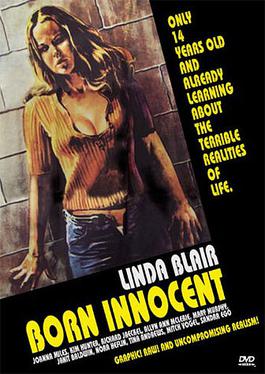
Born Innocent is often described as being an exploitation film and, indeed, one can just look at the artwork at the top of this review and see how the film was advertised when it was eventually released on video.  That said, the film itself may be undeniably melodramatic but there’s also a sincerity and a sensitivity to it that sets it apart from other women in prison films.  Born Innocent is all about how the System creates criminals.  From the start of the film, it’s obvious that being locked up is the last thing that Chris needs.  Instead, Chris just needs someone to be willing to listen to her but the System would rather just toss her in juvenile hall and then forget about her.  Only Chris’s teacher cares about her but, by the time they actually meet, it’s already too late for Chris.  She’s already been tossed into a situation where the only thing that matters is survival.  Born Innocent is controversial for a scene in which Chris is attacked by several other inmates and sexually assaulted with with a plunger.  It’s a shocking scene and I can only imagine have television audiences in 1974 reacted to it.  In this scene and the scenes that immediately follow, Linda Blair gives a harrowing performance that captures the emotional trauma of what Chris has been put through.  It’s not easy to watch and that’s the point.

Unfortunately, Blair is a bit less convincing during the second half of the film, in which Chris becomes progressively more and more cold-hearted.  The idea is that Chris, in order to protect herself, becomes just as intimidating as the girls who attacked her.  Unfortunately, the vulnerability that made Linda Blair ideal for The Exorcist and the first half of this film also make it difficult to take her seriously as cold-hearted sociopath.  During the second half of the film, Blair tries so hard to come across as being tough that she never convinces us.  Later, in films like Savage Streets, Blair would become one of the toughest badasses around but, in this film, she still come across as being essentially born innocent.

Horror On TV: Suspense 2.13 “Man In The House” (dir by Robert Stevens)


Look out!  There’s a man in the house!

In this case, the man (Alan Baxter) is an escapee from a psychiatric institution and he’s taken the owner of the house (Ruth McDevit) hostage!  Can Emily (Kim Hunter), the daughter of the hostage, maintain her daily routine without letting anyone in on what’s happening back at the house?  If she can’t, her mother will pay the consequences!

This suspenseful episode of Suspense originally aired on November 29th, 1949.  Two years after appearing on this show, Kim Hunter would appear in the film version of A Streetcar Named Desire.  Hunter would go on to win an Oscar for playing Stella Kowalski.

Enjoy!

sound + vision: THE SEVENTH VICTIM (RKO 1943)


gary loggins's avatarcracked rear viewer

sev1

Producer Val Lewton revitalized the horror film during his tenure at RKO Studios in the 1940s. Working with a miniscule budget, Lewton used the power of suggestion rather than monsters to create a body of work that’s still influential on filmmakers today. Studio execs came up with the sensationalistic titles (CAT PEOPLE, I WALKED WITH A ZOMBIE) and gave the producer free rein to tell the stories. Using shadows, light, and sound, Lewton’s quiet, intelligent approach to terror was miles ahead of the juvenile (but fun) stuff cranked out at Universal and Monogram.

THE SEVENTH VICTIM could be considered lesser Lewton. It’s  not seen as often some of his other classics, and that’s a pity, because it’s superior to many of the better known horror movies of the era. This quiet psychological thriller with its civilized satanic cult was a rarity for its time. Only Edgar G Ulmer’s 1934 THE BLACK CAT dared to tackle this kind of material…

View original post 1,285 more words

Embracing the Melodrama #23: The Swimmer (dir by Frank Perry)


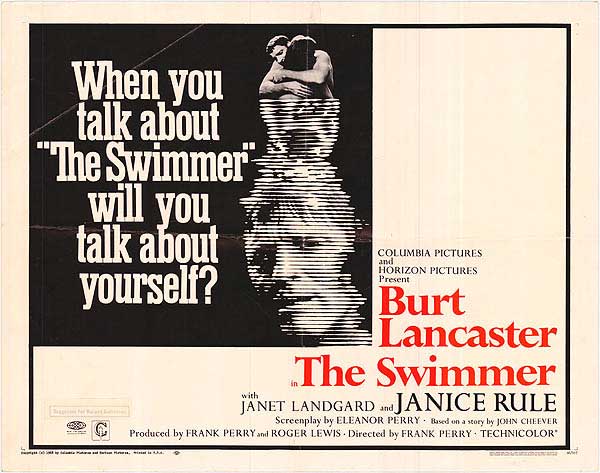
The Swimmer

The 1968 film The Swimmer opens with Ned Merrill (Burt Lancaster) emerging from the woods that surround an affluent Connecticut suburb.  He’s a tanned, middle-aged man and, because he spends the entire film wearing only a bathing suit, we can tell that he’s still in good shape for a man in his 50s.  When Ned speaks, it’s with the nonstop optimism of a man who has found and claimed his part of the American Dream.  In short, Ned appears to be ideal American male, living in the ideal American community.

However, it gradually starts to become apparent that all is not well with Ned.  When he mysteriously shows up at a pool party being held by a group of his friends, they all seem to be shocked to see him, commenting that it’s been a while since Ned has been around.  Ned, however, acts as if there’s nothing wrong and instead talks about how beautiful the day is and says that he’s heading back to his home.  He’s figured out that all of his neighbor’s swimming pools form a “river” to his house and Ned’s plan is to swim home.

And that’s exactly what Ned proceeds to do, going from neighbor to neighbor and swimming through their pools.  As he does so, he meets and talk to his neighbors and it becomes more and more obvious that there are secrets hidden behind his constant smile and friendly manner.  As Ned gets closer and closer to his actual home, the neighbors are far less happy to see him.

At one house, he runs into Julie (Janet Landgard) who used to babysit for his daughter.  Julie agrees to swim with Ned and eventually confesses that she once had a crush on him.  When Ned reacts by promising to always protect  and love her, Julie gets scared and runs away.

At another house, Ned comes across another pool party.  A woman named Joan (played by a youngish Joan Rivers) talks to him before a friend of her warns her to stay away from Ned.

When Ned reaches the house of actress Shirley (Janice Rule), it becomes obvious that Shirley was once Ned’s mistress.  They discuss their relationship and it quickly becomes apparent that Ned’s memories are totally different from Shirley’s.

And, through it all, Ned keeps swimming.  Even when he’s offered a ride to his house, Ned replies that he has to swim home.

The Swimmer is a film that I had wanted to see ever since I first saw the trailer on the DVD for I Drink Your Blood.  (That’s an interesting combination, no?  I Drink Your Blood and The Swimmer.)  I finally saw the film when it showed up on TCM one night and, when I first watched it, I have to admit that I was a little disappointed.  Stylistically, the film itself is such a product of the 1960s that, even though suburban ennui and financial instability are still very relevant topics, The Swimmer felt rather dated.  I mean, I love a good zoom shot as much as anyone but, often times during the 60s, they seemed to be used more for the sake of technique than the sake of story telling.

However, the second time I sat through The Swimmer, I appreciated the film a bit more.  I was able to look past the stylistic flourishes of the direction and I could focus more on Burt Lancaster’s excellent lead performance.  Lancaster plays Ned as the epitome of the American ideal and, as a result, his eventual collapse also mirror the collapse of that same ideal.  The Swimmer is based on a short story by John Cheever and, quite honestly, the film’s story is a bit too much of a literary conceit to really work on film.  That said, The Swimmer — much like the character of Ned Merrill — is an interesting failure, which is certainly more than can be said of most failures.


A Quickie With Lisa Marie: Escape From The Planet of the Apes (dir. by Don Taylor)


(Warning: Potential Spoilers, especially if you’re good at reading between the lines of my attempts to be all mysterious-like)

Continuing with our look at the original Planet of the Apes films, we come to 1971’s Escape from The Planet of the Apes.

Escape From The Planet of the Apes starts out with a huge problem — how do you make a sequel to a film that literally ended with the entire planet being destroyed?  Escape handles this problem by reversing the plotline of the original film.  Instead of a group of humans going into the future and landing on a planet dominated by apes, this film features three apes going into the past and landing on a planet dominated by the past.  It’s a premise that the film handles with a surprising amount of cleverness and the end result is probably the best of the various Planet of the Apes sequel.  Certainly, it is the only one that can stand alone as a film separate from the rest of the series.

Using Taylor’s old space capsule, Zira (Kim Hunter), Cornelius (Roddy McDowall), and Milo (Sal Mineo, who you know is doomed because he’s the only one of the three who hasn’t appeared in either of the two previous films) escape Earth shortly before Charlton Heston blows the planet up at the end of Beneath the Planet of the Apes.  Slipping through the same vortex as Heston did in the first film, they end up crash landing on Earth in the year 1974. 

At first, Cornelius and the outspoken Zira become media celebrities.  They do interviews with the press, appear on the covers of magazines, and are generally celebrated like simian Kardashians.  However, one scientist — played by a very handsome Eric Braeden (seriously, he has gorgeous hair in this film) — isn’t as charmed by Zira and Cornelius.  Instead, he views them as threats to the future of the human race, especially after he discovers that Zira is pregnant.

The character that Braeden plays, by the way, is named Dr. Otto Hasslien and attentive viewers will recognize the name from a throw-away reference made by Taylor (Charlton Heston) in the original Planet of the Apes.  One of the more interesting subtexts in this film is that, much as chimpanzees Zira and Cornelius are this film’s equivalent to the human Taylor, Braeden’s Hasslien is this film’s version of Dr. Zaius.  Much as Maurice Evans did for Dr. Zaius, Braeden brings a certain ambiguity to his villianous character.  Though Braeden’s actions are ultimately hateful, it’s also made clear that they’re more motivated by fear than by evil.  Indeed, when Braeden first appears in this film, he’s almost likable.  It’s only at the film’s conclusion that we become fully aware of the irony that the human, “civilized” Dr. Hasslien ultimately shows less mercy and empathy to Zira and Cornelius than the ape Dr. Zaius showed to Taylor.  The moral ambiguity of Braeden’s performance makes this a far more resonant film than most mainstream critics are willing to admit.

 As for, Zira and Cornelius, the once-fawing public eventually turns against them as it becomes apparent that for the two of them to exist, humanity has to be wiped out.  Zira and Cornelius find themselves hunted fugitives, fleeing for their lives while the whole planet — with the exception of a zoo keeper played by Ricardo Montalban and another scientist (played by Bradford Dillman — what a great name for an actor) — seems to be determined to destroy them.

Escape From The Planet of the Apes starts out as a likable, rather breezy social satire (much like Pierre Boulle’s Monkey Planet, the novel that Planet of the Apes was loosely adapted from) and that makes it even more surprising when, about halfway through, the movie shifts gears and becomes a rather dark and bleak action film.  It all ends, like many films from the early 70s, in a brutal act of violence that carries a surprising punch to it.  It’s after the end of the film that we truly become aware just how involved we had become with Zira and Cornelius.  A lot of that has to do with the strong performances of McDowall and Hunter who both created characters that came across as real and worthy, regardless of how many layers of makeup they were acting under.  Their chemistry as a couple makes this underrated film one of the surprising gems of the early 70s.

A Quickie With Lisa Marie: Beneath the Planet of the Apes (dir. by Ted Post)


(WARNING: SPOILERS)

Continuing my look at the original Planet of the Apes film series, we now come to the first sequel, 1970’s Beneath the Planet of the Apes.  Rather blandly directed by Ted Post and featuring only a cameo performance from Charlton Heston, Beneath the Planet of the Apes is rarely given the credit it deserves.  Yes, the first half of the film is rather forgettable but once you get through it, you discover one of the darkest films of the 1970s.

Beneath the Planet of the Apes begins with yet another human astronaut crash landing on the Earth of the future.  This astronaut is Brent and, as played by James Franciscus, he comes across as a slightly more earnest, far less charismatic copy of Charlton Heston’s Taylor.  Brent has been sent in search of Taylor.  Anyway, once he lands on the planet, he is quickly arrested by the apes, meets Zira (Kim Hunter) and Cornelius (David Watson, stepping in for Roddy McDowall), and then escapes with the still-mute Nova (Linda Harrison).  With Nova, Brent makes his way to the Forbidden City where he comes across the ruins of Grand Central Station and discovers that he’s actually on Earth. 

Yes, that’s right.  The first hour of this 95 minutes film is essentially just the first movie all over again.   And yes, this film’s (many) critics are correct when they say that this first hour drags and tests the audience’s patience.  Obviously, Brent may be shocked to discover he’s on Earth but it’s old news to us and many viewers are probably tempted to give up on this film before Brent even figures it out.

But don’t give up!  No, because if you stick with this film you’ll discover that, once Brent figures out where he is, things get really, really fucked up.

Essentially, Brent discovers that the ruins of New York City are now underground.  And in this underground city, there are people.  But they’re not people like Brent or Nova.  No, these are people who have been horribly scarred by radiation.  They’ve also mutated to the extent that they’ve developed the powers of telepathy and mind control.  Under the leadership of Mendez the Tenth (Paul Richards), they spend their time singing hymns to the Alpha/Omega nuclear bomb, or as they call it “The Holy Bomb.”  They keep the Holy Bomb in St. Patrick’s Cathedral.

These mutants capture both Nova and Brent.  Brent is tossed into a cell and who else is there but Taylor?  And Taylor, believe it or not, has become even more sarcastic and scornful than before!  Seriously, Charlton Heston frequently spoke about how much he hated this film and it’s obvious in his performance.  Heston might not have been happy about being there but the audience is because, even if he is busy hating himself, Taylor brings a jolt of life to the film.

And just in time because the Apes, led by Urko (James Gregory), have invaded the forbidden city!  They gun down all the mutants.  Brent , Taylor, and Nova manage to escape their prison and all three of them are promptly gunned down as well.  As he dies, Taylor manages to set off the Alpha/Omega bomb.  We see a blinding white light followed by a somber voice over that tells us: “In one of the countless billions of galaxies in the universe, lies a medium-sized star, and one of its satellites, a green and insignificant planet, is now dead.”

And that’s it!  There’s no final credits, not even a black-out. Instead, on that note, the movie just stops.

Now, seriously, tell me that’s not a great movie.