October Hacks: Wrong Turn (dir by Rob Schmidt)


Poor West Virginia!

Seriously, I’ve been to West Virginia.  It’s a beautiful state and the majority of the people that I met while I was there were just lovely.  And before anyone trots out all the usual stereotypes about rural communities, let me say that one of the nicest used book store that I’ve ever been to was in West Virginia.  It’s a nice state, one that feels like a throwback to a less cynical universe.  Even all of the bridges and the streets named after the loathsome Robert Byrd added to the lovely quaintness of the place.

And yet, when it comes to the entertainment industry, West Virginia is rarely portrayed in a positive light.  The coastal elite has never had much use for West Virginia or the surrounding states and that’s something that comes out in the films and television shows that are made in New York and California.  Whenever anyone says that they’re from West Virginia in a movie or a television show, you can be sure that they’re either going to be a meth cook or a villainous redneck.  West Virginia is one of those regions that’s never given much respect in Hollywood and that’s a shame.

Take Wrong Turn, for instance.  First released in 2003, the original Wrong Turn taught an entire generation that West Virginia was full of cannibals and blood farmers.  If you’re going to go for a drive in the wilderness of West Virginia, this film tells us, keep an eye out for barb wire booby traps.  If you’re going to hiking in the mountains, notify your next of kin because you probably won’t be coming back.  Wrong Turn follows a group of friends as they are tracked by a family of cannibal hillbillies and the main message seems to be, “For the love of God, stay out of Appalachia!”

(When I first started writing for this blog, I caused a mini-controversy when I said that no one would pay good money to see a film called The Vermont Chainsaw Massacre.  My point was that Texas has a reputation, albeit one that has more to do with fevered imaginings of out-of-staters than anything rooted in reality, that made it the only place where that film could really be effectively set.  The same is true of Wrong Turn.  It’s a story that people wouldn’t buy if it was happening anywhere other than in Appalachia.  Nobody would care about cannibals living in Minnesota, for instance.)

West Virginia slander aside, the original Wrong Turn holds up well.  It’s a slasher film from the era right before slasher films started taking themselves so seriously.  It’s a throwback to the rural horror films of the 70s, with an attractive cast getting picked off in various gruesome ways.  The cannibals are frightening and the victims are all likable without being so likable that you can’t handle seeing them killed off.  Jeremy Sisto and Lindy Booth both bring some comic relief to the film before their characters are dispatched.  Desmond Harrington is a sold-enough lead.  When I first saw Wrong Turn, my main reaction was that Eliza Dushku kicked ass and that was still my reactions when I rewatched it.  The film is bloody, shameless, and fully willing to give the audience what it wants without scolding them for it.  In short, it’s a perfectly fun slasher film and, watching it, it’s hard not to miss the era before horror films started taking themselves so damn seriously.

Wrong Turn‘s a fun movie.  But West Virginia is a lovely state and that should never be forgotten!
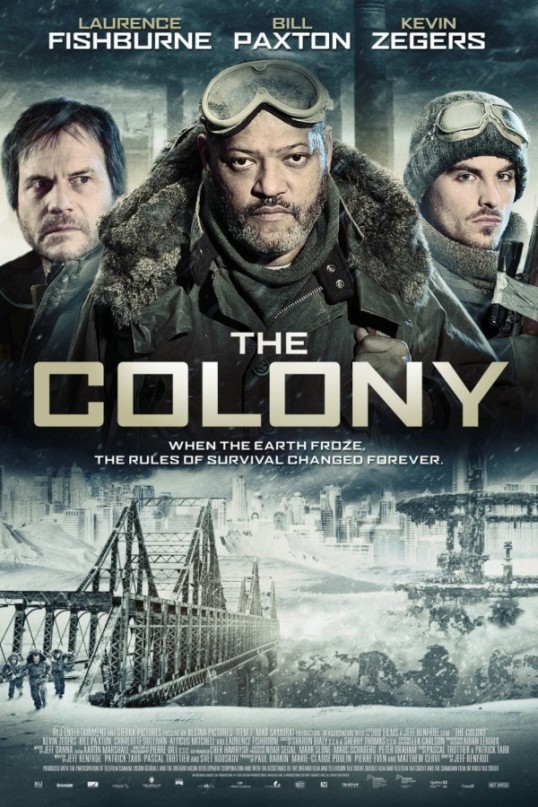
 

Horror Review: The Colony (dir. by Jeff Renfroe)


TheColony

“You’re going to need every bullet.”

The Colony was this little-seen horror film that came out in early 2013. From the trailers shown it looked like it was going to be a decent looking post-apocalyptic, scifi-horror that looked to evoke the sort of icy desolation and paranoia that Carpenter’s The Thing did so perfectly. Under Canadian-filmmaker Jeff Renfroe’s command the film’s high, lofty horror goals didn’t exactly come to fruition.

The film itself wasn’t awful by any stretch of the imagination, but it does suffer a lot from having it look like it was one of those mid-2000 SyFy film productions. At times some of the sequences even looked like it was copied off from one of those the SyFy “New Ice Age” disaster flicks starring Dean Cain. Yet, there’s some genuine tense moments in The Colony that should make this film a look-see if there’s nothing else to see.

Yes, the film is about the planet going through a sort of artificially-created Ice Age due to weather tampering. It’s a story that could’ve been lifted from early Twilight Zone episodes. Humanity barely survives inside spread out colonies using former factories and government bunkers. These colonies don’t just have the danger or dwindling supplies, simple diseases and the cold weather to deal with, but as we soon find out there’s now a new danger that’s much closer to home.

The Colony’s ad campaign and trailers have focused on it’s two American stars in Laurence Fishburne and Bill Paxton to sell the film. Both actors do some workman-like performances which helps anchor the ensemble cast’s performance. It’s the cast’s performances that elevates The Colony above it’s SyFy counterparts and one of it’s few saving graces. The other being the filmmakers’ success in creating a sense of freezing isolation through the use of arctic-like location shoots and some very well-done CGI icy landscapes.

The horror part of the film comes from the so-called “other” survivors who have adjusted to the scarcity of food by turning on the only abundant source of nourishment left in a world where there are no more growing things. Yes, The Colony tries to revive that old horror staple of the late 70’s and early 80’s which we know of as the cannibal-subgenre.

Cannibal films never truly went away but they remained mostly in the very outer fringes of the horror scene. They tended to be quite awful affairs that went for extreme shocks to bring in the horror crowd, but that only works when there’s a semblance of a narrative to explain things. With The Colony the film does a good enough job to try and explain why some have turned to a diet of the so-called other “white meat”. To add a new wrinkle to these feral antagonists the filmmakers they decided to update them for the modern audiences by giving them free-running skills that makes them seem more than human once they enter the screen. If the film has any sort of lesson to impart it could be that eating “long pig” might just give one parkour-like abilities.

The Colony definitely tried to be one of those scifi-horror that wanted to elevate itself to something beyond it’s grindhouse and exploitation roots, but it’s trying to be somethng it wasn’t meant to be that became it’s biggest flaw. The set-up of an Ice Age created by man is a time-tested story and the reintroduction of the cannibal thread to the film’s storyline was ripe for a grandg uignol-like production that could’ve been done using practical effects. But the filmmakers tried to mimic the CGI-smorgasbord of the Roland Emmerich-style, but they just barely distinguished themselves from what amounted to be an enhanced SyFy-production.

It’s a film that has enough entertaining moments, but overall it was a nice try that that just failed short of it’s goals.