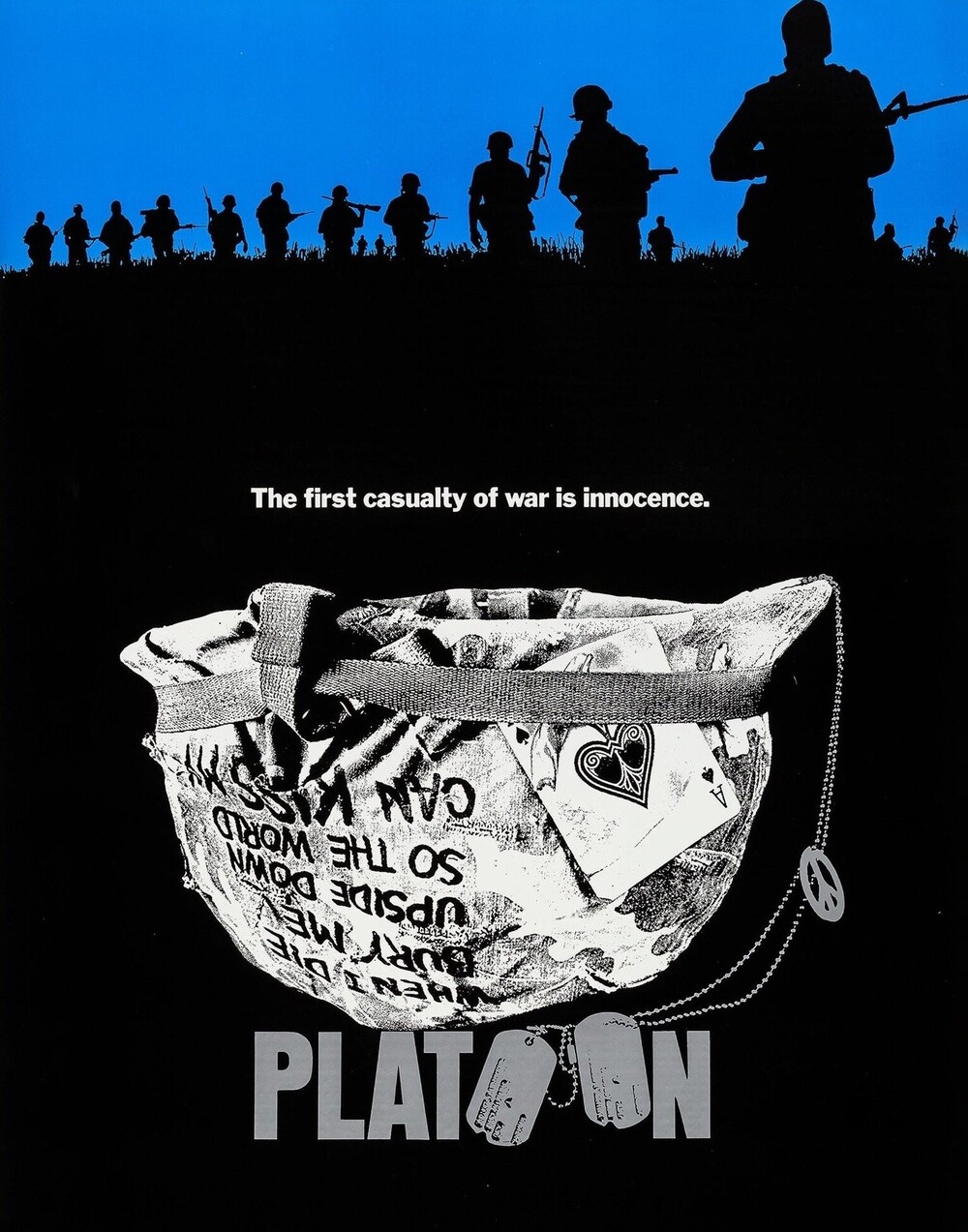
“We been kicking other peoples asses for so long, I figured it’s time we got ours kicked.” — Sgt. Elias
Platoon is one of those war movies that still feels raw, mean, and strangely alive decades later. It is not just a Vietnam movie about combat; it is a movie about confusion, fear, moral collapse, and what happens when young people are dropped into a nightmare with no real sense of why they are there.
What makes Platoon hit so hard is that it never feels polished in a comforting way. Oliver Stone keeps the film close to the mud, sweat, and panic of the battlefield, but he also spends plenty of time on the uglier stuff that happens between firefights: the resentment, the paranoia, the bullying, and the way men start forming little kingdoms inside a war zone. That is where the movie gets its power. The bullets matter, but so do the silences and side glances, because those moments show how war breaks people down before it even kills them.
Charlie Sheen’s Chris Taylor is a smart choice for the center of the film because he starts out as a kind of blank witness. He is young, idealistic in a vague way, and clearly not prepared for what he has walked into. That makes him easy to identify with, but it also makes him useful as a lens for everything around him. We learn the rules of this miserable little ecosystem as he does. Through Chris, the audience is pulled into the same sense of helpless observation that seems to define the whole experience of the platoon.
Stone’s screenplay makes that connection even stronger because he wrote it himself, drawing on his own experience as a young man who volunteered to go to Vietnam instead of being drafted. That detail gives Chris Taylor’s story a personal charge, since Chris feels less like a fictional stand-in and more like Stone working through his own memory and guilt. It adds another layer to the film’s emotional weight, because the perspective feels lived-in rather than invented for dramatic effect.
The film’s real muscle comes from the conflict between Sergeant Elias and Sergeant Barnes, played with complete commitment by Willem Dafoe and Tom Berenger. Elias feels like the last thread of conscience in a collapsing world. Barnes, by contrast, is the kind of man war can easily turn into a weapon: hard, cold, frightening, and convinced that brutality is just realism with the sentiment stripped out. Their conflict gives the movie a mythic quality without draining away its grit. It is not subtle in the usual sense, but it does not need to be. Stone wants these figures to feel bigger than life because that is how they register to a terrified kid in the jungle.
One of the best things about Platoon is how it balances chaos with purpose. A lot of war films either try to turn combat into spectacle or turn it into a lecture. Platoon mostly avoids both traps. The action is ugly, disorienting, and often difficult to follow in exactly the right way. You do not watch these battles and admire the choreography as much as you feel the confusion of everyone inside them. The filmmaking keeps you from getting too comfortable, which is exactly the point. War here is not heroic; it is exhausting, degrading, and terrifying.
That sense of exhaustion matters because the movie understands that war is not made up of only the big moments people remember. It is made up of waiting, heat, boredom, fear, and the slow erosion of judgment. Platoon is at its best when it lingers on that middle ground. The soldiers are not always in immediate danger, but they are always under pressure. That constant tension is what makes the movie feel so oppressive. Even when nothing explodes, it still feels like something bad is about to happen.
Stone also deserves credit for making a Vietnam movie that feels personal without becoming self-congratulatory. You can feel that this comes from experience, but the film never becomes some smug “I was there” statement. Instead, it channels memory into mood, character, and atmosphere. That gives the movie a lived-in authenticity that a lot of war films chase but never quite reach. It feels like a film made by someone trying to tell the truth about a memory that never stopped hurting.
There is also something brutally effective about the way Platoon presents morality as unstable rather than cleanly divided. The movie does not really pretend that everyone is either noble or evil. Instead, it shows how stress, fear, resentment, and power can shove people toward terrible choices. That is a big reason the film still works. It understands that war does not just expose character; it distorts it. Men do things they would never do anywhere else, and the movie keeps asking what is left of a person after that kind of damage.
Still, Platoon is not perfect, and part of its reputation comes from how forcefully it makes its points. Some viewers may find it a little heavy-handed at times, especially in the way it frames innocence, corruption, and betrayal. It is not exactly a subtle film, and it does occasionally aim for emotional impact with both fists. But honestly, that intensity is part of its identity. The movie is not trying to be cool or detached. It wants to wound you a little, and for this material, that approach makes sense.
The performances help keep the film from tipping over into empty grandstanding. Dafoe brings a wounded humanity to Elias that makes him feel like more than just a symbol. Berenger gives Barnes a dangerous stillness that is often more frightening than outright aggression. Sheen, meanwhile, does the important work of holding the center without overpowering the film. He is not the flashiest presence, but he does not need to be. His job is to absorb the madness, and that gives the audience a place to stand inside it.
What lingers most after Platoon is not any single battle scene, but the feeling that the whole movie is about a collapse of trust. Trust in leaders, trust in comrades, trust in the idea that there is some larger meaning to all this suffering. The film strips those things away layer by layer until all that is left is survival and the hope that maybe, somehow, the nightmare will end. That is a bleak place to sit for two hours, but it is also why the film remains so effective. It does not romanticize the experience. It forces you to sit with its mess.
The movie also has a strong visual identity. The jungle is not just background; it feels like an active pressure on every scene. The humidity, the darkness, the mud, and the smoke all help create a world that seems hostile even when nobody is shooting. That physical texture is a huge part of the movie’s success. You can almost feel the environment draining the people inside it. It is less like watching a battle than like watching human beings slowly get swallowed by a swamp of fear and violence.
If there is a reason Platoon still gets talked about so often, it is because it captures a very specific kind of war movie truth: the enemy is not only out there. Sometimes the real damage comes from within the unit, within the chain of command, within the soldier’s own mind. That is a grim idea, but Platoon never feels empty or cynical for saying it. It feels honest. And honesty, in a movie like this, goes a long way.
In the end, Platoon is powerful because it refuses to let war look clean, noble, or emotionally tidy. It is messy, relentless, and often hard to watch, but that is exactly why it matters. It is one of the defining Vietnam films for a reason, and even with its blunt edges, it earns that status through sheer force of feeling, strong performances, and a bleak sense of truth that never really lets up.
 Through the Shattered Lens