Long before he achieved holiday immortality by playing the father in A Christmas Story, Darren McGavin played journalist Carl Kolchak in the 1972 made-for-TV movie, The Night Stalker. Kolchak is investigating a series of murders in Las Vegas, all of which involve victims being drained of their blood. Kolchak thinks that the murderer might be a vampire. Everyone else thinks that he’s crazy.
When this movie first aired, it was the highest rated made-for-TV movie of all time. Eventually, it led to a weekly TV series in which Kolchak investigated various paranormal happenings. Though the TV series did not last long, it’s still regularly cited as one of the most influential shows ever made.
The Night Stalker is an effective little vampire movie and Darren McGavin gives an entertaining performance as the rather nervous Carl Kolchak.
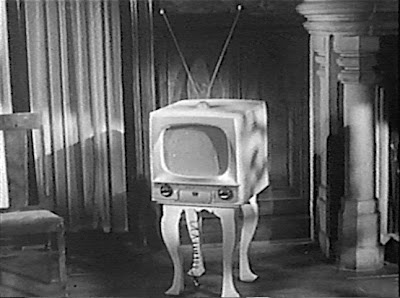
For today’s horror on the lens, we have a real treat! (We’ll get to the tricks later…)
Long before he achieved holiday immortality by playing the father in A Christmas Story, Darren McGavin played journalist Carl Kolchak in the 1972 made-for-TV movie, The Night Stalker. Kolchak is investigating a series of murders in Las Vegas, all of which involve victims being drained of their blood. Kolchak thinks that the murderer might be a vampire. Everyone else thinks that he’s crazy.
When this movie first aired, it was the highest rated made-for-TV movie of all time. Eventually, it led to a weekly TV series in which Kolchak investigated various paranormal happenings. Though the TV series did not last long, it’s still regularly cited as one of the most influential shows ever made.
The Night Stalker is an effective little vampire movie and Darren McGavin gives a great performance as Carl Kolchak.
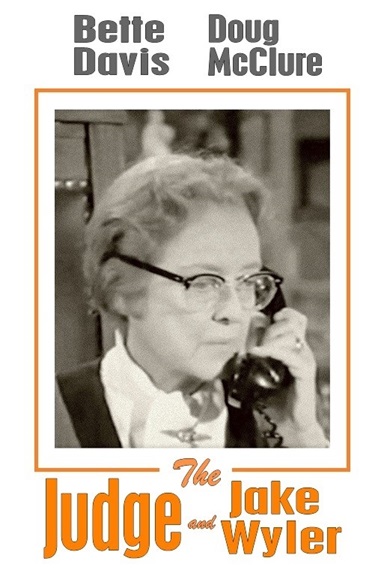
Welcome to Retro Television Reviews, a feature where we review some of our favorite and least favorite shows of the past! On Sundays, I will be reviewing the made-for-television movies that used to be a primetime mainstay. Today’s film is 1972’s The Judge and Jake Wyler! It can be viewed on YouTube.
Judge Meredith (Bette Davis) is a retired criminal court judge who has developed a severe case of hypochondria. She lives in a mansion that she never leaves. Anyone who comes to see her must be personally vacuumed by her butler before they can be allowed to stand in her presence. She hates people who take too long to get to the point and she also has little use for people who are rude on the phone. She especially dislikes cigarettes and refuses to have even an unlit one in her presence.
Jake Wyler (Doug McClure) is an ex-con who is currently on supervised probation. Despite his criminal past, he’s a likable and amiable guy and, every morning, he wakes up with a new woman in his bed. Jake enjoys tweaking authority and he always has a pack of cigarettes on him somewhere.
Together, they solve crimes!
They actually do! The judge is dealing with retirement by running her own detective agency, one that is exclusively staffed by people that she previously sentenced to prison. Jake does most of the leg work as far as the agency is concerned. The Judge calls him every morning and demands to know why he’s not working harder. Jake would rather just sleep-in but working for the judge is a part of his parole. She could easily send him and everyone else working for her back to prison. This sounds like a pretty unfair situation to me and the Judge is so demanding that I think it could be argued that she’s an abusive boss. But, because this is a pilot for a TV show and the Judge is played by Bette Davis, everyone is very loyal to her.
At the start of the film, Jake reveals to Robert Dodd (Kent Smith) that his wife, Caroline (Lisabeth Hush), has been cheating on him with Frank Morrison (Gary Conway). When Robert is later found dead in a hospital room, the official verdict is that he committed suicide. However, his daughter, Alicia (Joan Van Ark), claims that her father was murdered. At first, both Jake and the Judge suspect that Alicia just wants to collect a bigger life insurance settlement but it turns out that Dodd’s beneficiary wasn’t even Alicia. The money is going to his second wife, the one who was cheating on him. While the Judge yells at people on the phone, Jake investigates the death of Robert Dodd.
The Judge and Jake Wyler is a mix of comedy and mystery. Jake has a way with a quip and the majority of the suspects, including John Randolph and Eric Braeden, all have their own eccentricities. Director David Lowell Rich does a good job of keeping the action moving and the mystery itself is actually pretty interesting. Surprisingly, the show’s only real flaw is Bette Davis, who seems to be rather bored in the role of Judge Meredith. Even though the character seems to have been specifically written for her trademark caustic line delivery, Davis delivers her lines with little enthusiasm. One gets the feeling that she wasn’t particularly happy about the idea of having to do a television pilot.
Davis need not have worried. The Judge and Jake Wyler did not turn into a series. That said, the movie is an entertaining and diverting murder mystery.
For today’s horror on the lens, we have a real treat! (We’ll get to the tricks later…)
Long before he achieved holiday immortality by playing the father in A Christmas Story, Darren McGavin played journalist Carl Kolchak in the 1972 made-for-TV movie, The Night Stalker. Kolchak is investigating a series of murders in Las Vegas, all of which involve victims being drained of their blood. Kolchak thinks that the murderer might be a vampire. Everyone else thinks that he’s crazy.
When this movie first aired, it was the highest rated made-for-TV movie of all time. Eventually, it led to a weekly TV series in which Kolchak investigated various paranormal happenings. Though the TV series did not last long, it’s still regularly cited as one of the most influential shows ever made.
Anyway, The Night Stalker is an effective little vampire movie and Darren McGavin gives a great performance as Carl Kolchak.
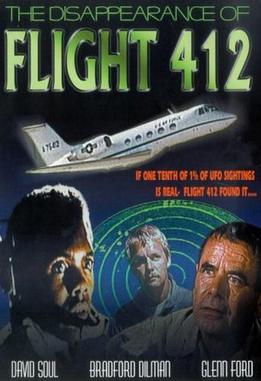
Because of recent electrical surges aboard its aircrafts, the commander of the Whitney Air Force Base 458th Radar Test Group sends a four-man crew up in Flight 412 to try to figure out what’s happening. Colonel Pete Moore (Glenn Ford) and Major Mike Dunning (Bradford DIllman) assume that it will just be a routine flight. Instead, they find themselves at the center of a government cover-up when Captain Bishop (David Soul) and the other members of the crew spot what appears to be a UFO. When two jets are sent out to intercept the object, the jets vanish.
Suddenly, Flight 412 is ordered to land at a seemingly deserted military base in the desert. When they do, the airplane is impounded and the crew is forced to undergo an 18-hour debriefing led by government agents. The agents demand that the crew members sign a statement saying that they didn’t see anything strange in the air before the jets vanished. Until all four of the men sign the release, the crew of Flight 412 are officially considered to be missing and will not be released until they agree to deny what they saw.
Meanwhile, Col. Moore tries to learn what happened to his men but the government, led by Col. Trottman (Guy Stockwell), is not eager to tell him.
This movie was made-for-television, at a time when people claiming to have been abducted by aliens was still a relatively new phenomenon. It was also made during the Watergate hearing and in the wake of the release of the Pentagon Papers, so the film’s sinister government conspiracy probably felt relevant to viewers in a way that it wouldn’t have just a few years earlier. I appreciated that the movie took a semi-documentary approach to the story but that it tried to be serious and even-handed. The film shows how witnesses can be fooled or coerced into saying that they saw the opposite of what they actually did see. Unfortunately, The Disappearance of Fight 412 is ultimately done in by its own cheapness. The overreliance on familiar stock footage doesn’t help the film’s credibility and there’s too many familiar faces in the cast for the audience to forget that they’re just watching a TV movie. The Disappearance of Flight 412 doesn’t really succeed but it is still interesting as an early attempt to make a serious film about the possibility of alien abduction and the government covering up the existence of UFOs.. Three years after this film first aired, Steven Spielberg would introduce these ideas to an even bigger audience with Close Encounters of The Third Kind.
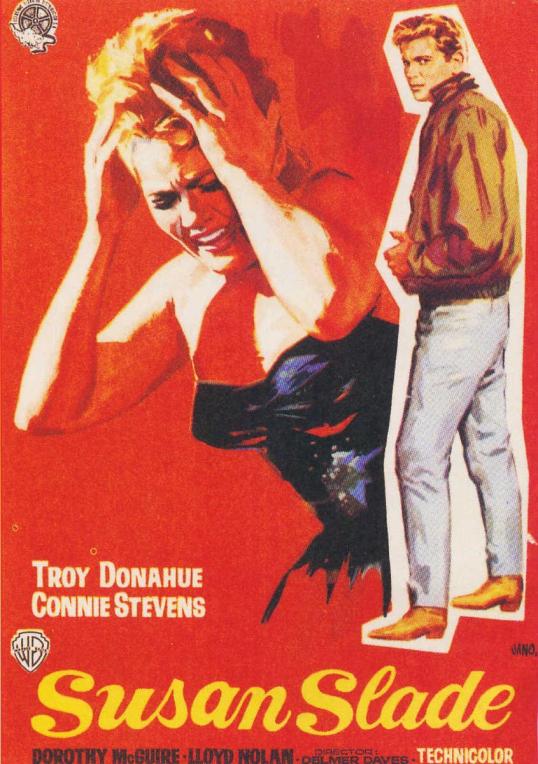
Shortly after this 1961 film begins, 17 year-old Susan Slade (Connie Stevens) announces, “We’ve been sinful!”
She’s talking to her first lover, Conn White (Grant Williams). You would think that anyone — even someone as unbelievably naive and innocent as Susan Slade — would know better than to ever trust someone named Conn White but no. From the minute that Conn and Susan met on an ocean liner heading from South America to California, it was love at first sight. In fact, Susan was so sure of her love that she spent the night in Conn’s cabin, fully knowing that it would mean surrendering her status as an Eisenhower era good girl.
Conn laughs off her concerns about sin. He also tells her that it makes perfect sense for her not to tell her parents (played by Dorothy McGuire and Lloyd Nolan). “When we’re married,” he asks, “are you going to tell your mother every time that we make love?”
Wow, Conn still wants to get married even though he’s already had sex with her!? And he’s also extremely wealthy and stands to inherit control of a multinational corporation! He sounds like the perfect guy! Way to go, Susan!
Unfortunately, it turns out that Conn does have one flaw. He really, really likes to go mountain climbing. In fact, he’s planning on scaling fearsome old Mt. McKinley. While Susan and her family settle into life in Monterey, California, Conn heads up to Alaska. He promises Susan that he’ll keep in touch but, when she doesn’t hear from him, she fears the worse. Has he abandoned her? Was he lying when he said he wanted to get married? Then one day, she gets a call from Conn’s father, informing her that Conn fell off the mountain and died. Susan’s almost father-in-law tells her that Conn’s body cannot be retrieved from the mountain. Though it’s neither confirmed nor denied by the film, I decided that this was because Conn faked his own death to get out of having to spend any more time listening to Susan talk about sin.
Anyway, Susan’s single again but, fortunately, she does not lack for suitors. For instance, there’s the spoiled Wells Corbett (Bert Convy), who is kind of shallow and arrogant but who has a lot of money. And then there’s Hoyt Brecker (played, in reliably vacuous style, by Troy Donahue), who is poor but honest and who is also an aspiring writer. “Someday,” Susan declares,”they’ll say that Robert Louis Stevenson, Jack London, and Hoyt Brecker wrote here!” Who will Susan chose? The sensitive artist who loves her unconditionally or the arrogant rich boy who smirks his way through the whole film?
Complicating matters is the fact that Susan is …. pregnant! That’s right, this is another one of those movies from the early 60s where having sex outside of marriage always leads to an unplanned pregnancy. And, because this movie is from 1961, the only solution is for the Slades to move down to Guatemala for two years, just so they can fool the people on Monterey into believing that the baby is actually McGuire’s and that Susan Slade is not an unwed mother but is instead an overprotective older sister. Will either of Susan’s two suitors be waiting for her when she and her family return to California?
Now, please don’t get me wrong. I do understand that there’s a big difference between 1961 and 2019 and that there used to be a lot more scandal attached to sex outside of marriage and unwed pregnancy. In fact, I guess that difference is really the only thing that makes Susan Slade interesting to a modern viewer. As soon as we see that this film was directed by Delmer Daves (the poor man’s Douglas Sirk) and that it stars Troy Donahue, we know who poor Susan is going to end up with so it’s not like there’s any real surprises lurking in the film’s plot. And none of the actors, though Connie Stevens sometimes to be trying, seems to be that invested in the film’s story. Instead, Susan Slade is mostly useful of a time capsule of the time in which it was made, a time when sex outside of marriage was unironically “sinful” and the only possible punishment was either pregnancy, death, or both. Indeed, Susan Slade is less concerned about the hypocrisy of a society that would force Susan to lie about her new “brother” and more about whether bland lunkhead Troy Donaue will still be willing to marry Susan even if she’s no longer eligible to wear white at their wedding. The film seems to be asking, “After being sinful, can Susan Slade become a good girl again?” As a movie, it’s fairly turgid but as a cultural artifact of a time in which everyone was obsessed with sex but no one was willing to talk about it, Susan Slade is occasionally fascinating.
Poor Susan Slade! If only she had gotten pregnant in a 1971 film instead of one made in 1961, her story could have been so different. But no, she was sinful in the early 60s and that means she’ll be have to settle for Troy Donahue.
I don’t know if I’ve ever seen Gary Cooper look as miserable in any film as he did in the 1949 film, The Fountainhead.
In The Fountainhead, Gary Cooper plays Howard Roark. Roark is an architect who we are repeatedly told is brilliant. However, he’s always has to go his own way, even if it means damaging his career. At the start of the film, we watch a montage of Howard Roark losing one opportunity after another. He gets kicked out of school. He gets kicked out of the top design firms. Howard Roark has his own vision and he’s not going to compromise. Roark’s a modernist, who creates sleek, powerful buildings that exist in defiance of the drab, collectivist architecture that surrounds them.
Howard Roark’s refusal to even consider compromising his vision threatens the rich and the powerful. A socialist architecture critic with the unfortunate name of Ellsworth Toohey (Robert Douglas) leads a crusade against Roark. And yet, even with the world against him, Roark’s obvious talent cannot be denied. Dominique Francon (Patricia Neal) finds herself enthralled by the sight of him working in a quarry. Fellow architect Peter Keating (Kent Smith) begs Howard to help him design a building. Newspaper publisher Gail Wynard (Raymond Massey) goes from criticizing Howard to worshipping him.
Have I mentioned that Howard Roark doesn’t believe in compromise? If you have any doubts about this, they’ll be erased about halfway through the movie. That’s when Roark responds to a company altering one of his designs by blowing up a housing project. Roark is arrested and his subsequent trial soon turns into a debate between two opposite philosophies: individualism vs. collectivism.
So, let’s just start with the obvious. Gary Cooper is all wrong for the role of Howard Roark. As envisioned by Ayn Rand (who wrote both the screenplay and the novel upon which it was based), Roark was meant to be the ideal man, a creative individualist who has no doubt about his vision and his abilities. Cooper, with his down-to-Earth and rather modest screen persona, often seems to be confused as to how to play such a dynamic (some might say arrogant) character. When Roark is meant to come across as being uncompromising, Cooper comes across as being mildly annoyed. When Roark explains why his designs must be followed exactly, Cooper seems to be as confused as the people with whom Roark is speaking. It doesn’t help that the 47 year-old Cooper seemed a bit too old to be playing an “up-and-coming” architect. In the book, Roark was in his 20s and certainly no older than his early 30s. Cooper looks like he should be relaxing in a Florida condo.
Who, among those available in 1949, could have been convincing in the role of Howard Roark? King Vidor wanted Humphrey Bogart for the role but if Cooper seemed to old for the part, one can only imagine what it would have been like with Bogart instead. Henry Fonda probably could have played the role. For that matter, William Holden would have been an interesting pick. Montgomery Clift and John Garfield would have been intriguing, though Garfield’s politics probably wouldn’t have made Ayn Rand happy. If Warner Bros. had been willing to wait for just a few years, they could have cast a young Marlon Brando or perhaps they could have let Douglas Sirk make the movie with Rock Hudson and Lana Turner. (Or, if you really wanted to achieve peak camp, they could have let Delmer Daves do it with Troy Donahue and Sandra Dee.)
If you can overlook the miscasting of Gary Cooper, The Fountainhead‘s an entertaining film. King Vidor directs the film as if it’s a fever dream. The film’s dialogue may be philosophical but the visuals are all about lust, with Pat Neal hungrily watching as a shirtless Gary Cooper breaks up rocks in the quarry and Vidor filling the film with almost fetishistic shots of phallic Howard Roark designs reaching high into the sky. If Cooper seems confused, Neal seems to be instinctively understand that there is no place for underplaying in the world of The Fountainhead. The same also holds true of Robert Douglas, who is a wonderfully hissable villain as the smug Ellsworth Toohey. Interestingly, the film ends with a suicide whereas the novel ended with a divorce because, under the production code, suicide was apparently preferable to divorce. I guess that’s 1949, for you.
Because America is currently having a socialist moment, there’s a tendency among critics to be dismissive of Ayn Rand and her worship of the individual above all else. Rand’s novels are often dismissed as just being psychobabble, despite the fact that, in some ways, they often seem to be borderline prophetic. (Barack Obama’s infamous “You didn’t build that!” speech from 2012 could have just as easily been uttered by Ellsworth Toohey or one of the many bureaucrats who pop up in Atlas Shrugged.) Here’s the thing, though — as critical as one can be of Rand’s philosophy, there’s still something undeniably appealing about someone who will not compromise their vision to the whims of the establishment. It’s goes beyond politics and it gets to heart of human nature. We like the people who know they’re talented and aren’t afraid to proclaim it. (Modesty, whether false or sincere, is a huge turn off.) We like the people who take control of situations. We like the people who are willing to say, “If you don’t do it my way, I’m leaving.” In a way, we’re all like Dominique Francon, running our hands over architectural models while trying to resist the temptation to compromise and accept something less than what we desire. We may not want to admit it but we like the Howard Roarks of the world.
For today’s horror on the lens, we have the 1946 suspense film, The Spiral Staircase!
In this film, Dorothy McGuire plays Helen, a young mute woman who has been hired to serve as a caretaker for wealthy old Mrs. Warren (Ethel Barrymore, who was nominated for an Oscar for this film). At the same time, someone is murdering women in the same town. Are they all connected? Of course, they are! The fun of the movie is discovering how they’re connected.
I was introduced to The Spiral Staircase by my friend and fellow member of the Late Night Movie Gang, Chris Filby. It’s a gothic murder mystery, full of atmosphere and menace. I think you’ll like it so, if you have 80 minutes to spend on it, please watch and enjoy!
For today’s horror on the lens, we have a real treat! (We’ll get to the tricks later…)
Long before he achieved holiday immortality by playing the father in A Christmas Story, Darren McGavin played journalist Carl Kolchak in the 1972 made-for-TV movie, The Night Stalker. Kolchak is investigating a series of murders in Las Vegas, all of which involve victims being drained of their blood. Kolchak thinks that the murderer might be a vampire. Everyone else thinks that he’s crazy.
When this movie first aired, it was the highest rated made-for-TV movie of all time. Eventually, it led to a weekly TV series in which Kolchak investigated various paranormal happenings. Though the TV series did not last long, it’s still regularly cited as one of the most influential shows ever made.
Anyway, The Night Stalker is an effective little vampire movie and Darren McGavin gives a great performance as Carl Kolchak.
At the turn of the 20th century, the mayor and the business community of Cottonwood Springs, Texas are determined to bring their small town into the modern era. The Mayor (Larry Gates) has even purchased one of those newfangled automobiles that have been taking the country by storm. However, the marshal of Cottonwood Spings, Frank Patch (Richard Widmark), is considered to be an embarrassing relic of the past. Patch has served as marshal for 20 years but now, his old west style of justice is seen as being detrimental to the town’s development. When Patch shoots a drunk in self-defense, the town leaders use it as an excuse to demand Patch’s resignation. When Patch refuses to quit and points out that he knows all of the secrets of what everyone did before they became respectable, the business community responds by bringing in their own gunfighters to kill the old marshal.
Death of a Gunfighter is historically significant because it was the very first film to ever be credited to Allen Smithee. The movie was actually started by TV director Robert Totten and, after Widmark demanded that Totten be fired, completed by the legendary Don Siegel. Since Totten worked for 25 days on the film while Siegel was only on set for 9, Siegel refused to take credit for the film. When Widmark protested against Totten receiving credit, the Director’s Guild of America compromised by allowing the film to be credited to the fictitious Allen Smithee.
In the years after the release of Death of a Gunfighter, the Allen (or, more often, Alan) Smithee name would be used for films on which the director felt that he had not been allowed to exercise creative control over the final product. The Smithee credit became associated with bad films like The O.J. Simpson Story and Let’s Get Harrywhich makes it ironic that Death of a Gunfighter is not bad at all. It’s an elegiac and intelligent film about the death of the old west and the coming of the modern era. It also features not only one of Richard Widmark’s best performances but an interracial love story between the marshal and a brothel madame played by Lena Horne. The supporting cast is full of familiar western actors, with Royal Dano, Harry Carey, Jr., Larry Gates, Dub Taylor, and Kent Smith all making an impression. Even the great John Saxon has a small role. Though it may be best known for its “director,” Death of a Gunfighter is a film that will be enjoyed by any good western fan.

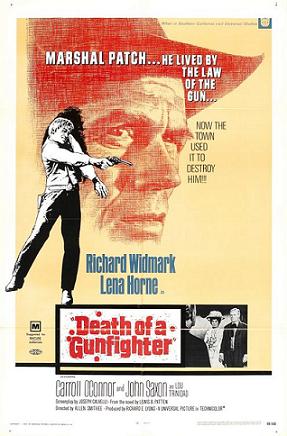 At the turn of the 20th century, the mayor and the business community of Cottonwood Springs, Texas are determined to bring their small town into the modern era. The Mayor (Larry Gates) has even purchased one of those newfangled automobiles that have been taking the country by storm. However, the marshal of Cottonwood Spings, Frank Patch (Richard Widmark), is considered to be an embarrassing relic of the past. Patch has served as marshal for 20 years but now, his old west style of justice is seen as being detrimental to the town’s development. When Patch shoots a drunk in self-defense, the town leaders use it as an excuse to demand Patch’s resignation. When Patch refuses to quit and points out that he knows all of the secrets of what everyone did before they became respectable, the business community responds by bringing in their own gunfighters to kill the old marshal.
 Through the Shattered Lens