Late Night Retro Television Review: Freddy’s Nightmares 1.18 “The Art of Death”


Welcome to Late Night Retro Television Reviews, a feature where we review some of our favorite and least favorite shows of the past! On Fridays, I will be reviewing Freddy’s Nightmares, a horror anthology show which ran in syndication from 1988 to 1990. The entire series can be found on Tubi!
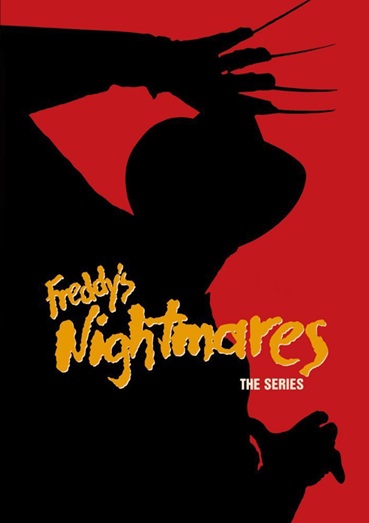
This week’s episode is actually decent.

Episode 1.18 “The Art of Death”

(Dir by Ken Wiederhorn, originally aired on March 12th, 1989)

Jack (Carey Scott) is a talented artist and college student who has a crush on Joan (Laura Schaefer).  When Joan’s jock boyfriend humiliates Jack, Jack suddenly finds himself approached by The Phantom (Judd Omen), a masked figure who claims that he can kill Jack’s enemies if Jack draws a picture of him doing it.  After the jock is killed in a treadmill accident, Joan sees the picture that Jack drew and decides she doesn’t want anything to do with Jack.  The Phantom suggests drawing a picture of him surprising Joan in the shower.  Jack refuses, just to discover that the picture has already been drawn and the Phantom is now holding Joan prisoner in a boiler room.  Jack draws a picture of the Phantom being sucked down a hole.  The Phantom vanishes but …. oh no, now Jack’s wearing the mask!  Jack was the Phantom all along!

As for the second story, Joan struggles to recover from the trauma.  In typical Freddy’s Nightmares fashion, she has a series of hallucinations that lead to her killing her psychiatrist.

This episode actually worked!  The first story was genuinely creepy.  The second story was predictable but it featured a good performance from Laura Schaefer and the action moved at a decent pace.  I’m going to give the majority of the credit to director Ken Wiederhorn, who previously directed one of my favorite zombie films, 1977’s Shock Waves.

This is my final Freddy’s Nightmares review for 2025.  Retro Television Review is taking a break for the holidays, so I can focus on Awards Season and Christmas movies!  Freddy’s Nightmares will return on January 9th.

Late Night Retro Television Review: Freddy’s Nightmares 1.7 “Sister’s Keeper”


Welcome to Late Night Retro Television Reviews, a feature where we review some of our favorite and least favorite shows of the past! On Fridays, I will be reviewing Freddy’s Nightmares, a horror anthology show which ran in syndication from 1988 to 1990. The entire series can be found on Plex!

This week, Freddy is out for revenge.

Episode 7.1 “Sister’s Keeper”

(Dir by Ken Wiederhorn, originally aired on November 20th, 1988)

Freddy’s Nightmares started with Freddy Krueger killing Deputy Blocker, the man who had led the vigilante mob that set him on fire.  This episode finds Freddy seeking revenge on Blocker’s twin teenager daughters, neurotic Merit (Hili Park) and the supercool, super awesome Lisa (Gry Park).  Merit is convinced hat Freddy is haunting her nightmares and, as a result, she’s a bit of an outcast at school.  Lisa, on the other hand, believes that Freddy is dead and buried.  Lisa is stable and popular at school and even has a jock boyfriend.

Needless to say, Merit is a bit jealous of Lisa.  For me, this was the most realistic part of this episode.  People are always jealous of girls named Lisa, especially when they’ve got it all together as this Lisa does.  (Trust me, I know!)  It’s a heavy burden to bear but it happens.  Lisa, being a saint, tries to help Merit out but Merit is pretty unappreciative.

Lisa even dresses up like Merit and pretends to be Merit so that she can experience what it’s like to be her sister.  Lisa discovers that her boyfriend is just as interesting in sleeping with Merit as in sleeping with her.  Booo!  What a creep!  Even worse, Lisa discovers that Freddy is real and that he’s after both her and Merit.

Like the pilot, this episode tells one story and most of the action centers around Freddy.  Freddy actually takes part in this week’s story and, even by his standards, he’s cruel.  “I’ll make it gentle,” he tells the terrified Merit, a reminder that Freddy was always a far more perverse killer than the seemingly asexual Jason Voorhees or Michael Myers.  This episode was a reminder of just how scary Freddy could be.  Robert Englund didn’t hold up.

Merit and Lisa learn how to dream “in sync” so that they can both face Freddy at the same time.  It’s a cool idea that does absolutely no good.  As Lisa puts it, “It doesn’t work, you can’t make him go away!”  Lisa ends up dead (boo!) while Merit is blamed for her murder.  And so the episode ends.

Wow, that’s not a happy ending.  Not only did Freddy triumph but supercool Lisa was killed, largely due to her sister’s incompetence.  Then again, there really aren’t that many happy endings to be found when it comes to Freddy Krueger.  The ending was depressing but effective and, even more importantly, it was really the only way the story could have ended.

This episode was pretty good.  It’s certainly the best that I’ve seen so far.  Merit and Lisa were real-played by the Park sisters and Robert Englund once again showed just how frightening he could be as Freddy Krueger.  Within the confines imposed by television syndication, this was a genuinely frightening episode.


10 Shots From 10 Horror Films: 1975 — 1977


4 Or More Shots From 4 Or More Films is just what it says it is, 4 shots from 4 of our favorite films. As opposed to the reviews and recaps that we usually post, 4 Shots From 4 Films lets the visuals do the talking!

This October, I’m going to be doing something a little bit different with my contribution to 4 (or more) Shots From 4 (or more) Films.  I’m going to be taking a little chronological tour of the history of horror cinema, moving from decade to decade.

Today, we take a look at three very important years: 1975, 1976, and 1977!

10 Shots From 10 Films: 1975 — 1977

Deep Red (1975, dir by Dario Argento, DP: Luigi Kuveiller)

Trilogy of Terror (1975, dir by Dan Curtis. DP: Paul Lohmann)

Eaten Alive (1976, dir by Tobe Hooper. DP: Robert Caramico)

The Omen (1976, dir by Richard Donner, DP: Gilbert Taylor)

Carrie (1976, dir by Brian De Palma, DP: Mario Tosi)

Shock (1977, dir by Mario Bava, DP: Alberto Spagnoli)

The Hills Have Eyes (1977, dir by Wes Craven, DP: Eric Saarinen)

Suspiria (1977, dir by Dario Argento, DP: Luciano Tuvalia)

Eraserhead (1977, directed by David Lynch, DP: Frederick Elmes and Herbert Cardwell)

Shock Waves (1977, dir by Ken Wiederhorn, DP: Reuben Trane)

4 Shots From 4 Peter Cushing Films: Corruption, Scream and Scream Again, Asylum, Shock Waves


4 Shots From 4 Films is just what it says it is, 4 shots from 4 of our favorite films. As opposed to the reviews and recaps that we usually post, 4 Shots From 4 Films lets the visuals do the talking.

Today, we pay tribute to one of the greatest British film stars with….

4 Shots From 4 Peter Cushing Films

Corruption (1968, dir by Robert Hartford-Davis)

Scream and Scream Again (1970, dir by Gordon Hessler)

Asylum (1972, dir by Roy Ward Baker)

Shock Waves (1977, dir by Ken Wiederhorn)

4 Shots From 4 James Karen Horror Films: Frankenstein Meets The Space Monster, Poltergeist, Return of the Living Dead, Return of the Living Dead Part II


4 Shots From 4 Films is just what it says it is, 4 shots from 4 of our favorite films. As opposed to the reviews and recaps that we usually post, 4 Shots From 4 Films lets the visuals do the talking.

Yesterday, we lost one of the great character actors, James Karen.  Over the course of his long career, Karen appeared work in almost genre imaginable, including horror.  Today, we pay tribute to him with….

4 Shots From 4 James Karen Horror Films

Frankenstein Meets The Space Monster (1965, dir by Robert Gaffney)

Poltergeist (1982, dir by Tobe Hooper)

Return of the Living Dead (1985, dir by Dan O’Bannon)

Return of the Living Dead Part II (1988, dir by Ken Wiederhorn)

The TSL’s Horror Grindhouse: Eyes of a Stranger (dir by Ken Wiederhorn)


In this 1981 slasher film, bad things are happening in the city of Miami.

There’s a serial killer on the loose.  He’s chopping off heads and leaving bodies on the beach and basically just making a huge mess of things.  Local new anchorwoman Jane (Lauren Tewes) is upset that there’s a killer roaming the streets of her hometown.  She even talks about how upset she is during a local newscast, which takes everyone at the station by surprise.  I don’t know why they’re so shocked.  Don’t they know that Jane has a younger sister named Tracy (Jennifer Jason Leigh) and that Tracy’s been blind, deaf, and mute ever since she was attacked by a maniac?

One day, Jane is returning to the apartment that she shares with her sister.  As she’s parking her car, she sees her neighbor, Stanley (John DiSanti), stuffing what appears to be a bloody shirt in a trash can.  Oh my God, could he be the murderer!?

Well, yes, he is.  The film actually makes no attempt to hide the fact that Stanley is the murderer.  Stanley is one of those movie murderers who is either hyper competent or totally oblivious, depending on what the scene demands.  For instance, despite being a rather heavyset, middle-aged man, he can still sneak up behind people without them ever hearing and chop off their head with one wave of a meat cleaver.  On the other hand, when he kills a couple on the beach, his car ends up getting stuck in the sand.

Anyway, Jane is pretty much instantly convinced that Stanley is the killer and she immediately starts doing stuff like taunting him over the telephone.  (Despite the fact that she’s on TV every night and her voice is apparently heard by everyone in Miami, she makes no effort to disguise her voice whenever she calls Stanley.)  She also breaks into his apartment to look for clues.

As I watched this film, I found myself thinking about how much more interesting it would have been if Stanley hadn’t been the killer and if Jane felt so guilty about what happened to her sister that she ended up harassing a totally innocent bystander.  But no, Stanley is the murderer so naturally all of this leads to an extended sequence where Stanley breaks into and then follows Tracy around Jane’s apartment.

So, Eyes of a Stranger is a fairly mediocre film, one that would probably be totally forgotten if not for the fact that it’s also the debut film of Jennifer Jason Leigh.  While the film is obviously meant to showcase Lauren Tewes (a TV actress who gives a rather wooden performance), Jennifer Jason Leigh steals every scene in which she appears.  Her total commitment to her character shines through and she even manages to sell a rather implausible plot twist that occurs towards the end of the film.  John DiSanti also deserves some credit for his performance as Stanley.  Again, it’s hard not to feel that the film would have worked better if it had tried to keep us guessing as to the question of Stanley’s guilt.

Eyes of a Stranger was directed by Ken Wiederhorn, who also did the far superior zombie movie, Shock Waves.  It’s interesting to note that both Lauren Tewes and Jennifer Jason Leigh would subsequently appear in Twin Peaks: The Return, though Leigh’s role was significantly larger.


Horror Film Review: Shock Waves (dir. by Ken Wiederhorn)


Tonight, as I watched the premiere of The Walking Dead’s 2nd season, I found myself thinking about some of my favorite zombie films.  One which came to mind immediately was Ken Wiederhorn’s low-budget but effectively disturbing 1977 film, Shock Waves.

In Shock Waves, a group of tourists find themselves shipwrecked off the Florida coast.  As they wander through the isolated, swampy terrain, they happen to come across a decaying mansion that is inhabited by one very mad scientist (Peter Cushing).  It turns out that Cushing is a Nazi war criminal who, during World War II, created the Death Corps., an elite unit of zombie super soldiers.  As World War II came to an end, Cushing somehow ended up in Florida and, unfortunately for the living, he brought the Death Corps. with him.  And now, with the arrival of the castaways, the Death Corps. has reawakened…

Shock Waves is considered by many (like me, for instance) to be the best example of the small genre of film known as the Nazi Zombie film.  (Though I have to admit that it’s not my favorite Nazi zombie film.  That honor would have to go to Jean Rollin’s delightfully weird Zombie Lake.  For another example of the genre, check out Arleigh’s review of Dead Snow.)  Admittedly, once you get past the idea of underwater zombies, the film is pretty predictable plot-wise.  But a certain predictability goes along with any zombie film.  One reason why zombies are so scary is the very fact that they are very simple and predictable.  Zombies exist solely to destroy and, beyond running and hiding, there’s not a whole lot of options available for dealing with them.  Vampires and werewolves are almost ludicrously vulnerable to all sorts of defensive moves (seriously, people, how difficult is it to wear a crucifix around your neck?) but zombies are pretty much an unstoppable force and for a zombie film to succeed, the zombies must truly seem unstoppable.  This is where Shock Waves truly succeeds because seriously, these zombies are brutal.  There’s a lengthy montage where the zombies literally tear apart a building, searching for the castaways and it’s probably one of the most chilling sequences of destruction ever caught on film.  It helps that these Nazi zombies are truly frightening to look at, with their hair plastered to the sides of emotionless faces and their eyes hidden behind dark goggles.  Add to that, they’re Nazis.  Seriously, nothing’s scarier than Nazis.  Perhaps the most enduring image from this film is of the members of the Death Corp. emerging from the water, one after another.  It’s a remarkable sequence and probably one of the most striking “zombie mob” scenes ever.

The Shock Waves DVD also features an audio commentary with director Ken Wiederhorn and a few other crew members.  It’s actually probably one of the more interesting DVD commentaries I’ve ever heard, as Wiederhorn is very honest about not being happy with how the final film turned out.  And certainly, this is one of those low budget B-films that you can pick to death.  As Wiederhorn himself points out, lead actress Brooke Adams often seems to just be going through the motions and, as effective as the Nazi zombies are, the film never explains how 1) they ended up off the coast of Florida or 2) how they haven’t been discovered before this.  But so what?  Shock Waves is one of those films that manages to be quite a bit more than the sum of its parts.  Wiederhorn might not be happy with the film but that doesn’t change the fact that he manages to create a true sense of menace and danger during the film’s first half and the second half features some of the scariest zombies ever.  Ultimately, Shock Waves is a genuinely scary and effective zombie film and one that the director has every right to be proud of.

One final note — Shock Waves opens up with one of those “This film might be based on a true story” narrations and it’s all the better for it.  I’m including a clip of it below because 1) it’s just so grindhouse that I can’t help but love it and 2) it also features a bit of the film’s brutally effective score.