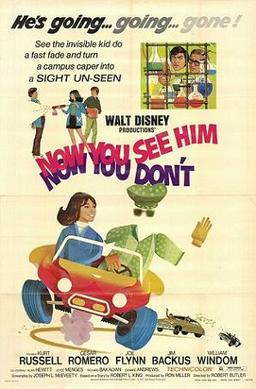
I Watched Now You See Him, Now You Don’t (1972, Dir. by Robert Butler)


Dexter Riley (Kurt Russell) is back and just in time because Medfield College is on the verge of getting closed down again.

In The Computer Wore Tennis Shoes, buying a computer was supposed to be the solution to all of Medfield’s financial problems.  I guess it didn’t work because Medfield is broke again and corrupt businessman A.J. Arnoe (Cesar Romero) is planning on canceling the school’s mortgage so that he can turn it into a casino.

There is some hope.  Dexter has accidentally created an invisibility spray.  Not only does it tun anything that it touches invisible but it also washes away with water so there’s no risk of disappearing forever.  Dexter and his friend Schuyler (Michael McGreevey) know that they can win the science fair with their invention but the science fair doesn’t want to allow small schools like Medfield to compete unless they really have something big to offer.  Dexter tells the Dean (Joe Flynn) that he has a sure winner but Dexter also refuses to reveal what it is because he doesn’t want word to leak before for the science fair.  The Dean decides to raise the money to pay off the mortgage by becoming a golfer, as one does.  Schulyer works as the Dean’s caddy while Dexter uses the invisibility spray to help the Dean cheat.  That’s a good message for a young audience, Disney!  But when Arno finds out about the spray, he wants to steal it so he can rob a bank.

This was even dumber than The Computer Wore Tennis Shoes but it was also hard to dislike it.  The comedy was too gentle, Kurt Russell and the rest of the cast were too likable, and the special effects were too amusingly cheap in that retro Disney way for it to matter that the movie didn’t make any sense.  When a bunch of college kids learn the secret of invisibility and use it to cheat at golf, you know you’re watching a Disney film.
Retro Television Reviews: The Day The Earth Moved (dir by Robert Michael Lewis)


Welcome to Retro Television Reviews, a feature where we review some of our favorite and least favorite shows of the past!  On Sundays, I will be reviewing the made-for-television movies that used to be a primetime mainstay.  Today’s film is 1974’s The Day The Earth Moved!  It  can be viewed on YouTube!

Sitting in the middle of the Nevada desert, there’s a town called Bates.

Bates was once a thriving community but the years and the hot Nevada winds have not been kind to it.  Now, it consists of only a  few buildings and a speed trap.  Judge Tom Backsler (William Windom) is the most powerful man in this tiny community and he’s determined to return Bates to its former glory.  His plan is to open up a Christmas park and to remake Bates as “Santa Claus’s home away from the North Pole.”  In order to raise the money for that project, he and the police run an aggressive speed trap.  When pilot and photographer Steve Barker (Jackie Cooper) is caught in the speed trap, it turns out that he doesn’t have enough money to pay his fine.  So, his car is impounded and he’s put to work, sweeping up the dust and helping to get the Christmas park ready to open.

With the help of friendly little townsgirl, Steve is finally able to escape from Bates and return to his job.  He works with his wife, Kate (Stella Stevens), and his best friend, Harley (Cleavon Little), as surveyors.  When someone wants to buy a stretch of the Nevada desert, Steve and Harley fly over the land and take pictures.  Looking over the latest batch of pictures, Steve deduces that not only is there going to be an earthquake but it’s going to destroy the town of Bates!  Can Steve return to the town that once held him prisoner and convince the townspeople to leave with him before disaster hits!?

In many ways, The Day The Earth Moved is a standard made-for-TV disaster flick.  Only Steve and Kate realize what’s about to happen and they struggle to get anyone else to believe them.  Indeed, it seems like the world is almost conspiring to keep them from warning everyone about the incoming earthquake.  The film’s story checks off all of the expected disaster movie plot points.  That said, the town of Bates itself — with its gigantic Santa Claus standing in the middle of the desert — is a nicely surreal location and the repeated shots of a deserted farm being gradually destroyed by minor tremors achieve a certain ominous grandeur.  Jackie Cooper and Stella Stevens are believable as a husband and wife who love each other despite the fact that they’re often very annoyed with each other.  To the film’s credit, William Windom’s character is not portrayed as being a cardboard villain but instead as someone who simply wants to give his neighbors some place decent to live.  The Day The Earth Moved is predictable but well-done.

Of course, the main reason anyone will have to watch this film will be for the earthquake.  Unfortunately, this is where viewers will run into a common problem that has afflicted many made-for-TV movies.  The low-budget earthquake is just not that impressive.  For all the scenes of people yelling, it’s always pretty obvious that the camera is doing most of the shaking.  But you know what?  It’s a made-for-TV movie from 1974.  Cut it some slack and just go with it.

Shattered Politics #34: The Parallax View (dir by Alan J. Pakula)


Parallax_View_movie_poster

Judging from the films that the decade produced, the 1970s were truly a paranoid time.  (Of course, 2015 is a paranoid time as well, which is probably why so many of the classic films of the 70s still feel incredibly relevant.)  Some weekend, you should watch a marathon of 1970s films and I guarantee that, by the time Monday rolls around, you will be looking for lurkers in every shadow and automatically distrusting any and all authority figures.  The 1970s were a good time to be paranoid.

And it’s really not surprising at all.  The previous decade was a time of turmoil and upheavel, a time when some people feared protestors and some people feared the establishment but, ultimately, everyone was afraid of someone.  When you think of the 1960s, you think about all the leaders who were violently assassinated — John F. Kennedy, Malcolm X, Martin Luther King, Robert F. Kennedy, and more.  (And that’s just in America!)  And then the 70s came along, with Watergate and the revelations about the CIA partnering up with the Mafia to try to kill Fidel Castro.

The 70s were a good time to be paranoid and the films of the 70s reflected that fact.

Take for instance, 1974’s The Parallax View.  The Parallax View opens and ends with assassination.  In both cases, the victims are U.S. politicians who are running for President and whose ambitions have caused concern for the shadowy and rarely seen leaders of the established order.  In both cases, the official story is that the assassin was a lone gunman, a nut with a gun and absolutely no political or religious motivations.  Of course, both accused assassins were apparently involved with the shadowy Parallax Corporation and, over the course of the film, anyone who knows anything about Parallax ends up dying.  Reporter Joe Frady (Warren Beatty) goes undercover to investigate the group but, as he does so, he grows increasingly paranoid and unstable, until finally  it’s easy to mistake him for any other paranoid madman, ranting in the street and, in many ways, indistinguishable from the accused assassins that he’s been investigating.  In many ways, Joe becomes like a character in a H.P. Lovecraft short story who, upon laying eyes on Cthulhu, is driven mad as punishment.

It’s a good film, one that’s enhanced by Gordon Willis’s trademark shadowy cinematography and the convincing desperation of Warren Beatty’s performance.  In the film’s best scene, Frady applies for a job with the Parallax Corporation.  As a part of his job interview, he’s taken a dark room and he’s told to watch a short film.  His reactions will help to determine what role he could possibly play at Parallax.

Needless to say, The Parallax View feels just as relevant today as it did when it was first released.  We still live in paranoid times and hints of conspiracy are still everywhere to be seen.  Perhaps the only thing that has changed is that, back in 1974, conspiracies could still take people be surprise.

Now, we just take them for granted.