Music Film Review: Tommy (dir by Ken Russell)


“Tommy, can you hear me?”

That’s a question that’s asked frequently in the 1975 film, Tommy.  An adaptation of the famous rock opera by the Who (though Pete Townshend apparently felt that the film’s vision was more director Ken Russell’s than anything that he had meant to say), Tommy tells the story of a “deaf, dumb, and blind kid” who grows up to play a mean pinball and then become a cult leader.  Why pinball?  Who knows?  Townshend’s the one who wrote Pinball Wizard but Ken Russell is the one who decided to have Elton John sing it while wearing giant platform shoes.

Tommy opens, like so many British films of the 70s, with the blitz.  With London in ruins, Captain Walker (the almost beatifically handsome Robert Powell) leaves his wife behind as he fights for his country.  When Walker is believed to be dead, Nora (Ann-Margaret) takes Tommy to a holiday camp run by Frank (Oliver Reed).  Oliver Reed might not be the first person you would expect to see in a musical and it is true that he wasn’t much of a singer.  However, it’s also true that he was Oliver Reed and, as such, he was impossible to look away from.  Even his tuneless warbling is somehow charmingly dangerous.  Nora falls for Frank but — uh oh! — Captain Walker’s not dead.  When the scarred captain surprises Frank in bed with Nora, Frank hits him over the head and kills him.  Young Tommy witnesses the crime and is told that he didn’t see anything and he didn’t hear anything and that he’s not going to say anything.

And so, as played by Roger Daltrey, Tommy grows up to be “deaf, dumb, and blind.”  Various cures — from drugs to religion to therapy — are pursued to no avail.  As the Acid Queen, Tina Turner sings and dances as if she’s stealing Tommy’s soul.  As the Therapist, Jack Nicholson is all smarmy charm as he gently croons to Ann-Margaret.  Eric Clapton performs in front of a statue of Marilyn Monroe.  Ann-Margaret dances in a pool of beans and chocolate and rides a phallic shaped pillow. As for Tommy, he eventually becomes the Pinball Wizard and also a new age messiah.  But it turns out that his new followers are just as destructive as the people who exploited him when he was younger.   It’s very much a Ken Russell film, full of imagery that is shocking and occasionally campy but always memorable.

I love Tommy.  It’s just so over-the-top and absurd that there’s no way you can ignore it.  Ann-Margaret sings and dances as if the fate of the world depends upon it while Oliver Reed drinks and glowers with the type of dangerous charisma that makes it clear why he was apparently seriously considered as Sean Connery’s replacement in the roles of James Bond.  As every scene is surreal and every line of dialogue is sung, it’s probably easy to read too much into the film.  It could very well be Ken Russell’s commentary on the New Age movement and the dangers of false messiahs.  It could also just be that Ken Russell enjoyed confusing people and 1975 was a year when directors could still get away with doing that.  With each subsequent viewing of Tommy, I become more convinced that some of the film’s most enigmatic moments are just Russell having a bit of fun.  The scenes of Tommy running underwater are so crudely put together that you can’t help but feel that Russell was having a laugh at the expense of people looking for some sort of deeper meaning in Tommy’s journey.  In the end, Tommy is a true masterpiece of pop art, an explosion of style and mystery.

Tommy may seem like a strange film for me to review in October.  It’s not a horror film, though it does contain elements of the genre, from the scarred face of the returned to Captain Walker to the Acid Queen sequence to a memorable side story that features a singer who looks like a junior Frankenstein.  To me, though, Tommy is a great Halloween film.  Halloween is about costumes and Tommy is ultimately about the costumes that people wear and the personas that they assume as they go through their lives.  Oliver Reed goes from wearing the polo shirt of a holiday camp owner to the monocle of a tycoon to the drab jumpsuits of a communist cult leader.  Ann-Margaret’s wardrobe is literally a character of its own.  Everyone in the film is looking for meaning and identity and the ultimate message (if there is one) appears to be that the search never ends.


Rockin’ in the Film World #18: The Who’s TOMMY (Columbia 1975)


gary loggins's avatarcracked rear viewer


Before MTV ever hit the airwaves, there was TOMMY, Ken Russell’s stylized cinematic vision of The Who’s 1969 ‘rock opera’. It was a match made in heaven, teaming Britain’s Wild Man of Cinema with the anarchic rock and roll of Pete Townshend, Roger Daltrey, John Entwistle, and Keith Moon (not to mention England’s own enfant terrible,Oliver Reed ). Russell both captures the spirit of Townsend’s hard rock opus and expands on it visually with an all-out assault-on-the-senses musical featuring an all-star cast that includes an Oscar-nominated performance by Ann-Margret as the mother of “that deaf, dumb, and blind kid” who “sure plays a mean pinball”!

The Who’s original album cover

Townshend, the group’s primary songwriter, had been experimenting with long-form rock’n’roll since the beginning, notably the nine minute suite “A Quick One While He’s Away” on their second album A QUICK ONE (retitled in America HAPPY JACK). TOMMY was…

View original post 467 more words

Rockin’ in the Film World #17: Frank Zappa’s 200 MOTELS (United Artists 1971)


gary loggins's avatarcracked rear viewer

Frank Zappa is definitely an acquired taste, one I acquired as a young kid listening to albums like “Absolutely Free”, “Weasels Ripped My Flesh”,  and “Apostrophe”, which goes a long way in helping to explain my warped world view. Zappa’s avant garde rock’n’roll, a mélange of jazz, classical, doo-wop, psychedelica, and anything else he could think of, combined with his nonsensical, sexual, and scatological lyrics, skewered convention, the plastic world of suburban America, and hippie culture as well (Zappa was an equal opportunity offender). 200 MOTELS was his first attempt at making a movie, co-directing and co-writing with British documentarian Tony Palmer, and to call it bizarre would be a gross understatement.

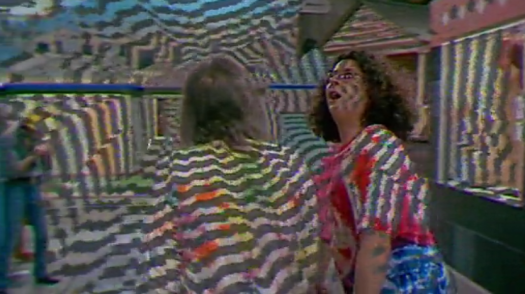
Visually, the film is as close to Zappa’s avant garde compositions as you can get. 200 MOTELS was shot on videotape and transferred to 35mm film, using techniques like double and triple exposure, color filters, flash-cut editing, and…

View original post 395 more words

So You Want To Be A Rock’n’Roll Star: The Idolmaker, Breaking Glass, That’ll Be The Day, Stardust


So, you want to be a rock and roll star?  Then listen now to what I say: just get an electric guitar and take some time and learn how to play.  And when your hair’s combed right and your pants fit tight, it’s gonna be all right.

If you need any more help, try watching these four films:

Idolmaker

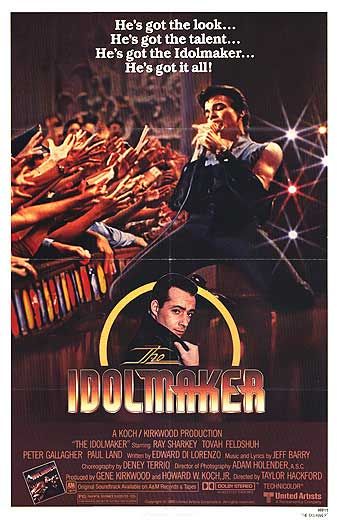
The Idolmaker (1980, directed by Taylor Hackford)

The Idolmaker is a movie that asks the question, “What does it take to be a star?  Who is more interesting, the Svengalis or the Trilbys?”  The year is 1959 and Vinny Vacari (Ray Sharkey, who won a Golden Globe for his performance but don’t let that dissuade you from seeing the movie) is a local kid from New Jersey who dreams of being a star.  He has got the talent.  He has got the ambition and he has got the media savvy.  He also has a receding hairline and a face like a porcupine.

Realizing that someone who looks like him is never going to make hundreds of teenage girls all scream at once, Vinny instead becomes a starmaker.  With the help of his girlfriend, teen mag editor Brenda (Tovah Feldshuh) and a little payola, he turns saxophone player Tomaso DeLorussa into teen idol Tommy Dee.  When Tommy Dee becomes a star and leaves his mentor, Vinny takes a shy waiter named Guido (Peter Gallagher) and turns him into a Neil Diamond-style crooner named Cesare.  Destined to always be  abandoned by the stars that he creates, Vinny continually ends up back in the same Jersey dive, performing his own songs with piano accompaniment.

The Idolmaker is a nostalgic look at rock and roll in the years between Elvis’s induction into the Army and the British invasion.  The Idolmaker has some slow spots but Ray Sharkey is great in the role of Vinny and the film’s look at what goes on behind the scenes of stardom is always interesting.  In the movie’s best scene, Tommy performs in front of an audience of screaming teenagers while Vinny mimics his exact moments backstage.

Vinny was based on real-life rock promoter and manager, Bob Marcucci.  Marcucci was responsible for launching the careers of both Frankie Avalon and Fabian Forte.  Marcucci served as an executive producer on The Idolmaker, which probably explains why this is the rare rock film in which the manager is more sympathetic than the musicians.

breakglass_lrg

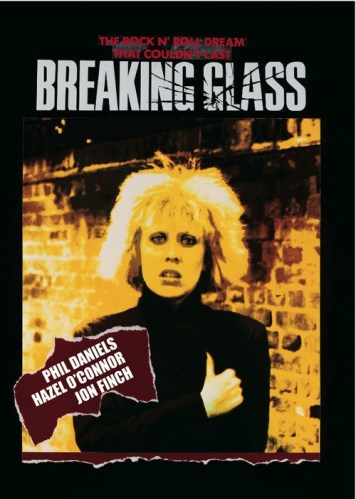
Breaking Glass (1980, directed by Brian Gibson)

At the same time that The Idolmaker was providing American audiences with a look at life behind-the-scenes of music stardom, Breaking Glass was doing the same thing for British audiences.

In Breaking Glass, the idolmaker is Danny (Phil Daniels, who also starred in Quadrophenia) and his star is an angry New Wave singer named Kate (Hazel O’Connor).  Danny first spots Kate while she is putting up flyers promoting herself and her band and talks her into allowing him to mange her.  At first, Kate refuses to compromise either her beliefs or her lyrics but that is before she starts to get famous.  The bigger a star she becomes, the more distant she becomes from Danny and her old life and the less control she has over what her music says.  While her new fans scare her by all trying to dress and look like her, Kate’s old fans accuse her of selling out.

http://www.youtube.com/watch?v=8ALdL8oV_sY

As a performer, Hazel O’Connor can be an acquired taste and how you feel about Breaking Glass will depend on how much tolerance you have for her and her music.  (She wrote and composed all of the songs here.)  Breaking Glass does provide an interesting look at post-punk London and Jonathan Pryce gives a good performance as a sax player with a heroin addiction.

thatll-be-the-day-poster

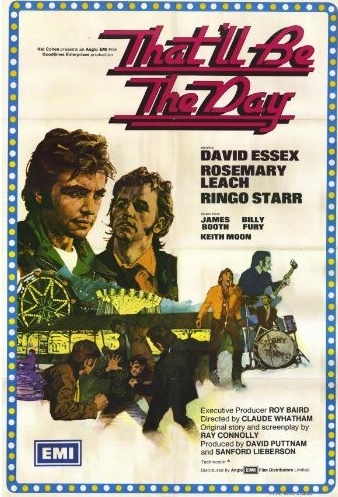
That’ll Be The Day (1973, directed by Claude Whatham)

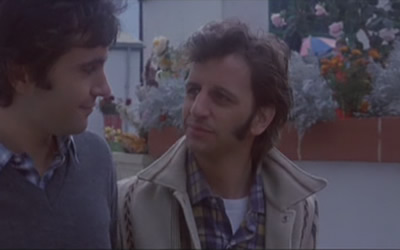
Real-life teen idol David Essex plays Jim MacClaine, a teenager in 1958 who blows off his university exams and runs away to the Isle of Wright.  He goes from renting deckchairs at a resort to being a barman to working as a carny.  He lives in squalor, has lots of sex, and constantly listens to rock and roll.  Eventually, when he has no other choice, he does return home and works in his mother’s shop.  He gets married and has a son but still finds himself tempted to abandon his family (just as his father previously abandoned him) and pursue his dreams of stardom.

David Essex and Ringo Starr

Based loosely on the early life of John Lennon, the tough and gritty That’ll Be The Day is more of a British kitchen sink character study than a traditional rock and roll film but rock fans will still find the film interesting because of its great soundtrack of late 50s rock and roll and a cast that is full of musical luminaries who actually lived through and survived the era.  Billy Fury and the Who’s Keith Moon both appear in small roles.  Mike, Jim’s mentor and best friend, is played by Ringo Starr who, of all the Beatles, was always the best actor.

That’ll Be The Day ends on a downbeat note but it does leave the story open for a sequel.

stardust-1

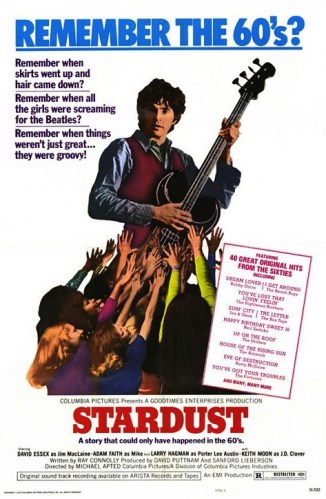
Stardust (1974, directed by Michael Apted)

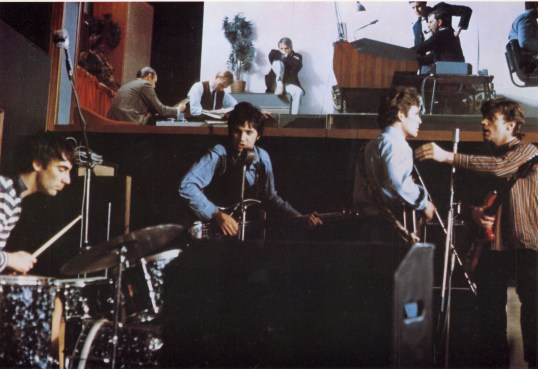
Stardust continues the story of Jim MacClaine.  Jim hires his old friend Mike (Adam Faith, replacing Ringo Starr) to manage a band that he is in, The Straycats (which includes Keith Moon, playing a far more prominent role here than in That’ll Be the Day).  With the help of Mike’s business savvy, The Stray Cats find early success and are signed to a record deal by eccentric Texas millionaire, Porter Lee Austin (Larry Hagman, playing an early version of J.R. Ewing).

When he becomes the breakout star of the group, Jim starts to overindulge in drugs, groupies, and everything that goes with being a superstar.  Having alienated both Mike and the rest of the group, Jim ends up as a recluse living in a Spanish castle.  Even worse, he gives into his own ego and writes a rock opera, Dea Sancta, which is reminiscent of the absolute worst of progressive rock.  Watching Jim perform Dea Sancta, you understand why, just a few years later, Johnny Rotten would be wearing a homemade “Pink Floyd Sucks” t-shirt.

Stardust works best as a sad-eyed look back at the lost promise of the 1960s and its music.  Watch the movie and then ask yourself, “So, do you really want to be a rock and roll star?”

21494_2