Late Night Retro Television Review: CHiPs 3.12 “Destruction Derby”


Welcome to Late Night Retro Television Reviews, a feature where we review some of our favorite and least favorite shows of the past!  On Mondays, I will be reviewing CHiPs, which ran on NBC from 1977 to 1983.  The entire show is currently streaming on Prime!
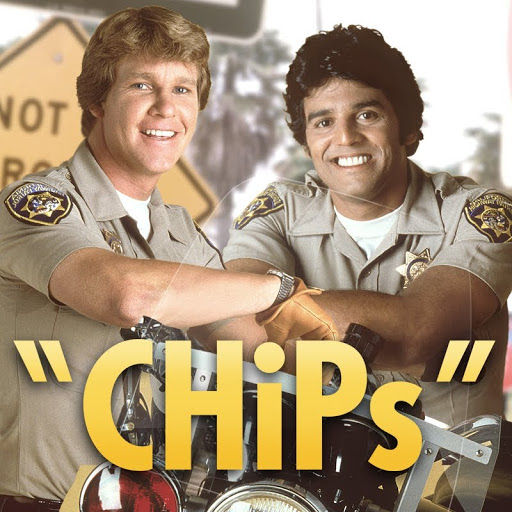
Baker and Ponch — but mostly Ponch — get a chance to shine this episode.

Episode 3.12 “Destruction Derby”

(Dir by Gordon Hessler, originally aired on November 24th, 1979)

Ponch and Baker are working undercover!

That’s …. odd.  Aren’t they just members of the Highway Patrol?  I mean, don’t get me wrong.  I know that being a member of the Highway Patrol isn’t easy and I don’t mean to imply that they’re not doing an important job.  But it just seems like undercover work would be something that you would give to a detective.  It seems like you would need some sort of special training to do that. For a show that, in the past, has pretty much taken a day-in-the-life approach to its stories, a sudden undercover episode just feels weird.

Ponch and Baker are working at the local demolition derby, trying to uncover a drug ring that…. I don’t know.  I guess people who sell drugs enjoy demolition derbys.  To be honest, I get the feeling that someone in production said, “Let’s shoot a bunch of demolition derby footage and then we’ll just make up something stupid to justify it.”  When it comes to the derby, Baker is working as a member of the pit crew and, of course, Ponch is the one driving the car.  And, of course, Ponch turns out to be a natural because there’s nothing that Ponch can’t master.  Ponch also falls for the only driver who can beat him, the mysterious Billy Wakefield (Angel Tompkins).  This episode is from the 70s so, of course, there’s a scene where she takes off her helmet, her long blonde hair falls across her back, and I guess everyone at home is supposed to go, “A woman race car driver!?  What is this madness!?”

Baker is not totally wasted in this episode.  He gets to save Ponch’s life when the bad guys attempt to booby trap Ponch’s car.  He also gets to play tennis with Getraer and Grossman.  This episode may feature Ponch and Baker going undercover but it seems like the real plot is just Baker and Ponch doing fun California things.  This episode basically is a commercial for the state.  Look! the episode says, Tennis!  Handball!  Demolition Derbies!  Erik Estrada!  We’ve got it all!

Erik Estrada can be seen wearing a wrist brace in this episode, which I assume is a lingering result of the accident that he’s spent the last few episodes recovering from.  I make a lot of jokes about Estrada but, from watching the last few accidents, it is obvious that he was pretty seriously injured in that stunt-gone-wrong.  That, while recovering, he appeared on camera at all seems worthy of respect.  A major theme of this episode seems to be that Ponch is back and Baker, after having the lead role for a few episodes, in once again back to being a supporting player.  Thank you for your service, Larry Wilcox.

Anyway, this episode featured a lot of fast cars and a lot of crashes so I liked it.
Film Review: The Pursuit of D.B. Cooper (dir by Roger Spottiswoode and Buzz Kulik)


The story of D.B. Cooper has always fascinated me.

D.B. Cooper is the name assigned to a man who, in 1971, hijacked an airplane, demanded $200,000, and then jumped off the plane after he got the money.  Reportedly, he was well-dressed and unfailingly polite during the entire hijacking.  When he jumped off the plane, he was about 10,000 feet over the Washington wilderness.  After he jumped, no further trace was found of him.  Over 50 years after the incident, the identity and the location of D.B. Cooper remains a mystery.

It’s been said that, even though Cooper had a parachute with him when he jumped, there’s no way that he could have survived the jump.  And yet, no body has ever been found.  (Of course, finding a body in the wilderness is not as easy as some people assume.)  Nine years after the the skyjacking, some of the money that Cooper received was found on the banks of the Columbia River, which was several miles away from the area that Cooper jumped over.  Did Cooper survive the jump and lose the money?  No one can say for sure.

Over the years, many people have come forward to say that they know the identity of D.B. Cooper.  Many distant fathers and secretive boyfriends and long lost friends have been accused of being D.B. Cooper.  Some of those suspects are more likely than others.  Even John List, the murderer who inspired the Stepfather films, was suspected at one point.

D.B. Cooper remains a fascinating character precisely because he’s never been captured and the mystery itself will probably never be solved.  Because he remains an enigma, it’s easy to project your own pet obsessions on him and his story.  Myself, I always imagine D.B. Cooper as being some sort of clever, fun-loving international rogue, even though there’s not really any evidence to back that up.  But, the fact of the matter is that I have a weakness for clever, fun-loving international rogues so, of course, that’s who I’m going to imagine D.B. to be.

I certainly would never imagine him to be like the character at the center of 1981’s The Pursuit of D.B. Cooper.

In this film, D.B. Cooper turns out to be Jim Meade (Treat Williams), a Vietnam vet and all around jackass who steals the money so that he can get back together with his estranged wife, Hannah (Kathryn Harrold).  Hannah does take him back because, seriously, who is going to say no to that much money?  Jim and Hannah spend the entire film running from one wilderness location to another.  They steal cars.  They steal trucks.  Meade steals an airplane at one point.  Hannah gets worried often and Jim tends to yell, “Woo hoo!” whenever he gets excited about anything.  At one point, Jim and Hannah are chased across some white water rapids.  When Hannah and Jim reach dry land, Jim gives the finger to the river.  I will say that, as someone who grew up in the South, Jim is a type of character who seems very familiar to me.  I’ve known a lot of Jim Meades and Treat Williams doesn’t do bad job playing Meade as being an impulsive, loud-mouthed good old boy.  The only problem is that, at no point, does Jim Meade come across like someone who could have pulled off what D.B. Cooper pulled off.

Jim is being pursued by two old army buddies.  The scruffier of the two is Remson (Paul Gleason), who somehow manages to keep popping up like a cartoon character at the most inopportune of times.  No matter what bad thing happens to Remson, he still shows up good-as-new a few minutes later.  Paul Gleason gives an energetic performance as Remson, a character who has little in common with the uptight authority figures that Gleason later played in The Breakfast Club and Die Hard.

The other person chasing Jim is Bill Gruen (Robert Duvall), who served with Meade in Vietnam but who is now working as an insurance investigator.  Gruen says that he knew Meade had to be D.B. Cooper because only Meade could survive jumping out of a plane over wilderness terrain.  Gruen wants some of the money for himself.  Despite his greed, it’s hard not to like Gruen because he’s played by Robert Duvall.  The best scene in the film is one where Duvall and Williams, exhausted from chasing each other, have a weary but friendly conversation.  It’s the one moment where Williams actually calms down and provides some hint that there’s actually something going on underneath Meade’s manic exterior.  Acting opposite Duvall brings out the best in him.

The Pursuit of D.B. Cooper had a notoriously troubled production and apparently, there was never a completed script during shooting.  Reportedly, bits of the film were directed by Robert Mulligan, John Frankenheimer, and Buzz Kulik before Roger Spottiswoode took over.  It’s a film that was obviously inspired by 70s chase films like Smokey and the Bandit but it also somehow managed to attract actors like Robert Duvall, who does his best to class up the joint.  The action quickly gets repetitive and the movie never seems to know if it wants to be a comedy or a drama.  On the plus side, Treat Williams and Kathryn Harrold make for a cute couple.

When this picture first came out, Universal Pictures offered a million dollar reward for any information that would lead to the capture and arrest of the real D.B. Cooper.  No one collected.

Nightwing (1979, directed by Arthur Hiller)


Cattle and humans are dying in New Mexico at an alarming rate.  Scientist Phillip Payne (David Warner) thinks that the local bat population has become infected with the plague.  Deputy Youngman Duran (Nick Mancuso) thinks that the bats may be attacking because of a curse that was cast by a Hopi medicine man.  Meanwhile, the corrupt tribal chief (Stephen Macht) just wants to sell the land to an evil land developer (Ben Piazza) and be done with it.  Dr. Anne Dillion (Kathryn Harrold) tries to spread the word about the bats but the authorities don’t want the bad publicity.  They’ve never seen Jaws.  And, finally, a group of missionaries camp in the desert with no idea what’s about to swoop down on them.

I don’t know about you but I would never think of missing an Arthur Hiller horror movie!  While many directors in the 70s proudly wore the auteur and rebel label, Arthur Hiller went the opposite route.  He oversw conventional, Hollywood productions, the best known of which was Love Story.  Arthur Hiller was so mainstream that he eventually served as President of the Academy.  This is all to say that Arthur Hiller directed some good films and he directed some bad films but, with his total lack of any sort of personal vision, he was absolutely the wrong director to do a horror movie.  Hiller’s direction is flat.  He’s not mean-spirited enough to enjoy the bat attacks and instead, he focuses on the debate over whether white developers should be buying native land, as if the people watching this movie are going to be watching for the human drama.  By the end of the film, the bats have almost been abandoned and the movie turns into an action film, with a group of survivors fighting off Stephen Macht’s security force.

The most interesting thing about Nightwing is catching Strother Martin, the veteran western actor who memorably talked about a failure to communicate in Cool Hand Luke, as an ex-missionary.  Otherwise, the film pales in comparison to The Birds and Wolfen, the two films which it must resembles in theme and action.

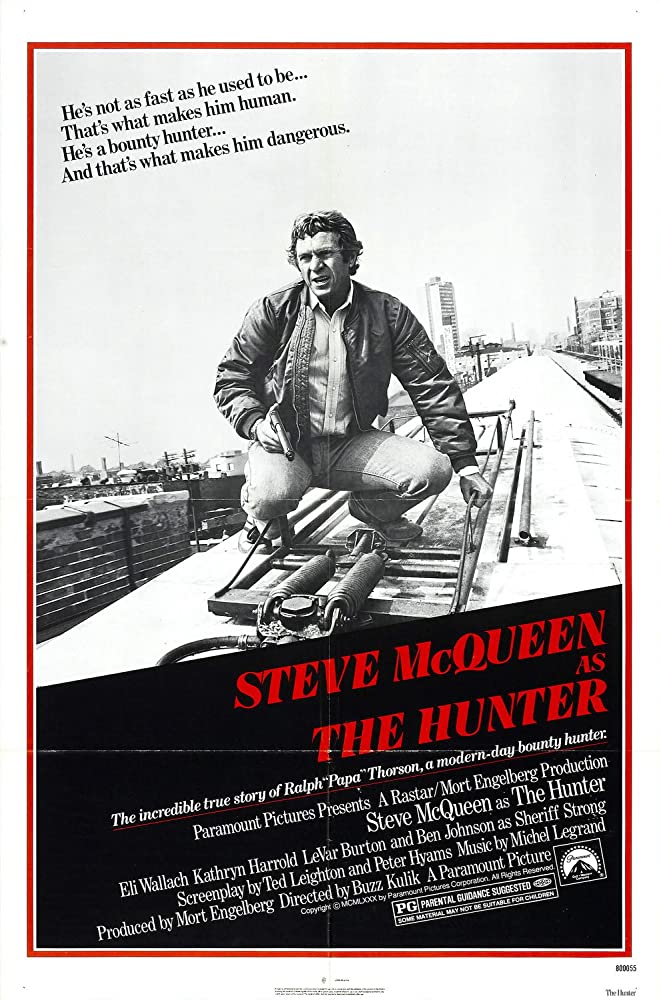
The Hunter (1980, directed by Buzz Kulick)


In The Hunter, legendary car nut, Steven McQueen, plays Papa Thorson, a bounty hunter who is a very bad driver.

That’s it.

That’s the joke.

Papa Thorson was a real-life bounty hunter, the Dog the Bounty Hunter of his day, and The Hunter was based on his own autobiography.  Maybe that explains why the film itself is so extremely episodic.  Thorson goes from one assignment to another, capturing criminals with relative ease and occasionally having to deal with an unappreciative sheriff (Ben Johnson).  Along the way, one of those criminals (Levar Burton) goes to work with Papa and becomes his protege.  Papa’s girlfriend (Kathryn Harrold) is pregnant and a crazed criminal (Tracey Walter) is targeting her because he wants revenge on Papa for putting him away.  It’s all Magnum P.I.-level stuff, without the backdrop of Hawaii to distract you from how predictable it all is.  It’s not terrible because there are a few good action scenes but it still feels more like a pilot for a weekly Papa Thorson television series than a feature film.

The Hunter was also Steve McQueen’s final film.  After The Towering Inferno, McQueen was inactive for most of the 70s.  He still received scripts and turned down good parts (including the roles of both Willard and Kurtz in Apocalypse Now) but the only film in which he appeared in a barely released version of An Enemy of the People.  It wasn’t until 1980 that McQueen finally started appearing in movies again, starring in both Tom Horn and The Hunter.  Tom Horn is an underrated western but The Hunter is largely forgettable.  Sadly, The Hunter would be McQueen’s last film as he died of lung cancer shortly after it was released.

McQueen was obviously ill during the filming of The Hunter, though he still had the laconic coolness that made him a star in the first place and he still looks credible, even at the age of 50, handling a gun and chasing criminals.  He doesn’t give a bad performance as Thorson and he even shows a talent for comedy.  Both Tom Horn and The Hunter show that McQueen wasn’t afraid to play his age.  Neither Tom Horn nor Thorson were young men and, in The Hunter, McQueen gets a lot of mileage out of being a cranky, middle-aged malcontent who has never figured out how to parallel park.  The film might be forgettable but Steve McQueen shows that, to the end, he was an actor who was often better than his material.

A Movie A Day #119: Dead Solid Perfect (1988, directed by Bobby Roth)


Based on a novel by veteran sports writer Dan Jenkins, Dead Solid Perfect takes an episodic look at a year on the PGA tour.  Kenny Lee (Randy Quaid) is a good but aging golfer who wants to finally have his time in the spotlight.  His sponsor (Jack Warden) is an eccentric old racist.  His girlfriend (Corinne Bohrer, who has a lengthy scene where she walks naked down hotel hallway while carrying an ice bucket) isn’t looking for a commitment while his wife (Kathryn Harrold) is getting sick of his emotional immaturity.  Kenny Lee just wants to hit the perfect shot.

An early HBO production, Dead Solid Perfect is one of the best movies ever made about pro golfers, not that there is really much competition.  Eschewing the pretentious blathering that has marred other golf films (like The Legend of Bagger Vance), Dead Solid Perfect focuses on the day-to-day life of aging athletes who have never had to grow up.  This was Dan Jenkins’s specialty and Dead Solid Perfect feels authentic in a way that many other sports film, like Bagger Vance, do not.  Randy Quaid, long before he had his widely publicized breakdown and started making videos about the “star whackers,” is perfectly cast as Kenny.  Sadly, Dead Solid Perfect has never been released on DVD or Blu-ray but it will entertain any golf fan who owns an operational VCR.

Of course, the best movie about golf is still Caddyshack.