Welcome to Retro Television Reviews, a feature where we review some of our favorite and least favorite shows of the past! On Mondays, I will be reviewing Miami Vice, which ran on NBC from 1984 to 1989. The entire show is currently streaming on Tubi!

This week, the second season with a two-hour long premiere! Crockett and Tubbs are going to New York!
Episode 2.1 and 2.2 “The Prodigal Son”
(Dir by Paul Michael Glaser, originally aired on September 27th, 1985)
The second season premiere of Miami Vice opens with a series of set pieces.
In Panama, Crockett and Tubbs visit a secret military base in the jungle and are disgusted to learn how the Panamanian military gets information about drug smugglers. Tubbs and Crockett find one horribly tortured man in a tent. Tubbs gives him a drink of water and gets what information he can from the man. Crockett and Tubbs leave the tent. A gunshot rings out as the involuntary informant is executed. When the shot rings out, both Crockett and Tubbs turn back to the tent in slow motion, stunned by the brutality of their allies in the Drug War. Indeed, it’s hard not to compare the scene to the famous photograph of a South Vietnamese general executing a communist during the Vietnam War.
The Vietnam analogy continues with the next scene. In the Everglades, Crockett, Tubbs, and the entire Vice Squad work with the DEA to ambush the Revilla cousins as they bring drugs into the U.S. Sitting in the swamp, Crockett compares the experience to Vietnam, suggesting that the war on the drugs is just as futile and as costly. And indeed, it’s hard not to notice that every drug dealer that Crockett and Tubbs has taken down over the course of this show has immediately been replaced by another. The Revillas are just another in a long line of people getting rich off of other people’s addictions.
After the bust goes down, Crockett and Tubbs arrives at a celebratory party, just to discover that almost of all of the undercover DEA agents have been murdered and Gina has been seriously wounded. There is something very haunting about this scene, with Crockett and Tubbs rushing through a penthouse and seeing a dead body in almost every room.
At a meeting in a stark office, the head DEA agent explains that his agency has been compromised and all of his undercover agents have been unmasked. Someone has to go to New York and work undercover to take down the Revillas but it can’t be any of his people. Since the Revillas are smuggling their stuff in through Miami, Miami Vice has jurisdiction. Paging Crockett and Tubbs!
Working undercover as Burnett and Cooper, Crockett and Tubbs visit a low-level drug dealer (played by Gene Simmons) who lives on a yacht and who gives them the name of a connection in New York City.
From there, Miami Vice moves to New York City, where Crockett and Tubbs meet a low-level criminal named Jimmy Borges (played by an almost impossibly young Penn Jillette) and they try to infiltrate the Revilla organization. Along the way, Tubbs meets up with Valerie (Pam Grier) and discovers that she has apparently lost herself working undercover. Meanwhile, Crockett has a brief — and kind of weird — romance with a photographer named Margaret (Susan Hess).
(“I like guns,” she says when Crockett demands to know why she stole his.)
With Crockett and Tubbs leaving Miami for New York in order to get revenge for a colleague who was wounded during an operation, The Prodigal Son almost feels like the pilot in reverse. Also, much like the pilot, the exact details of The Prodigal Son‘s story are often less important than how the story is told. This episode is full of moody shots of our heroes walking through New York while songs like You Belong To The City play on the soundtrack. (There’s also a song from Phil Collins, undoubtedly included to bring back memories of the In The Air Tonight scene from the pilot.) It’s all very entertaining to watch, even if the story itself doesn’t always make total sense. Indeed, you really do have to wonder how all of these criminals keep falling for Sonny’s undercover identity as Sonny Burnett. You would think that someone would eventually notice that anyone who buys from Sonny Burnett seems to get busted the very next day.
Stylish as the storytelling may be, this episode actually does have something on its mind. Those lines comparing the War on Drugs to the Vietnam Conflict was not just throwaways. Towards the end of the episode, Crockett and Tubbs follow a lead to the offices of J.J. Johnston (Julian Beck, the ghost preacher from Poltergeist II). The skeletal Johnston is an investor of some sort. He has no problem admitting that he’s involved in the drug trade, presumably because he knows that there’s nothing Crockett and Tubbs can do to touch him. Upon meeting the two cops, he immediately tells them exactly how much money they have in their checking accounts. He points out that they’re poor and they’re fighting a losing war whereas he’s rich and he’s making money off of a losing war. Beck gives a wonderfully smug performance as Johnston and it should be noted that, of all of the episode’s villains, he’s the only one who is not brought to any sort of justice. Val almost loses herself. Tubbs and Crockett don’t even get a thank you for their hard work. The somewhat sympathetic Jimmy Borges ends up dead while the Revillas were undoubtedly been replaced by even more viscous dealers. Meanwhile, J.J. Johnston relaxes in his office and counts his money. This is the No Country For Old Men of Miami Vice episodes.
This episode is also full of familiar faces. Charles S. Dutton, Kevin Anderson, Anthony Heald, Miguel Pinero, James Russo, Bill Smtirovich, Zoe Tamerlis, Paul Calderon, and Louis Guzman, they all show up in small roles and add to show’s rather surreal atmosphere. This is Miami Vice at its most dream-like, full of people you think you might know despite the fact that they’re doing things of which you don’t want to be a part.
As for the title, The Prodigal Son is Tubbs and he is tempted to stay in New York City. But, in the end, he joins Crockett on that flight back to Miami. It’s his home.
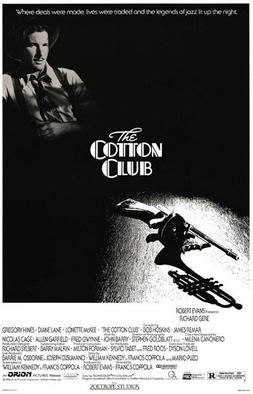 The time is the 1930s and the place is New York City. Everyone wants to get into the Cotton Club. Owned by British gangster Owney Madden (Bob Hoskins), the Cotton Club is a place where the stage is exclusively reserved for black performers and the audience is exclusively rich and white. Everyone from gangsters to film stars comes to the Cotton Club.
 Through the Shattered Lens