The Daily Grindhouse: Abduction (dir. by Joseph Zito)


Before I went on vacation, I searched through my film collection and I found a banged-up VHS tape that I had ordered off of Amazon a while back.  I had been inspired to order the tape because it contained a movie based on a true crime case that I was oddly obsessed with at that time.  However, as is typical with my obsessions, I had pretty much lost interest by the time the movie actually showed up on my doorstep.  Hence, that tape sat unwatched until last week when I finally curled up on my couch and watched it.

Released in 1975, Abduction is an example of the “Ripped-From-The-Headlines” genre of grindhouse filmmaking.  These films specialized in taking sordid true stories and giving them an even more sordid cinematic interpretation.  They were often advertised as the film that would tell you “the shocking true story!” or “the story that they don’t want you to know.”  Despite a disclaimer at the beginning of the film that informs us that any resemblance to anyone living or dead is “purely coincidental,” Abducted tells us “the shocking true story!” behind the kidnapping of Patricia Hearst.

In 1974, newspaper heiress Patty Hearst was a 19 year-old student at Berkeley who was kidnapped from her apartment by a group of left-wing revolutionaries known as the Symbionese Liberation Army (SLA).  The SLA was led by a charismatic escaped prisoner who called himself Field Marshal Cinque and who announced — via a messages that Hearst read into a tape recorder — that Hearst was being held hostage in the name of social justice.  The police and FBI spent several months unsuccessfully searching for Hearst until one day, the SLA released an audio tape in which Hearst announced that she had now joined the SLA and wanted to be known as Tania.  Hearst was soon robbing banks and went from being a hostage to a wanted criminal.  When she was arrested in 1975, Hearst claimed to have been brainwashed by the SLA and people still debate whether she was a sincere revolutionary, a calculating criminal, or just a weak-willed victim.

One of the more fascinating aspects of the Hearst case is that, a year before Hearst was kidnapped, a book called The Black Abductor  was released.  The Black Abductor tells the story of an heiress named Patricia who is kidnapped by a group of left-wing revolutionaries led by a charismatic escaped prisoner and who eventually decides to join with her violent captors.  No one was sure who actually wrote the book (though it was credited to a “Harrison Chase”) and the FBI apparently investigated whether or not the book had been used as a blue print for the actual kidnapping.

(I actually have a copy of the Black Abductor.  I found it in the nostalgia section of Half-Price Books, mixed in with the usual collection of detective novels, westerns, and tv novelizations.  I squealed a little when I recognized the title and wow, did I ever get the strangest look at the front register when I paid for it.  The book itself is actually pretty boring.)

Abduction, probably in order to avoid a lawsuit from the Hearst family, is officially based on the novel Black Abduction and not the kidnapping of Patty Hearst.  That said, the movie (which was released after Hearst had robbed her first bank but before she was arrested) is totally about the kidnapping of Patty Hearst.

In Abduction, Hearst is called Patricia Prescott and her father is no longer in the newspaper business.  Instead, he’s a real estate developer who is planning to destroy the ghetto and replace it with high-income housing.  Patricia (played by Judith-Marie Beragan) is kidnapped and her older boyfriend is beaten up by a group of revolutionaries.  Patricia is held prisoner in a barren apartment and, in a disturbingly clinical scene, is raped (and filmed) by both the group’s leader (an escaped prisoner, of course) and a female member of the group.  Scenes of Patricia being slowly brainwashed are intercut with scenes of a brutal FBI agent beating up liberal grad students and Patricia’s parents (played by Hollywood veterans Leif Erickson and Dorothy Malone) obsessively watching video tapes of their daughter being sexually assaulted.

Abduction is one of those low-budget, relentlessly sordid films that really can’t stand on its own as a work of art but, never the less, remains a fascinating portrait of the time that it was made.  In true exploitation fashion, the film is deliberately made to appeal to both sides of the cultural divide.  When the FBI agent played by Lawrence Tierney is seen smirking as his partner smacks around a smug leftist, the filmmakers are both appealing to the paranoia of the liberals and providing wish fulfilment for the right.  By the same token, when Patricia stands in a doorway with a smoking shotgun in her hands, it’s an image that’s calculated to be empowering, erotic, and frightening all at the same time.   Like many grindhouse film, Abduction might not be a great (or even good) film but as a reflection of the psyche of the times that produced it, it’s an invaluable document.
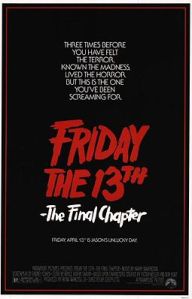
Film Review: Friday the 13th: The Final Chapter (dir. by Joseph Zito)


(spoilers below)

Today, continuing our look at the Friday the 13th horror franchise, we consider the misnamed Friday the 13th — The Final ChapterOriginally released in 1984, this film apparently was really sold as being the final chapter and Tom Savini even returned to do the gore effects because, supposedly, he wanted to kill off his most famous creation.  To be honest, that all sounds like a lot of hype and hucksterism to me but, regardless of the title’s insincerity, The Final Chapter is one of the best (some would say the best) installments in the series.

The Final Chapter begins less than an hour after the end of Part 3.  (One of the curious things about the Friday the 13th series is that the 2nd, 3rd, and fourth films all occur during the same long weekend.  It never seems to disturb anyone in the 3rd or 4th film that a bunch of people have just been murdered in the same general area.)  Jason, who was killed by the terrible Chris Higgins at the end of Part 3, is taken down to the county morgue where he promptly turns out to not be dead after all.  He kills a nurse and an orderly and then, instead of continuing to seek vengeance on Chris (with whom he was pretty much obsessed in Part 3) , he decides to go kill a whole bunch of other people who have just shown up at Crystal Lake for the weekend. 

Those other people are a group of dorky but rather likable college students who have rented a house on the lake.  This is probably the most quirky group of vacationers ever to come to Crystal Lake and it’s a credit to an unusually strong (and unsung) ensemble cast that you actually do believe that these people are friends.  In the group, we have Doug (a dreamy Peter Barton), shy virgin Sarah (Barbara Howard, who is so believable as a nice girl that I felt bad for her when she died), Paul (Alan Hayes), Paul’s slutty girlfriend Samantha (Judie Aronson), and finally heterosexual life partners Jimmy (Crispin Glover) and Ted (Lawrence Monoson).  Jimmy and Ted provide the film with its “comic relief,” the majority of which is pretty weak but Crispin Glover gives such an odd performance that he’s enjoyable nonetheless.  Eventually, our vacationers meet two twins, Tina and Terri (Camilla and Carey Moore) and then they all go back to the house to watch old nudie films and Crispin Glover does a hilariously spastic dance before losing his virginity to one of the twins.  (“Was I a dead fuck?” he asks after, with an aching sincerity.)  And then Sarah gets ready to lose her virginity to Doug but then that defender of purity, Jason (played here by Ted White), pops up and kills everyone.  Seriously, Jason had a busy weekend.

Unfortunately for Jason, Trish Jarvis (Kimberly Beck) and her little brother Tommy (Corey Feldman, who gives a pretty good performance here even if Tommy is kind of a brat when you get right down to it), happen to live next door.  Trish is prepared for Jason because she has previously met yet another camper — Rob (Erich Anderson),who specifically came up to Crystal Lake to track down and kill Jason because Jason killed his sister Sandra in Part 2.  (Of course, by the series chronology, Sandra only died two days ago so I guess Rob moves pretty quickly.)  Also unfortunate for Jason, Tommy is an aspiring makeup artist who makes himself up to look like Jason and, in the surprisingly exciting finale, uses his skills to fool Jason and then hack him up while screaming, “DIE!” all the while.

Plotwise, Friday the 13th: The Final Chapter is a pretty standard slasher film and, at times, it asks the audience to suspend its disbelief just a little bit too much.  Whenever I see the scene where Tina is pulled out the second story window, I always find myself wondering 1) how Jason managed to climb up the side of the house in the rain, 2) why did he decide to do that when, in the previous scene, he was already inside the house, and 3) why didn’t anyone inside the house hear Tina crashing into the station wagon below.  And yet, despite this, Friday the 13th: The Final Chapter is considered by many (including me) to be the best of the series. 

To me, this film succeeds because of two men — Joseph Zito and Tom Savini.    Whereas later Friday the 13th directors often times seemed to be ashamed of the films they were making, Zito was an exploitation vet who had already directed one of the most brutal slashers of all time, The Prowler.  As a director, Zito specialized in telling simple stories as brutally and efficiently as possible.  That’s certainly what he does here and the end result is a fast-paced Friday the 13th that — as opposed to Part 3 — didn’t suffer from any excessive filler.  As well, Zito also does a good job in framing and executing the film’s many tracking and p.o.v. shots, continually keeping the audience off-balance as to whether we’re seeing the camera’s point-of-view or Jason’s. Meanwhile, Tom Savini’s gore effects are just as realistic and disturbing as in the first film.  This is an undeniably bloody film that, at the same time, never slips into tedious “torture porn,” and both Zito and Savini deserve a lot of credit for that.

(Incidentally, here’s a little trivia for all of you Maniac fans — did you know that Joe Spinell’s loathsome Frank Zito was actually named after Joe Zito, who was apparently friends with William Lustig.)

Of all the Friday the 13th films, The Final Chapter probably features the strongest cast.  It certainly features one of the best “final girls”, with Kimberly Beck giving the type of strong performance  that Dana Kimmell failed to supply in Part 3.  Though only Corey Feldman and Crispin Glover would go on to any greater fame, the entire cast is likable and, as opposed to previous and future installments, no one gives a weak performance.  (Even the gimmicky twins do well enough.)  Though I know several people will laugh at this, I sincerely believe that there is an art to giving an effective performance in a film like Friday the 13th.  The key, I think, is to be likable enough that people will watch you and wish you well yet, at the same time, to be bland enough that nobody will be traumatized by your eventual death.  If anything, the cast of The Final Chapter isn’t quite bland enough.  Everyone brings almost too much life to these thinly drawn characters and, as a result,  it’s hard not to feel a little bit traumatized when they start dying.  Crispin Glover, for instance, gave such a quirky and interesting performance that I was actually pretty depressed to see him get that meat cleaver buried in his face.  As well, Peter Barton and Barbara Howard make such a cute couple that it’s upsetting that neither one of them survives to the end of the film. 

Despite the film’s title, the fourth installment of the Friday the 13th franchise was hardly the final chapter and it’s pretty obvious that it was never meant to be.  While I know that some people do complain about the cynicism behind the film’s title, I happen to love it.  It’s like a throwback to the classic old exploitation films that were always sold with sordid titles — like Too Young To Die and Arrested at 17 — that in no way reflected the actual content of the film.  Slasher films are the direct descendants of movies like Reefer Madness and Dwain Esper’s Maniac and it’s nice to see that heritage honored with the false promise of a final chapter.

Though the film’s ending was clearly set up to allow Tommy to eventually take Jason’s place (and, seriously, imagine how disturbing that could have been), Jason would eventually return.  But first, the series would take a major detour with its most over-the-top chapter yet.  We’ll talk about the infamous Friday the 13th — A New Beginning tomorrow.

Poll: Tell Lisa Marie What To Watch Next Sunday


So, guess what I did earlier today?  That’s right — I put on a blindfold, a stumbled over to my ever-growing DVD, Blu-ray. and even VHS collection and I randomly selected 12 films!

Why did I do this?

I did it so you, the beloved readers of Through the Shattered Lens, could once again have a chance to tell me what to do.  At the end of this post, you’ll find a poll.  Hopefully, between now and next Sunday (that’s August 21st), a few of you will take the time to vote for which of these 12 films I should watch and review.  I will then watch the winner on Sunday and post my review on Monday night.  In short, I’m putting the power to dominate in your hands.  Just remember: with great power comes great … well, you know how it goes.

Here are the 12 films that I randomly selected this afternoon:

Abduction From 1975, this soft-core grindhouse film is based on the real-life abduction of Patty Hearst and was made while Hearst was still missing.  Supposedly, the FBI ended up investigating director Joseph Zito to make sure he wasn’t involved in the actual kidnapping.

Aguirre, The Wrath of God From director Werner Herzog and star Klaus Kinski comes this story about a Spanish conquistador who fights a losing battle against the Amazon.

Black Caesar In one of the most succesful of the 70s blaxploitation films, Fred Williamson takes over the Harlem drug trade and battles the mafia.

Don’t Look Now Donald Sutherland and Julie Christie are a married couple who attempt to deal with the death of their daughter by going to Venice, Italy.  Christie quickly falls in with two blind psychics while Sutherland pursues a ghostly figure in a red raincoat through Venice.  Directed by Nicolas Roeg.

The Lion In Winter From 1968, this best picture nominee stars Peter O’Toole and Katharine Hepburn as King Henry II and his wife, Eleanor of Aquitaine.  Taking place on Christmas Eve, Henry and Eleanor debate which one of their useless sons will take over a king of England.  This film is also the feature debut of both Anthony Hopkins and Timothy Dalton.

Logan’s Run — From 1976, this sci-fi film features Michael York and Jenny Agutter as two future hedonists seeking Sanctuary and instead finding Peter Ustinov and a bunch of cats.  Filmed in my hometown of Dallas.

Lost Highway — From director David Lynch comes this 1997 film about … well, who knows for sure what it’s about?  Bill Pullman may or may not have killed Patricia Arquette and he may or may not end up changing into Balthazar Getty.

Mystic River — From director Clint Eastwood comes this film about murder, guilt, redemption, and suspicion in working-class Boston.  Starring Sean Penn, Kevin Bacon, and Tim Robbins.

Naked Massacre — From 1976, this stark film is something a grindhouse art film.  It takes the true life story of Chicago mass murderer Richard Speck and transfers the action to Belfast.  Also known as Born for Hell.

Night of the Creeps — From 1986, this film features alien slugs that turn an entire college campus into a breeding ground for frat boy zombies.  Tom Atkins gets to deliver the classic line: “Well don’t go out there…”

PetuliaConsidered by many to be one of the best American films ever made and one of the definitive films of the 60s, Petulia tells the story of a divorced doctor (George C. Scott) who enters into an odd relationship with Julie Christie.  Directed by Richard Lester, this film also stars Joseph Cotten, Richard Chamberlain, and the Grateful Dead.

What Have You Done To Solange? — From 1975, What Have You Done To Solange is a classic giallo that  features dream-like murders, disturbing subtext, and one of the best musical scores of all time.

So, there’s your 12 films.  Vote once, vote often, have fun, and I await your decision.

Voting will be open until Sunday, August 21st.