Film Review: Two Mules For Sister Sara (dir by Don Seigel)


In 1970’s Two Mules For Sister Sara, Clint Eastwood and Shirley MacClaine take on the French!

It’s an often forgotten piece of history that, during the American Civil War, the French invaded Mexico and tried to turn it into a colony, one that was ruled by the hapless Archduke Maximillian.  The French were then led by Napoleon III, a rather enigmatic figure who spent his entire reign trying to live up to his namesake (and failing).  While the Americans would never have tolerated a French invasion of Mexico under normal circumstances, the Civil War provided enough of a distraction for Napoleon III to make his move in 1861.  Of course, as soon as the Civil War ended, America turned its attention to getting the French out of Mexico and, by the end of 1867, Maximillian had been executed and Napoleon III had withdrawn his forces.

Two Mules For Sister Sara takes place shortly after the end of the American Civil War, when the latest Mexican Revolution was in full swing.  Clint Eastwood plays Hogan, a former union officer who is now in Mexico working as a mercenary.  He’s been hired to help the revolutionaries attack a French garrison, in return for being given half of whatever is found inside.  Traveling through the desert, he comes across a group of bandits who are about to rape a woman named Sara (Shirley MacClaine).  Hogan guns down the bandits and is then shocked when Sara dons a habit and introduces herself as a nun who has been helping the revolutionaries.  She requests that Hogan travel with her and continue to protect her.  Hogan is reluctant, saying that he doesn’t want to become Sara’s mule when she already has one.  (That would be two mules for Sister Sara …. get it?)  But since Sara is a nun and claims to have no idea how to defend herself in the wilderness, Hogan agrees.  Sara and Hogan become unlikely allies as they get further and further involved in the Mexican Revolution.

Two Mules For Sister Sara owes a good deal to the Spaghetti westerns that were then coming out of Italy.  (Eastwood, of course, owed much of his stardom to his appearances in Sergio Leone’s Dollars trilogy.)  The Mexican Revolution was always a popular subject amongst the writers and directors of the Italian Spaghetti westerns.  Of course, Two Mules For Sister Sara is lacking in the political subtext that appeared in many of the Italian films.  Director Don Siegel may have been a liberal but, unlike many of his Italian contemporaries, he wasn’t a Marxist.  Instead, Two Mules For Sister Sara shows its Spaghetti influence in its panoramic visuals, it’s somewhat cynical sense of humor, and the casting of Eastwood as a taciturn mercenary whose main concern is using the revolution to make some money.  Eastwood plays a slightly more humorous version of his Man With No Name.  Hogan may be a cynic who doesn’t speak unless it’s absolutely necessary but he also possesses a good enough heart that there’s no way he’s going to abandon Sister Sara to fend for herself.  (The Man With No Name, on the other hand, would probably not have been so generous.)  Of course, Sister Sara has a secret of her own….

Supposedly, Eastwood and MacClaine didn’t get along particularly well while making Two Mules For Sister Sara.  (During preproduction, the film was envisioned as starring Eastwood and Elizabeth Taylor.)  If there was hostility between the two leads, it worked in the film’s favor because both Eastwood and MacClaine do a good job of playing off of each other.  MacClaine, at first, seems too contemporary for the role but, as the film progresses, she becomes more convincing.  There’s a revelation towards the end of the film that reveals that many of the moments that made MacClaine seem miscast were actually deliberate.  As for Eastwood, there’s a subtle humor running through his performance, as if he’s poking fun at his own tight-lipped persona. His performance here shows hints of the actor that he would become.

Two Mules For Sister Sara is an entertaining western, one that features Eastwood and Seigel celebrating and, at the same time, poking fun at the genre.  A year after this film, Eastwood and Seigel would make film history with Dirty Harry.

Demonoid (1981, directed by Alfredo Zacarias)


Demonoid has a great title and it had a good one sheet but don’t be fooled.  The sword-wielding devil is barely in the move and the women at his feet may have appeared on the cover of every heavy metal album in the 80s but they’re not in the movie.

Exploring a recently uncovered tomb in Mexico, Jennifer (Samantha Eggar) and Mark Baines (Roy Jenson) are intrigued by a number of bodies that are missing their left hand.  Their guide explains that, centuries ago, men, women, and children were sacrificed to the Devil by having their left hands cut off.  When Mark and Jennifer discover a casket with a severed hand, they decide to take it back to the hotel with them.  Of course, the hand is not dead.  It springs from its casket and possesses Mark.  This leads to Mark fleeing back to the United States, trying to find a way to get rid of his possessed hand.  Unfortunately, the hand has a mind of its own and, even after Mark ends up getting set on fire, the hand continues to live and possess one person after another.  Jennifer teams up with Father Cunningham (Stuart Whitman), trying to bring an end to the hand’s reign of terror and giving the audience a chance to wonder how these two actors went from being Oscar nominees to co-starring in Demonoid.

Demonoid is a strange film that starts out as a leisurely travelogue of Mexico and then suddenly turn into a cinematic Grand Guignol, with person after person trying to figure out how to chop off their left hand without doing permanent damage to themselves.  Because the hand is immortal, it has no problem trying to kill whoever it is currently attached to, which leads to not only several scenes of actors fighting with themselves but also several detached hands running across the screen.  A detached but moving hand is creepy the first time you see it but it becomes progressively less so the more time that you spend with it.  The plot is ridiculous enough to be initially intriguing but ultimately, Demonoid is a handsy bore.

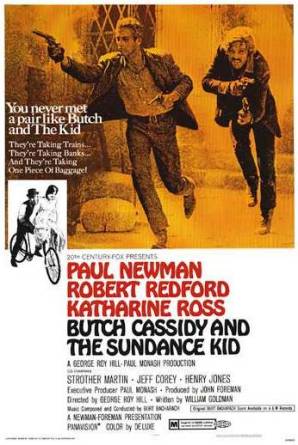
Lisa Watches An Oscar Nominee: Butch Cassidy and the Sundance Kid (dir by George Roy Hill)


Butch_sundance_poster

Should I start this post by ticking everyone off or should I start out by reviewing the 1969 best picture nominee Butch Cassidy and The Sundance Kid?

Let’s do the review first.  I recently watched Butch Cassidy and the Sundance Kid when it aired as a part of TCM’s 31 Days of Oscar.  This was actually my third time to see the film on TCM.  And, as I watched Butch Cassidy and the Sundance Kid for the third time, I was shocked to discover how much I had forgotten about the film.

Don’t get me wrong.  I remembered that it was a western and that it starred Paul Newman and Robert Redford as real-life outlaws Butch Cassidy and the Sundance Kid.  I remembered that it opened and ended with sepia-toned sequences that suggested that Butch and Sundance represented the last gasp of the old west.  I remembered that Butch won a fight by kicking a man in the balls.  I also remembered that they robbed the same train twice and, the second time, they accidentally used too much dynamite.  I remembered that, for some reason, Butch spent a lot of time riding around on a bicycle.  I remembered that Butch and Sundance ended up getting chased by a mysterious posse.  I remembered that Sundance could not swim.  And I remembered that the film eventually ended on a tragic note in South America…

And I know what you’re saying.  You’re saying, “It sounds like you remembered the whole movie, Lisa!”

No, actually I did not.  The thing with Butch Cassidy and the Sundance Kid is that the scenes that work are so memorable that it’s easy to forget that there’s also a lot of scenes that aren’t as memorable.  These are the scenes where the film drags and you’re thankful that Paul Newman and Robert Redford were cast as Butch and Sundance, because their charisma helps you overlook a lot of scenes that are either too heavy-handed or which drag on for too long.  You’re especially thankful for Newman, who plays every scene with a twinkle in his wonderful blue eyes and who is such a lively presence that it makes up for the fact that Redford’s performance occasionally crosses over from being stoic to wooden.  It can be argued that there’s no logical reason for a western to feature an outlaw riding around on a bicycle while Raindrops Keep Fallin’ On My Head plays on the soundtrack but Paul Newman’s so much fun to watch that you can forgive the film.

Newman and Redford both have so much chemistry that they’re always a joy to watch.  And really, that’s the whole appeal of Butch Cassidy and the Sundance Kid, the chance to watch two iconic actors have fun playing opposite each other.  Even though Katharine Ross appears as their shared romantic interest, the film’s love story is ultimately between Butch and Sundance (and, by extension, Newman and Redford).  You can find countless reviews that will give all the credit for the film’s appeal to William Goldman’s screenplay.  (You can also find countless self-satisfied essays by William Goldman where he does the exact same thing.)  But, honestly, the film’s screenplay is nothing special.  This film works because of good, old-fashioned star power.

Now, for the part that’ll probably tick everyone off (heh heh), I think that Butch Cassidy and the Sundance Kid is actually a pretty good pick for a future remake.  All you have to do is pick the right actors for Butch and Sundance.  I’m thinking Chris Pratt as Butch and Chris Evans as Sundance…

Oh, c’mon!  It’ll be great!