To Boldly Go Where No Man Has Gone Before: Re-Watching The Star Trek Films


59 years ago today, the first episode of Star Trek aired in America.

There’s been a lot of different Star Trek shows and crews over the decades.  I have to admit that I’ve always preferred the Original Series, with Kirk sleeping with every alien he met, McCoy and Spock bickering about logic, and Scotty warning that the engines can’t take much more.  The Next Generation was strong as well, especially in the later seasons.  The subsequent series have been hit-and-miss for me.

I was born long after the Original Series went off the air so, like a lot of people, my real introduction to Star Trek came through watching the films.  This weekend, I sat down and watched all fourteen of the Star Trek films in order, from The Motion Picture to Section 31.  Here are my thoughts.

Star Trek: The Motion Picture (1979, directed by Robert Wise)

In the first Star Trek film, Voyager returns to Earth, now known as V’ger.  James T. Kirk (William Shatner) returns to the Enterprise with his old crew and takes command from Decker (Stephen Collins).  Spock (Leonard Nimoy) returns from Vulcan is not happy about it.

Directed by Robert Wise, the first Star Trek film feels out-of-place amongst the films that followed it.  It’s long and slowly paced and it doesn’t have the sense of humor that runs through the best of the films featuring the original cast.  The film favors Kirk and Spock, with the rest of the original cast being largely used as bit players.  Even the costumes are different from the uniforms worn in the later films, making Star Trek: The Motion Picture feel like an entry from an alternate universe.

Despite mixed review, Star Trek: The Motion Picture made the most money of any of the pre-reboot films at the box office.  Because the film itself was so expensive, it was still judged to be a box office disappointment.  The Star Trek films would continue but in a new direction.

Star Trek II: The Wrath of Khan (1982, directed by Nicholas Meyer)

Featuring a character-driven script, exciting action, the best villain in the history of the franchise, and an ending that will bring tears to the eyes of the most cynical viewer, The Wrath of Khan is the film that set the standard for the Star Trek films that would follow.

Ricardo Montalban, recreating a character that he originally played in the television series, is a compelling villain as the vengeance-driven Khan.  Montalban and William Shatner make for perfect rivals, two sides of the same coin.  At the same time, the other members of the original cast all get their moments to shine, especially Walter Koenig as Chekhov.  Kirstie Alley is the sexist Vulcan to ever appear in the franchise and even the revelation that Kirk has a son is handled effectively.  Kirstie Alley, Bibi Besch, and Merritt Butrick all fit in with the original crew.

But the thing everyone remembers about The Wrath of Khan is the death of Spock.  Even though the movie features plenty of hints that Spock will return (including his command of “Remember” to McCoy), it’s impossible not to get emotional when Spock sacrifices himself for the crew.  “I have always been your friend.”  To quote George Costanza, that was hell of a thing when Spock died.  In that scene, Leonard Nimoy shows that he was the (logical) heart of the franchise.  Just as Spock brought out the best in the rest of the crew, Nimoy brought out the best in his co-stars.  Shatner was never better than when he was mourning Spock.

Star Trek III: The Search For Spock (1984, directed by Leonard Nimoy)

Spock’s back!  It’s not a surprise.  I think everyone knew, at the end of Wrath of Khan, that the Genesis Project would bring back Spock.  Star Trek III isn’t bad.  Christopher Lloyd reminds us of how brutal the Klingons were before their Next Generation makeover.  The self-destruction of the Enterprise is a powerful moment.  I just wish that a film about Spock being given a new life hadn’t featured so much death.  Both the revelation that David Marcus tampered with the Genesis Project and his subsequent death feel like missteps.  Robin Curtis takes over the role of Saavik and Kirstie Alley is very much missed.  DeForest Kelley playing McCoy possessed by Spock was, for me, the highlight of the film.

Star Trek IV: The Voyage Home (1986, directed by Leonard Nimoy)

Returning home after rescuing Spock from the Genesis Planet, the Enterprise crew is instead sent back into the past so that they can bring two whales into the future.  The Voyage Home might not be the best Star Trek film (that honor belongs to Wrath of Khan) but it is the most likable and the most entertaining.  Every member of the cast gets something to do in 20th Century San Francisco.  The film is full of classic moments, from Chekhov looking for the “nuclear wessels” to Scotty trying to speak to the computer.  The moment with the punk on the bus is a crowd-pleaser.  I always laugh at Spock’s “One damn minute, Admiral.”  After the violence in The Search for Spock, The Voyage Home‘s humor, gentle sincerity, and emphasis on the efforts of the entire ensemble is a welcome development.

Star Trek V: The Final Frontier (1989, directed by William Shatner)

Leonard Nimoy got his chance to shine as the director of the previous two Star Trek films so William Shatner was allowed to direct The Final Frontier.  The Enterprise crew is brainwashed by a religious fanatic (Laurence Luckinbill) who is also, improbably, Spock’s brother.  Only Kirk is able to resist and confront the entity claiming to be God.  “What does God need with a starship!?”  Kirk demands.  It’s such an obvious question that I can’t believe the entity didn’t already have an answer worked out.

The Final Frontier gets no respect and it was probably doomed as soon as Shatner was announced as director.  Shatner also developed the story and it’s probably not surprising that the main theme is that Kirk was the only person on the Enterprise strong enough to not be brainwashed by the film’s fake God.  Laurence Luckinbill gave a good performance as Sybok but this film really does feel like an unfortunate episode of the original television series.

Star Trek VI: The Undiscovered Country (1991, directed by Nicholas Meyer)

Star Trek VI featured the final appearance of the Original Series cast as a group and they get a send-off worthy of their legacy.  Having been previously established as the Federation’s greatest enemies, the Klingons finally pursue peace.  Just as only Nixon could go to China, only Kirk and the original Enterprise crew can go to the Klingons.  This movie is what Star Trek was all about, with enough world-building and continuity for the hardcore fans and a story that was interesting enough to hold the attention of the casual viewers.  By featuring the start of the era of peace between the Federation and the Klingons, this film also filled in some of the Next Generation‘s backstory.  The Final Frontier was meant to be the final Star Trek film featuring any of the original cast and it would have been the perfect entry for Captain Kirk to go out on.  Unfortunately, that didn’t happen.

Star Trek Generations (1994, directed by David Cason)

William Shatner meets Patrick Stewart as one Star Trek crew passes the torch to the new Star Trek crew.  Malcolm McDowell is the latest villain with an ill-defined plan.  Picard and Kirk team up to stop McDowell’s villain.  They succeed but at the cost of Kirk’s life.  As opposed to Spock’s death in Wrath of Khan, Kirk’s death feels pointless and tacked on for no reason other than to signify the arrival of The Next Generation to the films.  Seeing Shatner and Stewart together is interesting.  Stewart may have been the better actor but Shatner still dominates their scenes together.  Not giving Kirk a better send-off was one of the franchise’s biggest sins.

Star Trek: First Contact (1996, directed by Jonathan Frakes)

After the disappointing Generations, Picard and his crew finally got a film worthy of them with First Contact.  Not only do the Borg return but the crew goes back into their past and experience a key date in the history of the Federation.  After being outshone by Shatner in Generations, Patrick Stewart takes control in this film, giving a multi-layered and commanding performance that still gives the rest of the cast room to shine.  Director Jonathan Frakes not only handles the action well but he also shows that he understands what makes the characters click.  This was, without a doubt, the best of the Next Generation films and one the best of the Star Trek films overall.

Star Trek: Insurrection (1998, directed by Jonathan Frakes)

Entertaining but forgettable, Insurrection features Picard pulling a Kirk and defying orders from from a superior officer (played by Anthony Zerbe) and going out of his way to save Data from being decommissioned.  Insurrection feels like an extended episodes of the Next Generation television series and lacks the epic scale of First Contact.  Under the direction of Jonathan Frakes, the ensemble is strong and watching them interact feels like spending time with a group of old friends.  F. Murray Abraham and Anthony Zerbe make for effective villains.

Star Trek: Nemesis (2002, directed by Stuart Baird)

Just as the Original Series crew sought peace with the Klingons in The Undiscovered Country, the final Next Generation film finds Picard, Riker, and the rest seeking peace with the Romulan Empire.  Tom Hardy plays a clone of Picard who is now the leader of the Romulans.  Data sacrifices himself in a move that tries too hard to duplicate the death of Spock.  Picard retires.  Director Stuart Baird emphasizes action over the chemistry of the Next Generation cast and the end result is a disappointing finale that left critics and audiences underwhelmed.

Star Trek (2009, directed by J.J. Abrams)

I think people forget about what a big deal this Star Trek reboot was when it first came out.  Today, people focus on things like Kirk being a Beastie Boys fan and they forget how exciting it was to see Chris Pine, Zachary Quinto, Karl Urban, Simon Pegg, Anton Yelchin, John Cho, and Zoe Saldana all effortlessly stepping into the roles of the younger versions of the original cast.  The storyline is predictable and Eric Bana’s a bland villain but the scenes between Leonard Nimoy and Zachary Quinto were a reminder of how important Spock was and is to Star Trek.

Star Trek wasn’t perfect, of course.  In retrospect, I think creating an alternate timeline was a mistake because it created a situation where, even if someone died, it was just an alternate version dying and not the version that audiences knew and cared about.  The alternate timeline would also lead to one of the biggest missteps in the history of the franchise.

Star Trek Into The Darkness (2013, directed by J.J. Abrams)

After the surprising success, both critically and commercially, of his Star Trek reboot, J.J. Abrams. Robert Orci, Alex Kurtzman, and Damon Lindelof wasted most of that good will by messing around with one of the franchise’s most memorable characters.

There are some good things to be said about Star Trek Into The Darkness.  I like the action sequences and the climatic battle in the film’s futuristic version of San Francisco.  But casting Benedict Cumberbatch, of all people, as Khan is a misstep that can’t be overcome.  That the movie brought back Khan instead of exploring “strange new worlds” exposed the weakness of Abrams entire reboot.  For all the hype, did the Star Trek reboot actually have anything new or original to offer?  The answer here seemed to be no.

Star Trek Beyond (2016, directed by Justin Linn)

The final (for now) Star Trek theatrical film featured a memorable villain in the form of Idris Elba and a plot that felt like it could have just as easily been an episode of the original series.  In retrospect, the film is mostly memorable for featuring the announcement of the death of Ambassador Spock.  (The film was released a year after the death of Leonard Nimoy.)  The death of Spock, this time with no Genesis Project around to bring him back, makes this installment feel like right place to end the films.  For many of us, Nimoy was Star Trek.

Stark Trek: Section 31 (2025, directed by Olatunde Osunsanmi)

Though there have been many subsequent televisions shows, there hasn’t been a Star Trek theatrical release since 2016.  The next installment has been in pre-production limbo for nearly ten years.  (Quentin Tarantino was supposedly attached at one time.)  Instead of coming to theaters, the latest Star Trek movie came to Paramount Plus.

I debated whether or not to include Section 31 in this list, both because it was a “made-for-TV” movie and also because it was so bad that I think most Star Trek fans would rather forget about it.  A mediocre heist film that wastes star Michelle Yeoh and which doesn’t feel like it belongs in the Star Trek universe, Section 31 may still represent the way forward for the franchise.  With theaters having never recovered from the COVID shut-downs and more and more people preferring to stream their entertainment at home, the future of the Star Trek films could very well be a collection of assembly line Paramount Plus movies.

Finally, Case turned me onto this short film:

765874: Unification (2024, directed by Carlos Baena)

A collaboration between Otoy, a VFX company, and The Roddenberry Archive, with support from Paramount, 765874: Unification is a 10-minute short film that imagines Kirk meeting Spock in the afterlife.  Shatner returns as Kirk, de-aged with CGI.  Just as Kirk and Spock were friends in the film, the same was true of Shatner and Nimoy in real life.  (You only have to compare Nimoy’s comments about Shatner with George Takei’s endlessly bitter takes to see what true class actually is.)  This short film gives both characters the finale that they deserved.

It’s possible that we may never see another true Star Trek film.  Most of the original cast is gone now.  Patrick Stewart will always be Picard but even he is now approaching 90.  But whatever the future may hold, I’m happy for the films that Star Trek gave us.

Late Night Retro Television Reviews: Highway to Heaven 1.8 “A Divine Madness”


Welcome to Late Night Retro Television Reviews, a feature where we review some of our favorite and least favorite shows of the past!  On Thursdays, I will be reviewing Highway to Heaven, which aired on NBC from 1984 to 1989.  The entire show is currently streaming on Tubi and several other services!

This week, things get a bit silly on the highway.

Episode 1.8 “A Divine Madness”

(Dir by Michael Landon, originally aired on November 7th, 1984)

Oh, this episode.

Years ago, a ruthless land developer named Arthur Krock (Ron Moody) built a castle for his beloved wife.  Tragically, his wife passed away and Arthur had a nervous breakdown.  Now, he spends all of his time in his castle and he believes that he actually is King Arthur.  He says that he’s waiting for the return of his Guinevere.  Only Marian (Helen Kleeb), his loyal maid, has remained with him over the years.  He, of course, calls her Maid Marian even though that’s a Robin Hood reference and not anything from the Arthurian legends.

Though the elder Arthur Krock is still the head of his company, the day-to-day business is handled by his son, Arthur Krock, Jr. (played by a young and beardless Jonathan Frakes).  Bitter over his unhappy childhood, Arthur, Jr. is just as ruthless as his father once was.  Arthur, Jr. has a 12 million dollar deal to force a woman named Gwen (Jean Allison) off of her land and he’s determined to get it done, even if it means displacing all of the dogs that she and her veterinarian son (Scott Stevenson) look after.

Arthur, Sr.’s daughter, Linda (Ellen Maxted), hires two new handyman and you can probably already guess that they’re going to be Jonathan and Mark.  Working around the castle, Jonathan arranges for Arthur, Sr. to meet Gwen.  When Arthur, Sr. discovers that Gwen is short for Gweneviere, he announces that she can stay on her land.  Arthur, Jr. goes to court to get his father declared incompetent.

Can you guess what happens?  Well, if you think that Arthur, Sr. hires Jonathan to be his lawyer and then announces in court that he has not been the father that he should have been …. you’re absolutely correct!

When people talk about Highway to Heaven being a campy or cheesy show, it’s usually episodes like this that they’re talking about.  Unabashedly sentimental in its approach, this episode suffers from the fact that Arthur, Jr. has a point.  Arthur, Sr. is clearly mentally ill and allowing him to run the company is totally unfair to his employees and the people who have invested in his business.  Just because Arthur, Jr. isn’t particularly likable, that doesn’t make him incorrect.  If the episode had merely portrayed Arthur, Sr. as an eccentric who didn’t want to have to deal with the pain of the real world, that would be one thing.  But this episode has Arthur, Sr. living in a literal castle, sitting on an actual throne, and referring to his son as being Lancelot.  It’s all just a bit too much and Ron Moody’s over-the-top performance doesn’t particularly help.  To the show’s credit, it does eventually acknowledge that Arthur, Sr. needs some help but still, the whole thing just feels a bit …. well, silly.

Next week, Jonathan and Mark help a movie star become a better father!  Hopefully, he doesn’t think that he’s Prester John or Robin Hood or anyone like that.

Retro Television Reviews: Fantasy Island 2.6 “War Games/Queen of the Boston Bruisers”


Welcome to Retro Television Reviews, a feature where we review some of our favorite and least favorite shows of the past!  On Tuesdays, I will be reviewing the original Fantasy Island, which ran on ABC from 1977 to 1986.  The entire show is currently streaming on Tubi!

It’s time for another tonally confusing trip to Fantasy Island!

Episode 2.6 “War Games/Queen of the Boston Bruisers”

(Dir by Earl Bellamy, originally aired on October 28th, 1978)

We’re just six episodes into the second season of Fantasy Island but a definite pattern has emerged.  Just as in the first season, each episode features two fantasies.  But, in the second season, it appears that one fantasy is always comedic and the second is always serious.  This has created an interesting tonal mishmash on Fantasy Island.  Mr. Roarke spends half of his time laughing at the silliness of it all and the other half warning people that their fantasy could lead to death.

Take this episode for instance.

Rowdy Roberts (Anne Francis) is a roller derby champ whose fantasy is to become a “gentlelady” so that she can impress her daughter’s future in-laws.  (Rowdy’s future son-in-law, meanwhile, is played by a young Jonathan Frakes.)  Mr. Roarke and Tattoo spend an entire weekend teaching Rowdy how to speak properly, how to eat with silverware, and all the rest.  However, snobbish Betty Wendover (Joanna Barnes) doesn’t want her son marrying Rowdy’s daughter so she arranges for Rowdy’s roller derby rival, Hooligan Hanreddy (Mary Jo Catlett), to come to the island and challenge Rowdy to a fight.  Rowdy throws a punch and then runs off, ashamed at not being sophisticated.  But, it turns out that Rowdy’s future son-in-law is really impressed with what Rowdy did and the wedding takes place after all.  Yay!

Needless to say, this is all incredibly silly but it’s meant to be silly and both Anne Francis and Mary Jo Catlett seem to be having fun overplaying their rivalry.  There is nothing particularly realistic about this fantasy but it’s not meant to be.  It’s meant to make the viewer smile and, for the most part, that’s what it does.

But, at the same time, Vietnam vet Joe Beck (Christopher George) is chasing another Vietnam vet, attorney Ted Harmon (Greg Morris), through the jungle, intent on killing him.  Joe blames Ted for the death of Joe’s younger brother.  Apparently, they were all POWs together and Joe’s brother died during an escape.  Joe is convinced that Ted betrayed his country.  This is all pretty dramatic and it’s hard not to wonder why Roarke would have agreed to sponsor this fantasy in the first place.  Ted is a prominent attorney who is thinking of running for political office.  If he was murdered on Fantasy Island, that wouldn’t do much for the island’s reputation.  Fortunately, it all works out in the end as Joe discovers that his younger brother is not only still alive but that he’s also the one who informed the VC about the escape attempt.  Amazingly, Ted doesn’t seem to be at all upset that he was nearly murdered over a mistake.  I guess that’s the magic of Fantasy Island.

These two fantasies didn’t really go together and, as a result, this episode feels a bit messy.  But there is one cute moment in which Tattoo reveals to Mr. Rourke that his new side hustle involves selling phony college degrees.

Go Tattoo!

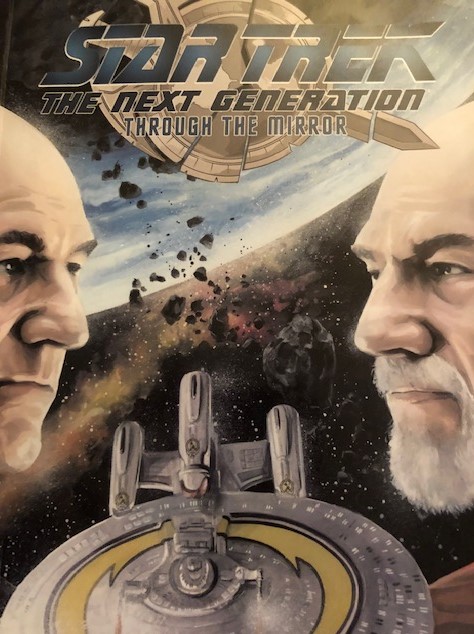
Star Trek: The Next Generation, Through The Mirror, Review by Case Wright


mu11.jpg

Happy Horrorthon!!! We are back in the eeeeeeeeevil Star Trek universe! Why is it evil? Obviously, it’s because they have beards and follow strict capitalist principles with a healthy dose of militarism.

Before I get into the story, I want to write that David and Scott Tipton do a good job of not having the mirror universe characters seeing themselves as villains.  This may seem obvious, but it’s actually very common – especially in comics.  For example, Stan Lee once had Magneto lead a group of mutants with the moniker of Brotherhood of Evil Mutants.  I get that the X-Men thought they were evil, but why would Magneto?

This volume: Through the Mirror brings our Mirror Universe to the Next Generation universe our youth for supplies and plunder.  Bearded Picard is faced with blockades from rival species in his universe and needs materiel and plunder to fuel his war machine in order to bring the Terran Empire back to its former glory before Emperor Spock made them go all drum-circle kumbaya…bleh.

My main complaint with the Volume Two is actually in the first installment.  It opens with Worf investigating the theft of precious minerals from a mining colony in the “good universe”.  He sees the thief and nearly catches him.  This is a recurring issue with volume 2; the story should be only from the perspective of the mirror universe characters.  There is simply too much of the “good universe”.  They also have the “Good Universe” find an Andorian Ship that has been attacked by Evil Picard after the fact.  WHY?  Show us the Evil Planning, Show us the Pirate Picard attack, Show us why they believe they are justified.  We bought the book; therefore, we are invested in these anti-heroes.   The story could be great if we just get to bathe in their villany.  Don’t judge them.  This is their code.  This is their society.  They don’t see themselves as evil and neither should we.  We can only judge them as evil if they violate their own code of morality not ours.  This isn’t our universe.  The good universe should be treated like MSG a little is … ok… too much and you vomit.

Back to the story, Pirate Picard lures the good enterprise into a trap, hoping to seize it.  They fail, but they failed too much.  It should’ve been more of a draw with a push to the evil universe. Scott and David – the evil guys are your heroes.  They need to win at least a bit.  You can have a close game, but don’t have them get their ass kicked because it makes it too much of a Good Next Gen story.  The other knock is that they left Evil Barclay behind, dragging us back unnecessarily into the good universe.  You are thwarting them waaaaay too much.

It’s time for Evil Picard to kick some ass, but it in a good way.  Is it just for wealth for Pirate Picard?  I don’t think so.  In this universe, the Terrans see themselves as Superior like the British or Roman Empire.  Therefore, when the Klingons and Cardassians took back a lot of the Empire they likely took many Human captives as slaves.  This must be disgustingly unacceptable to Pirate Picard or any Terran Empire member.  Have them liberate a planet, rescuing Human captives.  From their perspective, they are not only NOT EVIL, but good because they are reasserting rightful human dominance to their universe.   If you have to, make some propaganda posters with Pirate Picard.  Make it personal for Pirate Picard.  Maybe Picard’s brother joined the fleet and was captured?  Make it personal! Go for it!  Have Pirate Picard risk it all: mutiny, the ship, the Terran Empire to liberate and rescue his brother and nephew Robert.  It would be epic!!!!! You have an unending depth that you can give Pirate Picard.  Give him his version of humanity.

This volume was ok, but they are not fulfilling some great story potential here.   This could be a great way to reboot the series.  Just remember: They Don’t Consider Themselves Evil.


Horror on TV: Beyond Belief: Fact or Fiction Episode 4.7


It’s time for another episode of Beyond Belief!  This episode was originally broadcast on July 22nd, 2002 and host Jonathan Frakes appears to be even more amused with it all than usual!

Can you figure out what’s fact and what’s fiction?

http://www.youtube.com/watch?v=XizVKPBAunU

Horror on TV: Beyond Belief: Fact or Fiction Episode 3.13


Beyond Belief: Fact or Fiction aired off-and-on for about five years on the Fox network.  A sign of just how randomly this show was scheduled can be found in the fact that season 3 started in 2000 while season 4 didn’t start until 2002.  Reruns of the show currently air on the Chiller Network which is where I recently discovered it.

Hosted by Jonathan Frakes, each episode would present the viewers with five different stories.  Each story would appear to defy logic and then, at the end of the episode, Frakes would reveal which of the stories were fact and which were fiction.  The show was often incredibly silly and yet, it occasionally had an odd charm to it.  A lot of this was due to Jonathan Frakes, who always seemed to be rather amused with it all.

Even more importantly, as bad as this show often was, it’s the perfect type of show to watch in October.  It’s the television equivalent of a scary story being told around a campfire.

Below, you’ll find the final episode of the third season.  Can you guess what’s fact and what’s fiction?

http://www.youtube.com/watch?v=bZAYx1z96pg

Horror On TV: Beyond Belief: Fact or Fiction Episode 1


Earlier this month, we featured an episode of Beyond Belief: Fact or Fiction that was hosted by Jonathan Frakes.  What I did not mention, in that post, is that Frakes was not the 1st person to host this show.

The first season was hosted by veteran scenery-chewer James Brolin.  Whereas Frakes brought a bemused appreciation to the absurd to his role of host, Brolin’s approach was far more earnest.

And, in appreciation of that earnestness, here’s the very first episode of Beyond Belief: Fact or Fiction?  This originally aired on May 25th, 1997 and it’s worth watching just to compare Brolin’s blandly sincere approach to the far more snarky approach of Jonathan Frakes.

Horror On TV: Beyond Belief: Fact or Fiction Episode 13


Beyond Belief: Fact or Fiction aired off-and-on for about five years on the Fox network.  A sign of just how randomly this show was scheduled can be found in the fact that season 3 started in 2000 while season 4 didn’t start until 2002.  Reruns of the show currently air on the Chiller Network which is where I recently discovered it.

Hosted by Jonathan Frakes, each episode would present the viewers with five different stories.  Each story would appear to defy logic and then, at the end of the episode, Frakes would reveal which of the stories were fact and which were fiction.  The show was often incredibly silly and yet, it occasionally had an odd charm to it.  A lot of this was due to Jonathan Frakes, who always seemed to be rather amused with it all.

Even more importantly, as bad as this show often was, it’s the perfect type of show to watch in October.  It’s the television equivalent of a scary story being told around a campfire.

Episode 13 aired during the show’s 2nd season.  Can you guess what’s fact and what’s fiction?