Late Night Retro Television Review: 1st & Ten 3.6 “The Bulls Change Hands”


Welcome to Late Night Retro Television Reviews, a feature where we review some of our favorite and least favorite shows of the past! On Wednesdays, I will be reviewing 1st and Ten, which aired in syndication from 1984 to 1991. The entire series is streaming on Tubi.
This episode was confusing.  Is syndication to blame?

Episode 3.6 “The Bulls Change Hands”

(Dir by Stan Lathan, originally aired on September 9th, 1987)

Diana no longer owns the Bulls!

That was the main plot development to be found in this cluttered episode of 1st & Ten.  As I’ve mentioned before, the episodes of 1st & Ten that are available on Tubi are the heavily edited versions that were sold into syndication as opposed to the original, R-rated versions that appeared on HBO.  With quite a few of these episodes, it’s obvious that entire plotlines have been pretty much chopped out.  That certainly feels like the case here because, despite having watched the episode, I’m still not totally sure how Diane lost the Bulls in the first place.

What I do know is that she threatened to expose Teddy’s insider trading.  Teddy responded by leaving the country but, before he left, he gave his ownership shares to his daughter, Jill (Leah Ayres).  Teddy explains that this makes Jill the owner of the Bulls.  But my understanding was that Teddy only owned half the team so it seems like that would mean Jill and Diane would now be co-owners.  Perhaps I missed something in an earlier episode or maybe some line of dialogue was cut out for syndication, I’m not sure.  What I do know is that Jill now owns the Bulls.  The first thing she does is break up with Yinessa because she can’t be both his boss and his girlfriend.

In her final locker room speech, Diane orders the Bulls to win because Diane is taking Jill to court and she wants the team to be in the playoffs once she returns as the owner.  It’s not a bad speech but again, I thought Diane still owned at least half of the team.

Meanwhile, Yinessa is back as quarterback.  And he leads the Bulls to their first victory of the season.  His new wide receiver, Billy Cooper (Michael Toland) catches the game-winning pass.  At the same time that Billy is scoring, some guy who we’ve never seen before is shooting at him from the roof of the stadium.  The police arrest the guy and Billy later discovers a bullet lodged in his helmet.

Bubba’s sex therapist (Penny Johnson) is now obsessed with him, despite Bubba’s attempts to set her up with with Jethro.  I have a feeling that the Jethro/Bubba storylines were the ones that really got left on the cutting room floor when it came to editing these episodes for syndication.  Jethro and Bubba have been with the show since the beginning and they’ve got prominent billing in the opening credits but, when it comes to their roles in the episodes themselves, it seems like the only thing that happens is Bubba says that he needs to get laid and then the two of them disappear for several weeks.  When they do finally reappear, Bubba is always in some sort of new trouble with his wife.

Speaking of marriage, in this episode, TD Parker finally confesses to his wife that he’s been having an affair.
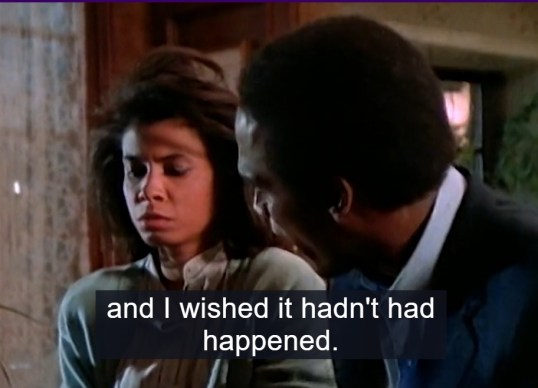
TD apologizes.  His wife tells him to get out.  Agck!  I can see where this storyline is heading but OJ Simpson fighting with his wife still lands differently in 2026 than it probably did in 1987.

This episode was a mess but I guess Jill is the owner of the Bulls now and Teddy’s fled to South America.  Can’t the Bull just concentrate on playing football and earning their paycheck?

A Movie A Day #33: Two-Minute Warning (1976, directed by Larry Peerce)


mpw-8771

For the longest time, I thought that Two-Minute Warning was a movie about a gang of art thieves who attempt to pull off a heist by hiring a sniper to shoot at empty seats at the Super Bowl.  As planned by a master criminal known as The Professor (Rossano Brazzi), the sniper will cause a riot and the police will be too busy trying to restore order to notice the robbery being committed at an art gallery that happens to be right next to the stadium.

I believed that because that was the version of Two-Minute Warning that would sometimes show up on television.  Whenever I saw the movie, I always through it was a strange plan, one that had too many obvious flaws for any halfway competent criminal mastermind to ignore them.  What if the sniper was captured before he got a chance to start shooting?  What if a riot didn’t break out?  The sniper spent the movie aiming at empty seats but, considering how many people were in the stadium, it was likely that he would accidentally shoot someone.  Were the paintings really worth the risk of a murder charge?

Even stranger was that Two-Minute Warning was not only a heist film but it was also a 1970s disaster film.  Spread out throughout the stadium were familiar character actors like Jack Klugman, John Cassevetes, David Janssen, Martin Balsam, Gena Rowlands, Walter Pidgeon, and Beau Bridges.  It seemed strange that, once the shots were fired and Brazzi’s men broke into the gallery, all of those familiar faces vanished.  When it comes to disaster movies, it is an ironclad rule that at least one B-list celebrity has to die.  It seemed strange that Two-Minute Warning, with all those characters, would feature a sniper shooting at only empty seats.  For that matter, why would there be empty seats at the Super Bowl?

That wasn’t the strangest thing about Two-Minute Warning, though.  The strangest thing was that Charlton Heston was in the film, playing a police captain.  In most of his scenes, he had dark hair.  But, in the scenes in which he talked about the art gallery, Heston’s hair was suddenly light brown.

Recently, I watched Two-Minute Warning on DVD and I was shocked to discover that the movie on the DVD had very little in common with the movie that I had seen on TV.  For instance, the television version started with the crooks discussing their plan to rob the gallery.  The DVD version opened with the sniper shooting at a couple in the park.  In the DVD version, there was no art heist.   The sniper had no motive and no personality.  He was just a random nut who opened fire on the Super Bowl.  And,  in the DVD version, he did not shoot at empty seats.  Several of the characters who survived in the version that I saw on TV did not survive in the version that I saw on DVD.

What happened?

The theatrical version of Two-Minute Warning was exactly what I saw on the DVD.  A nameless sniper opens fire and kills several people at the Super Bowl.  In 1978, when NBC purchased the television broadcast rights for Two-Minute Warning, they worried that it was too violent and too disturbing.  There was concern that, if the film was broadcast as it originally was, people would actually think there was a risk of some nut with a gun opening fire at a crowded event.  (In 1978, that was apparently considered to be implausible.)  So, 40 minutes of new footage was shot.  Charlton Heston even returned to film three new scenes, which explains his changing hair color.  The new version of Two-Minute Warning not only gave the sniper a motive (albeit one that did not make much sense) but it also took out all of the violent death scenes.

Having seen both versions of Two-Minute Warning, neither one is very good, though the theatrical version is at least more suspenseful than the television version.  (It turns out that it was better to give the sniper no motive than to saddle him with a completely implausible one.)  But, even in the theatrical version, the potential victims are too one-dimensional to really care about.  Ultimately, the most interesting thing about Two-Minute Warning is that, at one time, an art heist was considered more plausible than a mass shooting.

tmw