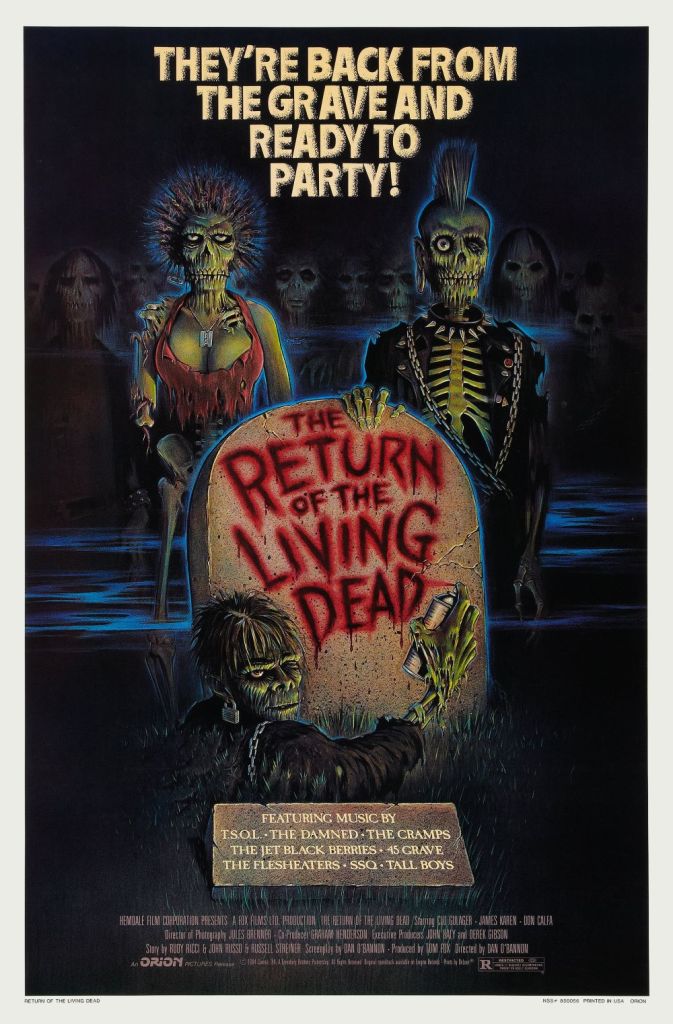
Brains, Laughs, and Decline: The Uneven Legacy of Return of the Living Dead


Subverting the Zombie Canon: Satire, Genre-Bending, and Decay in the Return of the Living Dead Series

When talking about cult horror films, the Return of the Living Dead series holds a special place—not only as a spin-off from George A. Romero’s seminal Night of the Living Dead, but as a unique creative force in its own right. Thanks to a legal split between Romero and co-writer John Russo over rights to the “Living Dead” name, Russo and director Dan O’Bannon got to imagine a parallel zombie universe. This franchise quickly carved out its own identity, mixing horror, black comedy, and punk spirit in a way that both paid tribute to and upended zombie tropes.

Reinventing Zombie Lore with a Wink

The original Return of the Living Dead (1985) starts with a clever “what if” twist: what if Romero’s Night wasn’t just a movie, but a dramatized cover-up of a real government disaster? This meta idea instantly frames the film as self-referential and playful, setting a tone unlike anything out at the time.

Central to the film’s identity is the invention of 2-4-5 Trioxin, a fictional military chemical designed to clear marijuana crops which instead raises the dead—zombies with surprising new abilities. Unlike the slow, drooling zombies Romero popularized, these ghouls sprint, talk, and set traps. Their hunger is peculiar as well: they crave brains exclusively, as it eases the pain of being undead. And the old rules of zombie combat? Forget shooting them in the head. These zombies resist it, raising the stakes and scare factor.

This refreshing rewrite of zombie rules allowed the movie to be both frightening and fun. The zombies were smart but still monstrous, turning classic horror expectations on their head in a way that invited both laughter and fear—a tricky balance that few horror comedies manage.

Playing with Comedy, Panic, and Punk Rock

One of the greatest strengths of the original film is how it embraces horror-comedy so naturally. It doesn’t shy away from being funny while still delivering tension. James Karen and Thom Mathews excel as the main pair—Karen’s frantic, over-the-top panicked man paired with Mathews’ straight, slowly succumbing counterpart create a perfect comedic rhythm. Their slow transformation into zombies adds a tragic dimension to what could have been simple slapstick. Meanwhile, Don Calfa’s mortician character and Clu Gulager’s warehouse owner provide a grounded center amidst chaos.

The punk subculture flavor adds another unique texture. Linnea Quigley’s famous graveyard striptease encapsulates the 1980s’ blend of irreverence, sexuality, and horror obsession. The scene is shocking, hilarious, and iconic—one of those moments that encapsulates everything this film is about: having fun with taboos while not losing the darker undercurrents of mortality and decay.

Beyond laughs, there’s biting satire here. The film skewers the government and military’s hubris—scientists create a superweapon they can’t control, leading to chaos and destruction. This reflects 1980s American anxieties about bioweapons, government cover-ups, and nuclear fears. Horror and comedy collide to reflect cultural distrust and paranoia.

The Problem of the Sequel: Part II’s Familiar Ground

When Return of the Living Dead Part II came out in 1988, it felt like the franchise was stuck in a loop. With much of the original cast returning in near-identical roles, and lines and situations seemingly recycled, the film circles back to the same story. This self-copying invites a mix of amusement and disappointment: it seems the filmmakers didn’t believe they could improve on the original and decided to replicate it instead.

While it has its moments—good practical effects and a rollicking tone reminiscent of the first film—it leans harder into comedy, sometimes at the expense of the horror. The suburban setting and clearer military lockdown raise the action stakes, but the humor feels broader and less sharp, which can make the movie seem a bit cartoonish.

In a way, Part II comments on the pitfalls of horror franchises: once you’ve struck gold with an unexpected idea, sequels often struggle to regain that freshness. This installment is entertaining, but signals the beginning of the franchise’s creative plateau.

Much Darker Territory: Part III’s Horror and Romance

With Return of the Living Dead 3 in 1993, things take a major tonal shift. Brian Yuzna’s direction removes much of the comedy and replaces it with body horror, gore, and a genuinely tragic romance. The story centers on Curt and Julie, two teenagers tragically pulled into the military’s secret zombie experiments. After Julie is accidentally killed and resurrected, she becomes a zombie who feeds on brains but manages her hunger through extreme self-inflicted pain.

This grim take pushes the franchise into more serious, intense horror territory, with heavy themes of love, loss, and bodily autonomy threaded throughout. Julie’s tortured transformation is both tragic and unsettling, symbolizing not only the loss of life but also the torment of trying to hold onto humanity while losing it from within.

Yuzna’s effects are grisly in the finest tradition of ‘90s practical SFX. The film revives the franchise’s sense of danger and stakes by mixing romance with horror, delivering something emotionally resonant and viscerally impactful. While it diverges sharply from the earlier comedic tone, Part III proves the series’ flexibility and capacity for reinvention.

Creative Collapse: Parts IV and V’s Direct-to-Cable Downfall

Sadly, the wheels come off with Return of the Living Dead 4: Necropolis and 5: Rave to the Grave, both made in 2005 and directed by Ellory Elkayem. Shot back-to-back and released direct-to-cable, these films are pale shadows of the earlier entries.

They ditch the original’s clever mix of horror and humor entirely. Instead, we get generic corporate conspiracies, confusing Eastern European settings, weak scripts, and inconsistent zombie characterizations. The zombies lose their unique “brains only” horror and instead act like run-of-the-mill undead. Even the acting is amateurish, with only Peter Coyote standing out briefly as a sinister scientist.

Part 5 further muddies continuity by introducing Trioxin as a rave drug, leading to a chaotic rave/zombie apocalypse scenario that is both baffling and poorly paced. The low-budget effects and uneven pacing betray the exhaustion and lack of passion behind these entries.

These final two films underscore a common fate for franchises that outlive their creative spark—once inventive mythology becomes shallow cliché, and attempts to cash in feel uninspired. Instead of honoring their roots, they become muddled and forgettable.

Why the Series Matters

Despite its uneven legacy, Return of the Living Dead remains important for what it dared to do in horror cinema. The first film’s originality influenced countless horror comedies and redefined how zombies could be portrayed. Its self-awareness and invention paved the way for postmodern horror, where genre is as much about commentary as it is fear.

The third film’s daring shift to tragic body horror further demonstrated the potential for zombie films to explore complex emotional and societal themes beyond gore or giggles.

While the later sequels falter, their failure serves as a cautionary tale about the dangers of diluting distinct voices and creative risks in franchise filmmaking.

Ultimately, Return of the Living Dead survives in cultural memory as a zombie series that captured the spirit of its time—punk rebellion, Cold War paranoia, and genre self-mockery—with flashes of brilliance that continue to entertain and inspire.
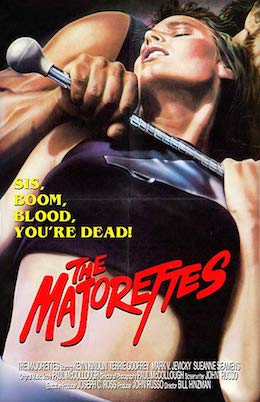
October Hacks: The Majorettes (dir by Bill Hinzman)


1987’s The Majorettes takes place in a small town in Pennsylvania.  It’s the type of town where everyone follows the high school football team, everyone goes to church on Sunday, and everyone admires the baton-twirling high school majorettes, even more so than the cheerleaders.

Unfortunately, it appears that someone is murdering the majorettes, one-by-one.  The first majorette victim is murdered while out on a date with Tommy, the class nerd.  (Poor old Tommy is killed as well.)  Her body is left in a creek.  The second victim is killed while lounging in front of her swimming pool.  The third victim is killed in the shower.  Detective Roland Martell (Cal Hetrick) thinks that the murders are linked to some sort of purification ritual.  Sheriff Braden (Mark V. Jivicky) says that he agrees but he doesn’t really have much time to worry about motives.  Braden’s dismissal of Martell could be due to the fact that Braden is a deeply religious man who we first see observing a creek baptism and singing a gospel song.  Meanwhile, Martell is an agnostic who is having an affair with a teenage girl named Nicole (Jacqueline Bowman).

Who could be the murderer?  Could it be Harry (Harold K. Keller), the slow-witted handyman who is always watching the majorettes while they’re practicing and who peeps on them and takes pictures while they’re changing in the locker room?

Could it be Harry’s mother, Helga (Denise Huot)?  Helga is a nurse who is plotting to murder both majorette Vicky McAlister (Terrie Godfrey) and her grandmother as a part of her plot to inherit the McAlister fortune.  But just because Helga is planning to kill one majorette, that doesn’t necessarily mean that she killed the others.

Or could the murderer be the school’s resident dope dealer, Mace (Tom E. Desrocher)?  Mace spends most of his time hanging out with his gang in their trailer, which is decorated with Confederate flags and 666 graffiti.  Mace was seen with the first victim and quarterback Jeff Holloway (Kevin Kindlin) is pretty sure that Mace was responsible for the murder.  When Jeff goes to the police, Mace decides to go after Jeff.

Anyone of them could be the murderer.  I won’t spoil the killer’s identity, beyond telling you that we learn who the killer is about halfway through the film.  And once the killer is known, The Majorettes goes from being a high school slasher film to being a backwoods action/revenge film, complete with shotguns being fired, vehicles blowing up, and Jeff the clean-cut quarterback suddenly running around with an arsenal of weapons.  Ultimately, The Majorettes feels like 3 different movies in one, with moments of horror balanced with scenes of Lifetime-style melodrama and Cannon-style action.  To be honest, the entire film is a bit silly but there’s enough twists and turns to hold one’s interest.  It’s hard not to enjoy the film’s “just toss it all in” approach to storytelling.

The Majorettes was based on a novel by John Russo, who is also credited as one of the screenwriters on Night of the Living Dead.  The film itself was directed by Bill Hinzman, who played the first zombie to show up in Romero’s classic film.  There’s not much visual flair to Hinzman’s direction but he keeps the action moving and really, that’s the most important thing that one can do with a film like The Majorettes.

Book Review: Night of the Living Dead by John A. Russo


A few years ago, I found a slightly beat-up copy of John Russo’s novelization of Night of the Living Dead at Half-Price Books. Of course, I immediately purchased it. From my own knowledge of the making of George Romero’s classic horror movie, I knew that John Russo was the one who came up with an idea involving zombies which led to Romero writing a story outline for Night of the Living Dead which Russo then turned into the film’s screenplay.

I also knew that Romero and Russo had a falling out of sorts after the success of Night of the Living Dead. With the film in the public domain as the result of a screw-up on the part of the movie’s distributor, there was some controversy over who had the rights to the original’s story. That’s one reason why the titles of Romero’s subsequent zombie films (i.e., Dawn of the Dead, Day of the Dead, Land of the Dead, and the rest) were all about “the Dead” as opposed to “the Living Dead.” Russo’s subsequent zombie-themed work (i.e. Return of the Living Dead) featured the term “Living Dead” and was also sold as a sequel to the original Night of the Living Dead.

With all that in mind, I was curious to see what Russo’s novelization would be like. What extra information would the book contain about the characters? Would there be any extra details that were cut from the film? How about an alternate ending? It’s been known to happen. (Check out the novelization for Halloween if you want to see how much a novelization can differ from the film that inspired it.)

Well, it turns out that novelization of Night of the Living Dead is pretty much a straight recreation of the film. We do learn a bit more about just how bad a relationship Barbara has with her brother Johnny. And it’s firmly established that Ben was a truck driver before the dead came back to life. Otherwise, it’s pretty much just the movie in novel form. We don’t learn much about the characters that we didn’t already know. Harry is still stubborn and cowardly. Ben is still the designated hero who manages to get everyone killed through his own stubbornness. Barbara is still catatonic for most of the book. (I know some would complain about Barbara being so passive but her stunned disbelief is perhaps the most realistic part of the film and the novel. That’s how most of us would react to going through what she’s just been through.) Russo is a good writer and he does a good job capturing the tension in that little house. The final few chapters — which recreate the film’s downbeat ending — are particularly well-done. But there’s not much in the book that isn’t also in the movie.

One interesting thing about the novelization is that it was originally published in 1974, six years after the release of Night of the Living Dead. Was it written in an attempt to help establish that Russo and/or Romero owned the rights to the film? Or did it just take the publisher that long to realize that they’re might be a market for a novel based on the film? Who knows?

The book doesn’t add much to the overall story but I’m still glad I’ve got a copy, You can never have enough Night of the Living Dead memorabilia.

Horror Book Review: Night of the Living Dead: Behind The Scenes of the Most Terrifying Zombie Movie Ever


Where would modern horror be without George Romero’s 1968 masterpiece, Night of the Living Dead?

Well, it’s hard to say.  Perhaps another film would have come along and influenced thousands of future directors and writers.  Maybe another film would have popularized zombies or mixed social commentary with horror.  Perhaps another film would have popularized the concept of body horror.  You never know.

Still, it’s hard not to think that modern horror would be a lot different if not for Romero’s low-budget, independent film.  So many movies have been influenced by Romero’s Dead films that it’s difficult to keep track of them all.  Even if you could discount the influence of Romero, what about the Living Dead films that were later made by John Russo?  Even if they don’t get as much attention as Romero’s films, their combination of comedy and horror continues to be influential to this day.

The 2010 book, Night of the Living Dead: Behind The Scenes Of The Most Terrifying Zombie Movie Ever, not only tells the behind-the-scenes story of Night of the Living Dead but it also examines the film’s lasting influence.  While the majority of the book is taken up with the production and reception of Night, it also discusses Romero’s subsequent Dead films, Russo’s Living Dead films, and all of the unofficial sequels and remakes as well.  Author Joe Kane interviews not only several of the people who worked on Romero’s film but also filmmakers like Danny Boyle, who discuss how Romero’s vision influenced their own.

Finally, the book also contains the original script of Night of the Living Dead!  Written by John Russo, the script makes for an interesting read.  Night of the Living Dead is often described as being some sort of “accidental” masterpiece but the script reveals that many of the film’s themes were there from the beginning.  At the same time, it also makes you appreciate not only the directorial skill of George Romero but also the performances of Judith O’Dea, Duane C. Jones, and even Karl Hardmann.  (If you thought Harry was bad in Night, reading the script will show you just how much Hardmann actually humanized an inherently unlikable character.)

This book is must have for horror fans like you and me.

Quickie Review: Return of the Living Dead (dir. by Dan O’Bannon)


Return of the Living Dead has to go down as one of the funniest and inventive take on the zombie subgenre that began after the release of George A. Romero’s Night of the Living Dead. Due to a dispute between Romero and John Russo (co-producer of the original NOTLD), the sequels to Night of the Living Dead that were produced and directed by Romero dropped the “Living Dead” part in their titles. Russo retained the rights to create sequels using those words while Romero just kept the word “Dead” in the follow-up films to Night. It took Russo awhile, but he finally got to use those naming rights with 1985’s Return of the Living Dead.

Even though there were some acrimony between Romero and Russo, the screenplay for Return of the Living Dead makes several complimentary nods to Night of the Living Dead. The film’s premise was what if Romero’s first film was actually based on a true event and that the government and the military covered it up before people got a wind of it. The film takes that simple premise and creates an action-packed horror-comedy that still stands the test of time.

Unlike Romero’s films, Return of the Living Dead actually gives an explanation as to what causes the dead to return to life with a singular purpose of attacking the living. The cause of all this undead mayhem was due to a bioweapon nerve toxin called 2-4-5 Trioxin which was originally designed by the military to defoliate marijuana crops. To say that the side-effects of the gas had some interesting effects was an understatement. The zombies created by Trioxin do attack the living but they’re also much more livelier and smarter (retaining agility, strength and mental capacity of their previous life) than the traditional Romero-zombies. They also do not feed on just humans. They also feed on other animals. The last major difference between the Romero-zombies and the Trioxin-zombies was that the latter only wanted to feed on live brains to end the pain of being dead. These differences made for a much faster-paced horror movie. As much as I consider the Romero zombie films as the best out there, I hold a special place in my horror-fan heart for these Trioxin dudes.

The story by John Russo would be turned into a screenplay and directed by Dan O’Bannon also made Return of the Living Dead behave more as a horror-comedy than just a straight-up horror. The dialogue between the characters were full of great one-liners that would’ve sounded cheesy if not for the great and game performances from the cast. Clu Gulager as Burt Wilson (owner of the medical supplies warehouse where the lost canister of Trioxin was being stored in) did a great job being incredulous at the events happening around him. His back and forth with his friend Ernie (played with Peter Lorre eyes by Don Calfa), the local mortuary’s gun-toting mortician, keep the film lively and hilarious in-between scenes of horror.

The scene stealers in the film must go to a bumbling pair of Burt’s employees who inadvertently release the toxic and reanimating gas from the warehouse’s inventory of Trioxin canister. James Karen as the worldly and cynical Frank was a riot from start to end. His over-the-top performance had me in stitches. He played Frank with such a manic, panicky style that it was difficult not to get caught up in his hysterics. To balance out Frank’s Hardy with his more subdued, but no less panicked Laurel, was Thom Mathews as Freddy. Mathews would later appear in other horror movies in the decade and even reprise a similar role in this film’s sequel. His performance as the straight man to Karen’s fool was also very good. His slow decline into becoming one of the zombies after the initial inhalation of the Trioxin gas in the film’s introduction was funny and sad. Of all the zombies in the film he gets the brunt of the slapstick sequences, especially once he starts hunting his girlfriend for her brains. His professing of his love for her and at the same time wanting her to give up her brain was hilarious, if not creepy as well.

Another thing that Return of the Living Dead had that made it different from Romero’s zombie movies were the scenes of gratuitious nudity throughout the film. A majority of the nude scenes were courtesy of scream queen Linnea Quigley as the punk rock Trash whose morbid obsession with all things death made her an early victim for the zombies and later on as one of their leaders. I know that kids my age at that time replayed over and over the scene of her strip-tease down to nothing atop a graveyard headstone. Even now many fans of the film consider that sequence as one of their favorite.

Return of the Living Dead still counts as one of the best zombie movies out there and preceded the UK’s Shaun of the Dead by two decades as a great horror-comedy. There was a sequel a few years later to capitalize on the popularity of the first film. It tried to capture the hilarity and horror of the first one but did not measure up in the end.