Days of Paranoia: Serpico (dir by Sidney Lumet)


In 1973’s Serpico, Al Pacino plays a cop who doesn’t look like a cop.

Indeed, that’s kind of the start of Frank Serpico’s problems.  He’s a New York cop who doesn’t fit the stereotype.  When we see him graduating from the Academy, he’s clean-shaven and wearing a standard patrolman uniform and he definitely looks like a new cop, someone who is young and enthusiastic and eager to keep the streets safe.  However, Serpico is an outsider at heart.  The rest of the cops have their homes in the suburbs, where they spend all of their time with their cop buddies and where they go also go out of their way not to actually live among the people that they police.  Serpico has an apartment in Greenwich Village and, as a plainclothes detective, he dresses like a civilian.  He has a beard.  He has long hair.  He has a succession of girlfriends who don’t have much in common with the stereotypical (and there’s that word again) cop’s wife.  Serpico is an outsider and he likes it that way.  In a world and a career that demands a certain amount of conformity, Frank Serpico is determined to do things his own way.

However, the real reason why Serpico is distrusted is because he refuses to take bribes.  While he’s willing to silently accompany his fellow officers while they collect their payoffs from not only the people that they’re supposed to be arresting but also from the storeowners that they’re meant to be protecting, Serpico refuses to take a cut.  Serpico understands that the small, everyday corruption is a way of forcing his silence.  The corruption may help the cops to bond as a unit but it also ensures that no one is going to talk.  Serpico’s refusal to take part makes him untrustworthy in the eyes of his fellow cops.

Serpico and Bob Blair (Tony Roberts), a politically-connected detective, both turn whistleblower but it turns out that getting people to listen to the truth is not as easy as Serpico thought it would be.  The Mayor’s office doesn’t want to deal with the political fallout of a police conspiracy.  Serpico finds himself growing more and more paranoid, perhaps with good reason.  When words gets out that Serpico has attempted to turn into a whistleblower, his fellow cops start to turn on him and, during a drug bust, Serpico finds himself deserted and in danger.

Serpico opens with its title character being rushed to the hospital after having been shot in the face.  This actually happened to the real Serpico as well.  What the film leaves out is that hundreds of New York cops showed up at the hospital, offering to donate blood during Serpico’s surgery.  That’s left out of the film, which at times can be more than a little heavy-handed in its portrayal of Serpico as an honest cop surrounded by nonstop corruption.  Filmed just three years after Serpico testified before New York’s Knapp Commission (which was the five-man panel assigned to investigate police corruption in the city), Serpico the movie can sometimes seem a bit too eager to idealize its title character.  (Vincent J. Cannato’s excellent look at the mayorship of John V. Lindsay, The Ungovernable City, presents far more nuanced look at the NYPD corruption scandals of the early 70s and Serpico’s role as a whistleblower.)  Director Sidney Lumet later expressed some dissatisfaction with the film and even made other films about police corruption — The Prince of the City, Q & A, Night Falls On Manhattan — that attempted to take a less heavy-handed approach to the subject.

That said, as a film, Serpico works as a thriller and as a portrait of a man who, because he refuses to compromise his ideals, finds himself isolated and paranoid.  Al Pacino, fresh from playing the tightly-controlled Michael Corleone in The Godfather, gives an intense, emotional, and charismatic performance as Serpico.  (One can see why the image of a bearded, hippie-ish Pacino was so popular in the 1970s.)  Sidney Lumet brings the streets of New York to vibrant and dangerous life and he surrounds Pacino with an excellent supporting cast, all of whom bring an authentic grit to their roles.  Serpico may not be a totally accurate piece of history but it is a good work of entertainment, one that works as a time capsule of New York in the 70s and as a portrait of bureaucratic corruption.  It’s also the film in which Al Pacino announced that he wasn’t just a good character actor.  He was also a movie star.
Film Review: Brothers (dir by Arthur Barron)


First released in 1977 and based on the real-life story of prison activist George Jackson, Brothers opens with David Thomas (Bernie Casey) being charged with robbing a gas station.

Thomas explains that, while he was in the car with the people who robbed the station, he personally had nothing to do with the robbery and did not know that it was going to happen.  Thomas’s attorney tells Thomas that the smart thing to do would just be to plead guilty.  That way, Thomas will probably just spend a few months in jail as an accessory and then he’ll be a free man.  Instead, the judge sentences Thomas to a sentence of one year to life in prison.  Essentially, Thomas will be in prison until the State decides to let him out.

Thomas serves his sentence at Mendocino Prison, where he has to deal with threats from both the white prisoners and the guards.  Thomas’s cellmate is Walter Nance (Ron O’Neal), a political activist who tells David that he’s “letting your time do you.”  Nance educates David, teaching him about both chess and radical politics.  Soon, David is publishing an underground newsletter that is discreetly passed around amongst the black prisoners.

Meanwhile, on the outside, David’s younger brother, Josh (Owen Pace), is trying to free David from prison.  Josh approaches a radical professor named Paula Jones (Vonetta McGee) and asks for her help in publicizing David’s case.  Paula is at first skeptical but, after she reads David’s writings, she starts to correspond with him.  Soon, David and Paula have fallen in love.  However, when Walter is murdered by the racist guards and David starts to organize within the prison, both David and Paula find themselves being targeted by the government.

As I said at the start of this review, Brothers is based on a true story.  David Thomas is based on George Jackson, who was sentenced to a year to life for robbery and who, while serving time in Soledad Penitentiary, wrote two books that made him a cause celebre amongst political radicals in the early 70s.  Paula Jones is based on Angela Davis, who was placed on the FBI’s Most Wanted list after a gun registered in her name was used by Jackson’s younger brother during a shoot-out at a courthouse.  (The shoot-out, which is depicted in the film, led to the murder of Judge Harold Haley and the deaths of Jonathan Jackson and two prisoners.)  George Jackson was later shot and killed while attempting to escape San Quentin.  In the film, the fate of David Thomas is just as violent but slightly more poetic.

There’s still a considerable amount of controversy as to whether or not George Jackson was a hardened criminal or an innocent man who was targeted for his activism.  Brothers is firmly on the side of George Jackson and Angela Davis, portraying them both as activists who are fighting back against an unjust system that is determined to hold them down and destroy them if necessary.  Bernie Casey and Vonetta McGree both give good performances as David Thomas and Paula Jones.  Casey, in particular, smolders with an intensity that makes him instantly believable as someone who could organize a rebellion.  Unfortunately, the film itself moves a bit too slowly for its own good and it ends on a false note, suggesting that David’s sacrifice has managed to unify both the white and the black prisoners against the guards.  Considering that, up until that point, the film had been honest about racism in prison, the ending feels like an attempt to provide some hope to an otherwise downbeat story.  Unfortunately, the hope doesn’t feel earned.  Still, Brothers is an interesting historical document, one that deals with issues that are still being fought over to this day.

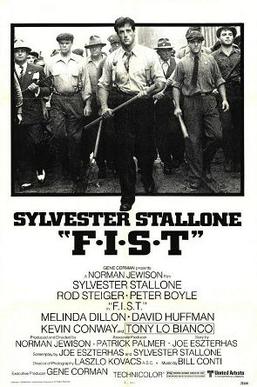
A Movie A Day #355: F.I.S.T. (1978, directed by Norman Jewison)


Sylvester Stallone is Jimmy Hoffa!

Actually, Stallone plays Johnny Kovak, a laborer who becomes a union organizer in 1939.  Working with him is his best friend, Abe Belkin (David Huffman).  In the fight for the working man, Abe refuses to compromise to either the bosses or the gangsters who want a piece of union.  Johnny is more pragmatic and willing to make deals with ruthless mobsters like Vince Doyle (Kevin Conway) and Babe Milano (Tony Lo Bianco).  Over thirty years, both Johnny and Abe marry and start families.  Both become powerful in the union.  When Johnny discovers that union official Max Graham (Peter Boyle) is embezzling funds, Johnny challenges him for the presidency.  When a powerful U.S. senator (Rod Steiger) launches an investigation into F.I.S.T. corruption, both Johnny and Abe end up marked for death.

Obviously based on the life and mysterious disappearance of Jimmy Hoffa, F.I.S.T. was one of two films that Stallone made immediately after the surprise success of Rocky.  (The other was Paradise Alley.)  F.I.S.T. features Stallone in one of his most serious roles and the results are mixed.  In the film’s quieter scenes, especially during the first half, Stallone is surprisingly convincing as the idealistic and morally conflicted Kovak.  Stallone is less convincing when Kovak has to give speeches.  If F.I.S.T. were made today, Stallone could probably pull off the scenes of the aged, compromised Johnny but in 1978, he was not yet strong enough as an actor.  Far better is the rest of the cast, especially Conway, Lo Bianco, and Boyle.  If you do see F.I.S.T., keep an eye on the actor playing Johnny’s son.  Though he was credited as Cole Dammett, he grew up to be Anthony Keidis of the Red Hot Chili Peppers.

The box office failures of both F.I.S.T. and Paradise Alley led Stallone back to his most famous role with Rocky II.  And the rest is history.


Lisa Reviews An Oscar Nominee: Bound for Glory (dir by Hal Ashby)


Bound_for_glory_Poster

One of my favorite online film reviewers is Mitch Lovell of the Video Vacuum.  The thing I like about Mitch is that he doesn’t worry about how many Oscars a film has been nominated for or whether or not a film’s politics are currently in fashion.  Unlike a lot of online reviewers, he doesn’t worry about whether or not he’s going against the “accepted” views of the critical establishment.  Instead, he’ll watch a film and tell you exactly how he felt about it.

For example, Mitch Lovell’s review of the otherwise critically acclaimed 1976 best picture nominee Bound for Glory can be summed up in three words: “boring as fuck.”  Every other online review that I’ve found for Bound for Glory offers up polite but rarely inspiring praise for this rather lengthy film about the folk singer Woody Guthrie.  Most of those reviews do acknowledge that the film moves at its own pace but we are told that we will be rewarded for being patient.  If the review was written after 2010, you can be sure that the reviewer will be sure to say that Bound for Glory reminds us of why labor unions are still important and need to be protected from the Tea Party.  (The idea apparently being that, if a film has the right politics, it doesn’t have to actually be all that interesting.)  It’s all rather predictable and that’s why we’re lucky to have reviewers like Mitch Lovell around.  Whether you agree with him or not, it’s good to have a reviewer who will go against the conventional wisdom.

I recently watched Bound for Glory as a part of TCM’s 31 Days of Oscars and, to a large extent, I have to agree with Mitch Lovell’s review.  This is a movie that is not only long but which moves slowly as well.  It’s not that the film has a deliberate pace.  It’s just slow!  (If you want to see a film that makes good use of a deliberate pace, check out Barry Lyndon.)  David Carradine plays Woody Guthrie, a sign painter who, during the Great Depression, abandons his family in Texas and, by hopping trains, makes his way to California.  He works with fruit pickers.  He tries to convince his fellow workers to form a union.  He gets beat up a lot.

And he plays his guitar.

If there’s anything that remains consistent about Bound for Glory, it’s that Woody is always playing his guitar and that every time he starts to play, something terrible either has happened or does happen.  There’s a huge dust storm.  Woody plays his guitar.  A fight breaks out at a union meeting.  Woody plays his guitar.  A bunch of hoboes on a train get beat up.  Woody plays his guitar.  Woody shows up at a textile mill and starts to play his guitar.  He gets beaten up by a bunch of thugs.  Woody impresses Pauline (Gail Strickland) by playing his guitar and soon, he’s cheating on his wife.  Woody partners up with another folk singer, Ozark Blue (Ronny Cox), and they get their own radio show where Woody plays guitar.  Woody promptly gets fired.

It quickly became apparent to me that Woody Guthrie’s guitar was cursed.  Whenever he played it, poor people ended up getting oppressed.

In many ways, Bound for Glory is a prototypical example of what it means to be an acclaimed-at-its-time-but-subsequently-forgotten best picture nominee.  It’s a big epic film that tells a fictionalized account of a real person’s life story.  Woody Guthrie is best known for writing This Land Is Your Land, which is a song that I mostly associate with pretentious super bowl commercials.  As Bound for Glory details, Woody was also a union organizer and political activist but what’s odd is that the film keeps the exact details of what he believed rather vague.  We’re given the general idea of what Woody believed but we’re not given any specifics.  As a result, Woody just comes across like another part-time social protestor as opposed to being a true political thinker (much less a revolutionary).

On a positive note, Bound for Glory is impressive to look at.  The film’s cinematographer was the famous Haskell Wexler (who also directed Medium Cool, a film that was as upfront about its politics as Bound for Glory is vague) and Wexler captures some hauntingly beautiful images of the American wilderness.  The scene where a gigantic wall of dust crashes down onto a small Texas town is especially memorable.

Otherwise, though, Bound for Glory is pretty much a snoozefest.  It was nominated for best picture of 1976 and, when you compare it to fellow nominees like All The President’s Men, Network, Taxi Driver, and even RockyBound for Glory does feel a bit out of place.

Then when you consider some of the other films that came out in ’76 — Carrie,  Face to FaceThe Front, God Told Me To, Logan’s Run, The Man Who Fell To Earth, Marathon Man, The Omen, The Outlaw Josey Wales, Lipstick, Robin and Marian, The Sailor Who Fell From Grace With The Sea, and The Town That Dreaded Sundown — the nomination of Bound for Glory feels like even more of a mistake.

Oh well.

Occasionally, the Academy gets it wrong.

Shocking, I know.