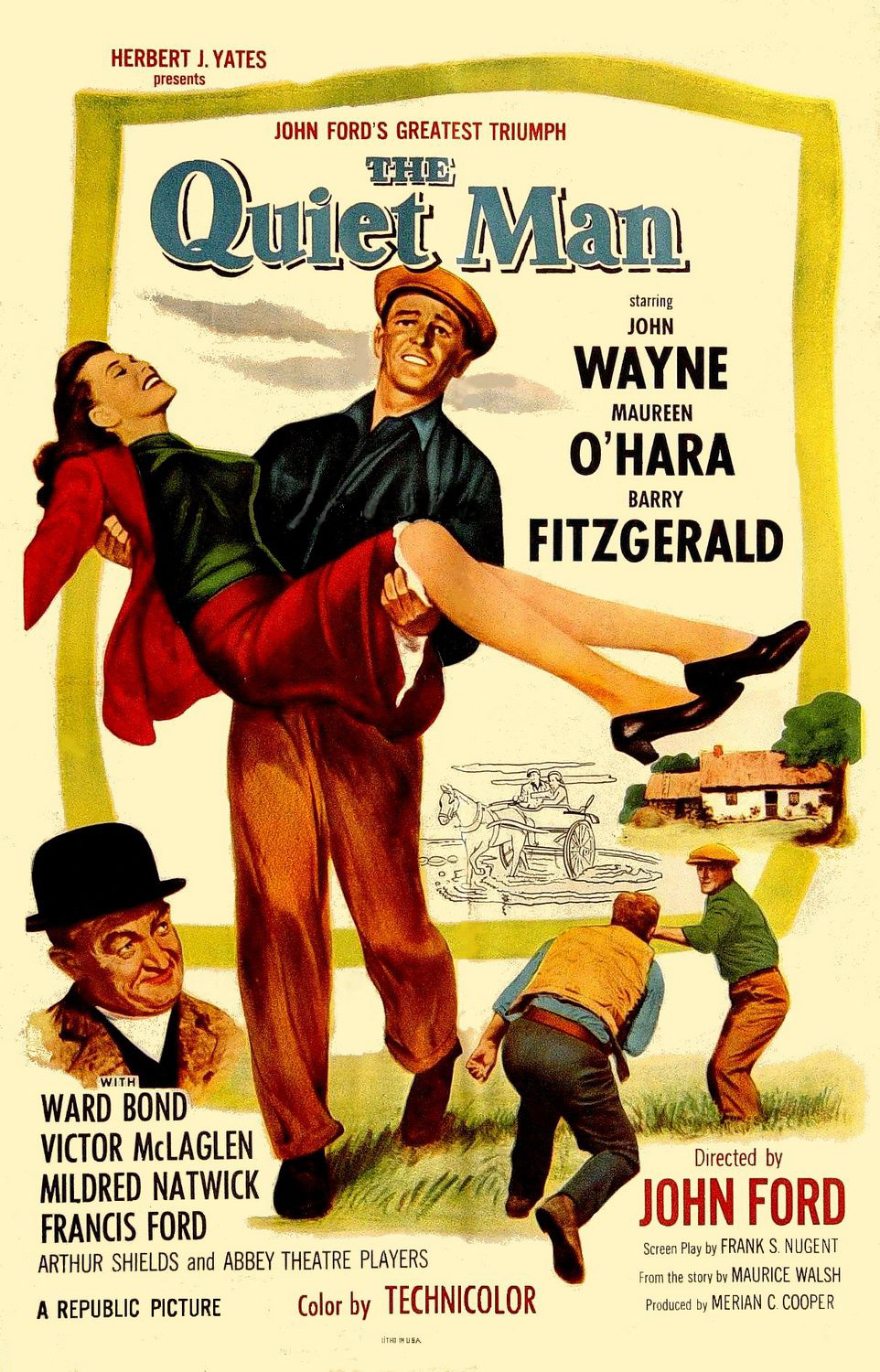
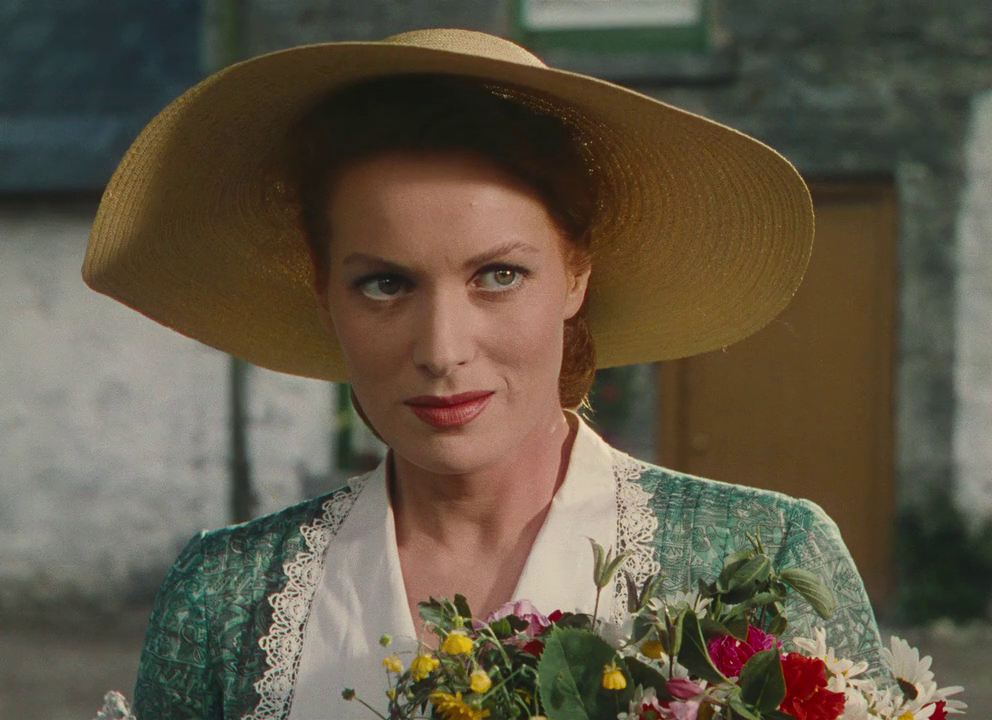
With the passing of screen legend Maureen O’Hara today, I’ve decided to put aside my Halloween Havoc! series this evening to take a look at one of my favorite Maureen movies, THE QUIET MAN. Paired once again with John Wayne and director John Ford, Maureen shines as Mary Kate Danneher, a feisty, hot tempered colleen who refuses to honor her marriage vows until she gets her “fortune” from brutish brother Red Will Danneher (perennial big lug Victor McLaglen). Mostly filmed in Ireland by Winton Hoch, the countryside scenery is breathtaking in vivid Technicolor, with Maureen radiant as ever.
The story concerns American ex-boxer Sean Thornton (Wayne), returning to his Emerald Isle birthplace of Innisfree after accidentally killing an opponent in the ring. When he first sets eyes on Mary Kate herding sheep, he’s immediately smitten. Sean buys his family homestead from the Widow Tillane (Mildred Natwick), outbidding Danneher, who knows how…
4 Shots From 4 Films is just what it says it is, 4 shots from 4 of our favorite films. As opposed to the reviews and recaps that we usually post, 4 Shots From 4 Films is all about letting the visuals do the talking.
Sadly, it had been announced that actress Maureen O’Hara passed away this morning. As a lover of Golden Age Hollywood, Maureen was always one of my favorite actresses. (After all, we were both outspoken Irish redheads!) Maureen was one of the last surviving actresses from Hollywood’s golden age and, with her passing, a bit history passes too.
(I should also mention that Maureen played the mother of one of my favorite actress, Natalie Wood, in one of my favorite films of all time, Miracle on 34th Street. Whenever I see Miracle, I think about my mom.)
These 4 Shots From 4 Films are dedicated to the memory of the great Maureen O’Hara.
4 Shots From 4 Films
The Hunchback of Notre Dame (1939, dir by William Dieterle)
Dance, Girl. Dance (1940, dir by Dorothy Arzner)
Miracle on the 34th Street (1947, dir by George Seaton)
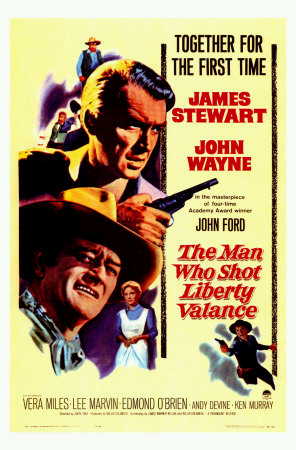
“When the legend become fact, print the legend.” — Maxwell Scott (Carleton Young) in The Man Who Shot Liberty Valance (1962)
Though I understand and respect their importance in the history of both American and Italian cinema, I have never really been a huge fan of westerns. Maybe its all the testosterone (“A man’s got to do what a man’s got to do…”) or maybe it’s all the dust but westerns have just never really been my thing.
However, I will always make an exception for The Man Who Shot Liberty Valance, which is not just a great western but a great film period.
But you already knew that. It’s a little bit intimidating to review a film that everyone already knows is great. I even opened this review with the exact same quote that everyone uses to open their reviews of The Man Who Shot Liberty Valance. To a certain extent, I feel like I should have found a quote that everyone hasn’t already heard a thousand times but then again, it’s a great quote from a great film and sometimes, there’s nothing wrong with agreeing with the critical consensus.
The Man Who Shot Liberty Valance opens with a train stopping in the small western town of Shinbone. The residents of the town — including newspaper editor Maxwell Scott (Carleton Young) — are shocked when Sen. Rance Stoddard (James Stewart) and his wife Hallie (Vera Miles) get off the train. Sen. Stoddard is considered to be a front-runner to become the next Vice President of the United States. Scott is even more shocked to discover why the Stoddards are in town. They’ve come to Shinbone to attend the funeral of an obscure rancher named Tom Doniphon (played, in flashback, by John Wayne).
Sitting in the funeral home with Doniphon’s coffin (and having reprimanded the local mortician for attempting to steal Tom’s boots), Rance tells Scott why he’s come to pay respect to Tom Doniphon. We see, in flashback, how Rance first came to Shinbone 25 years ago, an idealistic lawyer who — unlike most of the men in the west — refused to carry a gun. We see how Rance was robbed and assaulted by local outlaw Liberty Valance (a wonderfully intimidating and bullying Lee Marvin), we discover how Rance first met Hallie while working as a dishwasher and how he eventually taught her how to read, and we also see how he first met Tom Doniphon, the only man in town strong enough to intimidate Liberty Valance.
At first, Rance and Doniphon had an uneasy friendship, epitomized by the condescending way Doniphon would call Rance “pilgrim.” Doniphon was in love with Hallie and, when he attempted to teach Rance how to defend himself, he was largely did so for Hallie. Rance, meanwhile, was determined to bring law and society to the west.
And, eventually, Rance did just that. When Shinbone elected two delegates to the statehood convention in the territory’s capitol, Rance attempted to nominate Doniphon for the position but Doniphon refused it and nominated Rance instead, explaining that Rance understood “the law.” When Liberty Valance attempted to claim the other delegate spot, Rance and Doniphon worked together to make sure that it instead went to newspaper editor Dutton Peabody (Edmond O’Brien). And when Liberty Valance attempted to gun Rance down in the street, Rance shot him.
Or did he?
That’s the question that’s at the heart of The Man Who Shot Liberty Valance. However, as a film, The Man Who Shot Liberty Valance is far less interested in gunfights than it is in politics. Perhaps the most important scene in the film is not when Rance and Liberty meet out on that dark street. Instead, it’s the scene at the statehood convention where the reformers (represented by Rance) and the cattlemen (represented by John Carradine) battle over who will be the territory’s delegate to Washington. Between John Carradine orating, the horses riding in and out of the hall, Edmond O’Brien drinking, James Stewart looking humble, and John Wayne glowering in the background, this is one of the best political scenes ever put on film.
When Rance first arrives in the west, there is no political system in place. With the exception of the ineffectual town marshal (Andy Devine), there is no law. The peace is kept by men like Tom Doniphon and, oddly enough, by Liberty Valance as well. (Whether he realizes it or not, Shinbone’s fear of Liberty has caused the town to form into a community.) What little official law there is doesn’t matter because the majority of the Shinbone’s citizens can’t read.
When Rance arrives, he brings both education and the law. He makes Shinbone into a town that no longer needs Liberty Valance but, at the same time, it no longer need Tom Doniphon either. Hence, it’s Rance Stoddard who goes from dishwasher to U.S. Senator while Tom Doniphon dies forgotten. Rance represents progress and unfortunately, progress often means losing the good along with the bad things of the past.
(It’s no coincidence that when Rance and Hallie return to Shinbone, the first person that they see is the former town marshal, who no longer wears a star and who, we’re told, hasn’t for years. Time has passed by.)
It’s a bittersweet and beautiful film, one that features four great performances from Stewart, Wayne, Marvin, and Vera Miles. Personally, I like to think that maybe Sen. Stoddard had a daughter who married a man named Smith and maybe they had a son named Jefferson who later made his way to the Senate as well.
Down here in Dallas, we have a county commissioner named John Wiley Price. Even if you don’t live in Texas, you might have heard about him. A few years ago, Price stormed out of a commissioners meeting while shouting, “All of you are white! Go the Hell!” It was a popular YouTube video for a while and attracted all of the usual type of comments that you see online. It even made the national news.
Nobody down here in Dallas was surprised by Price’s outburst. To us, that was just John Wiley being John Wiley. For that matter, nobody was particularly surprised when it was reported that he was being investigated by the FBI. Everyone always took it for granted that John Wiley Price was taking bribes and receiving kickbacks. That’s just the way that things are done down here in Dallas, by politicians both white and black. (Of course, most of the white politicians who do it don’t get publicly investigated by the FBI.)
Now, if you ask the majority of people in Dallas county what they think about John Wiley Price and they’ll probably say something negative. I’ll admit that I would probably be among them. But the thing is — John Wiley Price’s constituents love him. John Wiley Price was first elected to the commissioner’s court before I was even born and, as long as he’s on the ballot, he will be reelected. Even if Price is convicted on corruption charges, he will still be reelected.
I can still remember the night that it was announced that John Wiley Price was on the verge of being arrested by the FBI. All across his district, emergency meetings were held in churches and ministers stood behind the pulpit and, while the TV cameras rolled, they called upon everyone to pray for John Wiley Price. In Price’s district, he’s known as “our man downtown,” the idea being that John Wiley Price is standing up to the rich and white Dallas establishment and, if he makes some money for himself in the process, so be it. As long as he’s doing right for the people who elected him, who cares how he does it?
And, as much as we may want to judge the John Wiley Prices of the world, the fact that of the matter is that he’s a part of a long American political tradition. That political tradition is also the driving force behind today’s final entry in Shattered Politics.
First released in 1958 and directed by John Ford, The Last Hurrah tells the story of Frank Skeffington (Spencer Tracy), the mayor of an unnamed city in New England that’s obviously meant to be Boston. Skeffington is the flamboyant head of a large and powerful (but, as the film makes clear, aging) Irish-American political machine. He’s preparing to run for his fifth term for mayor, a campaign that he says will be his last.
Whether Frank Skeffington is a good mayor or not depends on who you ask. The poor and the disenfranchised love him. Skeffington, after all, is the son of Irish immigrants. He was born poor. His mother worked as a maid and was even fired by a member of the wealthy and influential Force family. They know that Skeffington has had to cut corners and that he’s gone out of his way to reward his cronies but they also know that Skeffington is on their side. Though the phrase is never used in the film, Skeffington is “their man downtown.”
Meanwhile, the wealthy and the upper class see Frank Skeffington as being a crook, a man who has run a corrupt administration and who uses class warfare to keep the city divided against itself and to make himself and his cronies rich. Newspaper editor Amos Force (John Carradine) has thrown his considerable influence between Skeffington’s opponent, a wealthy but dull man named Kevin McCluskey.
Reporter Adam Caulfield (Jeffrey Hunter) is in an interesting position. On the one hand, he is Skeffington’s nephew. On the other hand, as a journalist, he works for Amos Force. Skeffington invites Adam to follow and record his final campaign for posterity.
It’s interesting to compare The Last Hurrah to films like The Boss or All The King’s Men. Whereas those two films came down squarely on the sides of the reformers, The Last Hurrah is firmly on the side of Frank Skeffington. It presents Skeffington as being a sentimental figure, the type of old-fashioned, populist politician who won office by going out and meeting the people face-to-face and personally giving them a reason to vote for him. As Skeffington himself points out, he’s the type of politician that will soon be made obsolete by television and modern campaigning.
And it’s impossible not to enjoy The Last Hurrah‘s refusal to pass judgment on its lead character. It helps, of course, that Spencer Tracy plays Skeffington with a twinkle in his eye while all of his opponents are played by villainous and aristocratic character actors like John Carradine and Basil Rathbone. Yes, the film says, Skeffington may have been corrupt but at least he wasn’t boring!
Finally, I enjoyed the film because all of the “good” guys were Irish Catholic and all of the bad guys most definitely were not.
So, with that last hurrah, we conclude Shattered Politics for today. We’ll be back tomorrow, when we’ll start to get into the 1960s.
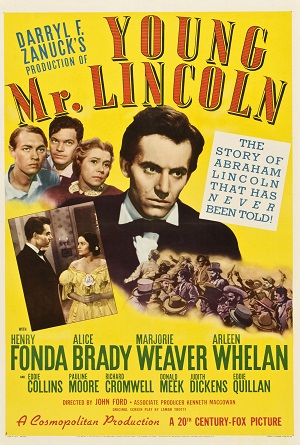
Way back in 1939, at the same time that Jimmy Stewart was conquering Washington in Frank Capra’s Mr. Smith Goes To Washington, the great director John Ford was making a film about another man who would eventually go to Washington.
In Young Mr. Lincoln, Henry Fonda plays the future 16th President. Even though Fonda was probably far better looking than Abraham Lincoln ever was, he’s ideally cast in the role. Along with being a very natural actor, Fonda personified a certain middle-of-the-country, stoic decency. He played characters who were smart but never elitist and who were guided mostly by common decency. In short, his screen persona was everything that people tend to think about when considering Abraham Lincoln.
As for the film itself, it begins with Lincoln as a simple storekeeper who accepts, as payment for groceries, a barrel of old books. After reading the books and having a conversation with his doomed first love, Anne Rutledge (Pauline Moore), Lincoln decides to learn the law.
Years later, now a poor-but-honest lawyer, Abraham Lincoln arrives at Springfield, Illinois, sitting a top mule because he can’t afford a horse. Lincoln opens a law office, awkwardly courts the rich and spoiled Mary Todd (Marjorie Weaver), and eventually defends two brothers who have been accused of murder. While the case’s prosecutor (played by Donald Meek) may have a better education, he can’t compete with Lincoln’s common sense and ability to relate to the common people.
Obviously, the whole point behind Young Mr. Lincoln is that it’s about the early life of an American hero. You watch the entire film with the knowledge that Lincoln is going to be the man who eventually leads the U.S. during the Civil War and who frees the slaves. The viewer knows that Lincoln is going to be a great man, even if nobody else does and a good deal of the film’s effectiveness come from the moments when Fonda will strike an iconic pose or will casually deploy a familiar phase and you’re reminded of just who exactly it is he’s playing.
But, and this is why Young Mr. Lincoln remains a great film, the important thing is that the film is just effective when viewed as being a portrait of a dedicated lawyer trying to prove the innocence of his clients. Fonda is compelling as both a future President and as an honest man trying to do the right thing. Ultimately, the film would be just as compelling even if it was called Young Mr. Jones and didn’t open with soaring, patriotic music and end with a shot of the Lincoln Memorial.
It’s interesting to compare Young Mr. Lincoln to some of the other films made about Abraham Lincoln. It’s a far more assured film than D.W. Griffith’s Abraham Lincoln and, needless to say, Henry Fonda makes for a better Lincoln than Walter Huston did. At the same time, it’s far more naturalistic and less overly manipulative film than Steven Spielberg’s Lincoln.In the end, it’s a good film and a great tribute to our 16th President.
For today’s entry in the 44 Days of Paranoia, I want to take a look at John Ford’s Oscar-winning 1935 film, The Informer.
The Informer takes place in Dublin in 1921, during the Irish War of Independence and shortly before the creation of the Irish Free State. Friendly but stupid and irresponsible Gypo Nolan (Victor McLaglen) has been kicked out of the Irish Republican Army and is pretty much a pariah among his own people. His prostitute girlfriend, meanwhile, only wants to raise enough money to book passage for America and start a new life.
Gypo sees an opportunity when he runs into his former IRA colleague Frankie (Wallace Ford), who is one of the few people to treat Gypo kindly. Frankie is also fugitive who has a £20 bounty on his head. Gypo impulsively turns informer and lets the British know where Frankie is hiding.
When Frankie is killed, the guilt-ridden Gypo uses the reward money to buy a bottle of whiskey and then spends the rest of the day drunk and trying to convince the IRA the Frankie was betrayed by a nonexistent man named Mulligan.
When it was initially released in 1935, The Informer did well with both audiences and critics. It was nominated for Best Picture and won Oscars for John Ford, Victor McLaglen, and screenwriter Dudley Nichols. However, when viewed today, it’s easy to see the flaws in The Informer. The film feels stagey, heavy-handed, and rather melodramatic.
And yet, with all that in mind, I still like The Informer.
Some of that, of course, is because it’s a film about Ireland and, specifically, it’s a film about how the Irish Catholics were oppressed by British occupiers. This is a topic that I find to be endlessly fascinating and, speaking a someone who still has family living in Ardglass, County Down, I have to admit that I have a weakness for films (like this one) which tend to take the Irish side of things.
On a technical level, John Ford’s direction holds up pretty well. There’s a few scenes where the story’s theatricality gets the better of him but, for the most part, Ford does a good job of capturing Gypo’s dreary existence and maintaining a level of suspense, despite the fact that Gypo’s fate is obvious to the audience long before it’s obvious to anyone in the film. In Ford’s hands, the fog-filled and shadowy streets of Dublin serve as a representation of Gypo’s increasingly desperate and paranoid mindset. Ford’s Dublin is a world where danger can come out of nowhere and where there’s no place for a big and stupid target like Gypo to hide.
The film is dominated by Victor McLaglen’s theatrical performance. Again, there a few moments where McLaglen’s performance is a bit too broad but, for the most part, his boisterous approach works will for his well-meaning but not too smart character. One can see not only why the film’s characters are weary of Gypo but also why they have a difficult time rejecting him all together.
The Informer may not be perfect but it’s still worth tracking down and seeing.




 Through the Shattered Lens