October True Crime: The Onion Field (dir by Harold Becker)


This 1979 true crime drama opens in Los Angeles in 1963.

Rookie Detective Karl Hettinger (John Savage) has just joined the Felony Squad and met his new partner, Ian Campbell (Ted Danson, making his film debut).  Ian is a tall, somewhat eccentric detective, the type who practices playing the bagpipes in the basement and who takes Hettinger under his wing.

Meanwhile, Jimmy Smith (Franklyn Seales) has just been released from prison.  The nervous and easily-led Jimmy almost immediately runs into Gregory Powell (James Woods), a small-time hood with delusions of grandeur.  Powell is the type who talks a big game but who really isn’t even that good of a thief.  Smith and Powell form an uneasy criminal partnership.  They are easily annoyed with each other but they also share an instant bond.  Though the film doesn’t actually come out and say what most viewers will be thinking, there’s a lot of subtext to a brief scene where Powell appears to caress Smith’s shoulder.

One night, Hettinger and Campbell are kidnapped by Smith and Powell.  Smith and Powell drive them out to an onion field.  Because he’s misinterpreted the Federal Kidnapping Act and incorrectly believes that he and Smith are already eligible for the death penalty because they kidnapped two police officers, Powell shoots and kills Campbell.  (The close-up image of Campbell falling dead is a disturbing one, not the least because he’s played by the instantly likable Ted Danson.)  Hettinger runs and manages to escape.  He saves his life but he’s now haunted by the feeling that he abandoned his partner.

The rest of the film deals with the years that follow that one terrible moment in the onion field.  Treated as a pariah by his fellow cops, Hettinger sinks into alcoholism and eventually becomes a compulsive shoplifter.  Smith and Powell, meanwhile, use a variety of tricks to continually escape the death penalty and to keep their case moving through the California justice system.  Powell, for instance, defends himself and then later complains that he had incompetent counsel.  Smith, meanwhile, is defended by the infamous Irving Karanek, a legendary California attorney who specialized in filing nuisances motions.  (Later Karanek found a measure of fame as Charles Manson’s attorney.  Eventually, he had a nervous breakdown in 1989, lived in his car, and was briefly suspended by practicing law.)  While Smith and especially Powell quickly adjust to being imprisoned, Hettinger spends the next decade trapped in a mental prison of guilty and bitterness.

Based on a non-fiction book by Joseph Wambaugh, The Onion Field is a compelling look at a true crime case that continue to resonate today.  The film can be a bit heavy-handed in its comparisons between the two partnerships that define the story.  Both Hettinger and Smith are young and neurotic men who find themselves working with a more confident mentor.  The difference is that Hettinger’s mentor is the cool, composed, and compassionate Ian Campbell while Smith’s sad fate is to be forever linked to the erratic Gregory Powell.  While the film may have the flat look of something that was made for television, it’s elevated by the performances of its lead actors.  James Woods give an especially strong performance as the cocky Powell, a loser in the streets who becomes a winner behind bars.  Over the course of the film, he goes from being a joke to being the prisoner that others come to for legal advice.  John Savage, meanwhile, poignantly captures Hettinger’s descent as the trauma from that night leaves him as shell of the man that he once was.

The film’s supporting cast is full of familiar faces.  Christopher Lloyd and William Sanderson show up as prisoners.  Ronny Cox plays the detective in charge of the onion field investigation.  David Huffman plays a district attorney who is pushed to his breaking point by the obstructive tactics of Smith’s attorney.  Priscilla Pointer play Ian Campbell’s haunted mother.  All of them do their part to bring this sad story to life.

The Onion Field is a chillingly effective true crime drama and a look at a murder that was inspired by one man’s inability to understand federal law.


Arcade (1993, directed by Albert Pyun)


Alex (Megan Ward) is a suburban teen still trying to come to terms with the suicide of her mother.  She and her friend, Nick (Peter Billingsley), spend all of their time hanging out at the local video arcade, Dante’s Inferno.  (Symbolic name alert!)  Also hanging out at Dante’s Inferno is a man (John de Lancie) who is desperate to find people willing to play what he says is the next step in the evolution of gaming.  The game, which is simply called “Arcade,” is a virtual reality simulator and soon, all the teens want to play it!

Unfortunately, there’s a problem with Arcade.  It was partially programmed with the brain cells of a child who had been beaten to death by his mother.  Don’t ask why anyone thought this was a good idea because this is a Charles Band production so you know no one would explain even if they could.  The child wants either friends or revenge so, as a result, the game is stealing the souls of the people who play it and transporting them to the virtual reality world.

Realizing that all of her friends will soon be gone, Alex enters the virtual reality world to save them and thwart Arcade!  She’ll have to defeat skulls, serpents, and every other CGI challenge that the game can throw at her.

If you remember this film, it’s probably because you’re like me and you saw it on HBO when you were kid.  Though the film has an R-rating because of some awkwardly deployed bad language, the film really is a teen boy fantasy, one in which you can enter the world of your favorite video game and save the world with Megan Ward, a hot girl who loves video games just as much as you do.  When it was released, Arcade’s special effects were pretty impressive.  If you watch the movie today, it’s obvious that the actors have just been superimposed against a virtual background.  Watching the film today, I had the same feeling that I had when I recently hooked up my old Xbox 360 and played a few games.  It was more primitive than I remembered but that rush of nostalgia was enjoyable for a few hours..  Arcade features an energetic cast (including Seth Green and  AJ Langer in supporting roles) and Dante’s Inferno was the coolest arcade I’ve ever seen.  It was a hundred times better than the one from Joysicks.

One final note: If you needed any more evidence that Disney is evil, they actually sued Charles Band because they claimed Arcade was too similar to Tron!  As a result, Band, working with Peter Billingsley, actually had to redesign a good deal of the CGI before the film could be released.  Disney was right about Arcade being a goof on Tron but who cares?  I doubt anyone has ever said, “I’ve seen Arcade, I don’t need to see Tron.”  Chill out, Disney.  There’s room for at everyone at the arcade.


A Movie A Day #250: Taking Care of Business (1990, directed by Arthur Hiller)


Jimmy Dworski (Jim Belushi) is a convicted car thief who only has a few days left in his criminal sentence but still decides to break out of prison so he can go see the Cubs play in the World Series.  Spencer Barnes (Charles Grodin) is an uptight ad executive who needs to learn how to relax and have a good time.  When Spencer loses his organizer, Jimmy finds it.  Before you can say “The prince and the pauper,” Jimmy has access to all of Spencer’s money and the mansion that Spencer is supposed to be staying at over the weekend.  While Spencer tries to survive on the streets and track down his organizer, Jimmy is living it up, spending money, impressing a Japanese businessman (Mako), romancing the boss’s daughter, and taking care of business.
Made in the uncertain period between the end of the culture of 80s materialism and the start of the 90s indie boom, Taking Care of Business is a rip-off of Trading Places that came out six years too late to be effective.  Everything that needs to be known about Jimmy and Spencer is apparentl from the minute that Charles Grodin’s and Jim Belushi’s names appear in the credits.  Grodin was usually the best when it came to playing uptight yuppies but he seems bored in Taking Care of Business.  Belushi mugs through his role, overplaying his character’s blue collar roots.  The movie builds up to a huge confrontation between Belushi and Grodin but it never really delivers, instead devolving into a predictable buddy comedy, complete with a trip to Wrigley Field and an elaborate plan to sneak Belushi back into prison before the warden (Hector Elizondo) discovers that he’s been gone for the weekend.  Taking Care of Business has a few laughs but it’s never as good as the BTO song.

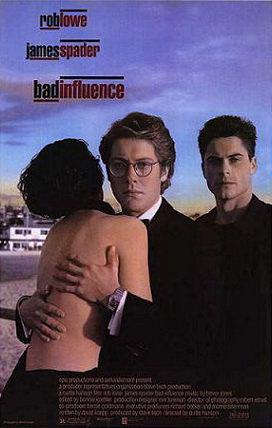
Embracing the Melodrama Part II #83: Bad Influence (dir by Curtis Hanson)


Bad_Influence_Film_PosterThough it may seem like a lifetime ago, it’s only been 6 weeks since I started on my latest series of reviews.  I am currently in the process of reviewing, in chronological order, 126 cinematic melodramas.  I started with the 1927 classic Sunrise and now, 82 reviews later, I have finally reached the 1990s.

(Of course, when I started this series of reviews, I somehow managed to convince myself that it would only take me 3 weeks to review 126 films.  Instead, it looks like it’s going to take two months.  So, I was only off by 5 weeks.)

Let’s start the 90s by taking a quick look at a 1990 film called Bad Influence.  I have to admit that, when I made out my list of films to review, Bad Influence was not even on my radar.  I was planning on launching my look at the 90s with a review of Ghost.  But then I saw The Avengers: Age of Ultron and I was so taken with James Spader’s performance as Ultron that  I decided to add a few James Spader films to Embracing the Melodrama.

In Bad Influence, James Spader is cast somewhat against type.  He plays Michael, who has a good job and is engaged to marry the wealthy and overbearing Ruth (who, I was surprised to learn from the end credits, was played by a pre-Desperate Housewives Marcia Cross).  Michael should be happy but instead, he feels oddly dissatisfied with his life.  He’s shy and meek and spends all of his time trying to do the right thing and conform to the petty demands of society.

One day, as he’s sitting in a bar, Michael makes the mistake of trying to flirt with a woman who is obviously having a bad day.  When the woman’s boyfriend shows up, he tells Michael to leave.  When Michael mutters that it’s a free country, the man responds by grabbing Michael.  However, before the fight can go any further, handsome and charming Alex (played, somewhat inevitably, by Rob Lowe) pops up out of nowhere, smashes a bottle, and scares the man off.

Michael and Alex become fast friends, with Michael viewing the extroverted and confident Alex as being everything that he wants to be.  (Meanwhile, Alex seems to appreciate the fact that Michael has money and a nice apartment.)  Under the influence of Alex, Michael starts to stand up for himself and even manages to get a big promotion at work.  At the same time, he also ends up cheating on his fiancée (while Alex films them) , helping Alex hold up a series of convenience stores, and beating up an obnoxious co-worker.

Ultimately, Bad Influence is a lot of sordid fun.  It’s a bit like Fight Club, minus the satire and the big identity twist.  (Michael and Alex are differently separate characters.)  Director Curtis Hanson (who is perhaps best known for L.A. Confidential) brings a lot of style to the film’s tawdry fun and keeps the action moving quickly enough that you don’t have too much time to obsess over what doesn’t make sense.

Finally, James Spader and Rob Lowe are just a lot of fun to watch.  Spader turns Michael into a sympathetic protagonist and Rob Lowe seems to be having a blast going full psycho in his role.

Bad Influence is a well-made B-movie and it’s a lot of fun.  You can watch it below!

http://www.youtube.com/watch?v=o5lxJusJoAg

Review: Torchwood: Miracle Day Ep. 08 “End of the Road”


“End of the Road” is quite an apt title for the eight episode in the fourth season of Torchwood. We see the end of a couple characters during the episode and at the same time we finally get the final pieces to the question of who or what caused “Miracle Day”.

The episode begins with the Torchwood team arriving at the Colasanto estate and led by Olivia Colasanto to her grandfather and Jack’s former companion and lover from the late 1920’s. We find out that Angelo Colasanto has kept himself alive through natural means, but is now in a coma as Jack looks on. Angelo’s condition when revealed almost felt like a cop out, but in a major exposition info dump done by his granddaughter we find out who is behind Miracle Day”. They’re called The Families and are made up of the descendants of the three men last seen in the previous episode forming an alliance to study Jack’s seeming immortality.

Angelo himself has been kept out of the alliance due to the three men’s discomfort over his homosexuality. Angelo has been observing not just the three families through the years, but Jack as well in an attempt to either stave off whatever plans The Families have in regards to the “Miracle” or, at the very least, give Jack the clues needed to fix the problem. But before Jack, Gwen, Esther and Rex can do their thing to save the day there’s the little obstacle of Rex’s old boss in the form of Wayne Knight interrupting the Jack/Colasanto reunion. The rest of the episode never lets go of the throttle once John De Lancie’s CIA head honcho Shapiro show’s up and we get closer to this season’s endgame.

The episode was well-written even with the major expositional scene involving Nana Visitor’s character. Each character in the Torchwood team got a chance to shine in their roles with Barrowman making Jack’s bittersweet reunion with Angelo a mixture of happiness and regret. If there was a weak point in the cast’s performance it would continue to be some of the side characters like Wayne Knight’s deputy director Friedkin and Bill Pullman’s Oswald Danes. While I can understand the role of Knight’s character in the overall scheme of things this season I still can’t quite grasp just exactly what Pullman’s Danes character is suppose to do other than be over-the-top creepy. Even Ambrose’s Kitzinger got a chance to own her scene as she finally unleashes what she truly feels about Oswald Danes despite having to be his publicist.

“End of the Road” ends on a major cliffhanger with one of the Torchwood team members shot and the team split apart as the CIA, The Families and everyone else seem to be pulling at them from all directions making their task about solving “Miracle Day” that much more difficult. With only two more episodes remaining this season what looked to be a show that seemed stuck on idle for most of the middle episodes has suddenly begun to speed ahead towards what could be an epic conclusion.