Horror on TV: The Night Strangler (dir by Dan Curtis)


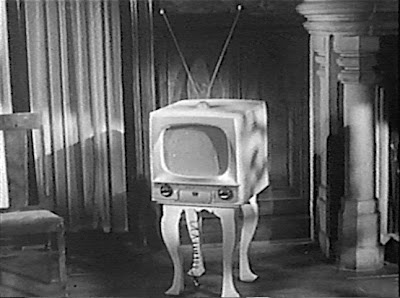
For tonight’s horror on television, we have 1973’s The Night Strangler.

This is the sequel to The Night Stalker and it features journalist Carl Kolchak (Darren McGavin) in Seattle.  (After all the stuff that happened during the previous movie, Kolchak was kicked out of Las Vegas.)  When Kolchak investigates yet another series of murders, he discovers that paranormal murders don’t just occur in Las Vegas and aren’t just committed by vampires.

I actually prefer this movie to The Night Stalker.  The Night Strangler features a truly creepy villain, as well as a trip down to an “underground city.”  It’s full of ominous atmosphere and, as always, Darren McGavin is a lot of fun to watch in the role in Kolchak.

Enjoy!

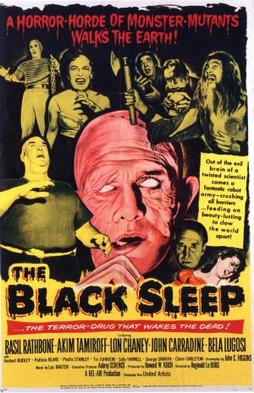
Horror Film Review: The Black Sleep (dir by Reginald Le Borg)


1956’s The Black Sleep opens in a London prison cell.  The year is 1872 and Dr. Gordon Ramsay (Herbert Radley) awaits execution.  He’s accused of murdering a chef who twice sent rubbery scallops to the pass …. wait, a minute, sorry.  Wrong Gordon Ramsay!  This Gordon Ramsay is accused of murdering a man named Curry and he’s considerably more whiny than the modern-day Gordon Ramsay.

Ramsay is visited by Sir Joel Cadman (Basil Rathbone) and Cadman’s associate, Odo the Gypsy (Akim Tamiroff).  Cadman explains that he has developed a potion called “The Black Sleep.”  Drinking it will put the drinker in a state of suspended animation that can pass for death.  And, indeed, it will turn into death unless Cadman administers the antidote.  Cadman offers to give the potion to Ramsay, in return for Ramsay helping Cadman out with his own experiments.  Ramsay agrees.

Ramsay is found “dead” in his cell.  His body is claimed by Cadman and Odo.  (Odo mentions that, in a past life, he was a grave robber and that he died as a result of the guillotine.)  Ramsay is revived and goes to work with Cadman.  As soon as Ramsay enters Cadman’s mansion, he finds himself surrounded by several familiar faces.  For instance, Lon Chaney, Jr. plays the twisted Mungo, who stumbles through the hallways of the mansion and can only be controlled by Daphnae (Phyllis Stanley).  Bela Lugosi plays Casimir, the mute butler.  Bohemud (John Carradine) is a bearded man who rants and raves and calls for Biblical vengeance.  And finally, in the basement, there’s Mr. Curry (Tor Johnson), the man who Ramsay was convicted of murdering!  It turns out that Cadman isn’t quite as benevolent as he presented himself as being.

The Black Sleep may feature an incoherent story but it has a great cast and it is entertaining to see Carradine, Chaney, Tor Johnson, Akim Tamiroff, Bela Lugosi, and Basil Rathbone all living under the same roof and trying to outdo each other as far as the scenery chewing is concerned.  Admittedly, some members of the cast look healthier than others.  Rathbone is as imperiously dashing as always and John Carradine appears to be having a lot of fun with his role.  Akim Tamiroff gets all of the best lines as Odo and he delivers them with just the right amount of wit.  Unfortunately, neither Chaney and Lugosi were in good shape when they appeared in this film.  Lugosi was ill when he did the film.  Chaney, meanwhile, had seen his one-promising career sabotaged by his own alcoholism and, by the time the 50s rolled around, his once handsome features were now ravaged by his drinking.  It transformed him from being a somewhat dull leading man to a craggly character actor.  (Producer/director Stanley Kramer considered Chaney to be one of the best character actors in Hollywood and cast him in both High Noon and The Defiant Ones.)  In The Black Sheep, Chaney’s face is twisted and almost ravaged.  It works for the film but it’s still sad to see.  As for Tor Johnson …. hey, he’s Tor Johnson.  He growls and he tosses things around and he does so convincingly.

(In an interview shortly before his death, Tor said he was offered the role of Oddjob in Goldfinger.  It’s sad to think the world was robbed of the Sean Connery/Tor Johnson team-up it needed.)

This was Bela Lugosi’s final film performance before his death in 1956.  (The footage that appears in Plan 9 From Outer Space was filmed before The Black Sleep.)  It’s a shame that Lugosi wasn’t given more to do in his final film.  Lugosi, with that famous voice, ending his career playing a mute just doesn’t seem right.

Horror Scenes that I Love: Tor Johnson In The Unearthly


We honor the birthday of Tor Johnson with today’s scene of the day.

Even though Tor Johnson is playing a character named Lobo, today’s scene that I love isn’t from Ed Wood’s 1955 film, Bride of the Monster. Instead, it’s from 1957’s The Unearthly. In this film, Lobo is now John Carradine’s servant. (Lobo made quite a career out of working for mad scientists.) The Unearthly was directed by Boris Peftroff, a friend of Wood’s, so it’s not improbable that this film’s Lobo was meant to be the same Lobo as the one who appeared in Bride of the Monster and Night of the Ghouls.

Anyway, in this scene, Tor does his usual Lobo stuff while John Carradine plays the piano. “Time for go to bed,” Lobo says at one point, a much-mocked line but one that is delivered with a bit of gentleness by Tor Johnson. My point is that Tor did the best that he could and bless him for it.

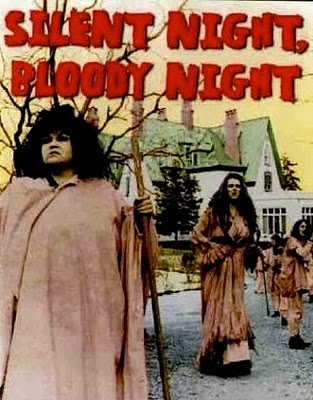
October Hacks: Silent Night, Bloody Night (dir by Theodore Gershuny)


Filmed in 1972 and subsequently released in 1974, Silent Night Bloody Night is a real treat, an atmospheric thriller that has a wonderfully complicated plot that will keep you guessing.

Silent Night Bloody Night opens with attorney John Carter (Patrick O’Neal) arriving in a small town on Christmas Eve.  He’s traveling with his assistant and mistress, Ingrid (Astrid Heeren).  He’s been hired by Jeff Butler (James Patterson) to oversee the sell of his grandfather’s home.  When Carter arrives, he finds that the town is run by a group of elderly eccentrics, including the mute Charlie Towman (John Carradine).  Charlie communicates by ringing a bell and he’s the editor of the town newspaper.  Carter convinces the town council to buy the Butler mansion.  Then, Carter and Ingrid go to the mansion, make love, and are promptly brutally hacked to death by an unseen assailant with an axe.  It’s a shocking moment because, up until their death scene, Carter and Ingrid seemed to be our main characters.  Much as with Marion Crane’s shower in Psycho, their murder leaves an absence at the heart of the film.

That night, our new hero, Jeff Butler (James Patterson) comes to the isolated town to check on how the sale is going.  He finds the mansion locked up and no one willing to talk about John Carter.  With the help of local girl Diane (Mary Woronov), Jeff investigates his grandfather’s death and discovers that the town is full of secrets and people who are willing to kill to maintain them.  As we discover through some wonderfully dream-like flashbacks, Jeff’s grandfather died nearly 40 years ago when he was set on fire in his own home.  Those aren’t the only flashbacks to the film.  In an extended sepia-toned flashback, we learn about the previous inhabitants of the house.  They are all played by former Warhol superstars, including Candy Darling, Ondine, Tally Brown, Charlotte Fairchild, Lewis Love, Harvey Cohen, George Trakas, Susan Rothenberg, and Jack Smith.  (Mary Woronov was, herself, a former member of Warhol’s entourage.)

Silent Night Bloody Night has a terrible reputation.  Mary Woronov, who was married to director Theodore Gershuny at the time she made the film, later described it as being “lousy.”  Personally, I think the film’s reputation has more to do with all of the grainy, bad copies of the film that have turned up in various Mill Creek box sets over the years than the quality of the film itself.  (Silent Night Bloody Night is in public domain.)  The film itself is atmospheric, memorably bloody, and — for those who have the patience to deal with the occasional slow spot — effectively creepy.  Mary Woronov is a likable lead and the Warhol superstars definitely make an impression.  The film plays out at its own deliberate pace and, at its best, it duplicates the feeling of a particularly macabre holiday dream.

Director Theodore Gershuny uses the low budget to his advantage and the sepia-toned flashbacks are truly disturbing and haunting.  Ultimately, Silent Night Bloody Night feels like a dream itself and the mystery’s solution is less important than the journey taken to reach it.

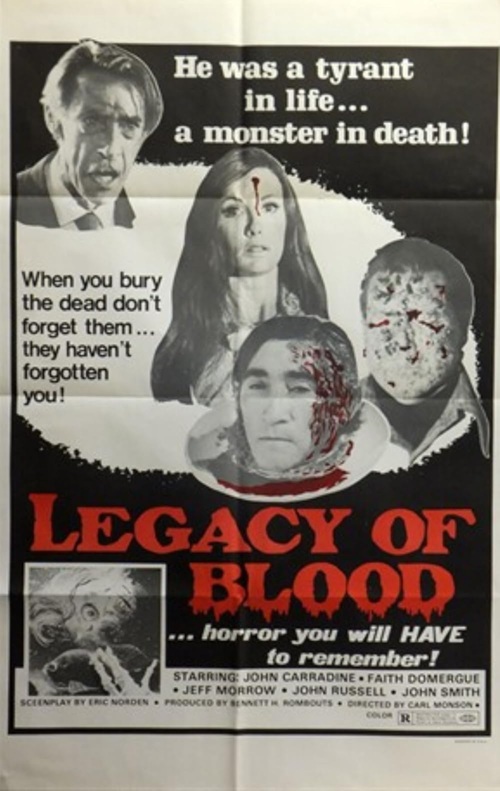
October Hacks: Blood Legacy (dir by Carl Monson)


a.k.a. Blood Legacy

In this 1971 film, John Carradine briefly plays Christopher Dean, a wealthy man who hated his family and his servants.  He dies before the film actually begins but we do get to see him in flashbacks and we also hear his voice at the reading of his will.  Dean leaves a fortune to his children and his servants, but he does so only on the condition that they spend a week at Dean’s estate.  If anyone dies or leaves the estate, they will lose their inheritance and the money will be split amongst those who stayed and/or survived.  You can see where this is leading, right?

This is actually a promising premise and it’s easy to imagine how it could have inspired an American version of Mario Bava’s Bay of Blood, where one person is killed by another just for that killer to then be killed by someone else until eventually, there’s no one left.  Unfortunately, while the characters are all unpleasant and greedy, none of them are as memorable as anyone in Bava’s classic shocker.  They’re all generic jerks and, as such, it’s hard to have much of a reaction when they start dying.  The film does feature several familiar B-movie stars.  Jeff Morrow and Faith Domergue (both of whom were in This Island Earth) appear as brother and sister.  Richard Davalos (who played James Dean’s brother in East of Eden) has an eccentric role.  Western character actor Rodolfo Acosta plays the sheriff who eventually takes an axe to the forehead.  B-movie veteran Buck Kartalian plays Igor, the butler.  (His name is actually Igor!)  Some of the members of the cast were good actors but few of them are particularly good in this film.  I did appreciate the weird energy of Buck Kartalian.  John Carradine doesn’t do much but he does deliver his lines with the proper amount of contempt.

The film does have a few vaguely interesting kills.  Bees are used as a weapon at one point.  A head is found in a refrigerator and Richard Davlos says, “This is just like a horror movie.”  Wow, Richard, thanks for sharing!  There’s a big twist ending but it really not that impressive of a twist.

Probably the most interesting thing about Blood Legacy is that it’s essentially a remake of Andy Milligan’s The Ghastly Ones. (Director Carl Monson had a habit of ripping off other films.  In 1973, he remade Roger Corman’s Little Shop of Horrors.  Monson called his remake Please Don’t Eat My Mother.  The film starred Buck Kartalian.)  Blood Legacy was originally released under the title Legacy of Blood but Milligan was so annoyed at being ripped-off that he later made his own remake of The Ghastly Ones and decided to give it the same title as Carl Monson’s rip-off.  Monson changed his film’s title and distributed it under the names Will To Die and Blood Legacy so that it wouldn’t be confused with Andy Milligan’s Legacy of Blood.  It makes sense.  Why would anyone want their Andy Milligan rip-off to be confused with an actual Andy Milligan film?

The TSL Horror Grindhouse: Mary, Mary, Bloody Mary (dir by Juan López Moctezuma)


In 1975’s Mary, Mary, Bloody Mary, Cristina Ferrare plays Mary, an American painter who lives and works in Mexico.

Mary seems to be living her ideal life.  She paints.  She travels.  Her work is popular.  She has glamorous and wealthy friends.  She has her independence.  Even when she starts a relationship with a young American diplomat named Ben (David Young), he seems like a genuinely nice guy who respects her need to have a space of her own.

However, Mary has a secret.

Mary is a vampire.  She doesn’t have fangs, she doesn’t sleep in a coffin, and she can go out in the daylight.  But she has an obsessive need to drink blood.  Whenever she can get away from Ben, she’ll pull out a knife and slit the nearest throat.  On the beach, a pushy, middle-aged man falls victim to her.  Back in the city, she kills her former lover (Helena Rojo), who is not happy that Mary is now dating a man.  Mary does her best to hide her murderous inclinations from Ben, even as she finds herself tempted to taste his blood.

However, someone else has recently arrived in Mexico and he appears to be looking for Mary.  The Man (John Carradine) dresses in black and wears a mask over his face.  The Man also carries a blade and, like Mary, he drinks the blood of his victims.  When Mary reads a newspaper story about a murder that she didn’t commit, she realizes that she’s not the only vampire in Mexico.  At the film progresses, we learn that Mary and the Man share a very close connection and Mary is forced to confront whether or not she can be both in love and a vampire.

One thing that I appreciated about Mary, Mary Bloody Mary is that it didn’t leave much ambiguity as to whether or not Mary was actually a vampire.  At first, it seemed like the movie was going to play the “Is-she-or-isn’t-she” game and maybe suggest that Mary was just mentally disturbed,  But instead, the film makes it clear that Mary is dependent upon drinking the blood of others.  It’s suggested that vampirism is something that was passed down to her, much like how I inherited my red hair from my father’s side of the family.  But, in the end, there’s no doubt that Mary actually is a vampire.  Cristina Ferrare occasionally seems miscast as a ruthless killer but, ultimately, she brings the right amount of sophistication to the role and John Carradine is, as always, a nice addition to the cast.

Unfortunately, the majority of Mary, Mary, Bloody Mary is very slowly paced.  I can appreciate a film that takes it time but the first 45 minutes of Mary, Mary, Bloody Mary really does sometimes feel like an endurance test.  Once The Man shows up, the film’s pace starts to pick up and Mary is very quickly forced to confront the truth of her cursed existence.  At times, I got the feeling that the director was trying too hard to convince me that there was more to Mary, Mary, Bloody Mary than there actually was.  The film is littered with scenes that suggest the story was meant to be a statement on the human condition but …. nah.  Ultimately, it’s just a film about a woman who drinks blood.

Star Slammer (1986, directed by Fred Olen Ray)


On the planet of Arous, Taura (Sandy Brooke) leads a group of dwarf miners in rebellion against the international empire.  The empire sends Captain Bantor (Ross Hagen), Krago (Michael D. Sonye), and the Inquisitor (Aldo Ray) to capture Taura and put down the revolution.  When Bantor attempts to attack Taura, he sticks his hand in a volcanic acid plume and screams as it dissolves.  Taura is arrested.  Judge John Carradine sentences her to a term on Vehemence, a spaceship that serves as an intergalactic women’s prison.

Star Slammer is a Women In Prison film that happens to be set in space.  Taura makes an enemy of the sadistic warden (Marya Grant) and her henchwoman, Muffin (Dawn Wildsmith).  Taura also befriend Mike (Susan Stokey) and the two of them plot to overthrow the guards and make their escape.  When the now crazed Bantor boards the ship, Taura sees her chance.  Meanwhile, the prisoners have to deal not only with pervy guards but mutant rats.

Legend has it that Fred Olen Ray had rented Roger Corman’s New World Pictures studio for four days so that he could shoot some extra scenes for his film Biohazard.  Ray finished his Biohazard work in one day and then spent the other three days filming promotional footage for the film that would become Star Slammer.  He used props that were left over from Galaxy of Terror and was able to get Aldo Ray to come in for a day so that the footage would feature “a name.”  Producer Jack H. Harris looked at the footage and put up the money to shoot the rest of the film on the condition that Ray change the title from Prison Ship to Star Slammer.

Amazingly, the resulting film itself is not that bad.  Ray used the outer space setting as a way to both indulge in and poke fun at the common tropes of the Women In Prison genre and Sandy Brooke and Susan Stokey both turn in committed performances.  Ross Hagen laughs like a maniac and demands vengeance for his missing hand while trying to get his remaining hand on a mind control device.  The prisoners are kept in check by promises of prizes and free trips in return for good behavior.  A thoroughly deformed guard is promoted as a sex symbol and there’s a sharp wit to many of the scenes.  Star Slammer is much more clever and fun than anyone would have any right to expect it to be.

Horror Film Review: Evils of the Night (dir by Mardi Rustam)


How dumb can one movie be without becoming unwatchable?

1985’s Evils of the Night is here to answer that question!

Three space alien vampires (John Carradine, Julie Newmar, and Tina Louise) have led an expedition to Earth.  They’ve taken over a hospital and they’re stealing the blood of their patients so that it can be sent back to their dying planet.  They especially want young blood, which is why they specifically came to a college town.  Unfortunately, their intelligence was faulty and they arrived during the summer, when the campus was closed.  (I guess this is one of those rare colleges that don’t offer a summer term.)  There’s actually a very lengthy scene in which Carradine explains the faulty intelligence to Newmar and Louise and then Newmar complains about how the alien intelligence service just isn’t that good.  What makes this scene so special is that Carradine delivers his lines with a straight face and Newmar actually seems to be sincerely annoyed.  Aliens — they’re just like us!

Just because college is out of session, that doesn’t mean that there aren’t any young people hanging out down at the lake.  There’s actually quite a few, though all of them look to be a little bit too old for high school or college or whatever they’re supposed to be attending.  Several of them are played by veterans of the adult film industry, including Amber Lynn and Jerry Butler.  Everyone wants to get laid down at the lake, which is probably the most realistic thing about Evils of the Night.  However, John Carradine needs their blood so he has Julie Newmar hire two slovenly mechanics, Kurt (Neville Brand) and Fred (Aldo Ray), and sends them out to kidnap any young people that they find.  Kurt and Fred are very good at their job.  Newman pays them and mocks them for caring so much about coins.  Little do the mechanics realize that the aliens are planning on shooting them with their space laser as soon as they leave the planet.

Evils of the Night is a good example of a bad movie that is oddly watchable just because the viewer finds themselves curious as to just how stupid things can get.  The answer here is very stupid and very nonsensical  It never seems to occur to anyone just go to a different lake or maybe just do their skinny dipping in a pool somewhere.  The plot has a “make it up as you along” feel to it and that, at the very least, keeps things vaguely interesting.  The actors playing the “teen” victims are enthusiastic without being particularly good while most of the veterans in the cast are all obviously just there for the paycheck.

That said, John Carradine.  Wow.  What a career.  A trained Shakespearean actor who made his stage debut in 1925 and went on to appear in a countless number of movie, Carradine was a favorite of both John Ford and Fred Olen Ray.  Carradine appeared in hundreds of a theatrical films.  In fact, his final film was released seven years after Carradine’s death.  Carradine was one of the great actors, with that deep voice and that commanding stare.  But he was also one of those actors who was apparently willing to appear in just about anything and that’s one reason why he’s still such a beloved icon.  Playing an outer space vampire-turned-doctor was definitely not the strangest role that Carradine ever played.  Carradine handles his scenes like a pro!

Evils of the Night is dumb but I dare you to look away.

Horror Film Review: Voodoo Man (dir by William Beaudine)


In 1944’s Voodoo Man, Michael Ames stars as Ralph, a screenwriter who has been asked to write a treatment based on the real case of several “girl motorists” who have disappeared in the surrounding area.  Ralph turns down the assignment because he’s busy planning his wedding to Betty (Wanda McKay).  However, when Betty’s maid of honor, Stella (Louise Currie), vanishes, Ralph and Betty set out to investigate.  As Ralph puts it, he’s become a part of the story that he earlier rejected.

What has happened to Stella and all of the other women?  They’ve been abducted by Toby (John Carradine) and Grego (Pat McKee), two lunkheads who work for Dr. Marlowe (Bela Lugosi).  Dr. Marlowe lives in an isolated mansion where he is cared for by his loyal housekeeper (Mici Goty).  Twenty-two years ago, Dr. Marlowe’s wife, Evelyn (Ellen Hall), died but Marlowe has been able to keep her body in a sort of suspended animation ever since.  Marlowe is kidnapping women because, through the use of voodoo and mad science, he hopes to take their “will to live” and transfers it into Evelyn.  Helping Marlowe out is a voodoo priest named Nicholas (George Zucco).

Lugosi, Carradine, and Zucco!  Obviously, the main appeal of Voodoo Man is that it brings together three great names in horror. Even if the story doesn’t really make much sense (and it doesn’t), the film gets a lot of mileage out of the combination of Lugosi, Carradine, and Zucco.  While Lugosi does seem to be a bit bored with his role, Carradine and Zucco really throw themselves into their characters.  John Carradine, in particular, seems to be having the time of his life as he shuffles around the mansion and replies, “Yes, master,” to every command from Dr. Marlowe.  It’s the type of entertaining performance that could only be delivered by a trained Shakespearean slumming in a low-budget, B-grade horror film.  As for Zucco, he plays Nicholas with a certain amount of ruthless erudition.  Zucco is playing the Boris Karloff role here and he definitely seems to understand what that means.

As for the film itself, it has its moments.  Legend has it that director William Beaudine’s nickname was “One Shot” because he was usually only willing to do one take of each scene.  As a result, he filmed quickly and he didn’t spend a lot of money and that was probably a good thing for a production like Voodoo Man.  It also meant that if someone flubbed a line or bumped into a piece of furniture, that take would still be the one that showed up in the film.  My favorite moment of Voodoo Man was when the local sheriff (Henry Hall) referred to Dr. Marlowe as being “Dr. Martin,” and Bela Lugosi, who appeared to be struggling not to laugh, quickly said, “It’s Marlowe.”  The sheriff corrected himself.  That’s the type of fun you don’t get in movies made by people who do more than one take.

Voodoo Man has a quick 61-minute running time.  To enjoy it, it probably helps to already be a fan of low-budget, B-horror films from the 40s.  Lugosi, Carradine, and Zucco are combination that deserves to be seen.

4 Shots From 4 Films – Thomas Mitchell Edition!


4 Shots From 4 Films is just what it says it is, 4 shots from 4 of our favorite films. As opposed to the reviews and recaps that we usually post, 4 Shots From 4 Films lets the visuals do the talking.

I noticed that today, July 11th, 2025, is actor Thomas Mitchell’s 133rd birthday in cinema heaven! I can guarantee that I, along with most of you, watch him every year around Christmas time. I also found out today that he worked with my movie hero Charles Bronson on THE O. HENRY PLAYHOUSE TV series back in 1957. That combination of appearances makes Mitchell about as close to a cinematic immortal as a person can get!

Enjoy 4 shots from 4 films, with Thomas Mitchell!

Stagecoach (1939)
Mr. Smith Goes to Washington (1939)
It’s a Wonderful Life (1946)
The O. Henry Playhouse: Two Renegades (1957)