It has been over ten years since one of the masters of horror has released a full-length feature film. Sure, John Carpenter has filmed episodes for two seasons of Showtime’s horror anthology, Masters of Horror. But it seemed like the bad experience he had in filming his last feature-length, 2001’s Ghosts of Mars, might have soured him in doing anything for the big-screen.
That was then and this is now 2011 and Carpenter looks to make his return to the big-screen with the horror film, The Ward. It will star one of the industry’s rising stars in Amber Heard with veteran performers both young (Danielle Panabaker, Lyndsy Fonseca) and old (Jared Harris) backing her up.
The Ward was first show in this past 2010 Toronto International Film Festival and the reaction to the film was generally positive with most saying this was a good return for one of the horror genre’s most admired and beloved filmmakers.
The film looks to be set in a 1960’s mental institution with Heard’s character the center of attention. Mysterious happenings involving the staff, current patients and the presence of a ghost seem to be the main plot of the film.
Will Carpenter’s bag of filmmaking skills remain as it was before he left feature-length filmmaking a decade ago or will he show that he’s learned a few new tricks to add to his considerable skillset? The film certainly seem to echo some of the Japanese-style gothic and ghost story films which still remains a staple of Japanese horror cinema. In the end, I’m just glad to see one of the masters of horror back in the driver’s seat. Time for him to show some of the young horror filmmakers nowadays how to do it.
Cigarette Burns was John Carpenter’s episodic contribution to the Showtime series, Masters of Horror. This 13-episode horror anthology thought up by Mick Garris (a fellow horror director best known for adapting Stephen King stories) which includes eleven other directors known for their work in the horror genre.
John Carpenter works off of a screenplay that posits an interesting premise about an infamous film that caused the audience it was shown to the first time to go homicidal. The story itself involves a man known in the film community as someone who can find and hunt down any copy of film no matter how rare. Norman Reedus (he of Blade II, The Boondock Saints) plays the cinephile who takes on the job to hunt down a copy of this infamous film titled Le Fin Absolue Du Monde. His client was played with relish by resident weirdo Udo Kier. Really, Kier could be given any role and he’ll add his brand of idiosyncracy and weirdness to the part. In Cigarette Burns he plays an obsessive fan of the rare film to the hilt. His contribution to the the climactic ending will bring a smile to gorehounds everywhere. Alas, it’s Kier’s performance that’s the highlight of the acting in Cigarette Burns. Reedus’ performance as Kirby Sweetman the cinephile leaves much to be desired. The screenplay itself was already average, but with genuine ideas that could be explored if the acting could raise it beyond its C-grade pedigree, but Reedus wasn’t up to it.
Carpenter’s directing really can’t be faulted for the major flaws in the screenplay and in his lead’s performance. It’s not early Carpenter, but his work in Cigarette Burns was much better than what he’s done in his last couple films. In fact, this tv show entry in Carpenter’s body of work resembles one of his more underrated films. I am talking about his ode to Stephen King and H.P. Lovecraft with In the Mouth of Madness. Instead of a book influencing the sanity of the reader, its a film that does it instead. A film that may or may not have divine origins that doesn’t just turn its viewers homicidal but bend their sense of reality.
I think with a better cast and a screenplay that’s worked on a bit more by its writers, Cigarette Burns could’ve been a great episode in the Masters of Horror anthology or, better yet, become a full-fledged feature film. Instead, it’s just a very good work from Carpenter with great gore sequences (courtesy of KNB EFX), but brought low due to a very rough screenplay and a lead actor in Norman Reedus who seemed stoned, drunk or both throughout his entire performance. It’s not something great, but a good showing from Carpenter that said he’s not as washed-up as many seem to be calling him.
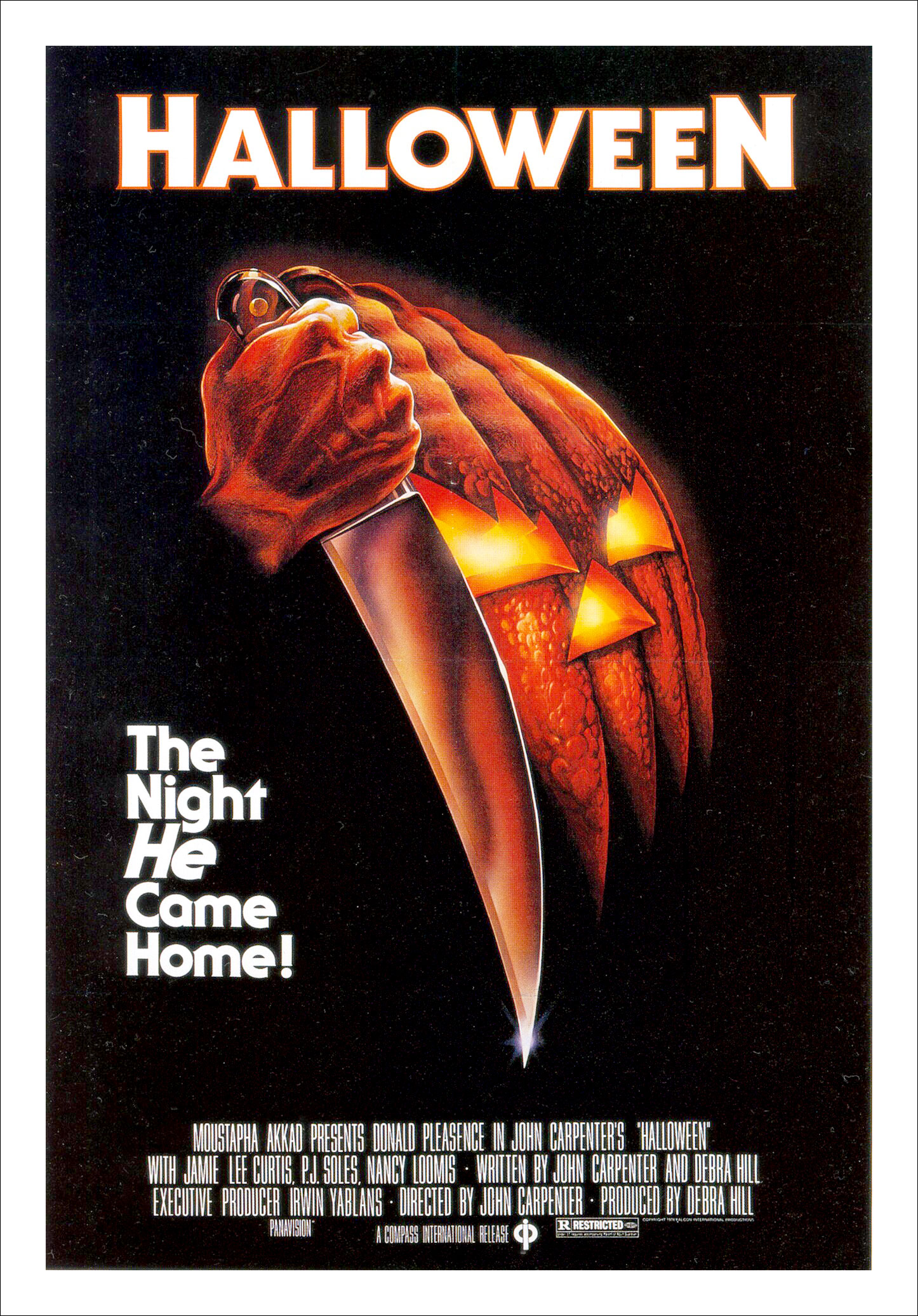
The penultimate choice for this week’s horror-themed “Song of the Day” feature brings one of the best theme songs ever composed and put on film. I am talking about the Main Title theme for John Carpenter’s classic horror film (also one of the best grindhouse films ever made) and one which launched a whole new horror subgenre with Halloween. This theme would become synonymous with the “slasher film” that when the many copies and imitators of the film came out in droves a year later they would try to replicate this keyboard synthesizer-based theme and fail miserably.
It’s actually a pretty simple theme. Carpenter composed the theme as a piano melody played in a 5/4 meter that even the most novice piano player could play with ease. This theme could be heard throughout the film whenever Michael Myers appears and/or in the vicinity. Some have even started calling it the Michael Myers theme and they wouldn’t be far off. It’s become the film’s leitmotif that Carpenter ends up relying on it to set the mood and tension in the film. Other kids of songs could be heard throughout the film but outside of the Blue Oyster Cult’s “Don’t Fear the Reaper” the rest of the score is forgettable until this theme kicks in.
This theme will be the final of the instrumental themes for the week. With one more day left in this special week-long horror-themed week for “Song of the Day” the last one will definitely usher in another awesome Halloween and help kick off the premiere of what will probably be the best thing to ever grace the tv screen past, present and future.
Day Three of the week-long horror-themed “Song of the Day” feature brings us one of the greatest pieces of film music ever composed. I’m talking about the score for John Carpenter’s remake of The Thing from Another World. The remake retains only the first two words of the original’s title, and that alone speaks volumes.
At first listen, one might mistake this music as being composed by John Carpenter himself—an accomplished film composer in his own right, known for scoring most of his own films. Its similarity to his iconic Halloween theme and even his earlier work on Assault on Precinct 13 makes the connection understandable. But one would be wrong to assume Carpenter had a hand in writing it. For the first time, Carpenter allowed someone else to compose the score, and for the task he selected none other than the Italian maestro Ennio Morricone.
By the time he collaborated with Carpenter on this sci-fi horror masterpiece, Morricone was already firmly established as one of the great masters of film composition. Audiences knew him best for his legendary work on Sergio Leone’s “spaghetti westerns” as well as numerous classics of Italian cinema. While Morricone’s full score for The Thing deserves a complete discussion of its own, I’ll focus on the one track that most powerfully captures the themes of horror, isolation, dread, and paranoia that make Carpenter’s film such a landmark: “Humanity (Part II).”
The piece opens with a heartbeat-like sequence that pulses steadily through most of its length. Strings layer on top of this rhythm, creating a mournful, dirge-like quality, while the bass thump lurks ominously just beneath the surface, as though danger is present but unseen. For much of its runtime, the music exudes a stark sense of emptiness, forcing the listener into the same suffocating isolation as the characters onscreen, stranded in the vast Arctic wasteland. The repetition and looping structure almost feel like a trap, with no release or resolution, mirroring the crew’s paranoia as suspicion and fear close in tighter than the snowstorms outside. Each cycle draws the listener deeper into a psychological cage, heightening the dread with its unrelenting stillness.
It isn’t until the final two minutes that the track breaks from its oppressive restraint. Here, Morricone channels Carpenter’s trademark minimalism with unsettling synthesizer tones, jagged and piercing against the steady backdrop. The music shifts from mournful to dissonant, almost alien, capturing the horrifying essence of the creature in its most grotesque form. This sharp intrusion is not just an auditory shock but a symbolic transformation—the moment when the lurking horror finally emerges from shadow into focus, confirming that the paranoia has been justified all along. It is this careful build, held back until the very end, that demonstrates Morricone’s mastery at fusing Carpenter’s sensibilities with his own, delivering a piece that is both restrained and devastatingly effective.
There’s a reason so many film aficionados cite Carpenter’s The Thing as one of their all-time favorites. Its reputation owes much to Carpenter’s skill as a filmmaker and editor, but Morricone’s score plays an equally crucial role in shaping the film’s atmosphere. “Humanity (Part II)” stands as one of the finest pieces of horror film music ever written.
What better way to bring back a new daily grindhouse than the film which started the teen slasher genre. I speak of John Carpenter’s Halloween.
The film was truly a child of 1970’s independent filmmaking. With a budget of just $320,000 (even adjusting for inflation it’s still quite low) Carpenter made what’s considered one of horror’s defining films. Carpenter’s film was a smash hit when it was released in 1978. It played mostly in drive-in’s, grindhouse cinema houses before finally appearing in more mainstream venues. By then the film had become one of those must-see titles that many films both independent and mainstream try for but fail to do.
Some have commented that since Halloween was such a success in the box-office then it shouldn’t be considered grindhouse. I look at such thinking as quite narrow. Grindhouse was never synonymous with bad filmmaking. If one said the term meant cheap filmmaking then I would agree. Carpenter’s film has all the trappings of what makes a great grindhouse. It’s violent (though it really has less blood than what audience really remember) and uses sex as a storytelling tool (again the sex is quite chaste compared to later teen slashers).
While some film historians credit Hitchcock’s Psycho as the granddaddy of the slasher genre it wasn’t primogenitor of the teen slasher subgenre which has become an industry onto itself since Carpenter’s breakthrough hit. A hit that set many of the basic rules of teen slasher horror for decades to come. We get the nigh-unstoppable killer who seems more like a force of nature than human. The notion that teenage girls who have premarital sex will die horribly because of it while the chaste and virginal girl survives and inevitably stops the killer (until the subsequent sequel that is).
Halloween is grindhouse through and through. The fact that Carpenter’s obvious talent and skill as a director, editor, film composer and cinematographer shouldn’t DQ this film from being called grindhouse.
“There are things in this world that go beyond human understanding.”
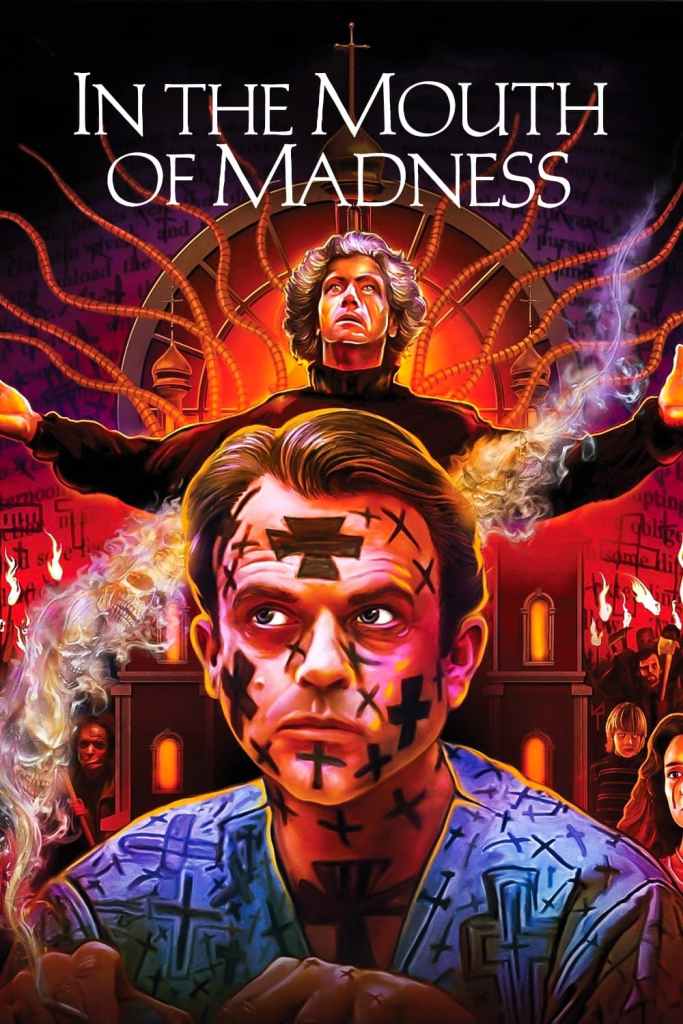
John Carpenter’s reputation as one of the great American horror directors rests on his ability to merge the cinematic with the philosophical—to craft films that stay frightening not because of what they show, but because of what they suggest. Yet by the early 1990s, Carpenter’s once unshakable relationship with audiences had weakened. His influence remained undeniable, but several of his later films seemed to miss the spark that defined Halloween, The Fog, or The Thing. Then arrived In the Mouth of Madness (1995), a work that signaled a late creative resurgence. It paid intelligent homage to two pillars of horror literature—Stephen King and H. P. Lovecraft—while offering a disturbing reflection on authorship, sanity, and the power of belief. The film reasserted Carpenter’s command not only over frightening imagery but also over the psychological territory that underpins enduring horror.
At a narrative level, In the Mouth of Madness follows John Trent (Sam Neill), an insurance investigator known for exposing fraud and deception. His skepticism becomes both his strength and undoing. Trent is hired by publishing executive Jackson Harglow (played by the legendary Charlton Heston) to locate Sutter Cane, a best-selling horror novelist whose disappearance threatens both the company’s finances and the stability of Cane’s obsessed fanbase. Every sign points to something far stranger than a publicity stunt. Cane’s readers are exhibiting troubling behavior, as though the author’s new book has triggered more than just entertainment—it has become contagion.
Carpenter crafts Trent’s descent into uncertainty with meticulous pacing. At first, Neill’s character regards the assignment as routine, dismissing the hysteria surrounding Cane’s novels as marketing excess. But when his investigation hints that the locations and events in Cane’s fiction may correspond to real places and real disturbances, the film begins to twist the rational into the uncanny. The story’s sense of unreality builds with deliberate restraint—incidents grow progressively stranger, but never so overt that Trent can confidently identify what’s madness and what’s truth. Carpenter thrives on this ambiguity, pulling both protagonist and viewer into an atmosphere where logic erodes and fiction itself seems to rewrite reality.
Accompanying Trent on his search is Linda Styles (Julie Carmen), the publisher’s editor assigned to ensure the investigation runs smoothly. While her performance has sometimes been considered subdued, Styles functions as the audience’s second perspective: observant, mildly skeptical, and gradually aware that the world around her no longer behaves according to its former rules. Carpenter positions her as a necessary counterpoint to Trent’s brittle rationalism, highlighting the conflict between recognizing patterns and succumbing to fear. As they move closer to locating Cane, their surroundings take on the familiar haunted quality of an archetypal New England town—Hobb’s End—built from the shared DNA of King’s Castle Rock and Lovecraft’s Arkham. The town becomes more than setting; it is a physical embodiment of literary influence and psychological instability.
The choice of Sam Neill proves essential to the film’s success. His trademark combination of intelligence and emotional vulnerability allows Trent’s transformation from calculating skeptic to disoriented seeker to feel natural rather than theatrical. Few actors could portray a man so evidently rational who nonetheless finds himself seduced by forces his disciplined mind cannot resist. Neill’s body language carries much of the horror; his expressions shift between dry disbelief and quiet terror, suggesting that intellect offers no protection once perception itself begins to betray you. Carpenter exploits this performance with close framing and asymmetric compositions, visually trapping Trent in spaces that subtly curve or distort. The director’s technical command ensures that even ordinary scenes seem charged with quiet wrongness.
While In the Mouth of Madness never references the mythos of Lovecraft by name, its influence saturates the film. Lovecraft’s hallmark—cosmic indifference—exists here not through tentacled gods but through the crumbling borders between fiction and the human mind. The suggestion is that the very act of creating and consuming stories might awaken something ancient and uncontrollable. When Trent confronts the nature of Cane’s work, Carpenter’s direction avoids overstatement. Instead of grand confrontations, he conveys horror through disorientation—the feeling that language, images, and even memory are slipping toward incoherence. Reality itself becomes a character, unstable and untrustworthy.
Jürgen Prochnow’s portrayal of Sutter Cane adds another layer of unease. His calm, confident manner diverges from standard portrayals of deranged genius. Prochnow makes Cane unnerving precisely because he appears so certain of his vision. The author views himself not as a mere storyteller but as a conduit, claiming that what he writes merely reveals a preexisting truth. Through him, Carpenter explores a potent question that haunts all creators: does imagination serve human purpose, or is it an independent force that uses human minds as tools? Cane’s conviction blurs that line, turning the creative process into possession. To audiences familiar with the concept of “mad artists” in literature, his belief offers both fascination and dread.
Carpenter imbues this theme with visual invention. The cinematography and set design combine the mundane with the surreal—painted walls pulse, corridors bend, horizons vanish. Rather than relying on excessive gore or digital spectacle, the director emphasizes textures and shadows, creating optical unease rather than overt shock. The town of Hobb’s End seems perpetually detached from time, its streets looping back on themselves. By employing low, creeping camera movements and deliberate color desaturation, Carpenter evokes a dreamscape decaying from within. The film’s sound design—especially Carpenter’s own pulsating score, co-composed with Jim Lang—heightens that tension with rhythmic basslines reminiscent of a heartbeat slowing to a stop. Every technical choice reinforces the narrative’s central sensation: uncertainty.
Michael De Luca’s screenplay deserves particular credit for its clever structure. The film is framed as a story told from inside an asylum, immediately hinting that the perspective may be unreliable. This framing allows Carpenter to shift between psychological thriller and cosmic horror without losing cohesion. As viewers, we are made complicit in Trent’s investigation but warned not to trust his perceptions. The resulting experience is disorienting yet coherent—a cinematic maze where each turn feels inevitable once taken. The writing never lingers long on exposition, instead suggesting connections through implication and repetition. In this way, De Luca’s script succeeds in translating Lovecraftian dread into visual terms: a fear of knowledge itself.
Very few directors have managed this particular tone as successfully. Lovecraft’s fiction often resists cinematic adaptation precisely because its greatest horror lies in what cannot be shown. In the Mouth of Madness solves this problem by making the act of storytelling itself the subject of terror. By focusing on an author whose imagination reshapes reality, Carpenter transforms literary horror into filmic language. In doing so, he edges close to achieving what decades of other attempts had failed to capture—a true Lovecraftian mood rendered on screen, grounded not in spectacle but in existential dislocation.
Despite its craftsmanship and intelligence, In the Mouth of Madness struggled at the box office upon release. Its ambiguity, self-reflexivity, and intellectual leanings proved challenging for mid-1990s audiences who expected more conventional scares. Yet over time, the film’s reputation has flourished. Today, it is often regarded as the concluding entry in Carpenter’s loosely connected “Apocalypse Trilogy,” following The Thing (1982) and Prince of Darkness (1987). All three films share a fascination with humanity confronting forces it cannot comprehend—scientific, metaphysical, or divine. In each, Carpenter presents apocalypse not as fiery destruction but as revelation: the moment when human understanding collapses under greater cosmic truth. That philosophical core links these works across more than a decade of filmmaking.
Revisiting In the Mouth of Madness now, one is struck by how prophetic it feels. Its concerns about cultural contagion and media-induced madness anticipate contemporary conversations surrounding viral misinformation, fandom extremism, and the blurring between online identity and reality. The “disease” in the film—ideas that rewrite perception—mirrors our present anxiety about the stories and images that shape collective belief. Carpenter’s horror, always grounded in social awareness, here expands into a warning about a world unable to distinguish narrative invention from lived experience.
Even limited in budget, Carpenter demonstrates confident control of visual tone and rhythm. His filmmaking reminds viewers that suggestion often unsettles more deeply than spectacle. Rather than overwhelming audiences with jump scares, he leads them through gradual disintegration, where each logical step seems to justify the next until coherence itself fractures. The film invites reflection rather than relief, leaving viewers haunted by the possibility that the boundaries between art and life are far thinner than comfort allows.
While Carpenter would go on to direct more films after 1995, In the Mouth of Madness stands as one of his last profoundly accomplished achievements. It encapsulates the elements that made his earlier works enduring: tight pacing, minimalist storytelling, and ideas that resonate beneath genre tropes. The film’s legacy continues among filmmakers who explore metafictional or cosmic horror, from Guillermo del Toro’s long-sought adaptation of At the Mountains of Madness (a feat that may never come to fruition outside of concept art and videos) to the psychological labyrinths of contemporary horror auteurs. Though Carpenter’s film never directly adapts Lovecraft, it succeeds where many literal adaptations fail—by preserving the essence of incomprehensible terror rather than translating it into spectacle.
Ultimately, In the Mouth of Madness remains a rare horror film that asks not just what we fear, but why we need fear in the first place. Its central notion—that imagination itself can undo reality—strikes at the heart of storytelling. Carpenter’s mastery lies in letting that idea linger long after the credits roll. What begins as an investigation grows into a philosophical nightmare, compelling viewers to question how much of their world is built from collective belief. In that sense, the film transcends its genre to become one of Carpenter’s most unsettling reflections on human perception. Decades later, its message still resonates: the stories we consume may shape us more profoundly than we realize.
Robert Rodriguez and Quentin Tarantino have always professed to anyone within hearing distance their extreme and fanboyish love for the grindhouse days of filmmaking. Both directors’ resume of work look like a modern grindhouse films but with better writing, effects and directing. Anyone who grew up watching grindhouse film’s of the 70’s and 80’s can see it’s heavy influence on films such as From Dusk Til Dawn, Desperado, Pulp Fiction and Kill Bill. With 2007’s Grindhouse, both Rodriguez and Tarantino take their fanboy love for all things grindhouse and exploitation to a whole new level with personal take on the cheap John Carpenter-knock offs, zombie gorefests, slasher film and revenge-driven flicks that made being a young kid during the 70’s and 80’s quite enjoyable.
For those who do not know what grindhouse films are they’re the ultra-cheap and, most of the time, very bad, shlocky horror, revenge, softcore porn, badly-dubbed kung fu flicks and a myriad of other B- to Z-grade movies. These movies were shown in dingy, decrepit (usually former burlesque stagehouses) movie houses which showed double to triple-bills of titles for a low, cheap price all day long (where the popcorn and concession snacks were as stale as week-old coffee). These places and their films were book-ended by the cheap drive-in theaters which grew out of the suburban sprawl boom era of the 60’s and 70’s. One could not avoid the fact that the projector equipment were in bad shape and in desperate need of maintenance while the films played out. Then there’s the film reels themselves with their washed out sequences, out of focus scenes, burnt-in spots and missing film reels where the sex scenes would’ve been. This was the grindhouse experience and with the rise of Hollywood as a corporate entity even moreso than it’s been in the past and urban renewal projects by big city leaders, the grindhouse experience has pretty much faded away and kept alive only in the memories of its fans worldwide.
What Robert Rodriguez and Quentin Tarantino have cranked out with their three-hour long opus to those grindhouse days has been both a literal and thematic homage to an era long since gone. Grindhouse also has allowed Rodriguez and Tarantino to pull out all the stops in filming their respective halves of the film. Rodriguez went all-out in paying literal homage to the zombie gore-fests of George A. Romero, Lucio Fulci and Umberto Lenzi. Planet Terror plays like a hodgepodge of all the zombie movies from these masters of the walking dead but Rodriguez has the use of digital effects to match the over-the-top feel of the past zombie-fests without making the effects look too cheap.
The story for Planet Terror is quite simple yet full of so many incoherent subplots that trying to keep track with whats going on would just confuse a viewer even more. Rodriguez gets the grindhouse feel with such a ludicrous storyline. Whether it was done on purpose or not, the feeling of confusion in addition to the non-stop zombie action was only compounded even more by the digitally-added film stock scratches, burns to the edges of the reel and when the movie was about to get all hot and sexy, missing reel footage. Anyone who watched movies in grindhouse theaters would recognize the look quite well. Rodriguez goes all out in letting his zombie fanboy out. The violence in Planet Terror begins strong and just gets stronger and even more over-the-top right up to the final frame. Zombie’s getting their heads blown apart is shown in scratchy, loving detail with an impossible amount of blood, bone and brain for people to gawk at. The female characters are hot and sexy. Rose McGowan as Cherry Darling holds Planet Terror together with her spunky go-go dancer dreaming to be a stand-up comedienne turning into Ellen Ripley minus a leg but gaining an M16A3 w/ M203 grenade launcher as a leg prosthetic. Freddy Rodriguez as El Wray, her wayward and mysterious lover, almost seem to be channeling a hilariously bad version of Snake Plissken. These two make for quite the explosive couple as they must try and save their small Texas town from the infected townspeople turned pus-oozing, boil-ridden zombies.
Planet Terror sports a nice collection of current B-list actors like Josh Brolin (making like a Nick Nolte at his growliest) and Marley Shelton as a pair of married doctors with marital problems compounded by the increasing amount of zombies their hospital seem to be bringing in for medical help. There’s also genre veterans Michael Biehn, Jeff Fahey and Tom Savini to give Planet Terror the appropriate grindhouse look and feel to it. Ever the good friend and buddy collaborator, Rodriguez even gives Quentin Tarantino a role in his half of the film. He’s shown in the credits for Planet Terror as The Rapist. If any director seem destined to be one, if their love for movies didn’t steer them on the right path, Tarantino seem to look just like one to be called “Tha Rapist”.
There’s explosion and gore galore in Rodriguez’s ode to the zombie genre. Some who sees it might say there’s too much and they would be right if the title of the whole film wasn’t Grindhouse. I, for one, am glad Rodriguez decided to not hold back with what he threw onto the screen. I’m sure that when the dvd finally comes out and the unedited full version of Planet Terror is shown it’ll even surpass the 85-minute running time in the film. I think I can forgive Rodriguez for his gore excess and at times I actually wished for more, but then that would mean taking even more time before I get to Tarantino’s half of the movie. Planet Terror truly got the look of a grindhouse flick, but it’s Tarantino’s Death Proof half which got the spirit of grindhouse down to near-perfect.
Before Tarantino’s Death Proof half of Grindhouse begins the audience gets treated to a sort of intermission involving three fake trailers for movies which celebrate just how ridiculously fun grindhouse movies really were during the 70’s and 80’s. There’s Rob Zombie’s Werewolf Women of the SS which was this weird mish-mash of the women-in-prison flicks with that of the infamous Ilsa: She-Wolf of the SS films that brought about the exploitation in grindhouse. This trailer was great just for the inspired casting of Nicolas Cage as Fu Manchu and Sybil Danning as one of the so-called SS women werewolves. There’s also Edgar Wright’s fake trailer for Don’t (director of Shaun of the Dead and Hot Fuzz) which parodies the trailers for all the gothic, European haunted and horror movies where none of the actors in the trailer speak a word to make sure the film doesn’t get labeled as a “foreign film”. But it’s the third trailer in that intermission trio which had everyone in the audience reacting wildly.
Eli Roth’s Thanksgiving is a throwback to the seasonal-themed slasher flicks like Black Christmas but this time turns the yearly, turkey day and Pilgrim celebration into a trailer with some of the most disturbingly inventive scenes for a fake slasher movie. I don’t know what the Pilgrim serial killer was doing with that turkey at the end of the trailer but I’m sure it will have many people talking about it afterwards. It’s this Eli Roth trailer which fully captures the gritty and gratuitious nature of what makes a grindhouse horror movie. It’s also the one fake trailer I hope Roth would re-visit and turn into a full-length movie.
Now, with the trailers out of the way, Tarantino’s half of Grindhouse begins and we’re treated to a different take on the grindhouse experience. Death Proof begins as if it will continue Rodriguez’s literal examination and homage to the grindhouse experience, but after messing with the film’s focus, adding a few film scratches to the celluloid and even adding a missing reel gag, Tarantino suddenly slows all those grindhouse trickeries and actually ends up making a rip-roaring slasher-revenge-carchase flick. Tarantino takes one part slasher movie adds in a heavy dose of his own Reservoir Dogs (the talking between the female characters in Death Proof are as foul-mouthed and trivial as the diner scene in Reservoir Dogs) then mixes in equal amounts of Vanishing Point, Faster Pussycat! Kill! Kill! and I Spit On Your Grave. Instead of just mimicking these particular grindhouse classics, Tarantino uses his own flair for extended dialogue to slow down the pace of the film thus lulling the audience for the two pay-offs which happen in the middle and the end of Death Proof. Tarantino’s half of Grindhouse could’ve went nowhere with all its estrogen-laced talkies, but Kurt “I AM SNAKE PLISSKEN” Russell really saves the day once he makes his appearance as the automotive-themed serial killer, Stuntman Mike. Where Jason uses farming and bladed implements as his tool of the serial killing trade, Stuntman Mike uses both a 1971 Chevy Nova SS and a 1970 Dodge Charger R/T 440 as his weapons of choice. Both vehicles have been made death proof for filming violent car stunt sequences, but in order to appreciate it’s unique life-saving properties then one has to sit where Mike sits.
Kurt Russell can now add Stuntman Mike to his classic list of badass roles. Mike would feel quite welcome amongst the like of Snake Plissken, John J. MacReady, and Jack Burton to name a few of Russell’s classic characters. Mike comes across as cooly and slickly dangerous, yet not psychotic. His charm is quite disarming until it turns deadly. He really takes the slasher-character stereotype and turns it on its ear. Death Proof once again shows that when Tarantino gets to work with one of his boyhood idols he really gives them a role that they could sink their teeth into.
Death Proof captures the spirit of what makes a grindhouse exploitation film. Even with the heavy references to Vanishing Point, especially with a white 70’s Dodge Challenger used just like in that movie, Tarantino still injects his own brand of craziness to the whole movie. I know many who have complained that Death Proof was too much talk with only the car chase in the end being the saving grace. I politely disagree and say that it’s that very long periods of dialogue between the women in Death Proof that brings some of the spirit of grindhouse to the story. Many forget or don’t remember that most grindhouse cheapies had so much extraneous dialogue to hide the fact that the budget was low to none when the movies were being made so they had to fill-up the movie’s running time with as much nonsensical dialogue before the big effect shots payoff.
The final chase-scene between the Russell’s Stuntman Mike and the female-trio of Rosario Dawson, Tracie Thoms (channeling Jules from Pulp Fiction) and real-life stuntwoman Zoe Bell (she doubled as Uma Thurman in the more dangerous stunts in Kill Bill) has to go down as one of the craziest, whiteknuckling, barnburning car chase sequences of the modern times. No CGI-effects trickery and fancy MTV-style editing was used. George Miller, John Frankenheimer and Richard Sarafian would be proud of what Tarantino was able to accomplish with Death Proof‘s 20-minute long car chase. By the time Death Proof ends the audience have bee put through the wringer and one was hard-pressed not to cheer and root for Stuntman Mike even though we know we shouldn’t. Death Proof proves that “hell hath no fury like a woman scorned” or at least a trio of women endangered.
Grindhouse is a film not for everyone. There’s going to be quite a few people who won’t “get” the film homages and references by both Robert Rodriguez and Quentin Tarantino. Some would say that the movie was too over-the-top, badly made and just out there, but then they would be missing the point of the whole project altogether. For those who grew up watching these kind of films as kids and teenagers, it’s a belated Valentine’s gift from two fanboy filmmakers who finally were able to do the films they grew up idolizing and enjoying. For the rest who are not as well-versed in the grindhouse cinema, this is a good enough starter before they move on to try the classic ones which are now on video (I would suggest they find a worn-out VHS copy of it instead of the cleaned up DVD version). The film is over three-hours long, but one who goes in really can’t say that they didn’t get their money’s worth when they went in to watch Grindhouse.
In what may well be John Carpenter’s finest film—greater even than Halloween and Escape from New York—the director boldly remakes Howard Hawks’ 1950s sci‑fi classic The Thing from Another World and, incredibly, surpasses the original. Unlike Hawks’ version, steeped in Cold War anxiety, Carpenter draws more directly from John W. Campbell Jr.’s short story Who Goes There?, shifting the focus to paranoia festering within an isolated group of men. His setting, an American scientific station buried deep in the frozen desolation of Antarctica, becomes the perfect pressure cooker for suspicion, distrust, and barely contained madness.
Carpenter’s vision announces itself immediately. The film begins with an overhead shot of jagged, snow‑capped mountains—an endless expanse of icy barrenness. This stark imagery is paired with Ennio Morricone’s minimalist score, a low, pulsating bass throb that mimics a heartbeat. In just these opening moments, Carpenter and Morricone establish the film’s defining tone: desolation, unease, and a creeping inevitability. Carpenter never lets this sense of dread relent; the unease initiated in the opening frames lingers throughout, until the final note of the end credits.
Where the 1951 film wasted no time showing an alien in the flesh, Carpenter follows Campbell’s original concept more faithfully: the creature hides, assimilates, and imitates. It kills and replicates members of the Antarctic crew, transforming everyday interactions into moments of terror. This conceit allows Carpenter to stage his film not just as a monster movie, but as a psychological exercise in tension. Each man is a potential threat. Each argument, however trivial, is laced with suspicion. The audience feels trapped alongside the crew, caught in their spiral of mistrust. At its core, the film is less about the monster’s abilities than about what happens when trust is stripped away from a community forced to live in isolation. The most chilling moments often occur not during the creature’s violent reveals, but in quiet exchanges where fear and doubt spread faster than the Antarctic cold.
The special effects remain legendary, an enduring benchmark even decades later. In the early 1980s, CGI was not a viable option, so Carpenter entrusted Rob Bottin, then in his early 20s, with designing the creature effects. Puppetry, animatronics, latex, and rivers of stage blood combined to create some of the most grotesque and imaginative transformations ever put on film. The kennel scene—when the alien first erupts from the body of a sled dog—remains a horrifying pinnacle of practical effects, unsettling in its creativity and biological plausibility. Bottin’s work is still studied in film schools as a triumph of practical ingenuity. The tactile, slimy, unpredictable reality of these effects would be nearly impossible to replicate with CGI. If any film demonstrates why computer graphics can feel cold and weightless compared to visceral practical effects, The Thing is it.
Anchoring the film is Kurt Russell as helicopter pilot R.J. MacReady, equal parts rugged pragmatist and reluctant leader. Russell’s performance gives the film its center of gravity, portraying a man forced into command when order collapses. Keith David brings an equally commanding presence as Childs, his wary, confrontational energy making him a perfect foil to Russell. The ensemble cast is one of Carpenter’s great strengths here. Each character is distinct, each performance meaningful; there are no throwaway roles. Even smaller parts resonate, as every man crumbles at his own pace under the weight of fear. One of the film’s most unsettling turns comes from Wilford Brimley, whose genial, trustworthy persona makes his gradual descent into paranoia and violence all the more disturbing.
The music deserves as much recognition as the visuals. Rather than scoring the film himself, as he had done in his earlier works, Carpenter handed the task to legendary composer Ennio Morricone. The gamble paid off. Morricone’s spare, throbbing motifs mesh seamlessly with Carpenter’s minimalist style, complementing the stark visuals rather than overwhelming them. The score is skeletal, almost primal—music that feels less composed than unearthed, vibrating with dread. It remains one of the finest examples of how sound can serve as a force multiplier for tension.
The Thing is not for the squeamish. The violence is graphic, the gore extreme, and the imagery deeply unsettling. Yet for those who admire masterful filmmaking, it stands as essential viewing: a perfect marriage of vision, execution, and atmosphere. For students of cinema, it offers a lesson in how genre filmmaking can transcend cliché and attain something close to pure, operatic terror. In the end, Carpenter’s The Thing is more than a remake—it is a redefinition. It strips away the veneer of mid‑century optimism and replaces it with a stark meditation on distrust, survival, and the alien within us all. Few horror films hold up this well or manage to stay this scary for fans old and new.
I just came across this little piece of very creative writing. Let’s just say that it puts a nice take on the ending to John Carpenter’s The Thing. This short story definitely could be made into a very great short film. In the film we always thought the Thing was evil, but what if we actually got to see inside it’s mind and learned its motivations.
John Carpenter’s The Thing is one of my favorite films ever made and I consider it one of the best sci-fi horror ever put on celluloid. There’s been talk for years of making a sequel to the 1982 film. While nothing ever came of it outside of some very well-done and well-written Dark Horse Comics were issued and set after the events of the first film. SciFi Channel even had a tentative plan to film a 4-hour miniseries sequel, but after many delays and obstacles to getting the pre-production beyond the concept stage the plan was dropped.
In the beginning of the new millenium Ron D. Moore of Star Trek and Battlestar Galactica (reboot) fame wrote a script which would take place prior to the evtns of the first film. This prequel would tell the story of how the “the Thing” was first discovered by the Norwegian team on Antarctica and the subsequent incidents which would lead into and tie with Carpenter’s film.
I am quite excited that the prequel is going to finally start filming this March and into June. The same studio which financed and released two excellent horror films in the past 10 years (James Gunn’s Slither and Zack Snyder’s Dawn of the Dead remake), Strike Entertainment, will also be the one responsible for this prequel. Matthijs van Heijninjen will be directing the film from Ron D. Moore’s scriptment with rewrite work from Eric Heisserer.
The question, I am sure fans will have, is will the filmmakers go full on digital, traditional practical effects or a combination of both. If they even go with option 2 or 3 they definitely need to bring in Rob Bottin and Stan Winston’s Effects House to either consult or handle the FX work. Bottin should just be made part of the crew just because he’s Rob Bottin and The Thing was as much his film as Carpenter’s.
Here’s to hoping Heijningen and Heisserer don’t fuck this prequel up.



 Through the Shattered Lens