Insomnia File No. 7: Fair Game (dir by Andrew Sipes)


What’s an Insomnia File? You know how some times you just can’t get any sleep and, at about three in the morning, you’ll find yourself watching whatever you can find on cable? This feature is all about those insomnia-inspired discoveries!
Fair_game

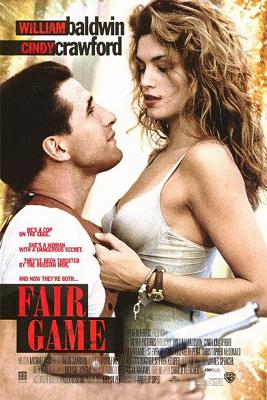
On Tuesday night, if you were suffering from insomnia at midnight, you could have turned over to HBO Signature (commonly listed as HBOSIG) and watched Fair Game, a remarkably mindless action film from 1995.

Originally, my plan was to start this review of Fair Game by telling you, in quite a bit of detail, just how sick I am of the Russian Mafia.  Seriously, Russian mobsters have become the default villain for lazy crime films everywhere.  And, quite frankly, I’m getting bored with them.  I’m bored with how the head Russian mobster is always described as being “former KGB” and is always found sitting in the back room of restaurant, wearing an overcoat and smoking filterless cigarettes.  I am bored with how his main henchman is always some big guy with a crew cut and that guy always has a thin sidekick who wears his hair in a pony tail and has a bad mustache.  I’m sick of the overexaggerated accents of American and British accents trying to sound Russian and the way they’re always listening to EDM while driving.  It’s all so predictable and tedious.

But then I considered that Fair Game was made 20 years ago.  Even if the villains are Russian mobsters and even if they are some of the least interesting Russian mobsters in cinema history, it’s totally possible that, when Fair Game, was made, there was still some sort of novelty about the Russian Mafia.

However, even if we give Fair Game a pass on using the cliché of the Russian mob, the villains still weren’t particularly interesting.  Kazak (Steven Berkoff) is … well, the film isn’t really that clear on what Kazak’s big plan is but he has a lot of henchmen and they certainly do end up killing a lot of people.  Kazak runs his operations off of a yacht that belongs to a Cuban criminal named Emilio (Miguel Sandoval).  Emilio is in the process of getting divorced and attorney Kate McQuean (model Cindy Crawford, who made her film debut here and has never played a leading role since) is determined to repossess his boat.  So, Kazak decides that the perfect solution would be to murder Kate…

Which makes absolutely no sense.  Kazak doesn’t want anyone to discover his operation so he decides to blow up a good portion of Miami, all in pursuit of one person.  Wouldn’t it make more sense for Kazak to just blow up the boat and buy a new one?

Anyway, as the film opens, Kate is out jogging when suddenly someone driving by in a car opens fire on her.  She ends up getting grazed in the arm, not that it seems to bother her.  She wears a bandage for a few scenes but it soon vanishes.  Kate is all business so, even after getting shot, she still goes into the office and starts to make plans to repossess that yacht.  Personally, if anyone ever shot at me, I would probably be so freaked out that I would never leave the house again.

Now, you may be thinking that Kate was shot because of Kazak but actually, it turns out that the shooting was just a random thing that happened.  Apparently, the shooter was trying to shoot someone else and Kate just happened to be in the wrong place at the wrong time.  So, we never find out who actually shot Kate and that really bothered me, as that seems to be kind of a huge plot point to bring up and then refuse to resolve.

Anyway, Kate meets a detective named Max Kirkpatrick (William Baldwin) and, soon, they’re on the run from Kazak’s assassins.  The majority of the film is made up of Max and Kate running from one location to another.  One thing that really bothered me was that literally everyone that Max and Kate talked to ended up getting killed just a few minutes later.  At one point, Kate flirts with a computer service expert to get him to help them out.  The scene is played for laughs but then, five minutes later, that same innocent technician guy is being brutally tortured by a bunch of Russians and, though we don’t see it happen, it’s safe to assume that he was eventually murdered by them.  And no point do Max or Kate appear to feel any guilt or concern about the number of innocent people who are killed just for associating with them.

Anyway, Fair Game is a completely mindless film that has a rather nasty streak of sadism to it.  (I imagine, when this film was released, it probably set a record for close-ups of people getting shot and stabbed in the crotch.)  William Baldwin and Cindy Crawford both have perfect bodies and give totally wooden performances, which leads to them having a dimly-lit sex scene that is both physically hot and emotionally cold at the same time.

(I have no idea what entropy at absolute zero means but it sounds like a pretty good description of the chemistry between Cindy Crawford and William Baldwin in Fair Game.)

One good note: Salma Hayek has a small role as Max’s ex-girlfriend.  Whenever she shows up in the movie, she starts screaming at everyone.  I don’t blame her.

Fair Game

Previous Insomnia Files:

  1. Story of Mankind
  2. Stag
  3. Love Is A Gun
  4. Nina Takes A Lover
  5. Black Ice
  6. Frogs For Snakes


44 Days of Paranoia #13: Quiz Show (dir by Robert Redford)


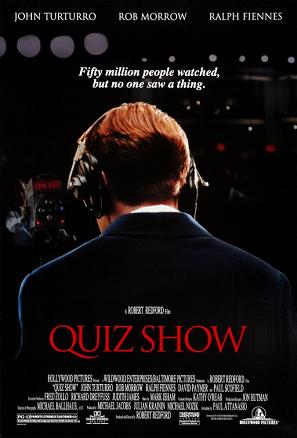
For today’s entry in the 44 Days of Paranoia, I want to take a look at a film that I recently caught on cable — 1994’s Quiz Show.

Directed by Robert Redford and based on a true story, Quiz Show was nominated for the Academy Award for best picture but lost to Forrest Gump.  Among those of us who obsess over Oscar history, Quiz Show is often overshadowed by not only Forrest Gump but two of the other nominees as well, Pulp Fiction and The Shawshank Redemption.  When compared to Pulp Fiction, Quiz Show certainly feels old-fashioned.  At the same time, it’s not quite as much of a sentimental crowd-pleaser as Gump or Shawshank.  Perhaps for those reasons, Quiz Show never gets quite as much attention as some other films that have been nominated for best picture.  However, taking all of that into consideration, Quiz Show is still one of the best films of the 90s.

Quiz Show takes us back to the 1950s.  The most popular show on television is 21, a game show in which two contestants answer questions, win money, and try to be the first to score 21 points.  The American public believes that all of the questions asked on 21 are locked away in a bank vault until it’s time for the show.  What they don’t know is that the show’s producers have instead been rigging the show, giving the answers to contestants who they feel will be good for ratings.

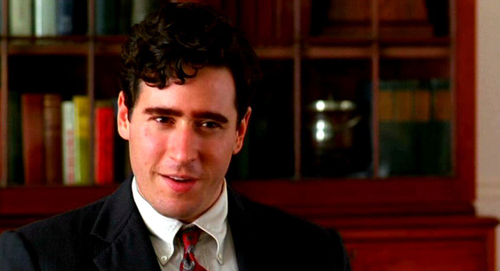
When Quiz Show begins, nerdy Herbie Stempel (John Turturro) has been the champion for several weeks.  However, both the show’s producers and sponsors feel that the untelegenic Herbie has peaked.  Hence, the handsome and charismatic Charles Van Doren (Ralph Fiennes) is brought on the show and Herbie is ordered to lose to him.  Reluctantly, Herbie does so.

john_turturro_quiz_show

Charles is initially reluctant to cheat but, as he continues to win, he finds himself becoming addicted to the fame.  Charles is the son of the prominent academic Mark Van Doren (Paul Scofield) and his success on television finally gives him a chance to escape from his father’s shadow.  Indeed, the film’s subtle and nuanced portrait of Charles and Mark’s loving but competetive relationship is one of the film’s greatest strengths.

ralph_fiennes_quiz_show

Herbie, however, is bitter over having to lose and has subsequently gambled away all of his winnings.  When 21′s producer (David Paymer) refuses to help Herbie get on another TV show, Herbie reacts by going to the New York County district attorney and publicly charging 21 as being fixed.  Though the grand jury dismisses Herbie as being obviously mentally unbalanced, his charges come to the attention of a congressional investigator, Richard Goodwin (Rob Morrow).

rob_morrow_quiz_show1

Goodwin launches his own investigation into 21 and discovers that the show is fixed.  (As the ambitious Goodwin puts it, he wants to “put television on trial.”)  Along the way, he also meets and befriends Charles Van Doren and finds himself torn between his desire to expose the show and to protect Charles from the bad publicity.  Again, the film is to be applauded for the subtle way that it uses Goodwin’s investigation of both Charles and Herbie as a way to explore issues of both class resentment and class envy.  Goodwin may have come from the same ethnic background of Herbie but it quickly becomes obvious that Goodwin has more sympathy for the genteel (and very WASPy) world that produced Charles Van Doren.  When Goodwin tries to justify protecting Charles, his wife (played by Mira Sorvino) responds by calling him “the Uncle Tom of the Jews” and it’s hard not to feel that she has a point.

1quiz3

While I greatly enjoyed Quiz Show, I do have to say that, on one major point, the film fails.  Try as he might, director Redford never convinces us that a rigged game show is really as big of a crime as he seems to be believe it to be.  Perhaps in the 1950s, people were still innocent enough to be shocked at the idea of television reality being fake but for cynical contemporary viewers, it’s hard not to feel that the “scandal” was more about Richard Goodwin’s ambition and less about any sort of ethical or legal issue.  Towards the end of the film, one character suggests that television will never be truly honest unless the government steps in to regulate it.  “What?” I yelled back at the TV.

Seriously, it seemed like a bit of an overreaction.

As I watched Quiz Show, I found it hard not to think about the reality shows that I love.  For instance, I know that The Bachelor and The Bachelorette are largely staged.  I know that the previous season of Big Brother was largely set up so that Amanda could win.  (And, believe me, if Amanda hadn’t sabotaged her chances by turning out to be a mentally unstable racist bully, she would have won and she would probably would have been invited back for the next all-stars season.)  I know that shows like Storage Wars and Dance Moms are “unscripted” in name only.  I know that reality shows aren’t real but my attitude can basically be summed up in two words: “who cares?”  Perhaps I would be more outraged if I lived in the 50s which, to judge from both Quiz Show and a host of other movies, was apparently a much more innocent time.

quiz-show-morrow-scorsese

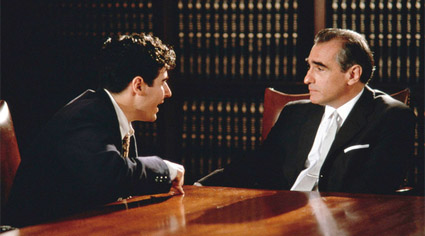
That said, I really enjoyed Quiz Show.  A lot of that is because I’m a history nerd and, therefore, I have a weakness for obsessively detailed period pieces.  But even beyond that, Quiz Show is a well-made, entertaining film that features three excellent lead performances and several strong supporting turns.  If you love to watch great actors playing great roles then Quiz Show is the film for you.  Rob Morrow lays his Boston accent on a bit thick but otherwise, he does a good job of suggesting both Goodwin’s ambition and the insecurities that lead him to desire Charles’s friendship even as he tries to expose him as a fraud.  John Turturro brings an odd — if manic — dignity to Herbie Stempel while Johann Carlo is well-cast as his wife.  Best of all, Ralph Fiennes makes Charles Van Doren into a sad, frustrating, and ultimately sympathetic character while Paul Scofield is the epitome of both paternal disappointment and love as his father.  The film is full of great supporting turns as well, with David Paymer and Hank Azaria perfectly cast as the show’s producers and Christopher McDonald playing the show’s host with the same smarmy charm that he brought to a similar role in the far different Requiem For A Dream.  Perhaps best of all, Martin Scorsese shows up as the owner of Geritol and gets to bark, “Queens is not New York!”

Even if Robert Redford doesn’t quite convince us that the quiz show scandal was as big a deal as he obviously believes it to be, Quiz Show is still an uncommonly intelligent film and one that deserves to rediscovered.

QuizShowPoster

Other entries in the 44 Days Of Paranoia:

  1. Clonus
  2. Executive Action
  3. Winter Kills
  4. Interview With The Assassin
  5. The Trial of Lee Harvey Oswald
  6. JFK
  7. Beyond The Doors
  8. Three Days of the Condor
  9. They Saved Hitler’s Brain
  10. The Intruder
  11. Police, Adjective
  12. Burn After Reading