The TSL Grindhouse: The Wild Angels (dir by Roger Corman)


“What is it exactly that you want?” a preacher (Frank Maxwell) asks a congregation of leather-clad bikers.

“We want to get loaded!” Heavenly Blues (Peter Fonda) replies, “And we want to have a good time!”

And have a good time, they proceed to have.  Of course, it’s a good time for them.  Everyone else who meets the bikers at the center of 1966’s The Wild Angels are horrified by this collection of rebellious and violent outsiders.  Sure, Heavenly Blues might actually be a soulful guy who mistakenly believes that he can control the gang’s more excessive tendencies.  His girlfriend, Mike (Nancy Sinatra), actually seems rather reserved and conservative when compared to the rest of the gang.  But make no mistake about it, the majority of the members of the gang are into violence for its own sake.  They are bullies who couldn’t make the football team so, instead, they hopped on a motorcycle and formed their own society.  They’re self-styled rebels  but what are they rebelling against?  What have you got?

I know, I know.  That famous line comes from Marlon Brando and it was uttered in The Wild One.  Peter Fonda, to put it lightly, was no Marlon Brando and, as directed by Roger Corman, The Wild Angels doesn’t have the societal concerns that lay at the hear of The Wild One.  As Corman was often the first to admit, his main concern when it came to making movies was to make money.  Corman wasn’t necessarily against message films.  He often stated that, as a director, 1962’s The Intruder was the film in which he took the most pride.  The Intruder took a firm stand against racism and it let everyone know where Corman stood on when it came to the Civil Rights Movement.  It was also one of his few films to lose money.  The Wild Angels celebrates rebellion but one gets the feeling that celebration is motivated by the fact that younger filmgoers would be happy to pay to see a movie about a bunch of “youngish” people telling the old folks to shut up and get out of the way.  The Wild Angels themselves don’t seem to be motivated by any sort of grand ideology.  Heavenly Blues preaches about getting loaded and having a good time and celebrating freedom but he also allows the members of the gang to drape a Nazi flag over a casket.  What does Heavenly Blues actually believe in?

Heavenly Blues believes in loyalty to his friends.  For all the fights and the orgies and the scenes of motorcycles roaring down country roads, this is ultimately just a film about a guy who wants to give his best friend a decent burial.  The Loser (Bruce Dern) dies about halfway through the film and one gets the feeling that he probably would have lived if the gang hadn’t kidnapped him from the hospital.  Heavenly Blues wants to give The Loser the type of wild funeral that Blues thinks he would have wanted though I think The Loser probably would have been happier not have been killed by the actions of his idiot friends.  Diane Ladd, who was married to Bruce Dern at the time and who has said Laura Dern was conceived during the filming of The Wild Angels, is heart-breaking as The Loser’s girlfriend, Gaysh.  Gaysh wants to mourn her boyfriend while the rest of the gang is more concerned with figuring out who her next boyfriend is going to be.

Does Heavenly Blues ever realize that he’s traveling with a bunch of animals?  He does but one gets the feeling that he’s accepted his fate.  There’s no going back.  The past can’t change and the future cannot be controlled so Heavenly Blues is content to live in the present.  All he can do is try to give his friend a decent burial while the sirens of cops shriek in the distance.

The Wild Angels was a controversial film when it was first released.  It also made a lot of money and led to a whole cycle of outlaw biker films, culminating with Easy Rider.  Seen today, it’s a portrait of a society coming apart, with the establishment and the bikers not even willing to stop fighting long enough to allow for a simple burial.  It’s definitely a time capsule film, one of those productions that epitomizes an era.  There’s not much going on underneath the surface and most of the film’s bikers really are awful people but there is something touching about Blues giving it all up just to try to give his friend a decent burial.

30 Days of Noir #22: Woman On The Run (dir by Norman Foster)


Like many film noirs, this 1950 film opens with a murder.

On a dark night in San Francisco, a man attempts to blackmail an unseen person called “Danny Boy” and gets shot for his trouble.  The gunshot is heard by a frustrated painter, named Frank Johnson (Ross Elliott), who is out walking his dog.  Frank sees the dead body being pushed out of a car and then catches a shadowy glimpse of the killer.  When the killer open fires on him, Frank runs for it.

Like a good citizen, Frank goes to the police but, when he learns that the victim was due to testify against a local gangster, Frank panics and vanishes.  When Inspector Ferris (Robert Keith) goes to see Frank’s wife, Eleanor (Ann Sheridan), he’s shocked to discover that Eleanor isn’t shocked by Frank’s disappearance and that she doesn’t seem to care one way or the other.  As Eleanor explains it, Frank is a notorious coward and, years ago, their once strong marriage became a loveless charade.  Frank’s vanished and Eleanor doesn’t care.

Or does she?

While it quickly becomes obvious that Eleanor is telling the truth about not knowing where Frank is, she’s not being totally honest about no longer caring about him.  For instance, when she learns that Frank has been hiding a heart condition from her, Eleanor goes to the doctor to pick up his medicine, just in case he should happen to come by the house.  Of course, it’s not always easy to get out of the house, especially now that the police are watching Eleanor.

Eleanor wants to track down Frank without involving the police and it seems like there’s only one person who is interested in helping he do that..  Played by Dennis O’Keefe, this person is a tough reporter and he says that he wants to do an exclusive story on Frank.  He offers to help Eleanor track him down and he even says that he’ll pay $1,000 for the chance to interview Frank.  The reporter and Eleanor are soon searching San Francisco, retracing Frank’s day-to-day life and discovering that Frank loved Eleanor more than she ever realized….

What’s that?  Oh, did I forget to mention the reporter’s name?

His name is Danny.

That’s right.  Eleanor is trying to find Frank so that she can save his life and working with her is the one man who wants to kill him!

Needless to say, this leads to a great deal of suspense.  On the one hand, you’re happy that Eleanor is rediscovering how much she loves Frank.  On the other hand, you spend almost the entire movie worried that Eleanor is going to lead Danny right to him.  Shot on location in San Francisco and featuring all of the dark shadows and tough dialogue that one could possibly hope to get in a film noir, Woman On The Run is an underrated suspense gem.  Full of atmosphere and steadily building suspense, Woman on the Run features a great and acerbic performance from Ann Sheridan and a genuinely exciting climax that’s set at a local amusement park.  Seriously, roller coasters are super scary!

Woman on the Run was directed by Norman Foster.  If you’ve recently watched The Other Side of the Wind on Netflix, you might recognize the name.  A longtime friend of Orson Welles, Foster played the role of Billy Boyle in Welles’s final film.

Halloween Havoc!: HOUSE OF HORRORS (Universal 1946)


gary loggins's avatarcracked rear viewer


Rondo Hatton (1894-1946) was dubbed by “The Ugliest Man in Hollywood” by Universal for his repulsive visage. Originally a Tampa-based sportswriter, Hatton began developing the disease acromegaly as a young adult, a form of gigantism which distorts the facial features and bone structure (wrestler Andre the Giant suffered from this). Rondo moved to Hollywood and got work as a film extra and some bit parts (he can be spotted in SAFE IN HELL , IN OLD CHICAGO, THE HUNCHBACK OF NOTRE DAME (’39 version), and THE OX BOW INCIDENT, among others).

1944’s “The Pearl of Death”

Hatton played “The Hoxton Creeper” in the 1944 Sherlock Holmes entry THE PEARL OF DEATH (with Universal Scream Queen Evelyn Ankers as a villainess, for a change), then proceeded to scare the daylights out of audiences in JUNGLE CAPTIVE and THE SPIDER WOMAN STRIKES BACK. While not a trained actor, his unique looks made…

View original post 409 more words

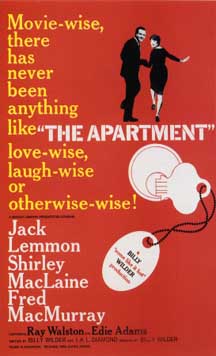
Lisa Watches The Oscar Winners: The Apartment (dir by Billy Wilder)


Apartment_60

After the Nun’s StoryI continued to experience TCM’s 31 Days of Oscar by watching the 1960 best picture winner, The Apartment.  The Apartment is unique among Oscar winners in that it’s one of the few comedies to win best picture.  (Though, in all honesty, it would probably be more appropriate to call The Apartment a dramedy.)  It was also, until the victory of The Artist, the last completely black-and-white film to win best picture.

(And, as long as we’re sharing trivia, it was also the first best picture winner to feature a character watching a previous best picture winner.  At the start of the film, Jack Lemmon deals with insomnia by watching Grand Hotel.)

The Apartment tells the story of C.C. “Bud” Baxter (Jack Lemmon), an anonymous officer worker who is determined to climb the corporate ladder despite not being very good at his job.  However, Baxter does have one advantage over his co-workers.  He’s single and therefore, his apartment has become the place to go for corporate executives who need a place where they can safely cheat on their wives.  Bud spends his day trying to coordinate who is going to be in his apartment and when.  Meanwhile, he spends his nights exiled from his own home and wandering around New York.  In fact, the only beneficial thing about this arrangement is that all of Bud’s supervisors have been giving him good evaluations in return for using his apartment.  (Well, that and Bud’s neighbor, played by Jack Kruschen, is convinced, based on the thinness of the apartment walls, that Bud must be a great lover.)

When Bud finally does get his promotion, it’s only because the personnel director, Jeff D. Sheldrake (an amazingly sleazy Fred MacMurray), wants to use Bud’s apartment.  Bud celebrates his promotion by finally working up the courage to ask out Fran (Shirley MacClaine), an elevator operator who works in the office.  What Bud doesn’t realize is that Fran is also the woman who Sheldrake wants to bring to the apartment….

Fran is convinced that Sheldrake is going to leave his wife for her.  What she doesn’t realize — and what Fred MacMurray’s performance makes disturbingly clear — is that Jeff Sheldrake is basically just a guy having a midlife crisis.  He’s the type of middle-aged guy that every woman has had to deal with at some point, the guy who pulls up next to you in a red convertible and stares at you from behind his sunglasses, attempting his best to entice you into helping him relive the youth that he never had.  When Fran eventually learns the truth about Sheldrake, it leads both to near tragedy and to Bud having to decide whether he wants to be a decent human being or if he wants to keep climbing the corporate ladder.

When one looks over a chronological list of all of the best picture winners, it’s a bit strange to see The Apartment listed in between Ben-Hur and West Side Story.  As opposed to those two grandly produced and vibrantly colorful films, The Apartment is a rather low-key film, one that devotes far more time to characterization than to spectacle.  And while both Ben-Hur and West Side Story are ultimately very idealistic films, The Apartment is about as cynical as a film can get.  The Apartment may be a comedy but the laughs come from a place of profound sadness.

Because it’s more interested in people than in spectacle, The Apartment holds up better than many past best picture winners.  We’ve all known someone like Bud.  We’ve all had to deal with men like Sheldrake.  And, in one way or another, we all know what it’s like to be someone like Fran.  The Apartment remains a truly poignant and relevant film.

http://www.youtube.com/watch?v=B4OXm9-E8OQ