Horror On TV: Dead of Night (dir by Dan Curtis)


For today’s horror on television, we’re very happy to present to you, Dead of Night!

From 1977, this television film is a horror anthology, made up of three stories directed by Dan Curtis and written by Richard Matheson.  In the first story, a youngish Ed Begley, Jr. travels through time.  In the 2nd story, Patrick Macnee plays a man whose wife is apparently being menaced by a vampire.  And in the third story, Joan Hackett plays a mother who brings her dead son back to life, just to discover that sometimes it’s best to just let sleeping corpses lies.

The entire anthology is good, though the third story is clearly the best and the most frightening.  Not only is it scary but it’s got a great twist ending.

Enjoy!

Retro Television Reviews: Five Desperate Women (dir by Ted Post)


Welcome to Retro Television Reviews, a feature where we review some of our favorite and least favorite shows of the past!  On Sundays, I will be reviewing the made-for-television movies that used to be a primetime mainstay.  Today’s film is 1971’s Five Desperate Women!  It  can be viewed on YouTube!

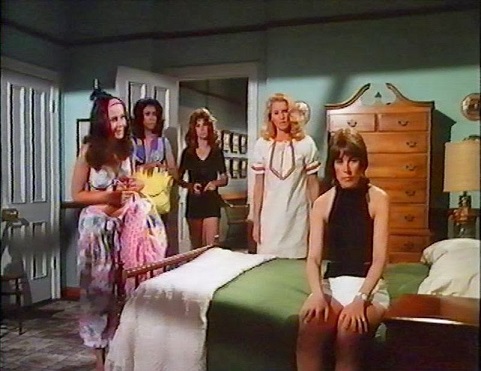
Five women, who all went to college together, reunite for the first time in five years.  They’re planning on spending a weekend at a cabin on a private island.  Lucy (Anjanette Comer) is the alcoholic who talks too much.  Dorian (Joan Hackett) is the pill popper who lies about having a handsome husband and two beautiful children.  Joy (Denise Nicholas) is the former activist turned trashy model.  Gloria (Stefanie Powers) is bitchy and self-centered.  And Mary Grace (Julie Sommars) is the one with the mentally ill mother who refuses to speak to her.  Upon reuniting on the dock, the five women all immediately gather in a circle sing an old sorority song.  It’s going to be one of those weekends!

The private island is lovely and the women believe that they have it to themselves, with the exception of the two men who are also on the island.  Wylie (Robert Conrad) is the caretaker and he seems to be a trustworthy gentleman and exactly the type of guy who you would want to be stranded on an island with.  And then there’s Meeker (Bradford Dillman), who drove the boat to the island and who is the type of overbearing jerk who has to be specifically told not to bother the women.  While the women stay in the main house, the men stay in the nearby caretaker’s cottage.

From the start, it proves to be a stressful weekend.  All of the women have secrets and long-buried resentments that come out at the slightest provocation.  Not helping the fact is that there’s a murderer on the island, one that goes from killing a dog to strangling Dorian while the rest of the women are at the beach.  The woman, figuring that the murderer has to be either Meeker or Wylie, lock themselves into their house for the night but it turns out that it’s going to take more than a locked door to defeat a killer.

Five Desperate Women has an intriguing premise but it also has an extremely short running time.  With only 70 minutes to tell its story and 7 major characters to deal with, the film doesn’t leave much room for character development and, as a result, each woman is only given one personality trait and each actress ends up portraying that trait as broadly as possible.  As a result, it doesn’t take long for the movie to go from being Five Desperate Women to Five Annoying Women.  As for Robert Conrad and Bradford Dillman, the two of them give effective performances but anyone with a hint of genre savvy will be able to guess who the killer is going to turn out to be.  There is one unintentionally funny moment where the desperate women attempt to fight off the killer by throwing rocks at him and none of the rocks come close to reaching their target but otherwise, Five Desperate Women is not particularly memorable.

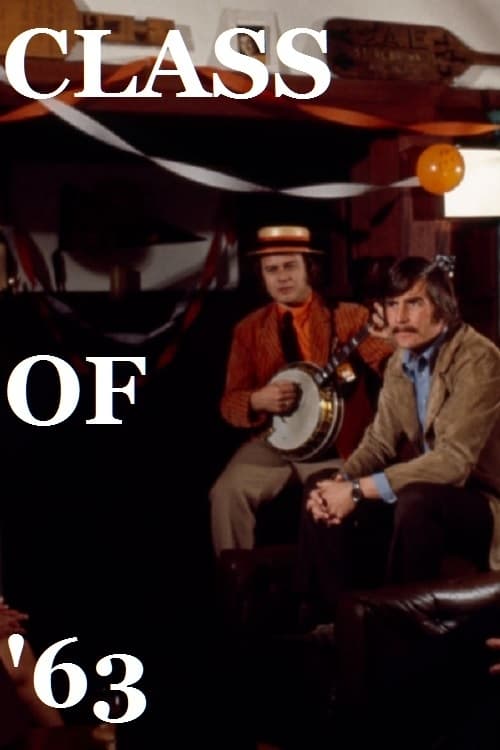
Retro Television Reviews: Class of ’63 (dir by John Korty)


Welcome to Retro Television Reviews, a feature where we review some of our favorite and least favorite shows of the past!  On Sundays, I will be reviewing the made-for-television movies that used to be a primetime mainstay.  Today’s film is 1973’s Class of ’63!  It  can be viewed on YouTube!

It’s college reunion time!  Alumni of all ages and from all over the country are returning to the place where they became adults and spent the best years of their lives.

Joe Hart (James Brolin), of the Class of ’63, returns to the campus but he immediately feels like a bit like an outsider.  As opposed to his former classmates, many of whom are desperately trying to recapture their fading youth, Joe is quiet and sensitive and he’s aware of the passage of time.  He hasn’t come back to college so that he can relive his carefree fraternity days.  Instead, his main interest is whether or not his former fiancée will be there.

And it turns out that Louise Swerner (Joan Hackett) is there!  She’s accompanied by her husband and fellow member of the Class 0f 63, Mickey Swerner (Cliff Gorman).  From the minute that Mickey appears, it’s obvious that he has both a chip on his shoulder and a lot of insecurity.  He is visibly annoyed when people fail to immediately recognize him.  He and Louise have a strained marriage and he’s not particularly happy with how excited she is to see Joe again.  While Mickey tries to convince everyone that he’s grown up to be a winner, Louise and Joe get reacquainted and it becomes obvious that they still love each other.  Will Louise and Joe leave the reunion together and should they be more concerned with the fact that Mickey just happens to have a sniper rifle in his luggage?  And what to make of Dave McKay (Ed Lauter), the former classmate who seems to be just a little bit too excited to see everyone?

It’s an interesting film and I have to say that it didn’t quite go the direction that I was expecting it to.  Despite the presence of the rifle and Mickey’s obvious instability, the film is less a thriller and more a look at what it means to grow up and the difficulty of letting go of the past.  None of the characters are caricatures.  Joe and Louise may seem perfect together but the film makes clear that they’re also idealizing their time together.  With neither one of them really happy with their current life, they’ve both fallen into the trap of wondering, “What if?”  Meanwhile, Mickey may be flawed but it’s impossible not to have some sympathy for him.  As hostile as Cliff can be, it’s obvious that the person that he hates the most is himself and Cliff Gorman does a good job of capturing Mickey’s raging insecurity.  Gorman’s intensity provides a good balance to Brolin’s more laid back performance and, by the end of the film, one can understand why and how Louise was able to fall in love with two men who superficially seem to be so different.

Class of ’63 is a good drama, one that requires a little patience but which ultimately rewards the audience for sticking with it.

Retro Television Reviews: The Love Boat 3.3 “The Grass Is Greener/Three Stages of Love/Oldies But Goodies”


Welcome to Retro Television Reviews, a feature where we review some of our favorite and least favorite shows of the past!  On Wednesdays, I will be reviewing the original Love Boat, which aired on ABC from 1977 to 1986!  The series can be streamed on Paramount Plus!
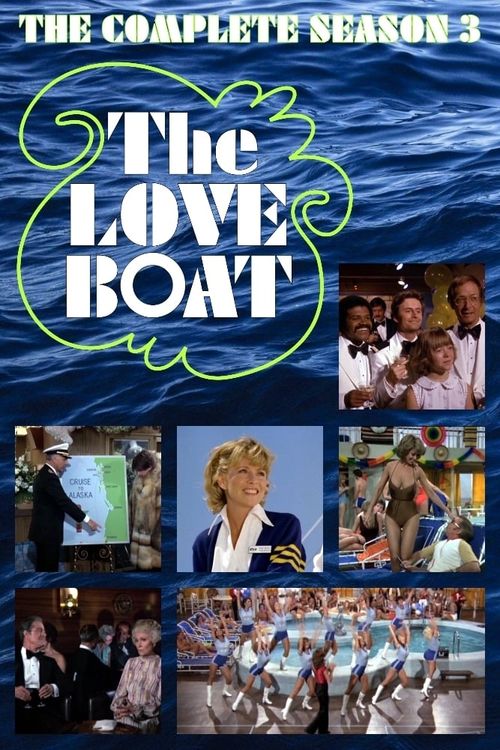
For this week’s cruise, Julie learns that she’s not the only person who can do her job!

Episode 3.3 “The Grass is Greener/Three Stages of Love/Oldies But Goodies”

(Dir by Alan Rafkin, originally aired on September 22nd, 1979)

This week, Julie is super excited when her friend, Tina Philips (Joan Hackett), boards the cruise with her young son, Brian (Adam Rich).  Tina and Julie went to cruise director school together, where they were both taught by none other than Captain Stubing.

(As I’ve mentioned before, there have been a lot of weird continuity issues with establishing just how long anyone had actually known Captain Stubing.  During the first season, everyone was unsure of what to make of Captain Stubing and none of them had any experience sailing with him.  But, in the second season, Stubing was suddenly celebrating his five year anniversary as the ship’s captain.  And, in this episode, Stubing is established as being Julie’s mentor.)

Tina had a crush on Stubing while she was a student and Stubing had a bit of a crush on her as well.  Though Tina could have had a great career as a cruise director, she decided to get married and settle down instead.  Now, with her marriage falling apart, Tina boards the boat and immediately starts giving Stubing and Julie advice.  Julie, meanwhile, takes care of Brian while Tina dances with the captain.  Tina lives Julie’s life and Julie lives the life she could have had if she had stayed in Alaska and gotten married.  It turns out that Julie’s a great substitute mom but Tina is a terrible substitute cruise director.  Her idea of throwing a sock hop is a huge bust and, to be honest, it does seem a bit childish for a luxury cruise.  In the end, Tina returns to being a single mom and Julie returns to being childless and career-driven.  Yay, I guess.

Meanwhile, Nora (Amanda Blake) boards the ship with her daughter, Daphne (Karen Morrow).  Daphne is determined to marry a millionaire but Nora is the one who finds love when she meets the wheelchair-bound Phillip (Barry Sullivan).  Unfortunately, Phillip’s stuffy valet, Perkins (Werner Klemperer), insists that Philip needs to stay in his cabin and watch his blood pressure.  Fear not, though.  Daphne finds a millionaire and the millionaire hires away Perkins so now Phillip and Nora are free to have fun.  Yay!

(Though, really, Phillip should keep an eye on his blood pressure….)

Finally, Mike (Eddie Mekka) and Robin (Lani O’Grady) seems like a perfect couple, except for the fact that Mike is convinced that all relationships go through three stages before ending and he has an annoying habit of saying stuff like, “We’ve just entered stage two!”  Robin gets tired of Mike and his cynicism and eventually, Mike decides to give love a try because …. well, I’m not sure why.  I think it was because the episode was nearly over.

This episode was pleasant but, ultimately, rather forgettable.  Nora and Phillip were a nice couple but Perkins was portrayed in an over-the=top villainous light, especially when one considers that he was just doing the job he was hired to do.  Mike and Robin seemed like they were still destined to break up, even as they left the ship in love.  I did enjoy the scenes in which Tina’s sock hop party turned out to be a bust, just because it seemed like a dumb idea from the minute she mentioned it.  That said, the main message of this episode seemed to be that having a family and career were two mutually exclusive things, which I certainly did not agree with.

Again, this was not necessarily a bad episode.  It was just kind of a bland one.

Horror On The Lens: Dead of Night (dir by Dan Curtis)


For today’s horror on the lens, we’re very happy to present to you, Dead of Night!
From 1977, this television film is a horror anthology, made up of three stories directed by Dan Curtis and written by Richard Matheson.  In the first story, a youngish Ed Begley, Jr. travels through time.  In the 2nd story, Patrick Macnee plays a man whose wife is apparently being menaced by a vampire.  And in the third story, Joan Hackett plays a mother who brings her dead son back to life, just to discover that sometimes it’s best to just let sleeping corpses lies.

The entire anthology is good, though the third story is clearly the best and the most frightening.  Not only is it scary but it’s got a great twist ending.

Enjoy!

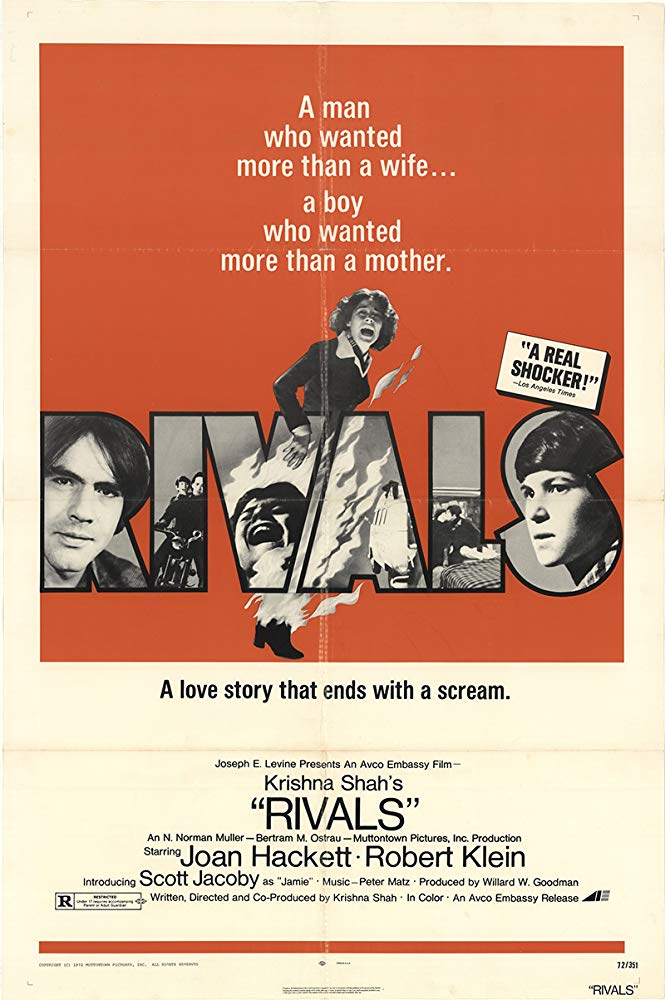
Oedipus Mess: Rivals (1972, directed by Krishna Shah)


Christine (Joan Hackett) is a young single mother and widow who lives in New York City.  She has a son, Jamie (Scott Colomby, playing a ten year-old even though he’s obviously a teenager).  Jamie is an aspiring director who make a film of his classmates running around the playground while wearing Richard Nixon masks.  Jamie, who is described as having a genius IQ, is also unhealthily obsessed with his mother, which the film, via flashback, links to her taking a shower in front of him while he was still potty training.

Jamie is not happy when Christine meets Peter (Robert Klein), a loudmouth who gives tours of the city to New York residents only.  If you’re from out-of-town, don’t even try to get in Peter’s microbus.  Peter and Christine start to date and then, eventually, they get married.  Despite the fact that his older babysitter wants to have an affair with him, Jamie remains obsessed with his mother and refuses to accept Peter as his stepfather.  Peter knows that Jamie doesn’t like him and eventually gives up on trying to win him over.  What Peter doesn’t know is that Jamie has come up with an elaborate scheme to murder him.

Rivals is the type of strange and messy film that could only have been made in 1972.  I guess it would be considered to be a mix of a horror movie and a psychological thriller but the tone of Rivals is all over the place so it’s hard to know what the film is trying to say about Jamie or his mother.  Throughout the film, there are sudden montages that seem to have little to do with the plot.  For instance, the film comes to a halt so we can spend several minutes watching as Peter attempts to harangue people into getting in his bus.  Peter is supposed to be likable but he comes across as being so obnoxious that it is easy to see why Jamie would not want him for a stepfather.  As for Jamie, he’s supposed to be ten but looks like he should be starting middle school so his obsession with sex is never as shocking as it should be.  The ludicrous subplot about his babysitter goes nowhere and just seems to disappear.  The one bright spot in the film is Joan Hackett as Christine.  Hackett does the best she can with her inconsistent role and she’s the one person in Rivals who you will actually care about.

Rivals is a mess, perhaps worth seeing only for the location footage of New York in the early 70s.  Otherwise, this is a forgotten film that does not need to be remembered.

The TSL’s Horror Grindhouse: The Terminal Man (dir by Mike Hodges)


Check out the poster for 1974’s The Terminal Man.

Look at it carefully.  Examine it.  Try to ignore the fact that it’s weird that George Segal was once a film star.  Yes, on the poster, Segal has been drawn to have a somewhat strange look on his face.  Ignore that.  Instead, concentrate on the words in the top left corner of the poster.

“ADULT ENTERTAINMENT!” it reads.

That’s actually quite an accurate description.  The Terminal Man is definitely a film for adults.  No, it’s not pornographic or anything like that.  Instead, it’s a movie about “grown up” concerns.  It’s a mature film.  In some ways, that’s a good thing.  In some ways, that’s a bad thing.

Taking place in the near future (and based on a novel by Michael Crichton), The Terminal Man tells the story of Harry Benson (played, of course, by George Segal).  Harry is an extremely intelligent computer programmer and he’s losing his mind.  It might be because he was in a serious car accident.  It may have even started before that.  Harry has black outs and when he wakes up, he discovers that he’s done violent things.  Even when he’s not blacked out, Harry worries that computers are going to rise up against humans and take over the world.

However, a group of scientists think that they have a way to “fix” Harry.  It’ll require a lot of brain surgery, of course.  (And, this being a film from 1973, the film goes into excruciating details as it explains what’s going to be done to Harry.)  The plan is to implant an electrode in Harry’s brain.  Whenever Harry starts to have a seizure, the electrode will shock him out of it.  The theory is that, much like Alex in A Clockwork Orange 0r Gerard Malanga in Vinyl, Harry will be rendered incapable of violence.

Of course, some people are more enthusiastic about this plan than others.  Harry’s psychiatrist (Joan Hackett) fears that implanting an electrode in Harry’s brain will just make him even more paranoid about the rise of the computers.  Other scientists worry about the ethics of using technology to modify someone’s behavior.  Whatever happens, will it be worth the price of Harry’s free will?

But, regardless of the risks, Harry goes through with the operation.

Does it work?  Well, if it worked, it would be a pretty boring movie so, of course, it doesn’t work.  (Allowing Harry’s operation to work would have been like allowing King Kong to enjoy his trip to New York.)  Harry’s brain becomes addicted to the electrical shocks and, as he starts to have more and more seizures, Harry becomes even more dangerous than he was before…

The Terminal Man is a thought-provoking but rather somber film.  On the one hand, it’s a rather slow movie.  The movie does eventually get exciting after Harry comes out of surgery but it literally takes forever to get there.  The movie seems to be really determined to convince the audience that the story it’s telling is scientifically plausible.  On the other hand, The Terminal Man does deal with very real and very important issues.  Considering how threatened society is by people who cannot be controlled, issues of behavior modification and free thought will always be relevant.

Though the film may be slow, I actually really liked The Terminal Man.  Judging from some of the other reviews that I’ve read, I may be alone in that.  It appears to be a seriously underrated film.  As directed by Mike Hodges, the film is visually stunning, emphasizing the sterility of the white-walled hospital, the gray blandness of the doctors, and the colorful vibrancy of life outside of science.  Though he initially seems miscast, George Segal gives a good and menacing performance as Harry.

The Terminal Man requires some patience but it’s worth it.

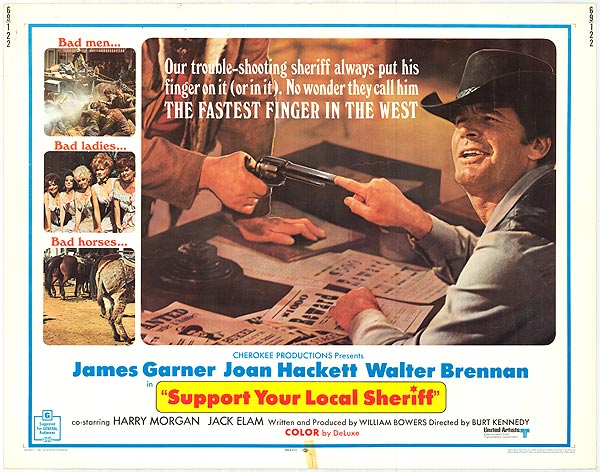
How The West Was Fun: SUPPORT YOUR LOCAL SHERIFF! (United Artists 1969)


gary loggins's avatarcracked rear viewer

sup1

SUPPORT YOUR LOCAL SHERIFF! is played strictly for laughs. It’s broad performances and slapstick situations won’t strain your brain, but will give you an hour and a half’s worth of escapist fun. Easy going James Garner has the lead, with solid comic support from Joan Hackett, Walter Brennan, Harry Morgan, and Jack Elam. Director Burt Kennedy made quite a few of these, and this is probably the best of the bunch.

sup2

While burying an itinerant drifter, the townsfolk of Calendar, Colorado discover a mother lode of gold. The subsequent boom turns Calendar into a lawless, rowdy town that can’t keep a sheriff alive long enough to tame it. The town elders also can’t get their gold through without paying a 20% tribute to the mean Danby clan. Enter our hero Jason McCullough (Garner), who applies for the sheriff’s position “on a temporary basis…I’m on my way to Australia”.  Jason is a crack shot and fast…

View original post 576 more words