Retro Television Review: Fantasy Island 5.17 “Funny Man/Tattoo, The Matchmaker”


Welcome to Retro Television Reviews, a feature where we review some of our favorite and least favorite shows of the past!  On Tuesdays, I will be reviewing the original Fantasy Island, which ran on ABC from 1977 to 1984.  Unfortunately, the show has been removed from most streaming sites.  Fortunately, I’ve got nearly every episode on my DVR.
Smiles, everyone!  Smiles!

Episode 5.17 “Funny Man/Tattoo, The Matchmaker”

(Dir by George W. Brooks, originally aired on February 20th, 1982)

For the second week in a row, Julie only appears in the stock footage at the start of the episode.  And again, for the second week in a row, no mention is made of her.  Mr. Roarke doesn’t say anything about why she’s not greeting the guests at the docks.  Tattoo doesn’t seem to care.

This is actually a big episode for Tattoo.  It turns out that Tattoo has a side hustle going.  He’s running a computer dating service!  (This isn’t surprising.  During the early seasons of the show, Tattoo always had some sort of extra money-making scheme going on.)  He’s invited both Harriet Wilson (Laurie Walters) and Claudette Mills (Misty Rowe) to the Island so that they can be set up with the perfect future husband.  Usually, Roarke isn’t happy when Tattoo invites people to the Island on his own but this time, he doesn’t seem to be too upset about it.  He tells Tattoo that the two women and their fantasies will be his responsibility.  At one point, Roarke even mentions that Tattoo is in charge of overseeing all of the weddings that occur on Fantasy Island.  Does that include Mr. Roarke’s wedding from a few seasons ago?

However, there’s a problem.  Tattoo’s big computer has decided that both Harriet and Claudette should marry Mr. Roarke.  Tattoo and his business partner, Ambrose Tuttle (Skip Stephenson), think that the computer must be malfunctioning but Tattoo did promise the women that he would set them up with the most charming man on the Island and what better description is there for Mr. Roarke?

Mr. Roarke is not particularly amused to discover that he is now expected to marry two women who he doesn’t even know.  Considering the tragic ending of Mr. Roarke’s previous marriage, this isn’t a huge shock.  Roarke tells Tattoo that he has to find other husbands for both Harriet and Claudia.  Fortunately, Amrbose Tuttle is single and a former football player (Russ Francis) has also come to the Island.  Can Tattoo pull it off and help all four of these people fall in love?  To quote Mr. Roarke, “Indeed, he can.”  This is Fantasy Island!

Along with learning about Tattoo’s computer dating operation, we also learn about Tattoo’s favorite comedian.  Beau Gillette (Jimmy Dean) has built a successful career telling jokes about his redneck family.  What he’s never told anyone, including his fiancée (Vicki Lawrence), is that his family is imaginary.  Beau grew up in an orphanage and created his family in his head so he wouldn’t be lonely.  Beau’s fantasy is for his family to exist, just so he can introduce them to his fiancée.  Mr. Roarke suggests that it might be a better idea for Beau to just tell the truth but Beau’s like, “Nah, let’s just bring imaginary people to life.”

While Beau’s performing his act, Uncle Jack (Morgan Woodward), grandma (Jeanette Nolan), and cousin Lindy (Linda Thompson Jenner) all come to life.  The only problem is that they all know that they’re really imaginary and they’re not happy that Beau’s been thinking less about them and more about his fiancée.  They decide that Lindy should break up Beau’s engagement by seducing him.  And if they doesn’t work, they can just kill Beau’s fiancée….

Wow, that got dark!

Actually, this isn’t a very dark fantasy at all.  Both fantasies are played largely for laughs.  Beau, realizing that his imaginary family has been a crutch that he’s been using for too long, confesses that they don’t really exist and, as a result, they all fade away.  Beau’s free to get married and I guess come up with new act.  Yay!

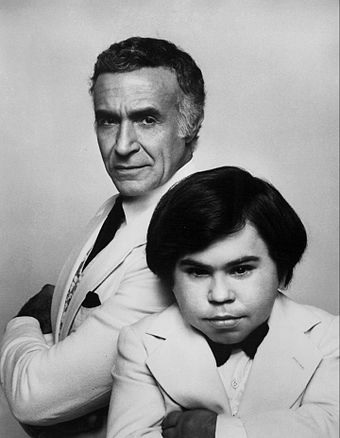
Much like last week, this episode felt like a throwback to the early seasons of Fantasy Island.  Tattoo got a storyline and Mr. Roarke was heavily involved in the fantasies, as opposed to just being a bystander.  Both Herve Villechaize and Ricardo Montalban appeared to be having fun in this episode and, as a result, it was fun to watch, even if it was hard to buy into the idea the Beau Gillette’s rather anodyne jokes about his redneck family would have made him into a star.  Largely due to Tattoo and his computer dating service, this was an enjoyable trip to the Island.
Retro Television Review: Fantasy Island 4.23 “Man-Beast/Ole Island Opry”


Welcome to Retro Television Reviews, a feature where we review some of our favorite and least favorite shows of the past!  On Tuesdays, I will be reviewing the original Fantasy Island, which ran on ABC from 1977 to 1984.  Almost the entire show is currently streaming on Daily Motion.

This week, we learn something new about the Island.

Episode 4.23 “Man-Beast/Ole Island Opry”

(Dir by George W. Brooks, originally aired on May 16th, 1981)

Did you know that Fantasy Island is home to a world-famous country music venue?

Yes, I’m talking about the Ole Island Opry!  Operated by Lottie McFadden (Anne Francis), the Ole Island Opry is a mainstay of the Island, even though it’s never been mentioned before.  Lottie says that everyone from Charley Pride to Hank Williams to Dolly Parton has played at the Ole Island Opry.

If you’re anything like me, you’re saying, “What the heck?”

I mean, seriously, why have we never heard of this place before?  How many country music fans live on the Island?  Why would established artists be so eager to play at a venue that’s sitting on an isolated island?  And how big is this Island anyway?  With the fishing village, the native villages, the downtown area that we see sometimes, the children’s side of the Island, the ancient castles, the isolated mansions, the Ole Island Opry, and all the magical portals, Fantasy Island has got to be at least the size of New Zealand.

These questions go unanswered, as usual.  Instead, the episode focuses on Charlie Rowlands (Jimmy Dean), who was an up-and-coming country music star until his wife died and he gave up stardom to raise his daughter, Jennie (Wendy Schaal).  Charlie is an old friend of Lottie’s and his fantasy is for Jennie to make her singing debut at the Ole Island Opry.

What Charlie doesn’t know is that Jennie has a fantasy of her own.  She wants her father to stop pressuring her to become a singer so that she can focus on her love of photography!  Mr. Roarke is able to grant both fantasies.  Jennie sings but is really bad and her father finally realizes that she’s not meant to be a country-western star.  Instead, Jennie asks her father to come up on stage and sing a song.  Charlie sings King of the Road and, despite being a bit older than the usual up-and-comer, he gets a recording contract.  He also wins the love of Lottie, who leaves the Island with him.  As for Jennie, she can now attend a Yankee art school without feeling guilty.  Yay!

Jimmy Dean gave a charming performance but otherwise, this fantasy was just silly.  Perhaps it would have worked if Charlie and his daughter had stepped into the past and found themselves in Nashville in the 40s but having Jennie make her debut (and farewell) at the “Ole Island Opry” just required a bit too much of a suspension of disbelief.  As well, Mr. Roarke has a habit of combining people’s fantasies without giving them any advance warning.  It always seem to work out okay but I still think Mr. Roarke is lucky that he hasn’t gotten sued by a guest who didn’t want to share their fantasy with anyone else.

The other fantasy featured David (David Hedison) and Elizabeth Tabori (Carol Lynley) coming to the Island in an attempt to cure David of a recurring nightmare that he’s been having, one in which Elizabeth and he are in a dark cave and Elizabeth is terrified of something.  Mr. Roarke quickly deduces that David is a werewolf.  David can be cured by a very rare plant.  Unfortunately, it will take the plant a few days to arrive so David will have to survive two full moons on Fantasy Island.

As with most of this show’s horror-themed fantasies, this fantasy was simple but fun.  The werewolf makeup was pretty basic but David Hedison poured himself into the role of the tortured David Tabori.  Fortunately, the magic flower arrives just in time to curse David of his ancestral curse.

As David and Elizabeth leave, Tattoo says that David must have been crazy because werewolves don’t exist.  Suddenly, Tattoo realizes that he’s turning into a werewolf.  Roarke has a good laugh as the end credits roll.

This week was another uneven trip to the Island.  It’s interesting that, even with a werewolf on the loose, everyone still braved the night to attend the show at the Ole Island Opry.  Fantasy Island is a strange place and I wouldn’t have it any other way.

Retro Television Reviews: The City (dir by Harvey Hart)


Welcome to Retro Television Reviews, a feature where we review some of our favorite and least favorite shows of the past!  On Sundays, I will be reviewing the made-for-television movies that used to be a primetime mainstay.  Today’s film is 1977’s The City.  It  can be viewed on YouTube!

“Civilization began when man realized that he could not survive alone. He left the wilderness and built his citadels, security against intruders and erosion from within. The cities of the world have since become the crossroads of trade and ideas. Ideas that have made the human race more powerful than primitive man could ever have dreamed. Among these was an invention, a machine that conquered to contemporary enemies of man: time and distance….”

So goes the opening narration of 1977’s The City.  The narrator is the veteran character actor (and television producer) William Conrad and, as he speaks, we sees images of the California desert eventually being conquered by the growing city of Los Angeles.  It’s a bit of a portentous opening for a film that turns out to be fairly standard police procedural but it makes sense when you consider that The City was apparently meant to be a pilot for an anthology series about the people of Los Angeles.

The City features Mark Hamill, shortly before Star Wars would turn him into a cultural icon.  Hamill plays Eugene Banks, a sweaty, wild-eyed petty criminal who has made his way to Los Angeles from Texas.  Banks manages to get a nice apartment and a job working at a gas station.  One day, after a lawyer demands that Banks fill the tank of his Porsche, Banks snaps.  He grabs a wrench and attacks the car.  Then, he attacks the lawyer, beating the man until he dies.  Banks proceed to go on a crime and killing spree across Los Angeles, flashing a particularly scary-looking knife whenever he gets the chance.

Searching for Banks are two mismatched cops.  Matt Lewis (Robert Forster) is the tough-as-nails, emotionally reserved veteran with a bad knee and a determination to catch the bad guys.  The case becomes personal for Lewis after Banks kills his partner.  Brain Scott (Don Johnson) is a shaggy-haired country boy, much like Banks.  Brian comes from a wealthy family and is a bit more idealistic in his approach than Lewis.

Banks, it turns out, is obsessed with a country singer named Wes Collins (Jimmy Dean).  Banks not only resents the fact that Collins has everything that Banks has ever wanted but he’s also convinced that Collins is actually the father who abandoned him when he was a baby.  Banks wants to get revenge and he’s not going to let anyone, whether they be a bystander, a cop, or a dog, stand in his way.

Yes, Eugene Banks kills a dog in this film.  Fortunately, it happens off-screen but it’s still an indication of just how different this role is from Hamill’s best-known live action role.  As the two cops, Forster and Johnson work well together and bring their somewhat stereotypical characters to life but the main reason most people will watch this film will be for the chance to see Mark Hamill play an absolute lunatic.  With the exception of his somewhat dodgy Texas accent, Hamill does a good job with the role.  He’s got the crazy eyes down and he’s actually frightening when he attacks the lawyer at the start of the film.  The film itself is a bit predictable (i.e., the mismatched partners learn to work together, the bad guy gives a speech at an inopportune time) but The City is worth watching for the cast.

The Ballad of Andy Crocker (1969, directed by George McCowan)


Andy Crocker (Lee Majors) is a earnest young Texan who enlists in Vietnam, is injured in a firefight, and returns home with a purple heart.  Upon landing in California, he discovers that America has changed.  A group of hippies (led by Stuart Margolin, who also wrote this film’s script and the folk-style song that’s played throughout the action) taunts him for wearing his uniform.  After Andy steals a motorcycle from them and makes his way back down to Dallas, he discovers that his girlfriend, Lisa (Joey Heatherton), has left him for another man and that his best friend (played by singer Jimmy Dean) has sold Andy’s business.  Lisa’s mother (Agnes Moorehead) orders Andy to stay away from her family while she’s skeet shooting.  Even though everyone tells him how proud they are of him, no one seems to want Andy around.  Finally, Andy ends up back in California without any direction home.

This made-for-television movie (which was produced by Aaron Spelling) was important in that it was the first film to attempt to explore the issues that would face servicemen as they returned home after serving in an unpopular war.  It was actually meant to be a pilot for a series called Corporal Crocker, which would have followed Andy Crocker as he traveled across the country, Route 66-style.  Since the series wasn’t picked up, The Ballad of Andy Crocker instead becomes a downbeat look at a man discovering that he no longer has any place in the world.  It’s only 72-minutes long so it doesn’t examine any issues in depth but it’s still sincere in its intentions and Lee Majors gives a good performance in the lead role.  Andy Crocker is an interesting character.  Despite the fact that he just returned from fighting in it, he doesn’t seem to have any strong opinion about the war in Vietnam.  He’s hardly a pacifist and he does steal a motorcycle but, at the same time, he’s not a gung ho warrior either.  He’s just an ordinary man who is trying to figure out where he fits in.  By the end of the movie, he’s more scarred by society’s indifference than he has been by the war.

Keep an eye out for Marvin Gaye, who has a small role as Crocker’s best friend from Vietnam.

The Return of 007: Sean Connery in DIAMONDS ARE FORVER (United Artists 1971)


gary loggins's avatarcracked rear viewer

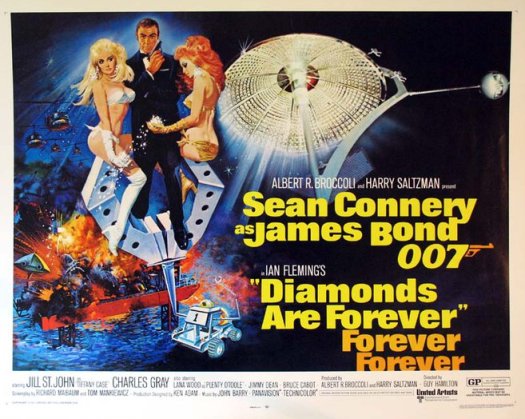
007 fans all over the world cheered when Sean Connery returned to the role that made him famous in DIAMONDS ARE FOREVER, the 6th James Bond screen outing. Connery left the series in 1967 (YOU ONLY LIVE TWICE), and was replaced by George Lazenby for 1969’s ON HER MAJESTY’S SECRET SERVICE. Lazenby was actually pretty good, if a bit boring, but he was one-and-done, choosing not to be typecast as cinema’s most famous spy (how’d that work out, George?). Producers Albert Broccoli and Harry Saltzman offered Connery an unprecedented $1.25 million dollars to come back, which the smart Scotsman snapped up in a heartbeat… who wouldn’t? Well, except for George Lazenby.

The opening sequence has Bond searching the globe to fins Ernst Stavro Blofeld, SPECTRE’s megalomanical leader who ordered the death of Bond’s wife in the previous movie. 007 hunts down his arch nemesis and ends his villainous career in…

View original post 538 more words

James Bond Review: Diamonds Are Forever (dir. by Guy Hamilton)


I think it’s a well-known fact that the Austin Powers series was spoofing the spy film of the 60’s and 70’s with it’s main target for laughs being the iconic James Bond character and his international adventures of action and intrigue. The James Bond films with each successive entry became more and more fantastic as the megalomania of each new villain became more and more cartoonish and over-the-top and the gadgets themselves started entering the realm of science-fiction (for that time and era, at least) and back-of-the-comic-book ingenuity. I think the tipping point for the series that took James Bond from action thriller to spoofing it’s own past was with Sean Connery’s last official film as James Bond with Diamonds Are Forever.

To say that Sean Connery was truly getting tired and bored with playing the character James Bond on the big screen would be an understatement. His previous Bond entry with You Only Live Twice showed him pretty much disinterested with the role and one would almost think he was phoning in his performance. After that film Connery had announced his retirement from playing Bond, but after George Lazenby also retired from the role after just one film Connery was soon back for one more ride on the James Bond train.

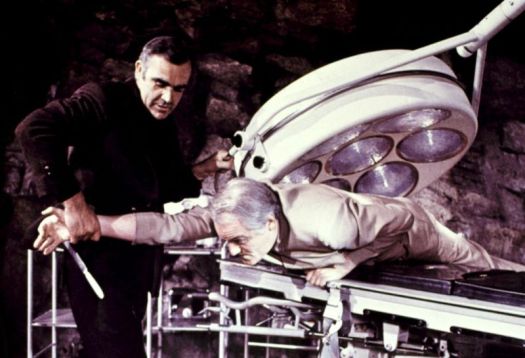
Diamonds Are Forever once again pits James Bond against his arch-nemesis, the leader of SPECTRE and feline connoisseur, Ernst Blofeld. This time around the role of Blofeld was played by the actor Charles Gray and the film does a good job in explaining why the character has been played by so many different actors in each entry he appeared in. It is in this early sequence in the film that we begin to see that this latest James Bond entry had jumped the shark when it came to trying to keep things even remotely believable. It’s the film’s biggest flaw an, at the same time, what made it such an interesting, fun ride.

Even the plot of the film owes more to the spoofs of the Blofeld character by way of the Austin Powers films as Bond must try to stop SPECTRE from using smuggled South African diamonds from being used to create  weaponized satellite with a massive “laser” that SPECTRE will use to destroy the nuclear arsenal of every superpower then auction off the rights to be the only nuclear power to the highest bidding country. It’s pretty much the the basic foundation of what would be the plot for the first Austin Powers, but with this film filmmaker Guy Hamilton still tried to treat the script as something that was of the serious Bond when it was more 60’s camp through and through.

Diamonds Are Forever may be the weakest of all the Connery Bond films, but it’s groovy sensibilities that celebrated the 60’s (despite the film having been made in 1971) psychedelic, swinging lifestyle poked fun at Bond’s predilection as a suave and charismatic womanizer that wouldn’t have looked out of place in a 60’s love-in. Even the action sequences was something that looked more humorous than thrilling whether it was Bond escaping SPECTRE henchmen on a moon buggy to the inept duo assassins Mr. Wint and Mr. Kidd looked more at home in an action comedy than a series that was known for serious action.

I would be remiss to not mention that this was the only time the Bond series had a redhead as a Bond Girl in the vivacious form of Jill St. John as Tiffany Case. I would also like to think that the other Bond Girl in the film, played by Lana Wood (Natalie Wood’s younger sister), was also a redhead but I’m not entirely sure since most audiences probably didn’t pay too close attention to Plenty O’Toole’s hair color. Either way this would be the only Bond film that would cast what fellow writer Lisa Marie calls the 2%.

Diamonds Are Forever might not have been the sort of return Sean Connery envisioned for himself when he agreed to return as James Bond after taking a film off, but then again this wouldn’t be the first time he would retire from the role only to come back again. Yet, despite all it’s flaws (there were many of them) the film does entertain though probably not in the way it’s filmmakers hoped it would. I do believe that it was this film that finally brought in Roger Moore as the next Bond, but also convinced the film’s producers to tailor the Bond films using some of the humorous aspect of Diamonds Are Forever but tempered to accompany the action in the story.

James Bond will soon return in Live And Let Die….