4 Shots From 4 Films is just what it says it is, 4 shots from 4 of our favorite films. As opposed to the reviews and recaps that we usually post, 4 Shots From 4 Films lets the visuals do the talking.
Today, we pay tribute to the enigmatic master of Spanish horror and suspense, Jesus “Jess” Franco! It’s time for….
4 Shots From 4 Jess Franco Films
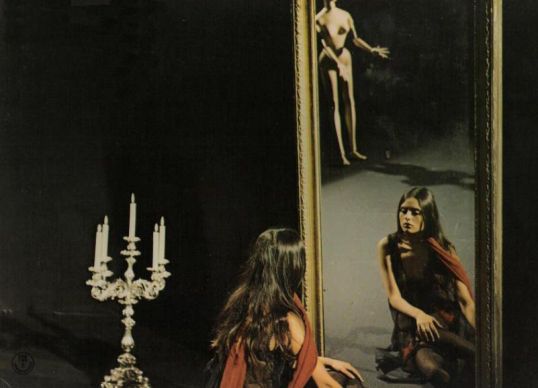
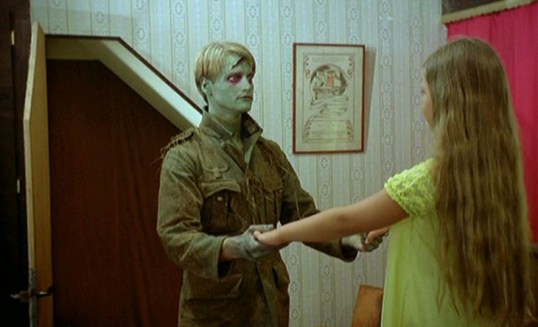
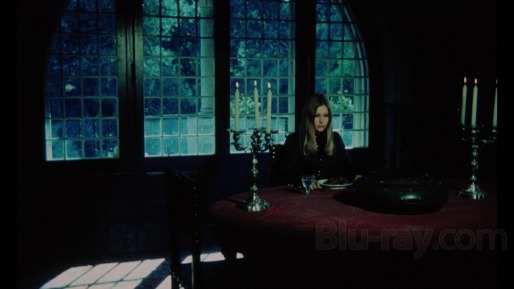
Vampyros Lesbos (1970, dir by Jess Franco, DP: Manuel Merino)
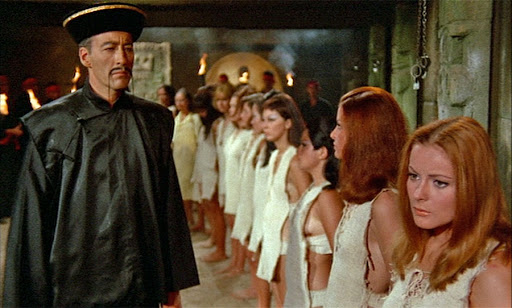
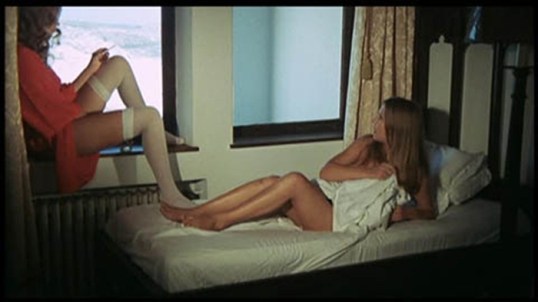
Female Vampire (1973, dir by Jess Franco, DP: Jess Franco)
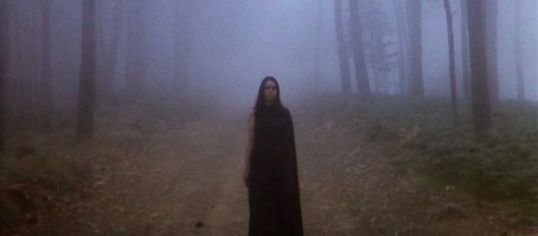
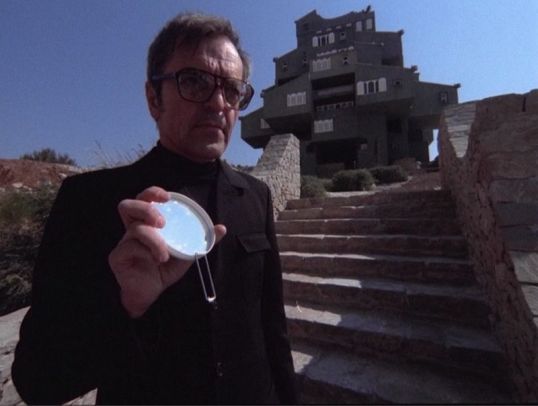
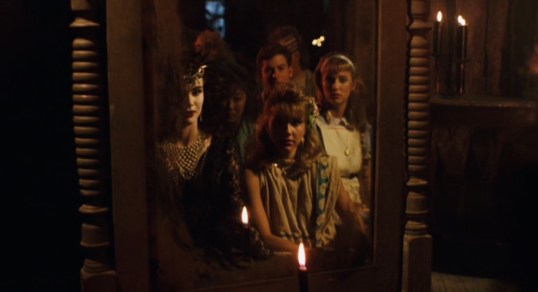
Countess Perverse (1973, dir by Jess Franco, DP: Manuel Merino)
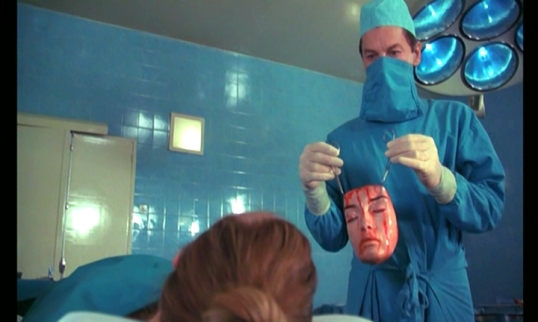
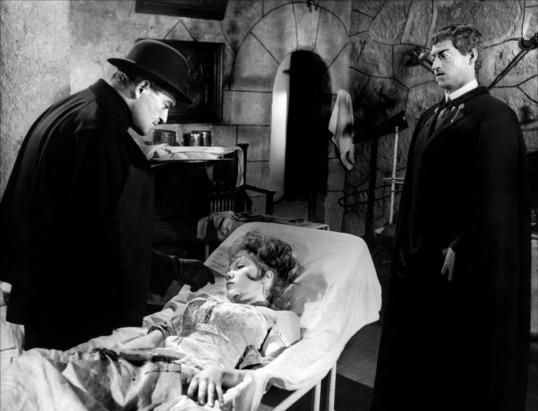
Faceless (1988, dir by Jess Franco, DP: Maurice Fellous)
4 Or More Shots From 4 Or More Films is just what it says it is, 4 shots from 4 of our favorite films. As opposed to the reviews and recaps that we usually post, 4 Shots From 4 Films lets the visuals do the talking!
Today, we honor the legacy of a man who was not just a great horror star but also a great actor. period Christopher Lee worked with everyone from Laurence Olivier to Steven Spielberg to Peter Jackson to Martin Scorsese. Though he turned own the chance to play Dr. No, Lee later did go play a Bond villain in The Man with The Golden Gun. He was one of those actors who was always great, even if the film wasn’t.
That said, it’s for his horror films that Lee is best known. He was the scariest Dracula and the most imposing Frankenstein’s Monster. He played mad scientists, decadent aristocrats, and even the occasional hero. Christopher Lee was an actor who could do it all and today, we honor him with….
6 Shots From 6 Christopher Lee Films
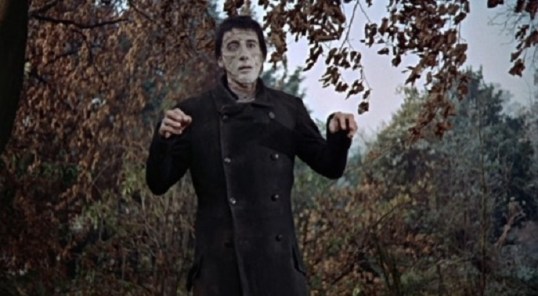
The Curse of Frankenstein (1957, dir by Terence Fisher, DP: Jack Asher)
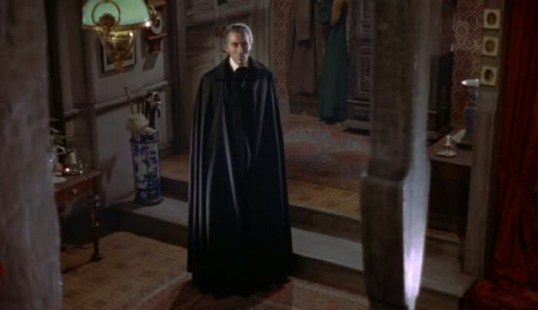
The Horror of Dracula (1958, dir by Terence Fisher, DP: Jack Asher)
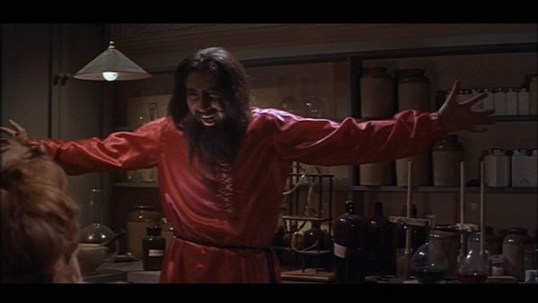
Rasputin The Mad Monk (1966, dir by Don Sharp, DP: Michael Reed)
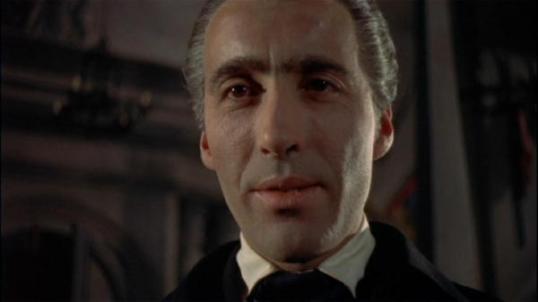
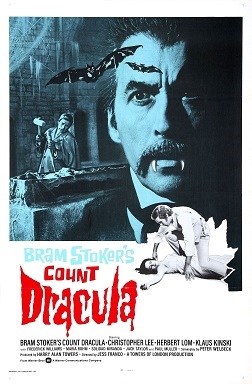
Count Dracula (1970, dir by Jess Franco, DP: Manuel Merino and Luciano Trasatti)
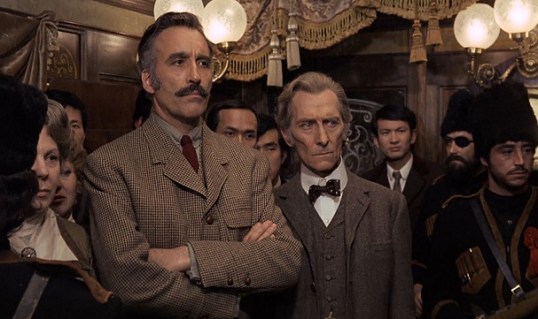
Horror Express (1972, dir by Eugenio Martin, DP: Alejandro Ulloa)
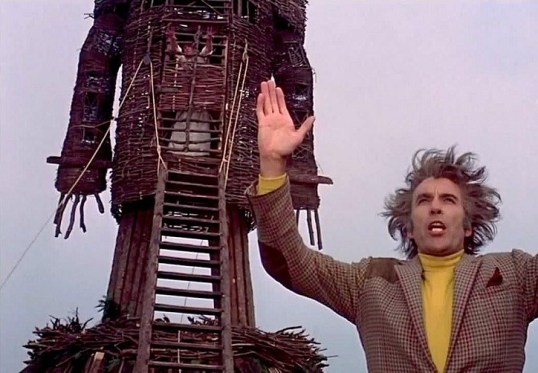
The Wicker Man (1973, dir by Robert Hardy. DP: Harry Waxman)
Christopher Lee played Dracula in seven horror films and he often said that he hated almost every single one of them.
Christopher Lee, you have to understand, was a fan of Bram Stoker’s original novel and he always wanted to play Dracula the way that Stoker wrote him, as a member of the old nobility who got younger each time he drank blood. As Lee often explained it, he spent years vainly trying to convince Hammer to do a Dracula film that was faithful to Stoker’s novel but Hammer instead preferred to use Dracula as an almost generic villain, one who was frequently plugged into equally generic films.
At some point, in the late 60s, producer Harry Alan Towers approached Christopher Lee and asked him to play Dracula in a non-Hammer film about the world’s most famous vampire. At first, Lee refused. If he was bored with playing Dracula for Hammer, why would he want to play him for someone else? However, Towers then explained that his version of Dracula would be the first Dracula film to actually be faithful to Stoker’s book. In fact, along with the presence of Christopher Lee, that would be the film’s major selling point! Hearing this, Lee agreed.
The resulting film was 1970’s Count Dracula, a German-Spanish-British co-production that was directed by none other than Jess Franco. Jess Franco, of course, is a beloved figure among many fans of Eurohorror and a bit of a controversial filmmaker. Some people admired him for his ability to direct atmospheric films while spending very little money. Others complained that Franco’s films were frequently amateurish and narratively incoherent. When it comes to Franco, both camps can make a compelling argument. Personally, I tend to come down on the pro-Franco side of things, particularly when it comes to the films that he made with Towers in the 70s. For his part, Christopher Lee said he enjoyed working with Franco and they would go on to collaborate on several more films together.
So, what type of film is Jess Franco’s Count Dracula? Well, Towers did not lie to Lee. For the most part, Count Dracula remains faithful to plot of Bram Stoker’s Dracula. There’s a few minor differences, of course. A few characters are combined, which is understandable given that you sometimes need a scorecard to keep up with everyone in the novel. The ending is a bit more abrupt in the film than it is in the book. This probably has something to do with the fact that Franco ran out of money before he finished the film. That was a fairly frequent occurrence on Franco’s films.
That said, film sticks close to the novel. Jonathan Harker (Frederick Williams) goes to Transylvania and meets Dracula (Christopher Lee, with a mustache), an aging nobleman. Harker soon finds himself being held prisoner in the castle, a victim of Dracula and his brides. Though Harker does manage to escape (though not before finding Dracula asleep in his coffin), he ends up at a psychiatric hospital in London. He meets Dr. Seward (Paul Muller) and Prof. Van Helsing (Herbert Lom). Eventually, his fiancee Mina (Maria Rohm) and her best friend, Lucy (Soledad Miranda, who was Franco’s muse until he tragic death in a car accident) come to visit him. Accompanying Lucy is Quincy Morris (Franco regular Jack Taylor), who, in the film, is a combination of two of the novel’s characters, Quincy and Arthur Holmwood. Meanwhile, a madman named Renfield (Klaus Kinski) babbles about his master and eats bugs.
That said, while the story may stick close to Stoker, this is definitely a Franco film. The action plays out at its own deliberate pace. Depending on how much tolerance you have for Franco’s aesthetic, you’ll find this film to be either dream-like or slow. Personally, I liked the amospheric images and the somewhat ragged editing style. Whether it was Franco’s intention or not, they gave the film a hallucinatory feel, as if one was watching a nightmare being dreamt by Stoker himself. At the same time, I can imagine others getting frustrated by the film and I can understand where they’re coming from. Franco, with his habit of mixing the sensual with a deep sense of ennui, is not for everyone.
Still, it was interesting to see Lee giving a much a different performance as Dracula than he did in the Hammer films. The Hammer films portrayed Dracula as being animalistic, driven by only his craving for blood. In Count Dracula, Lee plays with the idea of Dracula being a relic of the old world, someone who has no choice but to watch as civilization changes around him. While Dracula is undoubtedly evil, Lee plays him with hints of dignity. Gone is the snarling and growling monster of the Hammer films and instead, this movie features a Dracula who takes an almost Calvinistic approach to his affliction. He’s accepted his fate. As he tells Harker, Harker can either choose to enter the castle or not. In the end, it makes no difference because eventually, someone will enter. The film also retains the idea of Dracula growing younger in appearance as he drinks blood, which adds a whole other dimension to Dracula’s cravings. Blood is life and youth, two things that Dracula no longer possesses.
As for the rest of the cast, Klaus Kinski, not surprisingly, throws himself into the role of Renfield. Reportedly, he ate real bugs for the role. Herbert Lom seems a bit bored with the role of Van Helsing. He doesn’t have any of the eccentric energy that we typically associate with the role. Of course, some of that is due to the fact that, because of scheduling conflicts, Lom and Lee were never on set at the same time. The scenes where Dracula and Van Helsing confront each other were created through some editing sleight-of-hand. As is typical with Franco films, sometimes it works and sometimes, it’s extremely obvious that Lom wasn’t actually looking at Lee (or anyone other than the cameraman) when he delivered his lines.
Count Dracula is an interesting take on the story. It’s a bit uneven, though that’s perhaps not a surprise considering that the production was apparently beset by budgetary problems from the start. This film is Franco at his least lurid and it’s hard not to miss some Franco’s more sordid impulses. Watching the film, you get the feeling that Franco was holding back. But, the visuals are wonderfully dreamy, Kinski is compelling in his insane way, and Lee finally appears to be enjoying the role of Dracula. It’s actually kind of nice to see.
4 Shots From 4 Films is just what it says it is, 4 shots from 4 of our favorite films. As opposed to the reviews and recaps that we usually post, 4 Shots From 4 Films lets the visuals do the talking!
95 years ago today, Klaus Kinski was born in Poland. Kinski was a brilliant actor who, by all accounts, was an absolute monster in his private life. Werner Herzog worked with him on several films and reportedly considered murdering him on more than a few occasions. Herzog, himself, wrote about the time that he had spent in a mental asylum and the time that was diagnosed as being a psychopath. Because of his talent, he appeared in many great films. Because of his reputation for being a literal madman, he also missed out on a lot of great roles and spent much of his career appearing in low-budget exploitation flicks. Many of those films were in the horror genre.
Today, on the anniversary of Kinski’s birth, TSL presents….
4 Shots From 4 Klaus Kinski Films
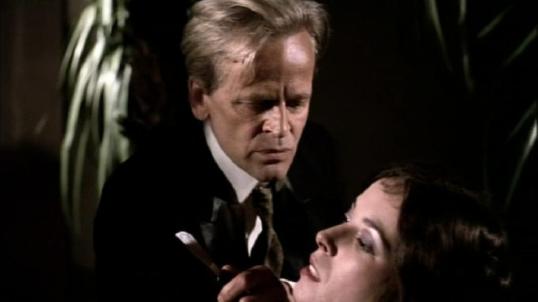
Count Dracula (1970, dir by Jess Franco, DPs: Manuel Merino and Luciano Trasatti)
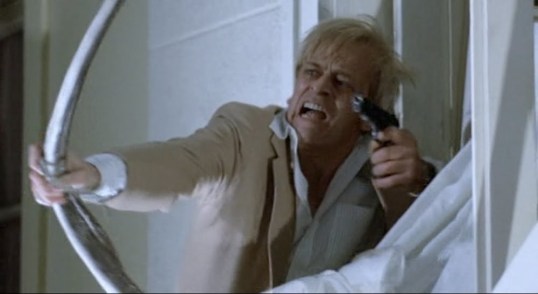
Jack the RIpper (1976, dir by Jess Franco, DPs: Peter Baumgartner and Peter Spoerri)
Nosferatu The Vampyre (1979, dir by Werner Herzog, DP: Jörg Schmidt-Reitwein)
Venom (1981, dir by Piers Haggard, DPs: Denys Coop and Gilbert Taylor)
4 Shots From 4 Films is just what it says it is, 4 shots from 4 of our favorite films. As opposed to the reviews and recaps that we usually post, 4 Shots From 4 Films lets the visuals do the talking!
This October, we’ve been using 4 Shots From 4 Films to pay tribute to some of our favorite horror directors! Today, we recognize the one and only Jesus “Jesse” Franco!
The 1970 film, Count Dracula, is unique in that it’s a film that stars Christopher Lee but it wasn’t produced by Hammer. Instead, it was directed by Lee’s friend, the Spanish director Jess Franco. It was sold as being a far more faithful adaptation of the Dracula story than anything that had been filmed up to that point. Lee, who frequently bemoaned the quality of the Hammer films, later described Count Dracula as being a personal favorite of the many films in which he appeared.
In the scene, Dracula confronts Herbert Lom’s Prof. Van Helsing. Lee gets more dialogue in this scene than he did throughout the entirety of Hammer’s Dracula, Prince of Darkness.
4 Shots From 4 Films is just what it says it is, 4 shots from 4 of our favorite films. As opposed to the reviews and recaps that we usually post, 4 Shots From 4 Films lets the visuals do the talking!
Today is the 90th anniversary of the birth of Jesus Franco! One of the most prolific filmmakers of all time, Franco made movies that …. well, they’re not easy to describe. Jess Franco was responsible for some of the most visually striking and narratively incoherent films ever made. He made films that you either loved or you hated but there was no mistaking his work for being the work of someone else.
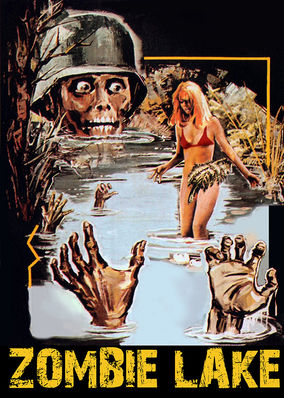
I approach this 1981 Spanish-French film with some trepidation because, while it’s undeniably one of the best known of Eurocine’s low-budget horror films, it was also directed by one of my favorite directors and, by most accounts, it was not an experience that he particularly enjoyed being asked about. He did not care for this film and (spoiler alert) his name was not J.A. Lazer.
In fact, for several years, it was assumed that this film was actually directed by Jess Franco. And while it’s true that Franco was originally hired to direct Zombie Lake, he left the project because he said the budget was too low to execute his vision. Consider that. A budget too low for Jess Franco! Franco left the project and went on to direct Oasis of the Zombies. Apparently, the film’s producers did not understand that Franco had actually left the project because, on the first day of shooting, they were shocked to discover that they didn’t have a director. In a panic, they called another fiercely independent horror director and asked him to come direct the film. Jean Rollin agreed.
By his own account, Rollin only had a few days to prepare for shooting and since he had already made a classic zombie film called The Grapes of Death, he didn’t worry too much about trying to do anything too spectacular with Zombie Lake. He simply filmed whatever scenes were required for the day, played the minor role of doomed police inspector, and, six days later, Zombie Lake had been filmed.
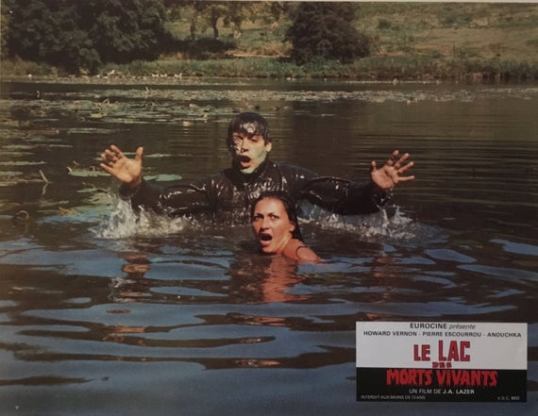
As for the film itself, it takes place in a French village that appears to be exclusively populated by cranky old men and naked young women. There’s a lake nearby. Despite seeing (and tossing aside) a big sign with a skull and crossbones on it, one of the naked women decides to go for a swim. This apparently awakens the green Nazi zombies who lives at the bottom of the lake. Soon, the zombies are randomly emerging from the lake and killing villagers. The town’s mayor (Howard Vernon, of all people) is concerned.
It all links back to World War II, when the members of the French Resistance (led by the mayor) gunned down a squad of Nazis and dumped their bodies in the lake. Somehow, this led to the Nazis coming back as zombies. One of the Nazis had a daughter with a French woman shortly before he was killed. Despite the fact that he was killed in 1943 and the movie clearly takes place in 1980, his daughter is only 12 years old. That’s the type of film that Zombie Lake is.
Watching the film, you can tell why Rollin wasn’t particularly interested in claiming any credit for it. It’s a messy film, largely because the green zombie makeup keeps washing off whenever the zombies have to emerge from the waters of the lake. As for the lake itself, the underwater scenes were clearly shot in a swimming pool. Beyond that, there’s not really any logic as to why the zombies keep emerging from the lake. Whenever it’s plot convenient, the zombies suddenly emerge and attack anyone who has recently undressed.
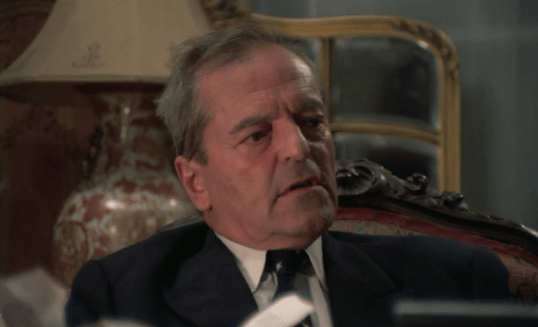
Howard Vernon in Zombie Lake
And yet, there are some good things about Zombie Lake. (Shut up, there are too!) For instance, it’s kind of charming how each actor cast as a zombie brings their own interpretation to the role. Some of them walk slowly with their arms outstretched. Others move a little bit stiffly with a thousand yard stare. Some of them just casually stroll around, doing their business. As well, we’re so used to assuming that any character played by Howard Vernon is going to be decadent and sleazy that it’s kind of fun to see him playing an outright hero here. Finally, even the frequent nudity is so gratuitous that it actually become rather humorous. One could easily use Zombie Lake to play a drinking game. Whenever anyone takes off their top, drink!
Finally, even though this was clearly just a film he did for the money, there are a few instances where Rollin’s signature style manage to peak through. For instance, when we first see the Mayor’s office, the camera lingers on all of the historical artifacts on the wall. The fact that one of the zombies has cloudy memories of his former lover and only wants to see his daughter actually works a lot better than you might expect, largely because that seems to be the only storyline that Rollin — with his fascination with memory and history — seems to really care about.
Zombie Lake is a mess and certainly not representative of Rollin’s best (or more personal) films. But I still kind of like it.
4 Shots From 4 Films is just what it says it is, 4 shots from 4 of our favorite films. As opposed to the reviews and recaps that we usually post, 4 Shots From 4 Films lets the visuals do the talking!
This October, we’re using 4 Shots From 4 Films to look at some of the best years that horror has to offer!
4 Shots From 4 1988 Horror Films
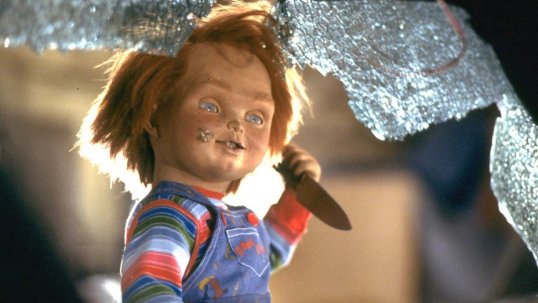
Child’s Play (1988, dir by Tom Holland)
Faceless (1988, dir by Jess Franco)
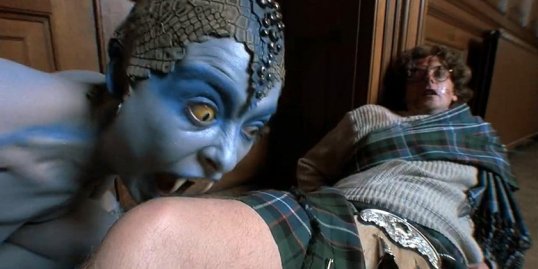
The Lair Of The White Worm (1988, dir by Ken Russell)
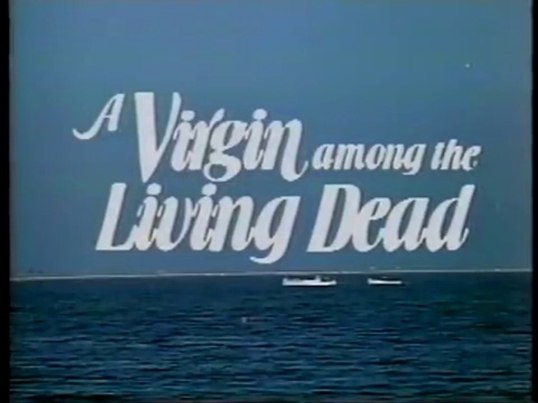
This 1973 Spanish-French-Italian production’s title is both its greatest strength and also its greatest weakness.
On the one hand, it’s impossible to forget a title like A Virgin Among the Living Dead. It’s a title that mixes both horror and sex, which are two things of which audiences simply cannot get enough. On the other hand, this is a a Jess Franco film and the title — which is so blatant and over-the-top — sounds like it could almost be a parody of Franco’s “unique” style of film-making. If you were coming up with a fake Franco film, you would probably give it a title that sounded a lot like “A Virgin Among the Living Dead.” A Virgin In The Castle of Dr. Orloff, perhaps.
Interestingly enough, Franco absolutely hated the film’s title. It, and quite a few other titles, were slapped onto the film by distributors who were apparently unconcerned with the fact that the film was not meant to be one of Franco’s typical, give-me-my-paycheck exploitation films. Franco’s title for the film was Night of the Shooting Stars, which is a bit bland but perhaps also a bit more honest. Incidentally, the film was also released under the titles Christina, Princess of Eroticism and The Erotic Dreams of Christina, which again were titles that Franco disliked.
In the version I saw (and, admittedly, there’s several versions floating around), it’s never even stated that the film’s frequently unclothed protagonist, Christina (Christina von Blanc), is a virgin. When compared to the other decadent members of her family, she certainly is innocent. For instance, she doesn’t drink blood or engage in strange purification rituals. When the cheerfully cynical Uncle Howard (Howard Vernon, because this is a Franco film, after all) plays a waltz while another member of the family is dying upstairs, Christina is properly shocked. But, at no point, is Christina identified as being a virgin.
In fact, Christina is rather uninhibited, nonchalantly greeting strangers (and a rather creepy servant, played by Franco himself) in her underwear, sleeping naked in a room with an unlocked door, and later casually skinny dipping in a nearby swamp. (When she’s informed that two wide-eyed townspeople were watching her from a nearby hill, she shrugs it off.) Perhaps she’s meant to be an Eve-like character, unaware of sex or her nudity until she eats from the tree of knowledge. Am I giving too much credit to Jess Franco? As is often the case with Franco, it’s hard to say.
As far as the film itself goes …. well, the plot isn’t always easy to follow. Christina has come to her family’s ancestral home for the reading of her dead father’s will. Her father hanged himself and, though he’s dead, he keeps showing up. Christina immediately discovers that the other members of her family are collection of rogues, eccentrics, and blood drinkers. She also eventually learns that all the members of her family are the living dead and that they’re all worried that Christina will make them leave the estate. Or are they? Is Christina just dreaming all of this or is it really happening? Is the Queen of Night really coming to claim everyone’s soul or is that just a part of Christina’s hallucinations?
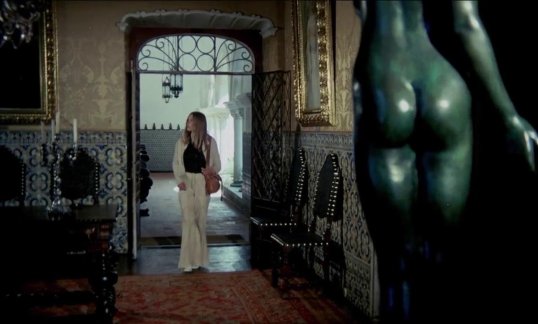
A Virgin Among The Living Dead features all of Franco’s usual directorial quirks. The story rambles. Franco alternates between scenes of surreal beauty and scenes of almost indifferent framing. At times, the score is hauntingly ominous and then, at other times, it sounds like it was lifted from a 70s porno. Christina comes across as being a beautiful blank but Howard Vernon is memorably perverse as Uncle Howard and all the members of the family are amusingly decadent. For once, though, all these quirks work to the film’s advantage, creating a surreal dreamscape that truly does seem to exist in a land between life and death. A Virgin Among The Living Dead truly does become a work of pure cinema, one in which the the visuals and the mood become the narrative as opposed to the film’s story itself.
Franco may have hated the title that was slapped on it but this is actually one of his better films. Unfortunately, how you react to the film will probably depend on which version you see. There are several floating around, some of which feature hardcore inserts that were filmed by other directors. There’s another version that features extra zombie footage that was filmed by Jean Rollin. The Redemption Blu-ray features Franco’s cut of the film, with no hardcore or extra zombie footage. That said, the scenes that Rollin shot are included as an extra. Personally, I like Rollin’s zombie footage but, at the same time, I can also see how its inclusion would have destroyed the film’s already deliberate pace.
(And, of course, it goes without saying that I’m opposed to producers inserting extra scenes into any film, especially when that footage wasn’t directed by the original director.)
Anyway, A Virgin Among The Living Dead never reaches the existential heights of Female Vampire but it’s still one of Franco’s “good” films. Even if he did hate the title….





 Through the Shattered Lens