Painter Bob Randolph is famous for painting a beautiful woman who is known as “the Randolph Girl.” Everyone wants to meet the model but they can’t because there is no one model. Instead, there are a dozen models, each with a perfect feature that Bob uses in his paintings. In need of money, Bob and his business partner, Chuck Donavon (Eddie Bracken) search for a woman who can be the real-life Randolph Girl. Chuck thinks that he’s found her when he spots school teacher Ruth Wilson (Virginia Mayo) but Ruth has no interest in being a model. She wants to be known for how she thinks and not how she looks. Hoping to change her mind, Randolph pretends to be Czech immigrant and enrolls in Ruth’s citizenship class.
When a photograph of Ruth in a swimsuit is published without her prior knowledge, the school board decides that Ruth is not a good role model and they fire her. With the support of Bob and Chuck, Ruth sues for reinstatement. Bob ends up posing in the courtroom in his own swimsuit, the better to prove that there’s nothing wrong with appearing in public in a swimsuit.
The role of Ruth was originally offered to Lauren Bacall, who turned it down because she didn’t think she could play a pin-up. Not to knock Bacall but Virginia Mayo does seem like a better choice for the role of Ruth and she does a good job of bringing the role to life. She proves to be a good match for Ronald Reagan, whose amiable nature allows him to get away with taking her class under a false pretext and speaking in a mangled approximation of a foreign accent. The comedy is light and it fits well with Reagan’s affable screen presence. The film is pleasant but ultimately lightweight and forgettable. I can understand why, by this point in his career, Reagan was getting frustrated with the quality of scripts he was being sent. The Girl From Jones Beach would be forgotten today if it didn’t star the future president of the United States.
I don’t know if I’ve ever seen Gary Cooper look as miserable in any film as he did in the 1949 film, The Fountainhead.
In The Fountainhead, Gary Cooper plays Howard Roark. Roark is an architect who we are repeatedly told is brilliant. However, he’s always has to go his own way, even if it means damaging his career. At the start of the film, we watch a montage of Howard Roark losing one opportunity after another. He gets kicked out of school. He gets kicked out of the top design firms. Howard Roark has his own vision and he’s not going to compromise. Roark’s a modernist, who creates sleek, powerful buildings that exist in defiance of the drab, collectivist architecture that surrounds them.
Howard Roark’s refusal to even consider compromising his vision threatens the rich and the powerful. A socialist architecture critic with the unfortunate name of Ellsworth Toohey (Robert Douglas) leads a crusade against Roark. And yet, even with the world against him, Roark’s obvious talent cannot be denied. Dominique Francon (Patricia Neal) finds herself enthralled by the sight of him working in a quarry. Fellow architect Peter Keating (Kent Smith) begs Howard to help him design a building. Newspaper publisher Gail Wynard (Raymond Massey) goes from criticizing Howard to worshipping him.
Have I mentioned that Howard Roark doesn’t believe in compromise? If you have any doubts about this, they’ll be erased about halfway through the movie. That’s when Roark responds to a company altering one of his designs by blowing up a housing project. Roark is arrested and his subsequent trial soon turns into a debate between two opposite philosophies: individualism vs. collectivism.
So, let’s just start with the obvious. Gary Cooper is all wrong for the role of Howard Roark. As envisioned by Ayn Rand (who wrote both the screenplay and the novel upon which it was based), Roark was meant to be the ideal man, a creative individualist who has no doubt about his vision and his abilities. Cooper, with his down-to-Earth and rather modest screen persona, often seems to be confused as to how to play such a dynamic (some might say arrogant) character. When Roark is meant to come across as being uncompromising, Cooper comes across as being mildly annoyed. When Roark explains why his designs must be followed exactly, Cooper seems to be as confused as the people with whom Roark is speaking. It doesn’t help that the 47 year-old Cooper seemed a bit too old to be playing an “up-and-coming” architect. In the book, Roark was in his 20s and certainly no older than his early 30s. Cooper looks like he should be relaxing in a Florida condo.
Who, among those available in 1949, could have been convincing in the role of Howard Roark? King Vidor wanted Humphrey Bogart for the role but if Cooper seemed to old for the part, one can only imagine what it would have been like with Bogart instead. Henry Fonda probably could have played the role. For that matter, William Holden would have been an interesting pick. Montgomery Clift and John Garfield would have been intriguing, though Garfield’s politics probably wouldn’t have made Ayn Rand happy. If Warner Bros. had been willing to wait for just a few years, they could have cast a young Marlon Brando or perhaps they could have let Douglas Sirk make the movie with Rock Hudson and Lana Turner. (Or, if you really wanted to achieve peak camp, they could have let Delmer Daves do it with Troy Donahue and Sandra Dee.)
If you can overlook the miscasting of Gary Cooper, The Fountainhead‘s an entertaining film. King Vidor directs the film as if it’s a fever dream. The film’s dialogue may be philosophical but the visuals are all about lust, with Pat Neal hungrily watching as a shirtless Gary Cooper breaks up rocks in the quarry and Vidor filling the film with almost fetishistic shots of phallic Howard Roark designs reaching high into the sky. If Cooper seems confused, Neal seems to be instinctively understand that there is no place for underplaying in the world of The Fountainhead. The same also holds true of Robert Douglas, who is a wonderfully hissable villain as the smug Ellsworth Toohey. Interestingly, the film ends with a suicide whereas the novel ended with a divorce because, under the production code, suicide was apparently preferable to divorce. I guess that’s 1949, for you.
Because America is currently having a socialist moment, there’s a tendency among critics to be dismissive of Ayn Rand and her worship of the individual above all else. Rand’s novels are often dismissed as just being psychobabble, despite the fact that, in some ways, they often seem to be borderline prophetic. (Barack Obama’s infamous “You didn’t build that!” speech from 2012 could have just as easily been uttered by Ellsworth Toohey or one of the many bureaucrats who pop up in Atlas Shrugged.) Here’s the thing, though — as critical as one can be of Rand’s philosophy, there’s still something undeniably appealing about someone who will not compromise their vision to the whims of the establishment. It’s goes beyond politics and it gets to heart of human nature. We like the people who know they’re talented and aren’t afraid to proclaim it. (Modesty, whether false or sincere, is a huge turn off.) We like the people who take control of situations. We like the people who are willing to say, “If you don’t do it my way, I’m leaving.” In a way, we’re all like Dominique Francon, running our hands over architectural models while trying to resist the temptation to compromise and accept something less than what we desire. We may not want to admit it but we like the Howard Roarks of the world.
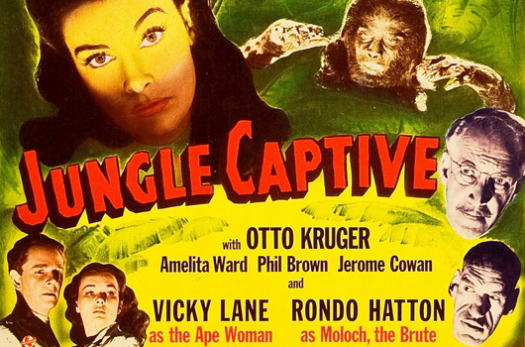
The third and final entry in Universal’s Paula Dupree/The Ape Woman series, JUNGLE CAPTIVE was released in 1945. I’m happy to report it’s a slight upgrade on JUNGLE WOMAN – by no means a classic horror movie, but certainly more enjoyable than that wretched sequel to CAPTIVE WILD WOMAN . The budget is lower-than-low, but the performances and script are far better, and it makes a good finale to the Ape Woman saga.
Hulking brute man Moloch, henchman of biochemist Mr. Stendahl (who’s not a doctor, by the way), strangles a morgue attendant and steals the body of the Ape Woman from it’s slab (where we left it in the last film). Inspector Harrigan is called in on the case, and a lab smock found near the abandoned crashed-and-burned meat wagon leads him to Stendahl’s lab, where he encounters pretty assistant Ann and her fiancé Don working (actually, they’re necking…
When two aging fishermen (Thomas Mitchell and John Qualen) attempt to buy a new boat, they run into a problem with local mobster, Harold Goff (John Garfield). As Goff explains, if they do not pay him $5.00 a week, something bad could happen to their boat. When one of the fisherman’s daughter (Ida Lupino) falls in love with Goff, she makes the mistake of letting him know that her father is planning on giving her $190 so that she can take a trip to Cuba. When Goff demands the money for himself, the fishermen attempt to go to the police, just to be told that there is nothing that the authorities can do. Goff tricked them into signing an “insurance” contract that allows him to demand whatever he wants. The two fishermen are forced to consider taking drastic measures on their own. Out of the Fog is an effective, early film noir, distinguished mostly be John Garfield’s sinister performance as Harold Goff.
Out of the Fog is also memorable as an example of how Hollywood dealt with adapting work with political content during the production code era. Out of the Fog was based on The Gentle People, a play by Irwin Shaw. In the play, which was staged by The Group Theater in 1939, Harold Goff was obviously meant to be a symbol of both European fascism and American capitalism. In the play, the two fisherman had Jewish names and were meant to symbolize those being persecuted by the Third Reich and its allies. In the transition for stage to film, Jonah Goodman became Jonah Goodwin and he was played by the very talented but definitely not Jewish Thomas Mitchell. The play ended with Harold triumphant and apparently unstoppable. Under the production code, all criminals had to be punished, which meant the ending had to be changed. Out of the Fog is an effective 1940s crime thriller but, without any political subtext, it lacks the play’s bight.
One final note: while Out of the Fog had a good cast, with up and comer John Garfield squaring against old vets Thomas Mitchell and John Qualen, the original Broadway play’s cast was also distinguished. Along with contemporary film stars Sylvia Sidney and Franchot Tone, the play’s cast was a who’s who of actors and directors who would go on to be prominent in the 1950 and 60s: Lee J. Cobb, Sam Jaffe, Karl Malden, Martin Ritt, and Elia Kazan all had roles.
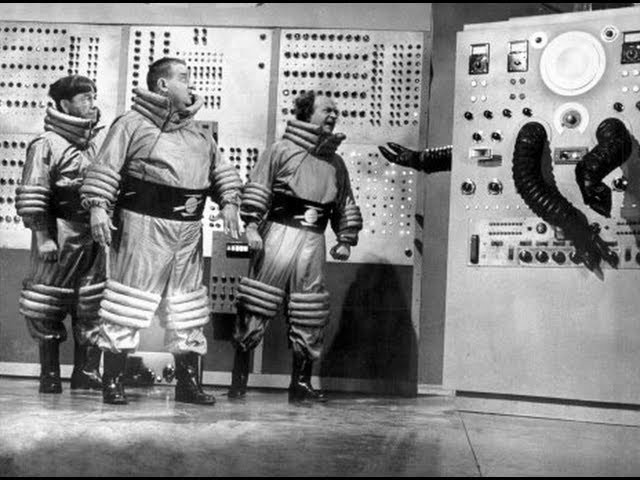
My DirecTV receiver decided to fry itself the other day. A new one won’t be shipped for another five days – no TCM, no DVR’d movies, no Red Sox, no nothin’! What’s a film blogger to do? Since my DVD player isn’t working either, I thought I’d reach into my collection of VHS tapes and see what I could come up with for viewing. Hmm, let’s see… wait a sec, what’s this? An unopened copy of HAVE ROCKET, WILL TRAVEL, the Three Stooges comeback starring feature! Good Lord, I haven’t seen this movie in years! The Stooges it is!
A little background first: after making shorts for Columbia since 1934, the studio dumped the trio when their contract ended in 1957. Television had killed the short subject market, and the boys were thrown out on their collective keisters. Ironically, it was television that revived their career when the Stooges shorts were released to…
The fifth film in Mill Creek’s Fabulous Forties box set was 1944’s Guest In The House. Before I get around to actually reviewing the film, there two important things that I need to share.
First off, according to the imdb, when Guest In The House was released into theaters, it ran a total of 121 minutes. The version that was released on video — the version that I watched for this review — only runs 100 minutes. Having watched the film, it’s hard for me to guess what could have been included in those 21 minutes. There’s no major plot holes in the 100 minute version or any unanswered questions. It’s hard for me to imagine that there could be anything in those 21 minutes that would have made Guest In The House a better film than the version that I watched last night. If anything, even at just 100 minutes, the version that I saw still felt too long!
Secondly, Guest In The House was re-released several times. At one point, the title was changed to Satan In Skirts! That has got to be one of the greatest titles ever! Seriously, Guest In The House is such a boring and mundane title. But Satan in Skirts — I mean, that sounds like something that you just have to watch, doesn’t it?
Anyway, Guest In The House is about a guest in the house. Shocking, right? Evelyn (Anne Baxter, playing a character similar to her classic role in All About Eve) is a mentally unstable woman with a heart ailment and a morbid fear of birds. She has recently become engaged to Dr. Dan Proctor (Scott Proctor) but she spends most her time writing nasty things about him in her diary.
Dan takes her to visit his wealthy Aunt Martha (Aline MacMahon). Also staying at Martha’s is Dan’s older brother, an artist named Douglas (Ralph Bellamy). Douglas is married to Ann (Ruth Warrick, who also played Kane’s first wife in Citizen Kane). Also living at the house is Douglas’s model, Miriam (Marie McDonald).
(“I used to have to hire one model for above the neck and one model for below the neck,” Douglas explains as Miriam poses for him, “But you’re the whole package!”)
When Evelyn has a panic attack upon seeing a bird, Douglas calms her down by drawing a woman on a lampshade. (Yes, that’s exactly what he does.) This leads to Evelyn becoming obsessed with Douglas. Soon, she is manipulating the entire household, trying to drive away Dan and Miriam while, at the same time, try to break up Douglas and Ann’s marriage….
So, does this sound like a Lifetime film to anyone? Well, it should because Guest In The House is basically a 1940s version of almost every film that aired on Lifetime last year. Normally that would be a good thing but, unlike the best Lifetime films, Guest In The House isn’t any fun. It should be fun, considering how melodramatic the storyline is. However, Guest In The House takes a prestige approach to its story, marking this as one of those films that was made to win Oscars as opposed to actually entertaining audiences. Other than a few time when Evelyn imagines that she’s being attacked by invisible birds, the film never allows itself to truly go over-the-top.
Lovers of The Wizard of Oz might want to note that the Wicked Witch of the West herself, Margaret Hamilton, plays a maid in this film but, in the end, Guest In The House is mostly just interesting as a precursor to Anne Baxter’s performance in All About Eve.
(For those following at home, Lisa is attempting to clean out her DVR by watching and reviewing 38 films by this Friday. Will she make it? Keep following the site to find out!)
I would love to see a remake of The Maltese Falcon with Bill Murray in the role of Sam Spade. Well, maybe not the Bill Murray of today because he’s getting a little bit too old to play a hard-boiled private detective who is as good with his fists as his brain. Instead, I’m thinking more of Lost In Translation era Bill Murray, when he was no longer young but could still probably beat up any sniveling punk who came at him with a gun.
Now, that may sound crazy to some but think about it. Bill Murray is one of the great deadpan snarkers and so is Sam Spade. Last night, when I watched the famous 1941 version of The Maltese Falcon (the story was filmed twice before, once with Bette Davis as the femme fatale), I was struck by how much of the film really was a comedy. It may have been a murder mystery that featured death and betrayal and a lot of people getting beaten up but, ultimately, The Maltese Falcon is really about Sam Spade reacting to all of the crazy and strange people around him. No matter how weird things get, Spade always responds with a smirk and a quip. It’s a role that, at times, seems to be tailor-made for an actor like Bill Murray.
Bill Murray wasn’t around in 1941 but fortunately, Humphrey Bogart was. Humphrey Bogart may have grown up wealthy and attended private schools but, on screen, nobody was tougher than Humphrey Bogart and nobody was better at delivering sarcastic, snark-filled dialogue. After spending years as a villainous supporting actor, Humphrey Bogart got his first starring role when he played Sam Spade in The Maltese Falcon. His performance, of course, would set the standard by which all future cinematic private eyes would be judged.
And, of course, Spade was tough and he was cynical and he has that wonderful moment at the end of the film where he explains that nobody’s going to make a “sap” out of him. But for me, Bogart’s best moments come when Spade is alone and thinking. It’s at those times that Spade suddenly becomes a human being. A slight smirk comes to his lips, almost as if he’s sharing a private joke with the audience. You can tell that he’s thinking to himself, “Can you believe how weird my life is?”
And it is indeed a weird life. The film opens with Spade’s partner, Miles Archer (Jerome Cowan), being murdered. The police believe that Archer was murdered by a man named Thursby and that Thursby was subsequently murdered by Spade. Spade, however, suspects that both Archer and Thursby were killed by his latest client, a woman who introduced herself as Ruth Wonderly (Mary Astor). Except, of course, that’s not her real name. Her real name is Brigid O’Shaughnessy and, as she admits to Spade, Thursby was her partner. She claims that Thursby must have murdered Archer but that she doesn’t know who could have possibly killed Thursby.
What’s particularly interesting about all this is that no one really seems to be that upset about Archer’s death. Spade’s main motivation for investigating the murder is to clear his name and there are several lines of dialogue that reveal how little regard he had for Miles. In fact, when Archer’s widow (Gladys George) suggests that Spade might be Archer’s killer, you can understand why she might think that. But then again, that’s the world of The Maltese Falcon. Only the tough survive. Getting sentimental or allowing yourself to care is the biggest mistake you can make.
The murders are connected to the hunt for a valuable statue of a bird. (This is the famous Maltese Falcon of the title.) As Spade tries to clear his name in the two murders, he also finds himself getting caught up with a strange group of treasure hunters. There’s the obsequious Joel Cairo (Peter Lorre). There’s the ruthless “fat man,” Kasper Gutman (Sidney Greenstreet). And then there’s Wilmer (Elisha Cook, Jr.), Gutman’s young henchman who spends the entire film trying to convince everyone that he’s tougher than he appears. Wilmer is a born patsy. Whenever Spade gets annoyed, he beats up Wilmer. And he usually smiles afterward.
Along with being the directorial debut of John Huston, The Maltese Falcon was also one of the first great film noirs. It’s one of the most influential films ever made and, even seen today, it’s a lot of fun. You really can’t go wrong with Bogart, Astor, Greenstreet, Lorre, and Cook all in the same movie. Bill Murray may never get a chance to play Sam Spade but that’s okay. Humphrey Bogart’s the only Sam Spade we really need.
The Maltese Falcon was nominated for best picture. However, it lost to How Green Was My Valley, a film that literally seems to take place in an entirely different universe from The Maltese Falcon.
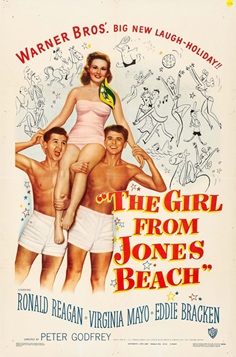 Painter Bob Randolph is famous for painting a beautiful woman who is known as “the Randolph Girl.” Everyone wants to meet the model but they can’t because there is no one model. Instead, there are a dozen models, each with a perfect feature that Bob uses in his paintings. In need of money, Bob and his business partner, Chuck Donavon (Eddie Bracken) search for a woman who can be the real-life Randolph Girl. Chuck thinks that he’s found her when he spots school teacher Ruth Wilson (Virginia Mayo) but Ruth has no interest in being a model. She wants to be known for how she thinks and not how she looks. Hoping to change her mind, Randolph pretends to be Czech immigrant and enrolls in Ruth’s citizenship class.


 When two aging fishermen (Thomas Mitchell and John Qualen) attempt to buy a new boat, they run into a problem with local mobster, Harold Goff (John Garfield). As Goff explains, if they do not pay him $5.00 a week, something bad could happen to their boat. When one of the fisherman’s daughter (Ida Lupino) falls in love with Goff, she makes the mistake of letting him know that her father is planning on giving her $190 so that she can take a trip to Cuba. When Goff demands the money for himself, the fishermen attempt to go to the police, just to be told that there is nothing that the authorities can do. Goff tricked them into signing an “insurance” contract that allows him to demand whatever he wants. The two fishermen are forced to consider taking drastic measures on their own. Out of the Fog is an effective, early film noir, distinguished mostly be John Garfield’s sinister performance as Harold Goff.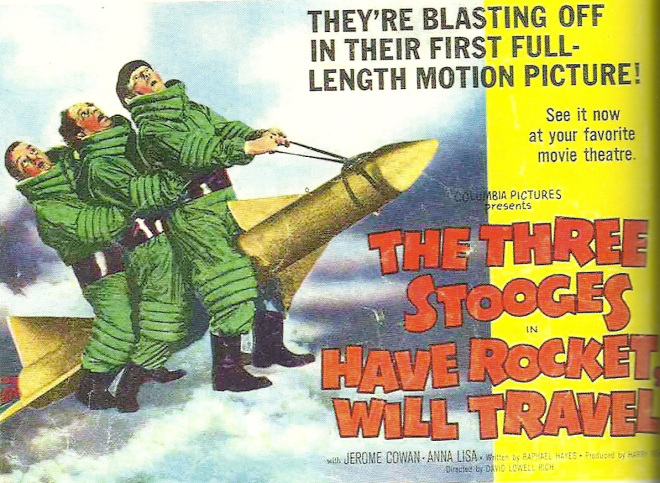


 Through the Shattered Lens