Late Night Retro Television Reviews: Gun 1.4 “All The President’s Women”


Welcome to Late Night Retro Television Reviews, a feature where we review some of our favorite and least favorite shows of the past!  On Tuesdays, I will be reviewing Gun, an anthology series that ran on ABC for six week in 1997.  The entire show is currently streaming on Tubi!

This week, Robert Altman!  This will be good …. right?

Episode 1.4 “All The President’s Women”

(Dir by Robert Altman, originally aired on May 10th, 1997)

When it comes to the fourth episode of Gun, I have to admit that my expectation were high because this episode was the only one in the series to be directed by Gun’s producer, Robert Altman.  The story, about the womanizing president of a golf club, sound like it would be right up Altman’s alley and allow him to engage in the social satire for which he was best-known.

Unfortunately, the episode itself just isn’t that good.  In fact, it’s the worst episode of Gun that I’ve seen so far.  Watching the show, it’s easy to see that Altman directed it.  There’s several very Altman-like moments.  The show’s plot and its characters all tend to mirror Altman’s trademark obsessions.  That said, for all of Altman’s strengths as a filmmaker and a satirist, he was also a bit self-indulgent and this episode is basically 50 minutes of Altman patting himself on the back and bragging about how clever he is.

The film takes place at a golf club in Texas.  After the club’s president is bitten by a rattlesnake and then accidentally shoots himself in the foot while trying to kill the snake, Bill Johnson (Randy Quaid) is elected as his replacement.  Bill is friendly but shallow, a businessman who is all about prestige and showing off his wealth.  While his wife (Daryl Hannah) spends her time researching real-life presidents, Bill is having an affair with the former’s president’s widow (Jennifer Tilly) while also flirting with his new secretary (Dina Spybey).  Meanwhile, another former lover (Sean Young) is now his attorney while Sally Kellerman plays Jennifer Tilly’s mother and continually warns Bill to stay away from her daughter.

Bill is shocked to discover that someone is sending packages to the women in his life.  Jennifer Tilly receives the gun that was used to shoot the rattlesnake.  Darryl Hannah receives the magazine.  Sean Young receives the bullets.  If you can’t already guess that this is going to end up with Bill in his underwear on the 18th hole, being menaced by a woman carrying a gun, I don’t know what to tell you.

This episode just falls flat and it’s largely the fault of the cast.  Randy Quaid, at the very least, has a Texas accent but he’s not a convincing lothario.  The women all butcher their accents, with the majority of them sounding more like they’re from Georgia than Texas.  Most the cast goes overboard with their quirkiness while Altman directs in a meandering fashion that robs the episode of whatever satirical impact that it might have had.  It’s just a boring episode, regardless on the nails-on-a-chalkboard accents and all the overacting.  Watching this episode, I was reminded of why I usually can’t stand anthology shows.  They just seem to bring out the worst in everyone.

Next week, Kirsten Dunst guest stars.  Did Gun bring out the worst in her?  We’ll find out!
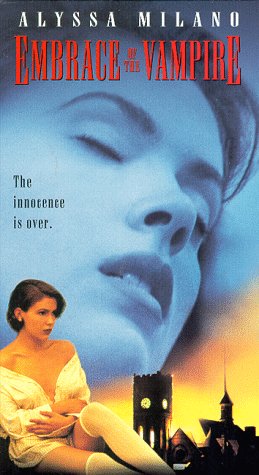
The TSL’s Horror Grindhouse: Embrace of the Vampire (dir by Anne Goursaud)


In this incredibly silly film from 1995, Martin Kemp plays The Vampire.  He doesn’t get a name but he does get a backstory.  Back when he was mortal, the Vampire pursued a secret and forbidden affair with a princess.  One day, after making love, the man who would became the Vampire was laying down next to a stream when he was approached by three naked women who proceeded to bite his neck and vampirize him.

Centuries later, the Vampire is sickly and approaching the end of his existence.  He only has three days to convince the reincarnation of his former lover to allow him to drink her blood so that he can continue to exist.  And apparently it won’t work unless she’s a virgin and unless she rejects all others and loves only him.  That sounds like a lot of rules to me and, to be honest, most of them seem to be kind of arbitrary.  Not only does The Vampire have to find the reincarnation of the Princess but he has to find her before she loses her virginity or otherwise, what?  She’ll cease to be the reincarnation?  Her love will somehow be devalued?  Her blood will no longer be worth drinking?  If this vampire has had to spend centuries only drinking blood from virgins who were in love with him, no wonder he looks so sickly.  I really think that maybe the other vampires were playing a practical joke when they explained the rules to him.  Hazing the new guy, it has consequences!

Anyway, the princess has been reincarnated as Charlotte (a young Alyssa Milano).  Fortunately, for the Vampire, Charlotte was raised in a convent and, even though she is now a college student, she’s still a virgin who blushes when she even hears the word sex.  Unfortunately, Charlotte has a boyfriend named Chris (Harrison Pruett) and she’s thinking about losing her virginity if she can convince herself that she loves Chris more than any other person that she will ever possibly meet.  So, the Vampire not only has to convince Charlotte to fall in love with him but he also has to make sure that she doesn’t have sex beforehand.  It’s going to be difficult because everyone on campus is determined to get Charlotte laid.  This has all the makings of Italian sex comedy but Embrace of the Vampire instead takes its plot very seriously.

The Vampire starts to appear in Charlotte’s dreams.  He gives her an ankh to replace the cross that Chris gave her.  Because the Ankh is a symbol of desire, just wearing it makes Charlotte more sexually aggressive and soon, she’s wearing short skirts, low-cut tops, and white stockings.  She’s also making out with Sarah (Charlotte Lewis), the photographer who lives in the dorm room next to hers.  (As played by Charlotte Lewis, Sarah is actually an interesting character and it’s a shame that the film pretty much just uses her for titillation.)  But since the Vampire’s whole thing is keeping Charlotte from losing her virginity, why would he give her something that would make her more open to sexual experiences?  Again, it’s hard not to think that the Vampire is just the victim of an elaborate practical joke.

As I said at the start of the review, Embrace of the Vampire is incredibly silly.  It’s also a film that seems to be a bit popular with viewers of a certain age.  I’m assuming that’s because of the frequent Alyssa Milano nudity and that one scene with Charlotte Lewis.  For the most part, Alyssa Milano gives a bland performance in Embrace of the Vampire.  It’s not so much that she’s bad as everything about her performance is on the surface.  One gets the feeling that there’s really not much going on with Charlotte’s inner life, both before and after she starts dreaming about The Vampire.  As The Vampire, Martin Kemp appears to be absolutely miserable.  He comes across as if he’d rather be anywhere than appearing in this movie.

That said, the film’s director got her start working with Francis Ford Coppola and she has a good eye for gothic scenery and atmosphere.  A scene where Charlotte imagines a frat party turning into a Hellish orgy is effectively done.  Jennifer Tilly has a small role as a vampire and she has said that Quentin Tarantino approached her at the Oscars to tell her that he enjoyed the movie.  It’s a silly movie (yes, third time I’ve used that specific term and that should tell you just how silly it is) but, for better or worse, it epitomizes an era.

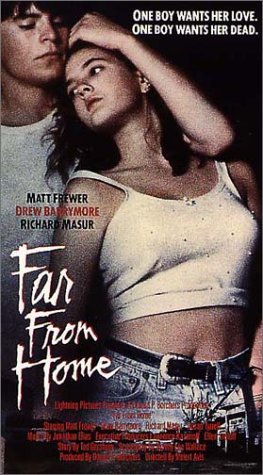
The TSL’s Horror Grindhouse: Far From Home (dir by Meiert Avis)


There are several lessons that can be learned from watching horror films.  One that is often overlooked is the importance of staying out of trailer parks.  Seriously, I have lost track of how many horror films have taken place within the confines of a trailer park.  Once you see someone surrounded by RVs and mobile homes, you know that they’re probably doomed.

Take 1989’s Far From Home, for instance.

Far From Home is set in perhaps the sleaziest trailer park in America.  This place sits in the middle of the Nevada desert and is run by chain-smoking Agnes Reed (Susan Tyrrell), who has a voice like a bullfrog, a daughter (Stephanie Walski) who is obsessed with watching TV and eating fishsticks, and a delinquent teenage son named Jimmy (Andras Jones).

The only law is provided by Sheriff Bill Childers (Dick Miller), who has a squad car but apparently no deputies.  Childers is gruff but not that bad of a guy once you get to know him.  However, he’s also played by Dick Miller and we all know better than to depend on Dick Miller to maintain the peace.

There’s a gas station nearby.  A mellow Vietnam vet named Duckett (Richard Masur) owns it.  Duckett is always willing to be helpful but he rarely has any gas.  This is one of those small towns where the gas truck apparently only rolls in every two months or so.  Still, Duckett’s a nice guy and he’s full of stories about how the government used to do atomic bomb tests in the surrounding desert.

(The scenes where Duckett drives around the desert feel somewhat out of place but they’re still enjoyable, due to Masur’s eccentric performance.)

Living in the trailer park, there’s a lot of odd people.  Some of them are permanent residents while some of them are just temporarily stranded.  14 year-old Pinky (Anthony Rapp, who would go on to appear in Dazed and Confused and Rent) lives with his mother and is a permanent resident.  His mother is rarely seen, though occasionally she can be glimpsed through a window, propped up in front of the TV.  Pinky says that, when he was a kid, he and Jimmy were best friends.  But now, Jimmy and Pinky are enemies.

And then there’s Amy (Jennifer Tilly) and Louise (Karen Austin), who are just waiting for enough gas to come in to be able to get Amy’s car to start running again.  Louise is intelligent and responsible.  Amy is flighty and undependable.  As soon as one of them accidentally pulls the handle off the driver’s side door, you just know one of them is going to end up getting trapped in that car at a bad moment.

When Far From Home opens, two newcomers have moved into the trailer park.  Writer, divorced father, and self-described “former angry young man” Charlie Cox (Matt Frewer) has just spent a month with his 13 year-old daughter, Joleen (Drew Barrymore, who was 14 when she made Far From Home).  It hasn’t exactly been a great vacation and it doesn’t get any better when Charlie’s car runs out of gas.  Joleen is about to turn fourteen and she doesn’t want to spend her birthday in a crummy trailer park with her incredibly dorky dad.

However, both Jimmy and Pinky are happy that Joleen will be spending at least a day or two at the trailer park.  At first, Joleen crushes on Jimmy and then, after Jimmy reveals himself to be aggressive and unstable, she crushes on Pinky, who protects her from Jimmy.  One of the two boys is so obsessed with Joleen that he is willing to commit murder to keep her from leaving the trailer park.  But which one?

(It’s actually pretty obvious but you probably already guessed that.)

Far From Home is a film about which I have mixed feelings.  On the one hand, the movie’s totally predictable.  Characters do dumb things for no real reason beyond needing to move the plot forward.  Charlie’s parenting abilities change drastically from scene to scene.  A traumatized character goes from catatonic to recovered to catatonic again with no real explanation.

One of my main issues with the film is that there’s no real surprise about who the killer turns out to be.  Even worse, once the killer’s identity is revealed, the killer suddenly turns into one of those psychos who can come up with a dozen one-liners while trying to kill someone.  I mean, seriously, who does that?  Are movie psychos required to take a year’s worth of improv clubs and do an apprenticeship with the Upright Citizens Brigade before they’re allowed to pick up a knife?  If I was the type to commit murder (and I’m not but let’s just say that I was), I would be too busy trying to make sure everyone was dead to be witty.  I’d save the jokes until I was safely on a beach somewhere, drinking pink lemonade and keeping an eye out for Ben Gardner’s boat.  That’s just me, I guess.

And yet, there’s a part of me that really likes this stupid, stupid movie.  It’s a surprisingly well-directed film, full of artfully composed shots.  The trailer park really does take on a life of its own and the film also makes good use of a nearby abandoned apartment building.  It’s a great location and, occasionally, it lends the film a dash of surrealism.  (Of course, I guess you could legitimately ask who would build an apartment complex in the middle of the desert, especially one that’s still humming with radiation from the Atomic bomb tests, but let’s not.)  Richard Masur, Dick Miller, and Susan Tyrrell all give good performances.  For that matter, the same is true of Anthony Rapp and Andras Jones.  Neither Rapp nor Jones are to blame for the fact that they were let down by a weak script.

Though I doubt either one of them would describe Far From Home as being their proudest cinematic achievement, Matt Frewer and Drew Barrymore are totally believable as father and daughter.  In the end, that’s why I like this movie.  Whenever I’ve watched Far From Home, I’ve always been able to relate to Joleen.  When I was thirteen, I basically was Joleen.

Fortunately, though, I was never found myself stranded in a trailer park full of homicidal maniacs.

I guess I just got lucky that way.

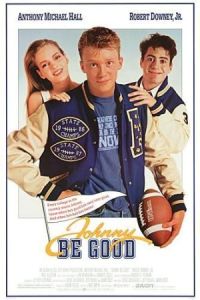
A Movie A Day #228: Johnny Be Good (1988, directed by Bud Smith)


Johnny Walker (Anthony Michael Hall) may be the best high school quarterback in the country but he has a difficult choice to make.  He promised his girlfriend, Georgia (Uma Thurman), that he would go to the local state college with her but every other university in the country wants him.  (Even legendary sportscaster Howard Cosell calls Johnny and advises him to go to an Ivy League college.)  As Johnny tours universities across the country, he faces every temptation.  By the time he makes his decision, will Johnny still be good?

The main problem with Johnny Be Good can be found in the first sentence of the above synopsis.  Anthony Michael Hall plays the best high school quarterback in the country.  By taking on the role of Johnny Walker, Hall was obviously attempting to prove that he was capable of more than just playing nerds for John Hughes.  But Hall is never convincing as a quarterback, much less the best in the country.  Though he bulked up for the role, it is impossible to imagine Hall in a huddle, coming up with the big play that wins the game.  It’s easier to imagine Johnny getting shoved in a locker and left there until the school year ends.  Hall seems to be lost in the role and the movie never seems to be sure who Johnny Walker is supposed to be.  (Two years later, Hall would again play a jock and give a far better performance in Edward Scissorhands.)

As for the rest of the cast, Robert Downey, Jr., who plays Johnny’s teammate and best friend, is even less convincing as a football player than Hall.  In the 1980s, Downey could play a quirky sidekick in his sleep but not a wide receiver.  Paul Gleason also shows up in the movie, basically playing the same role that he played in The Breakfast Club.  Uma Thurman is sweet and pretty in her film debut but it’s a nothing role.  Fans of Cannon Picture will want to keep an eye out for Steve James, in a small role as a coach.

Poorly written and slackly directed with few laughs, Johnny Be Good fails to take its own advice.