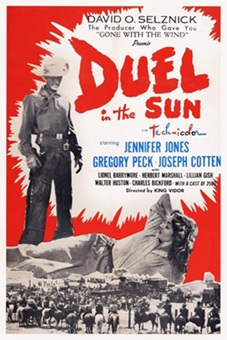
Duel In The Sun (1946, directed by King Vidor)


After her father is executed for killing her mother and her mother’s lover, “half-breed” Pearl Chavez (Jennifer Jones) is sent to live with her father’s second cousin, Laura Beth McCanles (Lillian Gish).  Laura is the wife of rancher, politician, and all-around racist Senator Jackson McCanles (Lionel Barrymore).  Worried that Pearl’s beauty and uninhibited manner will get her into trouble, Laura arranges for Pearl to meet with a minister known as The Sinkller (Walter Huston) who instructs Pearl on how to be a “good” girl.

Wanting to make Pearl bad and his, Lewton “Lewt” McCanles (Gregory Peck) becomes obsessed with Pearl and is soon forcing himself on her on a regular basis.  When the good McCanles brother, Jesse (Joseph Cotten), leaves the ranch despite being in love with Pearl, Pearl tries to find a good husband in the form of Sam Pierce (Charles Bickford).  Lewt responds by gunning Sam down and then goes on the run.  It all leads to an overwrought duel in the sun as the two doomed lovers take aim at each other.

Duel In The Sun is credited to veteran director King Vidor and there are a few shots of the western landscape that do feel typical of Vidor’s work.  However, Duel In The Sun’s true auteur was its producer, David O. Selznick.  Still looking to recapture his earlier success with Gone With The Wind and eager to make his future wife, Jennifer Jones, into an even bigger star than she was, Selznick obsessed over every detail of Duel In The Sun, pushing Vidor and a host of other directors (including Josef von Sternberg, William Dieterle, William Cameron Menzies, Otto Brower, and Sidney Franklin)  to make the film more steamy, more melodramatic, more violent, and more visually epic.  Reportedly, while Video was trying to shoot the film’s titular duel, he had to call cut several times when Selznick ran into the scene with a water bottle to spray more “sweat” onto Jones and Peck.  Today, the stiff Peck seems miscast as the black sheep of the family, the reserved Jones is even more miscast as a mestiza, and the plot is clearly too simplistic to carry the film’s epic ambitions.  A few impressive shots aside, Duel In The Sun is just boring,  In the 40s, though, the film’s relative openness about sex generated enough controversy to make Duel In The Sun into a box office hit.  It was one of the two top-grossing westerns of the 40s, beating out Red River, My Darling Clementine, Fort Apache, The Ox-Bow Incident, and several other films that were actually good.

Unlike Jones, Peck, and even usually reliable stalwart like Lionel Barrymore and Walter Huston, Joseph Cotten at least emerges from this film with his dignity intact.  Playing the good brother, Cotten gets to underplay while everyone else is overplaying and it turns out to be the right approach for him.  Surviving Duel In The Sun was no easy feat but Cotten pulled it off.
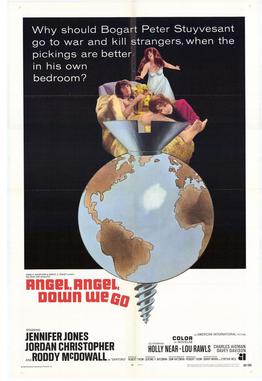
Film Review: Angel, Angel, Down We Go (dir by Robert Thom)


Oh dear Lord.

Listen, I’ve seen some bad movies before.  I’ve seen some annoying films before.  I’ve seen some pretentious movies before.  I don’t know if I’ve ever seen a movie as dedicated to being all three of them as 1969’s Angel, Angel, Down We Go appears to be.

Yes, this movie came out in 1969 and it’s one of those late 60s, counter culture films that’s so intent on impressing you by being daring that it doesn’t bother to actually come up with an interesting story or anything like that.  It’s a film that talks a lot but has nothing to say.  It’s a film that’s obviously meant to be very counter cultural and left-wing but it has a streak of such cruel misogyny running through it that it’s nearly impossible to watch certain scenes.

Singer Holly Near stars as Tara Steele, the teenage daughter of two wealthy parents.  Tara’s mother (Jennifer Jones) is a former actress who brags about having starred in over a hundred stag film without ever “faking an orgasm.”  Tara’s father (Charles Aidman) is a former military man who knew Douglas MacArthur and who is gay but closeted.  (The film handles the issue of his sexuality with all of the sensitivity that you would expect from an episode of the 700 Club.)  Tara is insecure because she’s overweight and her family doesn’t show her any love.  The film, it should be said, doesn’t really show her any love either.  Whether its the close-ups of her messily eating with food smeared across her face or the scenes in which other characters casually insult her, the film seems to have little sympathy for her.

Tara meets a rock singer named …. seriously, this is his fucking name …. Bogart Peter Stuyvesant (Jordan Christopher).  With his tight leather pants and his shirtless performances, Bogie (yes, he’s called Bogie) is supposed to be a Jim Morrison-style sex symbol.  Unfortunately, Jordan Christopher doesn’t have enough screen presence to pull off the role.  Bogie pretends to be in love with Tara (“Your breath stinks!” he shouts, “I dig it!”) but it’s just so he can seduce her mother and her father and make off with all of their money.  It’s supposed to have something to do with the hypocrisy of the American establishment or something but …. oh, who cares?

So, this movie is annoying for any number of reasons.  Robert Thom directs as if he was getting paid extra for every time he used a zoom lens or tossed in a jump cut.  Yet, despite all of the camera trickery, the story drags like you wouldn’t believe.  The walls of Jordan’s pad are decorated with a collage of American icons like Humphrey Bogart and Dwight Eisenhower and Thom often pointlessly zooms into the collage whenever he thinks it will help him make his point but since the film doesn’t really seem to have a point, the collage itself gets as boring as Bogie playing a harp.  Yes, Bogie does play a harp.  It goes over forever.

As I watched the film, I found myself growing more and more pissed off.  Every pretentious line of dialogue and arty camera angle just made me angrier and angrier.  Didn’t Jennifer Jones and Holly Near deserve better than this?  Who the Hell decided to cast bland, doughy Jordan Christopher as a sex symbol?  WHY WAS RODDY MCDOWALL IN THIS MOVIE!?  WHY CAST RODDY MCDOWALL AND THEN NOT HAVE HIM DO ANYTHING!?  Why did every scene have to drag on?  Why couldn’t the film just get to the freaking point!?  WHY WERE THEY SKY DIVING!?  WHY DID WE HAVE TO SIT THROUGH FIVE SONGS FROM JORDAN CHRISTOPHER!?  WHY?  WHY?  WHY!?

Anyway, I don’t really recommend this one.

6 Good Films That Were Not Nominated For Best Picture: The 1940s


Gary Cooper. Joan Fontaine, Mary Astor, and Donald Crisp at the 1942 Oscars.

Continuing our look at good films that were not nominated for best picture, here are 6 films from the 1940s.

Shadow of a Doubt (1943, dir by Alfred Hitchcock)

Amazing, Alfred Hitchcock never won the Best Directing Oscar.  In fact, it was rare that his films were even nominated.  (Though Rebecca did win Best Picture, it could be argued that film’s style was as much to due to David O. Selznick as it was to Hitchcock.)  One of the best of Hitchcock’s unnominated films was Shadow of a Doubt.  With its dark sense of humor and wonderful performances from Joseph Cotten and Teresa Wright, Shadow of a Doubt was Hitchcock at his best.  It was also, perhaps, a bit too darkly subversive for the Academy.

Detour (1945, dir by Edgar G. Ulmer)

The ultimate film noir nightmare, Detour was actually well-received when it was originally released, though it would take a while for the film to be recognized as a true classic.  Still, there was no way that the Academy was going to nominate a low-budget B-movie about a guy who hitchhikes across America and manages to accidentally kill two people.  Detour was far too nightmarish and surreal for the Academy but it’s remained one of the most influential films ever made.

Gilda (1946, dir by Charles Vidor)

Another classic film noir, Gilda is the film that, for many, will always define Rita Hayworth.  Through the film was a financial and critical success, it was ignored by the Academy.  The success of this film and the popularity of Hayworth’s performance led to the fourth atomic bomb to ever be detonated being named Gilda.  Rita Hayworth was reportedly not happy to hear it.

Black Narcissus (1947, dir by Michael Powell and Emeric Pressburger)

One of the most visually stunning films ever made, Black Narcissus won Oscars for Best Cinematography and for Art Design but it received no other nominations, not even for the outstanding performances of Deborah Kerr and Kathleen Byron, as two nuns who have very different reactions to the Himalayas.

Out of the Past (1947, dir by Jacques Tourneur)

A world-weary private investigator (Robert Michum) is hired by a slick and psychotic gangster (Kirk Douglas) and ordered to track down the gangster’s girlfriend (Jane Greer).  So beings this rather melancholy and introspective film noir, one that is distinguished by wonderfully shadowy photography and which features one of Mitchum’s best performances.  Sadly, the Academy recognized neither the film nor Mitchum’s performance.

Portrait of Jennie (1948, dir by William Dieterle)

This haunting and dream-like fantasy stars Joseph Cotten as a painter who meets, paints, and falls in love with a mysterious woman (Jennifer Jones) who may not be what she seems.  The film was apparently not a huge success when it was first released but, seen today, it’s hard not to get swept up in the film’s romantic sadness.  Though it received a nomination for Best Cinematography, it was otherwise ignored by the Academy.

Up next, in about an hour or so, the 1950s!

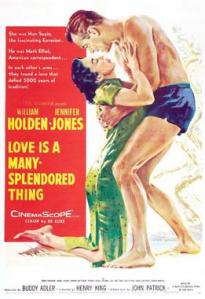
Lisa Reviews An Oscar Nominee: Love Is A Many-Splendored Thing (dir by Henry King)


(With the Oscars scheduled to be awarded on March 4th, I have decided to review at least one Oscar-nominated film a day.  These films could be nominees or they could be winners.  They could be from this year’s Oscars or they could be a previous year’s nominee!  We’ll see how things play out.  Today, I take a look at the 1955 best picture nominee, Love Is A Many-Splendored Thing!)

Before I talk about Love Is A Many-Splendored Thing, let’s play a little trivia game.

I’m going to list ten films.  Your job is to guess what they all have in common:

Did you guess?  All ten of these films came out in 1955 and not a single one of them was nominated for best picture.  That’s something that I found myself thinking about quite a bit as I watched Love Is A Many-Splendored Thing on TCM last night.  Of course, at this point, everyone knows that deserving films are often ignored by the Academy and that what seems like a great film during one year can often seem to be rather forgettable in subsequent years.

So, you can probably guess that I wasn’t terribly impressed with Love Is A Many-Splendored Thing but, before I get too critical, I want to start things off on a positive note.  William Holden was, without a doubt, one of the best actors to ever appear in the movies.  He started his film career in the 1930s and worked regularly until his death in 1981.  Just consider some of the films in which Holden appeared: Golden Boy, Our Town, Sunset Boulevard, Stalag 17, Sabrina, Picnic, Network, and so many others.  Of course, not every film in which Holden appeared was a masterpiece.  He made his share of films like Damien: Omen II and When Time Ran Out.  But the thing is that, regardless of the film, Holden was always good.

That’s certainly the case with Love Is A Many-Splendored Thing.  It’s not one of Holden’s better films but William Holden is his usual dependable self.  He plays Mark Elliott, a rugged American correspondent who is living in Hong Kong in the 1940s.  While the Chinese Civil War rages nearby, Mark deals with his failing marriage.  His wife is back in the States.  They’re separated but not quite divorced.  Mark owns a really nice car and, since he’s played by William Holden, he delivers the most world-weary of lines with an undeniable panache.  He also appears shirtless for a good deal of the film.  Between this and Picnic, 1955 was the year of the shirtless Holden.

The problem with Love Is A Many-Splendored Thing is not with William Holden.  Instead, the problem is with the miscasting of Jennifer Jones as Han Suyin, the woman with whom Mark Elliott falls in love.  Han Suyin was a real-life person, a doctor who wrote the autobiographical novel on which Love Is A Many-Splendored Thing was based.  Han Suyin was Eurasian.  Jennifer Jones most definitely was not.  Throughout the film, Han Suyin and Mark often discuss what it’s like to be Eurasian and to be in the middle of two very different cultures.  There’s even a discussion about whether Han Suying should try to pass as European.  It all has the potential to be very interesting except for the fact that Jennifer Jones, who was so good in so many films, is in no way convincing in her role.  Whenever she mentions being Eurasian, which she does frequently, the film come to a halt as we all stare at Jennifer Jones, one of the first film stars to ever come out of Tulsa, Oklahoma.

It all leads to a rather strained movie, one that never really drew me into its cinematic world or story.  (For the record, a lot of people on twitter disagreed with me on this point.)  Ultimately, the main reason to watch it was for William Holden.  According to the film’s Wikipedia entry (how’s that for in-depth research), Holden and Jones reportedly did not get along during filming, with Jones apparently chewing garlic before their love scenes and there was a definite lack of chemistry between them.  Maybe I got spoiled by William Holden and Kim Novak dancing in Picnic but I never believed that Mark and Han Suyin were attracted to each other.  Interestingly, Jones and Holden would later both appear in another best picture nominee, 1974’s The Towering Inferno.  However, they didn’t share any scenes.

Love Is A Many-Splendored Thing was nominated for best picture but it lost to a far different love story, Marty.  This was also the final film directed by Henry King to be nominated for best picture.  Previous King films to be nominated included State Fair, In Old Chicago, Alexander’s Ragtime Band, The Song of Bernadette, Wilson, and Twelve O’Clock High.

Embracing the Melodrama #28: The Towering Inferno (dir by John Guillermin)


The_Towering_Inferno_1974-500x300

I have a weakness for the old, all-star disaster movies of the 1970s.  It could be because those movies remind me of how fragile life really is and encourage me to make the most of every minute.  Or maybe it’s because I have my phobias and, by watching those movies, I can confront my fears without having to deal with a real-life tornado, hurricane, tidal wave, avalanche, or fire.

Or maybe I just have a weakness of glitz, glamour, and melodrama — especially when it involves a huge cast of stars and character actors.  Yes that’s probably the reason right there.

Case in point: the 1974 best picture nominee, The Towering Inferno. 

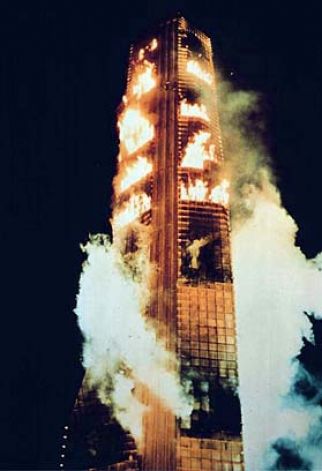
As is the case with most of the classic disaster films, The Towering Inferno is a long and big movie but it has a very simple plot.  The world’s tallest building — known as the Glass Tower — has been built in San Francisco.  On the night of the grand opening, a fire breaks out, trapping all the rich and famous guests on the 135th floor.  Now, it’s up to the fire department to put out the fire while the trapped guests simply try to survive long enough to be rescued.  Some will live, some will die but one thing is certain — every member of the all-star cast will get at least 15 minutes of screen time and at least one chance to scream in the face of the film’s still effective special effects.

628x471

As for the people trapped by the towering inferno, we don’t really get to know them or their motivations.  (Add to that, once the fire breaks out, everyone pretty much only has one motivation and that’s to not die.)  As a result, we don’t so much react to them as characters as we do to personas of the actors who are playing them.

Steve-McQueen-in-The-Towe-001

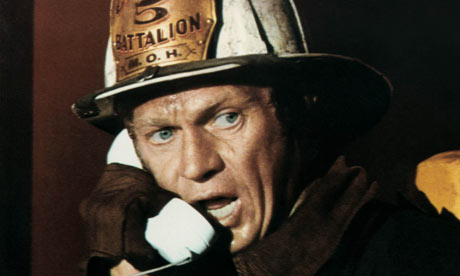
For instance, we know that Fire Chief O’Halloran is a fearless badass and a natural leader because he’s played by Steve McQueen.  McQueen brings a certain blue collar arrogance to this role and it’s a lot of fun to watch as he gets progressively more and more annoyed with the rich people that he’s been tasked with rescuing.

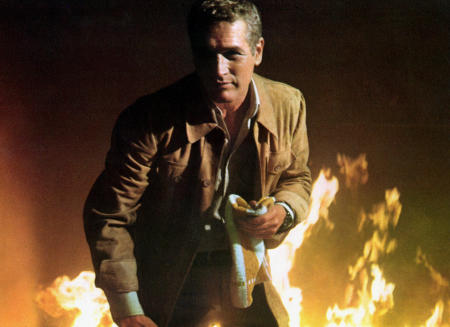
We know that architect Doug Roberts is a good guy because he’s played by Paul Newman.  Reportedly, Newman and McQueen were very competitive and, in this movie, we literally get to see them go-head-to-head.  And, as charismatic as Newman is, McQueen pretty much wins the movie.  That’s because there’s never a moment that O’Halloran isn’t in charge.  Doug, meanwhile, spends most of the movie begging everyone else in the tower to exercise the common sense necessary to not die.  (Unfortunately, despite the fact that he looks and sounds just like Paul Newman, nobody in the tower feels like listening to Doug.  If Towering Inferno proves anything, it’s that most people are too stupid to survive a disaster.)

paul-newman-inferno1

The tower’s owner, James Duncan, is played by William Holden so we know that Duncan may be a ruthless businessman but that ultimately he’s one of the good guys.  Holden gets one of the best scenes in the film when, after being told that people in the building are catching on fire, he replies, “I think you’re overreacting.”

Roger Simmons is Duncan’s son-in-law and we know that he’s ultimately to blame for the fire because he’s played by Richard Chamberlain.  Roger might as well have a sign on his back that reads “Doomed.”  The same can be said of publicity executive Dan (Robert Wagner) and his girlfriend, Lorrie (Susan Flannery).

The_Towering_Inferno_1974_Faye_Dunaway_Mike_Lookinland

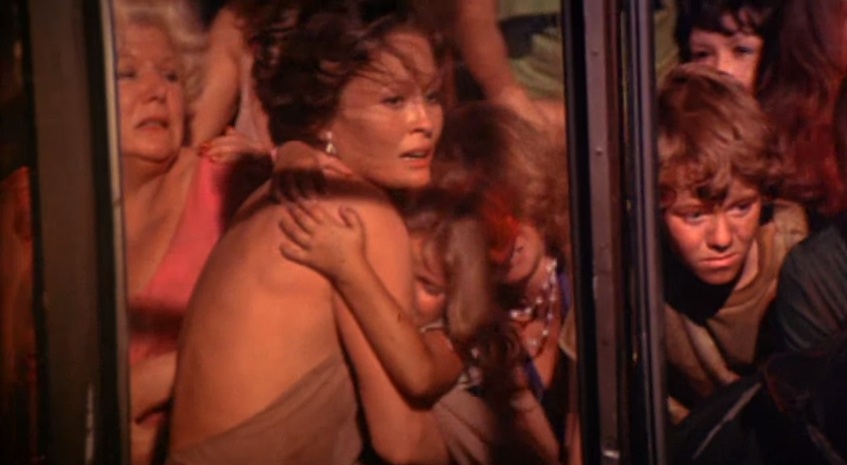
Faye Dunway is Susan.  She is Doug’s fiancée and she really doesn’t do much but she does get to wear a really pretty dress.  The same can be said of Susan Blakely, who plays Roger’s dissatisfied wife, and Jennifer Jones, who plays a recluse.  And good for them because if you’re going to be stuck in an inferno without much to do, you can at least take some comfort in looking good.

Then there’s Fred Astaire, who does not dance in this film.  Instead, he plays a kind-hearted con artist who ends up falling in love with Jennifer Jones.  Fred Astaire received his only Oscar nomination for his brief but likable performance in The Towering Inferno.

And finally, there’s the building’s head of security, Jernigan.  We know that he’s a murderer because he’s played by O.J. Simpson and … oh wait.  Jernigan is actually probably the second nicest guy in the whole film.  The only person nicer than Jernigan is Carlos, the bartender played by Gregory Sierra.

OJ

The real star of the film, of course, is the fire.  In the 40 years since The Towering Inferno was produced, there’s been a lot of advances in CGI and I imagine that if the film was made today, we’d be watching the fire in 3D and it would be so realistic that we’d probably feel the heat in the theater.  That said, the fire effects in The Towering Inferno are still pretty effective.  Now, I have to admit that I have a phobia (and frequent nightmares) about being trapped in a fire so, obviously, this is a film that’s specifically designed to work itself into my subconscious.  But that said, the scenes with various extras thrashing about in the flames are still difficult to watch.  There’s a scene where Robert Wagner and Susan Flannery find themselves trapped in a blazing reception area and it is pure nightmare fuel.

The Towering Inferno 9

The Towering Inferno is an undeniably effective disaster film.  At the same time, when one looks at the 1974 Oscar nominees, it’s odd to see The Towering Inferno nominated for best picture along with The Godfather Part II, Chinatown, and The Conversation.  Unlike those three, The Towering Inferno is hardly a great film.

But it is definitely an entertaining one.

toweringinferno2