In 1920s Hollywood, famed comedian Alfie Alperin (Malcolm McDowell) has made the transition from screen stardom to working behind the scenes as a producer and studio head. With the coming of the talkies and the death of silent cinema, Alfie plans to make his mark with an epic western starring Tom Mix (Bruce Willis) as Wyatt Earp. The real Wyatt (James Garner) is hired to act as an on-set consultant. Wyatt’s former girlfriend, Christina (Patricia Hodge), is now married to Alfie.
What Mix and Earp discover is that, despite his beloved public image, Alfie is actually a monster who is involved with organized crime and sex trafficking and who has the police on his payroll. While searching for Christina’s missing son (Dermot Mulroney), Mix and Earp get caught up in a murder involving Alife’s sister (Jennifer Edwards) and a gangster named Dutch (Joe Dallesandro). At the first Academy Awards are handed out in Beverly Hills, Tom Mix and Wyatt Earp prepare for the final showdown with their producer.
The idea behind Sunset was promising. Wyatt Earp, a real cowboy who survived the end of the West, teams up with Tom Mix, a movie cowboy who is trying to survive the end of the silent era. (Earp and Mix were friend in real life, as well.) Bruce Willis comes across as being too contemporary in the role of Tom Mix but James Garner plays Wyatt Earp with a weary dignity and Malcolm McDowell does a convincing Charlie Chaplin impersonation. Unfortunately, Blake Edwards’s direction allows the story to meander and the mystery itself is so full of red herrings that it’s impossible to follow. Edwards didn’t seem to know if he wanted this movie to be a buddy comedy, an elegiac tribute to the end of the silent era, or a satire of Hollywood. He tried to include elements of all three but the movie itself just doesn’t come together. Only Garner and McDowell emerge from the film relatively unscathed.
Fortunately, for Bruce Willis, DieHard was released just two months after Sunset.
(Lisa is currently in the process of cleaning out her DVR! She has got over 170 movies on the DVR to watch and she’s trying to get it done before the start of the new year! Can she get it done? Probably not, but she’s going to try! 1972’s The Carey Treatment was recorded off of TCM on July 23rd.)
Dr. Peter Carey (James Coburn) is the epitome of 1970s cool. He’s got hair long enough to cover the top half of ears. He’s got a fast car. He’s got a rebellious attitude and a girlfriend (Jennifer O’Neill) who rarely questions his decisions. Though you don’t see it in the movie, Dr. Carey probably smokes weed when he’s back at his fashionably decorated apartment. How do I know this? Well, he’s played by James Coburn. Even if some of them are nearly 50 years old, you can still get a contact high from watching any movie featuring James Coburn.
Anyway, what the Hell is The Carey Treatment about? Dr. Carey has just recently moved to Boston, where he’s taken a job at a stodgy old hospital. The hospital’s chief doctor, J.D. Randall (Dan O’Herlihy, of Halloween III: Season of The Witch fame), might want Dr. Carey to tone down his free-livin’, free-lovin’ California ways but no one tells Peter Carey what to do. In fact, the entire city of Boston might be too stodgy and conventional for Dr. Carey. You see, Dr. Carey not only heals people. He also beats up people who try to stand in his way. Peter Carey is a doctor who cares but he’s also a doctor who can kick ass.
And he’s going to have to kick a lot of ass because Dr. Randall’s daughter has just turned up dead. The police say that she died as the result of a botched abortion and they’ve arrested Carey’s best friend, Dr. David Tao (James Hong). (The Carey Treatment, it should be noted, was filmed before Roe v. Wade legalized abortion.) The Boston establishment is determined to use Dr. Tao as a scapegoat but Dr. Carey is convinced that his friend is innocent. In fact, he doesn’t think that the death was the result of an abortion at all. Carey sets out to solve the case … HIS WAY!
If it seems like I’m going a little bit overboard with my emphasis on the Dr. Peter Carey character, that’s because this entire movie feels more like a pilot for a weekly Dr. Carey television series as opposed to an actual feature film. It’s easy to image that each week, James Coburn would drive from hospital to hospital, solving medical mysteries and debating social issues with stuffy members of the Boston establishment. Henry Mancini would provide the theme music and Don Murray would guest star as Dr. Carey’s brother, a priest who encourages the young men in his parish to burn their draft cards.
It might have eventually become an interesting TV show but it falls pretty flat as a movie. James Coburn is in nearly every scene, which would usually be a good thing. But in The Carey Treatment, he gives an incredibly indifferent performance. He seems to be bored by the whole thing and, as a result, Dr. Peter Carey is less a cool rebel and more of a narcissistic jerk. The mystery itself is handled rather haphazardly. On the positive side, Michael Blodgett gives a wonderfully creepy performance as a duplicitous masseur but otherwise, The Carey Treatment is nothing special.
Someone is stalking soap opera star, Kristin (Catherine Oxenberg). She is receiving frightening notes and her coworkers are dying. Who is after her and what does it have to do with a tragic fire at a birthday party? Is it one of her jealous co-stars? Is it her duplicitous boyfriend (David Naughton)? Is it the stranger (William Bumiller) that she’s having an affair with? Or is it the obsessed fan (Karen Black)? Detective Morrison (Larry Brand) is on the case!
The return of Detective Morrison (played, again, by the film’s director) makes Overexposed a sequel to The Drifter. (Both films were directed by Brand and executive produced by Roger Corman). Morrison has much more to do in Overexposed than he did in The Drifter so maybe the plan was to launch a low-budget franchise of Detective Morrison movies. It didn’t happen, because Overexposed is much less interesting than The Drifter. The spoiled and rich Kristin is never a likable character and the movie’s real star was Oxenberg’s busy body double, Shelley Michelle.
Overexposed does have a few good scenes, including death-by-acidic-facial-cream. The best thing about movie is Karen Black, who brilliantly delivered a monologue about why she loves television. It doesn’t have much to do with the rest of the movie but Karen Black knocked it out of the park. The monologue ends with Karen Black paying homage to The Mod Squad by shouting out, “Solid!”
Earlier today, I took a look at The People Next Door, a film about a family torn apart by the discovery that their teenage daughter is taking drugs. For all of that film’s melodrama and over-the-top moments, it still worked. It may have felt like it was taking place on a plane of heightened reality but it still felt real nonetheless. Among the many films in the drugs-in-the-suburbs genre, that general feeling of reality made The People Next Door unique. Far more typical of the genre is the 1973 made-for-TV movie, Go Ask Alice.
Go Ask Alice is based on a YA book that’s been in print for 43 years now. (I can still remember spending an afternoon reading it in a Barnes and Noble when I was 14 years old.) The book claims to be the diary of a teenage girl who ended up getting addicted to drugs and sex. She runs away from home for a bit and, even when she does manage to stop using drugs, her friends still insist on secretly slipping her acid. She goes crazy and ends up spending some time in a mental asylum. Eventually, she’s released and moves to a new town with her family. She ends the diary saying that she’s looking forward to the future and then, in the afterward, we’re told that she died three weeks later of an overdose and this diary has been published so that we can all learn from her story.
Now, oddly enough, when Go Ask Alice was originally published, it was apparently sold as being an authentic diary of an anonymous teenage girl who had been a patient of the book’s “editor”, Dr. Beatrice Sparks. However, if you actually read the book, it’s pretty obvious that, while Dr. Sparks may have indeed used some of her patients’ real-life experiences, Go Ask Alice is in no way authentic. Instead, it’s a classic example of the type of cautionary tale in which a character makes one mistake (in this case, the girl drinks a soda that’s been spiked with LSD) and, immediately afterwards, everything bad thing that possibly could happen does happen. The purpose of the book is to shock and titillate, to make us wonder how this girl can go from being the sweet optimist who bought a diary because she feels that she finally has something to say to being so jaded that she casually says stuff like, “Another day, another blowjob.” And, of course, the answer is that she didn’t because the whole thing is totally made up.
But that still didn’t stop anyone from making a movie out of the book and informing us, at the start of the movie, that the story we are about to watch is true and only the names and certain details have been changed to protect everyone’s privacy. Our diarist (who is now definitely named Alice) is played by a young actress named Jamie Smith-Jackson, who is sympathetic and pretty. Alice’s mother (Ruth Roman) is too repressed and uptight to provide any guidance to her rapidly maturing daughter. Meanwhile, Alice’s father is played by William Shatner, so we know he’s not going to be able to do any good either.
Much as in the original book, Alice goes to one party, drinks on LSD-spiked soda, and her life is never the same. Soon, she’s spending all of her time doing drugs and, as she informs us, having a “monthly pregnancy scare.” She’s no longer hanging out with her smart, nerdy friends. Instead, she spends all of her time with a bunch of petty criminals who recruit Alice to help deliver drugs to the students at the junior high. (“I push at the elementary school!” one junior high kid snarls). Eventually, Alice runs away from home and lives on the streets. Fortunately, she runs into a liberal Catholic priest (played by Andy Griffith and yes, you read that right) and starts trying to get her life straight…
Go Ask Alice is no The People Next Door but it’s no Reefer Madnesseither. What it gets wrong about teenage drug use, it gets right about just how confusing and alienating it can be to be 15 years old. At the same time, I’d be lying if I said that this film did not have some camp appeal. How can it not when it features not only Andy Griffith talking tough but also William Shatner with a bushy mustache?
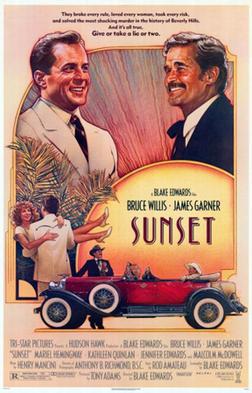 In 1920s Hollywood, famed comedian Alfie Alperin (Malcolm McDowell) has made the transition from screen stardom to working behind the scenes as a producer and studio head. With the coming of the talkies and the death of silent cinema, Alfie plans to make his mark with an epic western starring Tom Mix (Bruce Willis) as Wyatt Earp. The real Wyatt (James Garner) is hired to act as an on-set consultant. Wyatt’s former girlfriend, Christina (Patricia Hodge), is now married to Alfie.
 Someone is stalking soap opera star, Kristin (Catherine Oxenberg). She is receiving frightening notes and her coworkers are dying. Who is after her and what does it have to do with a tragic fire at a birthday party? Is it one of her jealous co-stars? Is it her duplicitous boyfriend (David Naughton)? Is it the stranger (William Bumiller) that she’s having an affair with? Or is it the obsessed fan (Karen Black)? Detective Morrison (Larry Brand) is on the case!
 Through the Shattered Lens