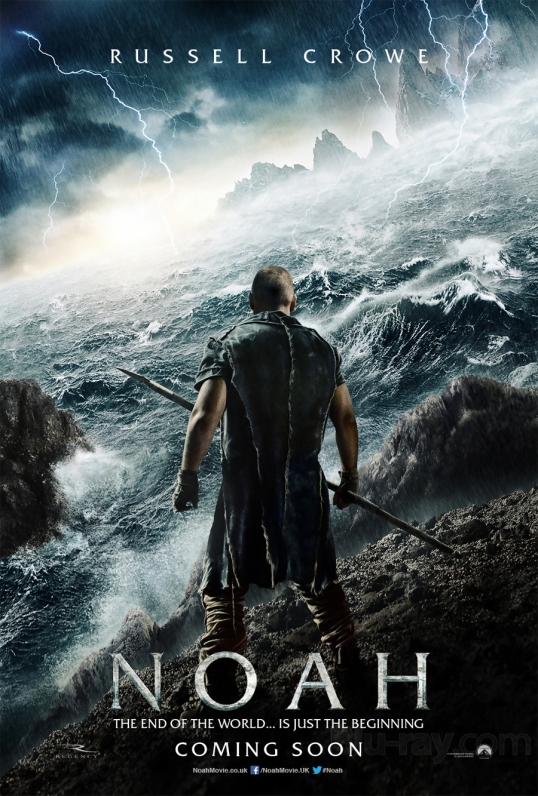
So, was Noah good or not?


Poster-Noah-Aronofsky

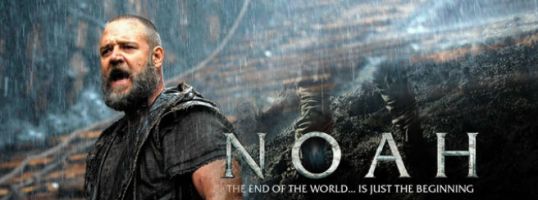
Was Noah a good movie or not?

That’s a question that was first asked way back in March.  At the time, the answer depended on who you asked.  For instance, Noah is one of Arleigh’s favorite films of the year.  My reaction, however, was far more mixed.  Noah was one of those movies that I thought I would review as soon as I watched it but that proved to be a lot more difficult than I expected.  As I found myself wondering what I should say in my review, it became very apparent to me that I wasn’t sure whether I liked the film or not.

By the time that I finally decided that I was, overall, disappointed by Darren Aronofsky’s controversial and spiritual-but-not-quite-biblical version of the Deluge, over a month had passed and we had all moved on to different movies.

And so that review remained unwritten.  And, at first, I thought it wouldn’t matter.  As much as I try to review every single movie that I see, I know that the world is not going to end if I miss a film or two.  After all, I’ve never specifically written down just how much I hated the latest Transformers movie and the world has yet to plunge into the sun…

And yet, for all of its flaws and the fact that it left me feeling underwhelmed, Noah has stuck in my mind in a way that many of the films that I saw this year have not.  It would be a struggle for me to remember much of anything about Dracula Untold but Noah Noah has stayed with me.

Thinking back, it’s easy for me to say what did not work about Noah.

As opposed to Aronofsky’s best films (Requiem for A Dream, The Wrestler, and my beloved Black Swan), Noah felt oddly paced with certain scenes ending too quickly while other scenes seemed to drag on forever.

The film’s environmental message was delivered with such a heavy hand that it ultimately did not make much of a difference whether you agreed or not.  For a film that went out of its way to establish itself as not being a traditional biblical film, Noah was certainly preachy.

While the film deserves credit for not flinching in its portrait of a surly and self-righteous Noah, it still doesn’t change the fact that the movie was essentially 138 minutes spent with a very unlikable character.

Anthony Hopkins gave perhaps the worst performance of his career as Methuselah.  In the role of Tubal-Cain, Ray Winstone was such a one-dimensional villain that I half expected him to invent trains just so he could tie Emma Watson to the tracks.

And, of course, there were the Watchers — fallen angels who had been turned into sentient piles of stone by a vengeful God.  I know that some people loved the Watchers but to me, they looked ludicrous…
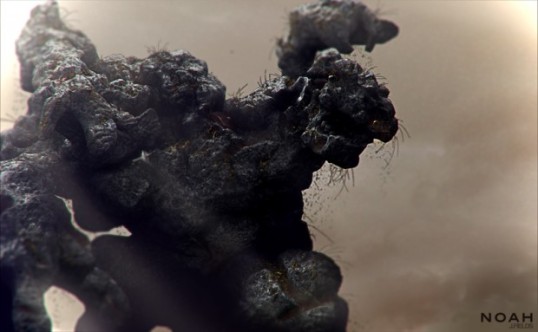
NoahWatchers

And yet, that’s the reason why we love Darren Aronofsky, isn’t it?

Obviously, it was a risk to portray the fallen angels as being a bunch of talking rocks.  It was also a risk to take a character who is mentioned only once in the book of Genesis — in this case, Tubal-Cain — and then use that character as a representation of everything that’s wrong with the human race.  It was a risk to make a “biblical” film that openly questioned both the existence and wisdom of God.  We expect and demand that directors take risks but, at the same time, we also want to ridicule and judge when those risks don’t work out.  That’s the issue that we, as film lovers, often face.  Do we celebrate and perhaps excuse a director for his intentions or do we solely judge him based on the results?

And the thing with Noah is that, as much as the movie did not work for me, it also did work for me.  For all of those flaws that I listed above, Noah is full of images that are so beautiful and so memorable that I can still visualize them as if I saw them yesterday:

Noah and his sons walk across a gray and blasted landscape, stopping just long enough to stare at a foreboding city in the distance.

Noah walks through a decadent settlement and briefly, this somber film is so full of bright colors and flamboyant characters that the viewer is almost as overwhelmed as Noah.

That Ark, looking small and isolated, floating across an endless blue ocean.

And finally, Noah talking about the horrors of humanity and briefly, we see that the shadows that he’s visualizing are dressed in modern clothing.

For all of my issues with Noah, it’s such a visually impressive film and takes so many risks that I can’t help but respect it.  I don’t consider it to be a great film but, after all this time, I can say that it’s a film that only a true artist could make.

And, considering the current state of American film, that’s one of the best compliments that one can give.
noah-banner222

A Late Film Review: Winter’s Tale (dir by Akiva Goldsman)


Winter's_tale_(film)

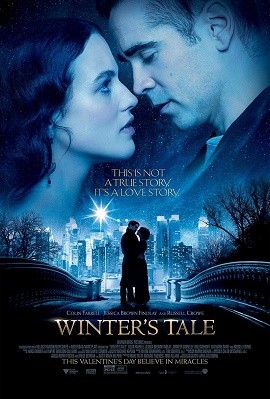
I liked Winter’s Tale.

And I don’t care what anybody else says!

And that’s a good thing too because, critically, Winter’s Tale has been one of the most maligned movies of 2014.  It came out on Valentine’s Day, at the same time as Endless Love.  And the critics absolutely hated it!  For a while there, the online film community was taking bets on which one of the two Valentine’s Day releases would end up with the lowest score on Rotten Tomatoes.  And, though it was a close race, Winter’s Tale actually ended up with the lower score, coming in at 13% as opposed to Endless Love‘s 15%.

That’s right — according to most mainstream film critics, Winter’s Tale was actually worse than Endless Love.

Well, those critics were wrong.  That’s how I felt when I first saw Winter’s Tale and, after watching it a second time on HBO, that’s still how I feel.  Winter’s Tale is not a bad movie!

(Incidentally, Winter’s Tale has a 6.2 rating over at the imdb, which would seem to indicate that I’m not the only person who knows better than Peter Travers.)

Admittedly, the plot of Winter’s Tale does not make much logical sense but that’s kind of the point.  It’s a tale and tales are not about being realistic.  Tales are about emotion and the whole point of listening to or telling a tale is to inspire feelings. To truly appreciate Winter’s Tale, you have to understand that this is a fairy tale that happens to be set in the most mythical of American cities, New York.

Opening in 1895 and ending in 2014, Winter’s Tale tells the story of Peter Lake (Colin Farrell).  When Peter was an infant, his immigrant parents were refused entry into Manhattan because they both had tuberculosis.  So, they put Peter in a toy boat and dropped him into ocean and watched as the boat slowly floated towards America.

Jump forward 21 years and Peter has grown up to be a thief, working for a gangster named Pearly Soames (Russell Crowe).  What few people know is that Pearly is actually a demon who regularly visits his boss, Luicfer (played by Will “Yes, that Will Smith” Smith).  Pearly is immortal as long as he stays in New York City.

When Peter decides that he wants to leave Pearly’s gang, Pearly orders that Peter be killed.  However, while fleeing from the rest of the gang, Peter is rescued by a flying white horse.  While Peter’s first instinct is to fly the horse out of New York and spend the winter in Florida, he instead decides to rob one more mansion.  (It helps that the horse literally takes him to the mansion.)

While robbing the mansion, Peter meets Beverly Penn (Jessica Brown Findlay), a passionate and talented pianist who is dying of tuberculosis.  In what is literally a case of love at first sight, Peter forgets about robbing the mansion and instead has a cup of tea with Beverly.  They discuss their lives and Beverly tells Peter that everyone has a miracle inside of them and that everyone becomes a star after dying.

Soon, Peter and Beverly are a couple and Peter even manages to win over Beverly’s suspicious father, Isaac (William Hurt).  Peter and Beverly spend the winter at her family’s summer home.  Peter believes that his miracle is to save Beverly.  Meanwhile, an angry Pearly waits for his chance to get revenge…

Now, I will admit that there are some obvious flaws with Winter’s Tale.  Russell Crowe goes totally overboard, with his accent wildly going from Australian to New Yorkish to Scottish and back again.  Meanwhile, Will Smith is not necessarily a bad choice to play the devil and he actually gives a pretty good performance but it doesn’t chance the fact that, whenever he’s on screen, all you can think about is that he’s Will Smith and he’s playing the devil.

But, honestly, who cares?  This is an amazingly romantic film and Farrell and Findlay have a lot of chemistry.  When you see them together, you have no doubt that Peter and Beverly are meant to be together.  You care about them as a characters, even if you don’t always understand everything that’s happening around them.  Their love feels real and, when it comes to telling a love story, isn’t that the most important thing?

(Add to that, does any actor fall in love as convincingly as Colin Farrell?)

And the film itself is gorgeous!  From the costumes to the set design to Caleb Deschanel’s cinematography, the film is just beautiful to look at.  Undoubtedly, cynics would argue that the film is almost too glossy in its appearance but Winter’s Tale is not a film for cynics.  It’s a film for romantics.

So, yes,  I did like Winter’s Tale and I am not ashamed to admit it.

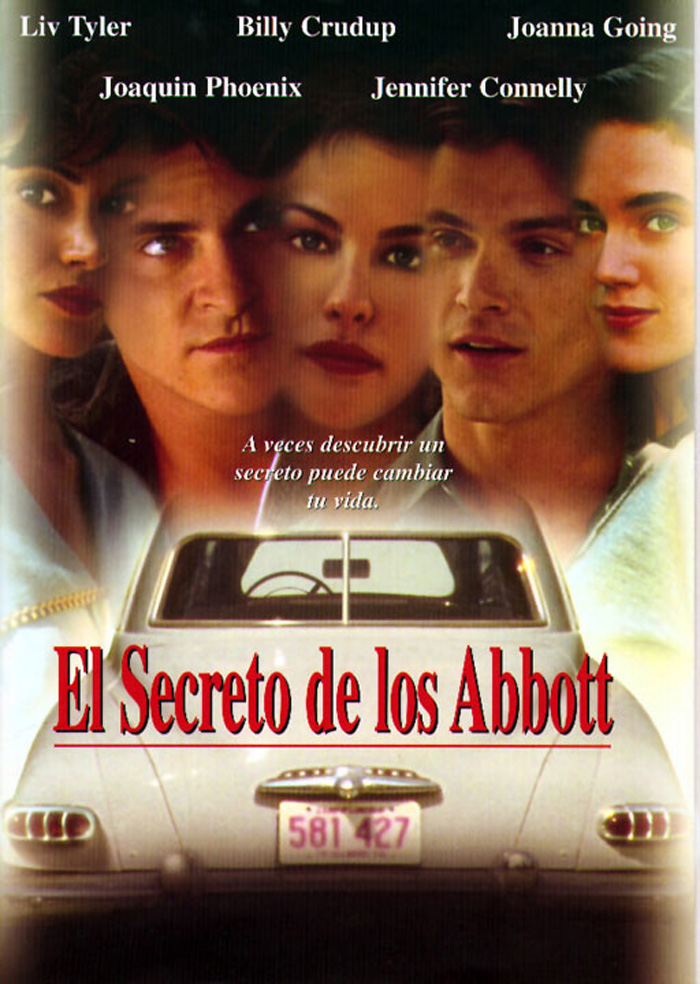
Embracing the Melodrama #45: Inventing the Abbotts (dir by Pat O’Connor)


First released in 1997, Inventing the Abbotts is a small town, romantic melodrama about two families in the 1950s.  One family is poor.  One family is rich.  As you can probably guess, each is fated to determine the destiny of the other.

Decades ago, Lloyd Abbott (Will Patton) and Holt were business partners.  However, after Lloyd had an affair with Holt’s wife (Kathy Baker), their friendship ended.  Lloyd eventually becomes the richest man in town and has three beautiful daughters: dutiful Alice (Joanna Going), wild Eleanor (Jennifer Connelly), and virginal Pam (Liv Tyler).  Holt is long since dead and his two sons, Jacey (Billy Crudup) and Doug (Joaquin Phoenix) live next door to the Abbotts.  While the bitter Jacey is obsessed with the Abbott family and ends up pursuing both Eleanor and the married Alice, Doug claims not to care about the Abbotts.  However, despite his claimed indifference, Doug soon finds himself falling in love with Pam.  Will Doug and Pam be together or will Lloyd succeed in keeping them apart?

To be honest, Inventing the Abbotts is not a particularly good film.  It moves way too slowly, Doug and Jacey frequently swtich personalities whenever the plot demands it, the story is way too predictable, the voice over narration is way too obvious, and Jennifer Connelly’s character leaves the film way too early.  This is one of those films that is determined to make sue that you never forget that it’s taking place in the 50s and you can be sure that every cliché that you associate with that decade will pop up at least once.  There are a few scenes that could have been easily been replaced with a picture of Joaquin Phoenix holding a sign reading, “It’s the 50s,” without causing us to miss out on any important information.

And yet, I still liked Inventing the Abbotts.  I think it really comes down to the fact that I’m the youngest of four sisters and therefore, I have a weakness for movies about sisters.  And the sisters in Inventing the Abbotts are all perfectly cast and believable as siblings so, for me, the movie was redeemed because of the number of scenes to which anyone who is a sister or who has a sister will be able to relate.

As such, despite its flaws, Inventing the Abbotts is definitely a guilty pleasure for me.

Your results may vary.

Inventing the Abbotts

Scenes I Love: Noah


Poster-Noah-Aronofsky

One of the best films (at least in this blogger’s honest opinion) of the year also happens to be one of it’s most controversial. It’s Darren Aronofsky’s follow-up to his equally critically-acclaimed and just as controversial Black Swan. I am speaking of his Biblical epic Noah and the story of the Flood.

It’s a film that doesn’t feel religious yet full of spirituality. It’s a film that dares to take a look at text seen as hallowed by billions in a way that doesn’t take a stand on the debate of science versus religion (though some feel that Aronofsky’s atheist background paints the film on the side of science). Noah has a scene in the beginning of it’s third act (one that some have called the dealbreaker for how they thought of the film in the end) that best exemplifies the conjoining of science and religion. It’s the best retelling of the Creation Story that I’ve heard and/or seen.

Courtesy of Protozoa Pictures…The Creation scene from Noah.

Super Bowl Trailer: Noah


5204

Noah is Darren Aronofsky’s follow-up to his critically-acclaimed film Black Swan (which was reviewed by Lisa Marie Bowman herself) and he looks to tell the tale of Noah’s Ark from the Book of Genesis.

When news first came out that Aronofsky would follow-up Black Swan with a biblical epic that retold the Flood and Noah’s role in saving those not corrupted according to Heaven was a sort of headscratcher. The teasers and trailers that has come out about the film hasn’t really fired up the masses. Some think it as another sword-and-sandals epic that’s late to that particular subgenre’s resurgence. Some think too much fantasy elements has been added.

One thing I’m sure of is that Aronofsky will not make an uninteresting film.

Noah is set for a March 28, 2014 release date.