Film Review: Clue (dir by Jonathan Lynn)


It was a dark and stormy night in 1954….

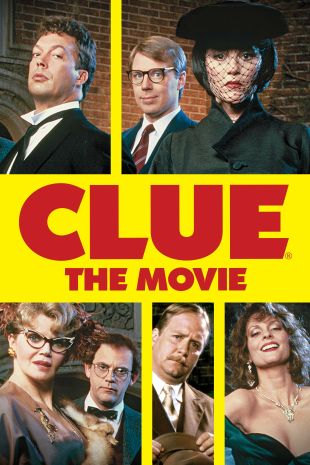
The 1985 comedy, Clue, opens with a set of six strangers arriving at an ominous mansion in New England.  They’re meet by Wadsworth (Tim Curry), an oddly charismatic butler who explains that all six of the strangers have a few things in common.  They all work in Washington D.C.  They are all, in some way, involved with the government.  And they’re all being blackmailed by Mr. Boddy (Lee Ving), the owner of the house.

The six strangers have all been assigned nicknames for the night.

Miss White (Madeleine Khan) is the enigmatic widow of a nuclear physicist who may have had communist sympathies.  Actually, Miss White is a widow several times over.  All of her husbands died in circumstances that were a bit odd.  Is Miss White a black widow or is she just unlucky?  And what about the flames of jealousy that she occasionally mentions?

Professor Plum (Christopher Lloyd) is a psychiatrist who once worked for the World Health Organization and who has an unfortunate habit of sleeping with his patients.

Mr. Green (Michaele McKean) explains that he works for the State Department and that he is also secretly gay.  If his secret got it, he would be deemed a security risk or perhaps even a communist agent.

Mrs. Peacock (Eileen Brennan) is the wife of a U.S. Senator who forced to resign after getting caught up in a bribery scandal.

Colonel Mustard (Martin Mull) is a somewhat stuffy war hero-turned-arms dealer.

And finally, Miss Scarlet (Lesley Ann Warren) is Washington D.C.’s most powerful and most witty madam.

Once everyone is in the house, Wadsworth explains that the police have been called and will arrive in 45 minutes, at which point Mr. Boddy will be arrested and everyone’s secrets will be exposed.  Mr. Boddy’s solution is to suggest that one of the six kills Wadsworth.  After tossing everyone a weapon, Mr. Boddy turns out the lights.  When the lights come back on, Wadsworth is still alive but Mr. Boddy is not.  But who murdered Mr. Boddy?  And in what room?  And with what weapon?  And what to make of the other people who were either in the house or show up at the front door, like the maid, Yvette (Collen Camp), or the motorist (Jeffrey Kramer) who shows up to use the phone or the traveling evangelist (Howard Hesseman)?  Can the mystery be solved before the police show up and presumably arrest everyone?

Based on the old board game, Clue is a hilariously exhausting film, one that mixes smart wordplay and broad physical comedy to wonderful effect.  It’s not often that you see a film that gets equal laughs from two people colliding in a hallway and from characters accusing each other of being communists.  In fact, it’s so easy to marvel at the physical comedy (especially the lengthy scene where Tim Curry runs from room to room while explaining his theory about who committed the murders) that it’s easy to forget that the film is also a sharp satire on political corruption, national paranoia, 50s morals, and the McCarthy era in general.  Since all of the characters are already convinced that they’re either surrounded by subversives or in danger of being accused of being a subversive themselves, it’s not a great leap for them to then assume that any one of them could be a murderer.  I mean, if you’re willing to betray your country than who knows what you might be willing do in the study with a candlestick?

The cast is full of comedy veterans, all of whom know how to get a laugh out of even the mildest of lines and none of whom hold back.  Madeline Kahn, in particular, is hilarious as Miss White though my favorite suspect, in both the game and the movie, has always been Miss Scarlet.  Not only is she usually portrayed as being a redhead in the game but, in the movie, her dress is to die for.  In the end, though, it’s perhaps not a surprise that the film is stolen by Tim Curry’s energetic performance.  The film’s final 15 minutes are essentially a masterclass in physical comedy from Tim Curry but he’s just as funny when he’s delivering his frequently snarky dialogue.  Both Wadsworth the character and Tim Curry the actor appear to be having a blast, running from room to room and shouting out accusations.

When Clue was originally released, it was released with three different endings.  Apparently, the audience wouldn’t know which ending they were going to get before the movie started.  I guess that the idea was to get people to go the movie three times to see each ending but I imagine few filmgoers had the patience to do that and who knows how many viewers went to multiple showings just to discover that the randomly selected ending was one that they had already seen.  I’m surprised that I haven’t come across any reports of riots breaking out.  Fortunately, the version of Clue that is now available for viewing features all three endings.  Of course, none of the endings make much sense.  Hercule Poirot would demand a do-over, especially if he was being played by Kenneth Branagh.  But the fact that it’s all so ludicrous just adds to the comedy.  I watched Clue two Fridays ago with a group of friends and we had a blast.  It’s definitely a movie that’s more fun when you watch it with other people.

(That said, as far as incoherent solutions are concerned, the third one was my favorite and I think Poirot would agree.)

As for the board game itself, I used to enjoy playing it when I was a kid.  We had really old version from the 60s and I always used to imagine what all of the suspects were like when they weren’t being accused of murder.  I always imagined that Mr. Green and Miss Scarlet probably had something going on.  Today, I’ve got a special Hitchcock edition of the game.  It’s all good fun, this never-ending murder mystery.
Film Review: Jaws 2 (dir by Jeannot Szwarc)


The 1978 film Jaws 2 poses a question that has been asked many times under many different circumstances:

When will people learn?

Seriously, you would think that after everything that happened during the first Jaws, the people of Amity Island would be a little bit smarter when it comes to sharks.  I mean, did Ben Gardner, the Kintner Boy, Quint, and Chrissie Watkins all die in vain?  If I lived on Amity Island, I would be so paranoid about another shark attack that I would probably move to Manitoba.  At the very least, I would demand that the beach be closed if there was even the slightest chance that another great white shark was somewhere out there, eating anyone foolish enough to get back in the water.

It’s just common sense!

But no.  In Jaws 2, when another shark shows up and eats two divers and a water skier before blowing up a motor boat, no one is even willing to consider shutting down the beach.  Even after Chief Brody (Roy Scheider) insists that another shark has shown up, no one is willing to listen to him.  “I know something about sharks!” Brody insists but the town council just shrugs him off.  Maybe they think that Quint and Hooper did all the work the last time and that Brody was just along for the ride.

Of course, Brody does bring some of his problems on himself.  Brody spends a lot of this film sitting in the dark, brooding about sharks.  When he sees a shadow in the ocean, he runs down to the beach and starts shooting at it.  “It’s just blue fish!” someone yells while Brody looks a little confused.  How shocked can we really be when the town council fires Brody?  He was a loose cannon.

Before he gets fired, Brody orders his teenage son, Mike (Mark Gruner) to stay out of the water.  Of course, Mike doesn’t listen.  He goes sailing with his friends and his younger brother, Sean (Marc Gilpin).  That’s a big mistake, of course.  As soon as Mike and company are a good distance away from Amity Island, the shark attacks and leaves them all stranded at sea.  Mike is knocked unconscious.  Sean is trapped on a boat all by himself.  One of the teenage girls, Jackie Peters (Donna Wilkes), totally freaks out while her older sister, Brooke (Gigi Voran), suggests that they all play charades to pass the time.  Everyone dismisses her idea but you know what?  I have it on very good authority that sharks love charades.  I think Brooke was on to something…

Jaws 2 is a strange, strange movie.  It’s really two films in one.  Jaws 2 starts out as an almost by-the-book remake of Jaws.  True, Quint’s dead.  And Richard Dreyfuss had just won an Oscar so there’s no way Hooper was going to come back.  But Brody’s back and he’s once again an island police chief who is afraid of the water and who can’t get anyone to listen to him.  Just as Jaws started out as almost a small town comedy, Jaws 2 has an early scene where Brody has to deal with the quirky citizens of Amity Island. (Unfortunately, Harry and his really bad hat don’t make a return appearance.)  A scene where a dead killer whale washes up on the beach is shot to remind us of the scene in the first in which Hooper and Brody examine a dead shark.

But then, halfway through, Jaws 2 turns into a totally different movie.  Suddenly, the teenagers are trapped out in the middle of the ocean and the shark is circling them and Brody is searching from them and the whole movie just goes insane.  Roy Scheider abandons any attempt at subtlety as he becomes as obsessed with shark as Donald Pleasence was with Michael Myers in Halloween.  The shark turns out to be incredibly sneaky.  He’s never around until you stick your hand in the water and then suddenly — SHARK!

How powerful is this shark?  He’s so powerful that he eats a freaking a helicopter!  Seriously, a coast guard helicopter tries to rescue the kids and ends up getting eaten by the shark!  That scene alone is worth whatever’s led up to it.  (I think Jaws 2 might be the first film to feature a shark eating a helicopter.)  The film only gets crazier from there, with Brody eventually reduced to verbally taunting the shark while clutching onto a power cable.

Now, admittedly, those stranded teenagers aren’t the most developed characters in the world.  There’s a lot of them and it’s sometimes difficult to keep track of who is who.  Fortunately, this is a 70s films and that means that Jaws 2 is all about the hair.  You may not know their names but you’ll never forget their hair:

Check out some of the members of the Jaws 2 hair club:

Jaws, come out to play…

(Okay, Luther wasn’t actually in the movie but just imagine if he had been!)

Anyway, Jaws 2 cannot begin to hold a candle to the original Jaws but it’s still a lot of fun.  Admittedly, there are a few parts, especially during the first hour, that drag in a way that Spielberg, the consummate story teller, would not have allowed.  I could have done without some of the lengthy scenes where Brody tries to convince the city council that there’s another shark in the water, if just because we already know that the shark’s there and we can guess that the beach isn’t going to be closed.  (After all, if the beach was closed, there wouldn’t be a movie…)

But once the teenagers are stranded in the ocean and the shark is eating the helicopter and Brody is calling it a bastard while hanging onto a power cable, there’s no way that you can resist the charms of this sequel.  Jaws 2 isn’t exactly good but it’s just so entertaining!

Jaws 2 frequently shows up on AMC so keep an eye out for it!

And, for the love of God — stay out of the water!

A Movie A Day #42: Hero and The Terror (1988, directed by Steve Tannen)


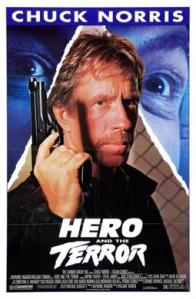
hero_and_the_terror_posterDanny O’Brien (Chuck Fucking Norris!) is a tough Los Angeles cop who has been nicknamed Hero.  Danny hates it when people call him “Hero.”  Maybe if Danny knew what people usually call cops, he would not complain so much about his nickname.  Three years ago, Danny captured Simon Moon (Jack O’Halloran), a neck-breaking serial killer nicknamed “The Terror.”  After he was captured, The Terror faked his own death and disappeared.  He ended up living in a deserted theater and not bothering anyone until the Mayor of Los Angeles (Ron O’Neal, Superfly himself!) decides to tear down his new home.  The Terror does not take kindly to urban renewal and goes on another killing spree.  Can Hero track down and beat the The Terror while also making it to the hospital in time to see his girlfriend give birth to their baby?

Not surprisingly, Hero and the Terror is one of the films that Chuck made for Cannon Films in the late 80s and, along with Chuck and Ron O’Neal, it features Cannon regulars Steve James and Billy Drago.  (Billy Drago actually plays a good guy, for a change.)  It’s obvious that Chuck was trying to broaden his horizons with Hero and the Terror: with the exception of the final confrontation between Hero and the Terror, there’s less kung fu action than in his previous films and a lot of the movie is dedicated to his relationship with his girlfriend and his struggle to handle her pregnancy.  That’s all good and well and the Chuck Norris of Hero and The Terror is a much better actor than the Chuck Norris who could barely deliver his lines in Breaker, Breaker but, ultimately, a Chuck Norris movie with more human interest and less roundhouse kicks just feels wrong.

(On Netflix, there’s a whole documentary about how Chuck Norris’s roundhouse kicks led to the collapse of Nicolae Ceaușescu’s communist dictatorship in Romania.  It’s called Chuck Norris vs. Communism.  Communism didn’t have a chance.  Hopefully, Chuck will never turn against capitalism because, if he does, it’ll probably lead to another stock market crash.)

I once read an interview with Gene Hackman, in which he was asked to name his least favorite of the movies that he had made.  Hackman selected March or Die.  “I can’t believe I was in something called March or Die,” Hackman said.  If he thought March or Die was a bad title, he should be happy that he didn’t end up in Hero and The Terror.  Give Chuck Norris credit.  Even if he’s not Gene Hackman and even if the movie does not really work, he is the only actor who could credibly star in something called Hero and the Terror.

Lisa Reviews An Oscar-Nominated Horror Film: Jaws (dir by Steven Spielberg)


JAWS_Movie_poster

There’s little that is more intimidating than trying to write a review of the 1975 best picture nominee, Jaws.

I mean, seriously, what’s left to be said about this film?  Jaws is one of those movies that everyone has seen and everyone loves.  And, even if someone somehow hasn’t seen the film, chances are that they still know all about it.  They know that it’s a movie about a giant shark that attacks Amity Island, just as the summer season is starting.  They know that the town’s mayor refuses to close the beaches, because he doesn’t want to lose the tourist dollars.  They know that the final half of the film is three men (Roy Scheider, Richard Dreyfuss, and Robert Shaw) floating around in a boat, searching for a shark.  And they certainly know that, whenever you hear John Williams’s iconic theme music, it means that someone is about to get attacked.

Jaws is such a part of our culture that probably not a single day goes by without someone saying a variation on “we’re going to need a bigger boat.”  Did you know that, on twitter, Ben Gardner’s boat has its own account?  And despite getting pretty graphically dismembered about halfway through Jaws, poor little Alex Kintner has an account as well!

What’s amazing about Jaws is that, even though everyone’s seen it and it’s been parodied a few thousand times, Jaws remains incredibly effective.  I still find myself cringing whenever the shark catches Alex Kintner and that geyser of blood explodes out of the ocean.  I still jump whenever the shark suddenly emerges from the water and scares the Hell out of Roy Scheider.  I still laugh at Richard Dreyfuss’s hyperactive performance and I instinctively cover my ears whenever I realize that Robert Shaw is about to drag his nails across that chalk board.

And then there’s that music, of course!  Even after being used, misused, and imitated in countless other films, the Jaws theme still fills me with a sort of existential dread.  The mechanical shark was notoriously fake-looking and was rarely seen onscreen as a result.  The camera and the music stand in for the shark and it works beautifully.

The one unfortunate thing about Jaws is that it’s been so critically acclaimed and so embraced by audiences that I think people tend to forget that it is primarily a horror film.  Mainstream critics tend to look down on horror as a genre so, rather than admit the obvious, they claim that Jaws is more of a thriller than a horror film.  Or they talk about how it’s actually meant to be a political allegory or an environmental allegory or an examination of male bonding.

So, let’s just make this clear.  No matter what the elitist critics or even Steven Spielberg himself may say, Jaws is primarily a horror film, with that relentless killer shark serving as a prototype for such future horror fiends as Michael Myers, Jason Voorhees, Freddy Krueger, and both of the Ghostface and Jigsaw Killers.  (Jaws even opens with a stereotypical slasher movie death, as a nude and stoned swimmer is suddenly attacked by an unseen killer.) If not for Scheider, Shaw, and Dreyfuss floating in the endless ocean, you would never have had films — like the Blair Witch Project — about people being lost and stalked in the wilderness.  And when that shark attacks and graphically rips apart its victims, how different is it from something you might find in a George Romero or Lucio Fulci zombie film?

On the basis of Jaws and Duel, I think it can be argued that, if Steven Spielberg hadn’t become America’s favorite director of crowd-pleasing, Oscar-contending blockbusters, he could have been one of our best horror directors.  Sadly, Spielberg has pretty much abandoned horror and I doubt that Jaws would be as effective if it were made today.  (I suspect that the temptation to resort to a cartoonish CGI shark would be too great.)

But that’s all speculation.

What matters is that Jaws remains one of the greatest films ever made.

And it’s a horror film!