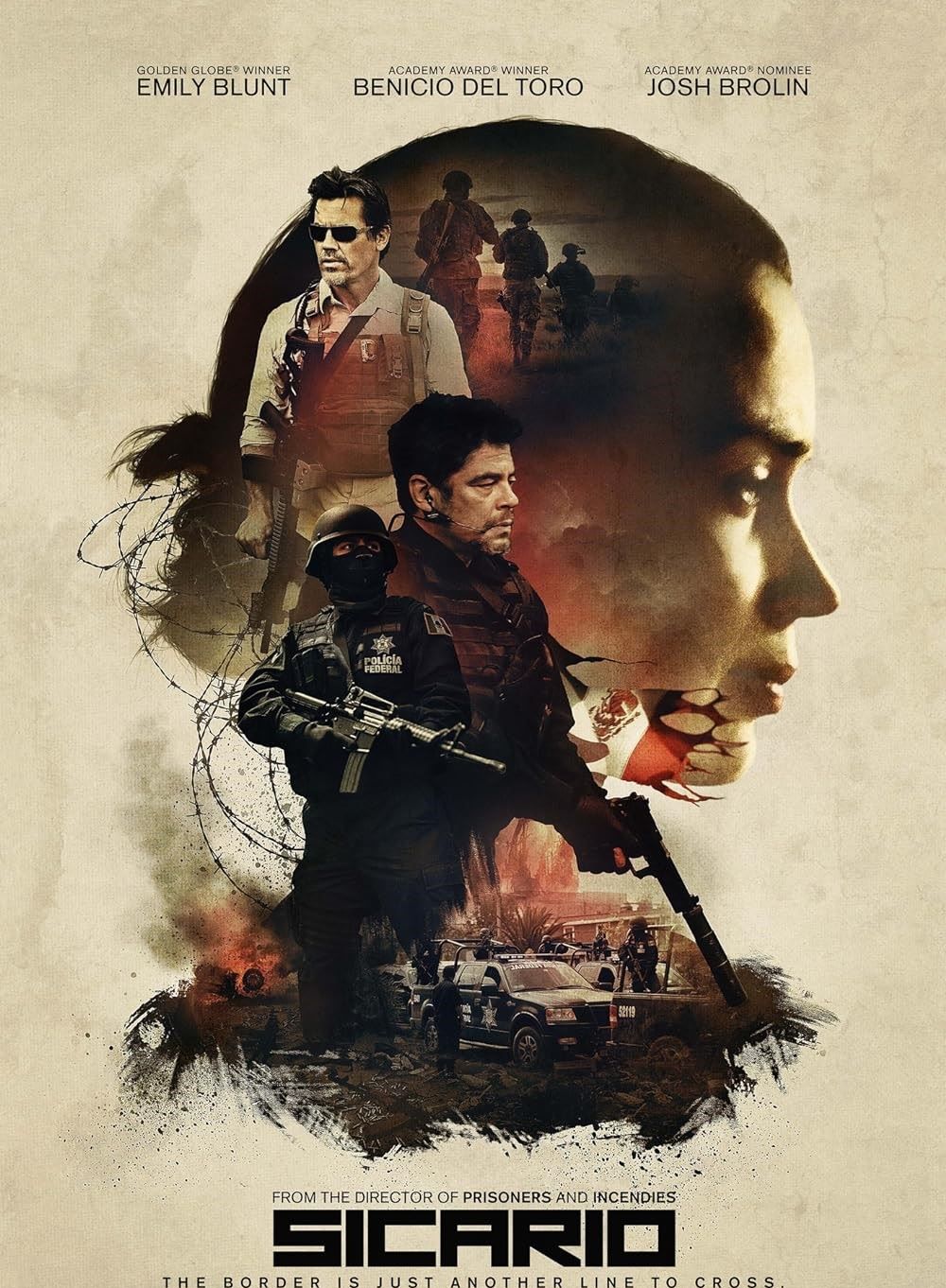
Review: Sicario (dir. by Denis Villeneuve)


“You should move to a small town where the rule of law still exists. You will not survive here. You are not a wolf. And this is the land of wolves now.” — Alejandro

Sicario is one of those thrillers that doesn’t just try to get your pulse up; it wants to leave you sitting there afterward, uncomfortable and a little hollowed out. Set in the murky world of the U.S.–Mexico drug war, it follows an idealistic FBI agent pulled into a “by any means necessary” operation and slowly realizing she’s basically a pawn in a much bigger, much uglier game. It’s not a movie about slick heroes taking down bad guys so much as a slow, grim spiral into the realization that the system is rigged on every level, and that’s where the film is both at its most impressive and its most uncompromising. Overall, it leans heavily positive as a piece of craft—beautifully shot, superbly acted, tightly directed—and its refusal to blink at where its story logically leads is a big part of what gives it power.

The basic setup is simple enough: Kate Macer, played by Emily Blunt, is an FBI agent used to doing things by the book, raiding cartel safe houses in Arizona with her partner Reggie. After a grisly opening operation that turns up corpses hidden in the walls and a deadly booby trap, she’s recruited into a joint task force helmed by Josh Brolin’s Matt Graver, a flip‑flop‑wearing CIA type who treats international borders and legal constraints as suggestions. The team’s official mission is to go after a cartel lieutenant, Manuel Díaz, but very quickly Kate realizes she’s only being told a fraction of what’s really going on. The more she pushes for answers, the more obvious it becomes that Matt and his mysterious associate Alejandro (Benicio Del Toro) are running their own agenda and using her badge and presence as cover.

From the start, Denis Villeneuve frames this story as a descent, and he does it by locking us into Kate’s perspective for most of the film. We’re as confused and kept in the dark as she is: we don’t fully know why the team is crossing into Juárez, why everyone is so tense at the border, or what the deeper objective is besides “disrupt the cartel.” That choice pays off in a huge way during the film’s standout sequences, whether it’s the convoy inching through traffic surrounded by armed federales or the nighttime tunnel infiltration lit by thermal and night‑vision photography. Those scenes aren’t just “cool action beats”; they’re engineered to make you feel boxed in and outmatched, like violence could erupt at any second and no one really has control. Even when nothing is technically happening, you can feel the nerves jangling under the surface.

One of the most striking things about Sicario is how it weaponizes space. The way the film uses its wide, open desert vistas isn’t just pretty scenery—it adds this creeping, suffocating dread to everything, as if the characters are tiny figures swallowed up by forces they can’t hope to understand or control. Those long shots of trucks threading their way across the landscape, or helicopters gliding over seemingly endless scrub, make the world feel vast, ancient, and totally indifferent to whoever’s spilling blood on it today. In those moments, the movie almost channels a kind of Lovecraftian horror, the same cosmic, indifferent menace that Cormac McCarthy managed to weave through his Westerns, where the land itself feels old, hostile, and utterly unmoved by human morality or suffering. It’s not supernatural, but that sense of something bigger, colder, and permanent presses down on every decision these characters make.

Roger Deakins’ cinematography is a huge part of why that dread lands so well. The desert is captured in these wide, ominous skyline shots with tiny vehicles creeping along the horizon, giving Sicario a sense of menace that feels baked into the environment. Even the daylight scenes feel threatening, all washed‑out heat and harsh sun flattening everything into a kind of moral no‑man’s‑land. Then the movie flips into night, and suddenly you’re plunged into infrared and silhouettes, which fits perfectly with the story’s obsession with secrecy and invisible lines being crossed. This is one of those films where you could watch with the sound off and still feel the tension just from how the images are composed, but the use of space and light also nudges the movie into that McCarthy‑adjacent territory where the West is less a backdrop and more a silent, malevolent presence.

The performances match that level of craft. Emily Blunt plays Kate as tough and competent, but not in a superhero way—she’s brave, but she’s also human, constantly trying to reconcile what she’s seeing with what she believes law enforcement is supposed to be. You can see the frustration mounting as she keeps demanding clarity and hitting a wall of smirks, deflections, and “you’ll understand later.” Benicio Del Toro, meanwhile, walks off with the film as Alejandro, this quiet, haunted figure who initially seems like just another operative but reveals layers of trauma and ruthlessness as the story goes on. The script is smart about keeping his backstory mostly hinted at until late in the film, which makes it all the more chilling when you finally see what he’s really there to do. Josh Brolin is the third pillar, playing Matt as casually flippant on the surface but utterly cold about collateral damage, the kind of guy who laughs through briefings because he already knows the moral lines are going to be erased.

On a thematic level, Sicario is very much about complicity and the idea that in this particular “war,” there are no clean hands. Kate comes in thinking she’s going to help nail cartel leadership through some kind of legal, targeted operation; what she slowly figures out is that the task force is really trying to destabilize one cartel to empower another, consolidating power into a more “manageable” single organization. That logic—“create one devil we can deal with instead of many we can’t”—is chilling, and the movie doesn’t really offer a comforting counterargument. Instead of pulling back or softening that stance, it commits to showing what that philosophy looks like in practice, all the way to the bitter end. By the time Alejandro reaches his personal endgame and we see what “justice” looks like in this world, any illusions about moral clarity are gone, and the film refuses to apologize for following that line through.

Where some films might hedge their bets or try to inject a last‑minute note of optimism, Sicario is deliberately straight‑backed about where its story logically leads. The CIA needs Kate’s FBI status to legitimize their operation on U.S. soil, but they don’t actually want her input; she’s there to sign off and be lied to, not to shape policy. Every time she pushes back—like when she tries to build a traditional case after the task force raids a cartel‑connected bank—she’s shut down because “that’s not what this mission is.” Even the brief subplot with the corrupt local cop Silvio is there to underline how the drug war trickles down: this isn’t just cartel bosses and shadowy agents, it’s working‑class people pulling double duty as mules because they’re desperate, and they end up as expendable as anyone else. Rather than treating that as background noise, the movie leans into the bleak implications and lets them sit with you.

The same goes for Kate’s arc. Some viewers see the film as sidelining its female lead in the third act, shifting the narrative fully over to Alejandro just when things are coming to a head. Structurally, that is what happens: the viewpoint tilts from Kate’s confused horror to Alejandro’s mission, and she becomes more of a witness than an active participant. But that shift feels of a piece with the movie’s overall approach—she has been outmaneuvered and used from the start, and Sicario isn’t interested in pretending otherwise just to deliver a more empowering or conventionally satisfying ending. There’s something bracing about the way the film sticks to its guns here; it says, “this is the world we’ve shown you for two hours, and this is how someone like Kate gets treated in it,” and then follows through.

All of this could have tipped into empty cynicism if the film didn’t feel so precise and purposeful. Jóhann Jóhannsson’s score, all pounding, low‑end rumble and ominous strings, practically turns the highway scenes into horror set‑pieces; it feels like the sound of something massive grinding forward that you can’t stop. Villeneuve keeps the pacing deliberate but never sluggish, using long stretches of quiet to make the explosions of violence feel random and brutal instead of exciting. Even small scenes, like Kate’s attempted hookup with a local cop who turns out to be on the cartel payroll, are staged to underline how deeply compromised everything is. There’s no safe space, no “off the clock” moment where the larger conflict doesn’t intrude, and the movie doesn’t pretend there is just to make you feel better walking out.

If you go into Sicario looking for a clean, cathartic crime thriller where the good guys outsmart the bad guys, you’ll probably come away irritated or even angry. The movie’s whole point is that those categories don’t really apply in this corner of the world, and it’s committed enough to that idea that it never gives you an easy out. But if you’re up for something more sobering—an incredibly well‑crafted, morally grim look at the drug war with standout work from Blunt, Del Toro, Brolin, Deakins, and Villeneuve—it’s a pretty exceptional ride. Its worldview is harsh, but it’s also coherent and honestly pursued, and that level of conviction is a big part of why the film lingers. It may not be the kind of movie you “enjoy” in a traditional sense, but it’s one that sticks with you, and in this genre, that counts for a lot.
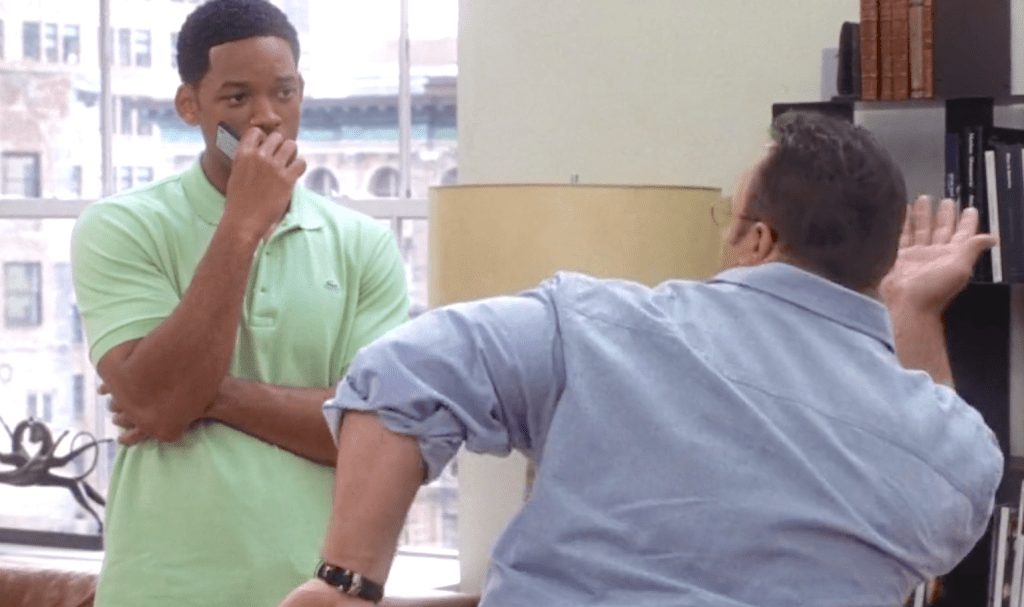
Brad reviews HITCH (2005), starring Will Smith and Kevin James!


I guess you can call this the holiday season of love for me, as I turn my attention today toward the 2005 romantic comedy HITCH. Will Smith stars as Alex “Hitch” Hitchens, a somewhat legendary and highly discreet consultant based in New York City. His specialty… helping less than perfect, even slightly awkward, men win the hearts of beautiful women. His methods are very effective, but he only works with men who are genuinely in love and not just chasing a one-night stand. His latest lovelorn client, the sweet and clumsy tax accountant Albert Brennaman (Kevin James), is smitten with a famous heiress named Allegra Cole (Amber Valletta), a client of the tax firm he works for. As Hitch works his magic for Albert, he also meets the cynical, but extremely beautiful tabloid journalist Sara Melas (Eva Mendes). Hitch finds himself falling for Sara at the same time that she’s on the trail of an urban myth of a “Date Doctor,” mistakenly believing that he is exploiting the emotions of women in the city for his own personal gain. When Sara and Amber discover who Hitch really is, will the guys’ true love win the day, or will the ladies believe it was all just a sleazy, manipulative setup?

HITCH is one of my favorite romantic comedies, and I watch it every year, usually multiple times. I’m a romantic at heart, and I really enjoy a film that plays with the idea of characters who truly care about, and respect, each other. This dynamic plays out through several different relationships. My favorite is the genuine friendship that develops between Hitch and Albert Brennamen. Hitch recognizes the sincere feelings that Albert has for Allegra, and he then goes all in to help him win her heart. While Will Smith is effortlessly charming and in peak movie star form, unsurprisingly, the character I identify the most with is Kevin James as Albert. His character is so sweet and earnest in his pursuit of Allegra that you just can’t help but pull for him. Balance that part of his character with James’ excellent physical comedy, whether it be his natural clumsiness or his unfounded confidence in his dance moves, and James gives the performance that takes this movie over the top for me. When teaching Albert the dance moves that he should stick with when he’s out on a date with Allegra, Hitch utters the line, “Don’t you bite your lip. Stop it!” It was that moment when I realized that, like Albert, I never dance without biting my own lip!

While the fraternal love between Hitch and Albert is my favorite relationship in the film, I also like the romantic relationship that develops between Hitch and Sara. I appreciate the way both characters step out of their comfort zones and risk their own hearts for each other. This is not easy for either of them, as Hitch’s charm and confidence actually masks deep insecurities based on his past relationships. Sara, on the other hand, has allowed herself to become very cynical towards all men, building walls so tall that no man can climb them. The fact that they truly open themselves up to each other, even if there are some serious complications along the way, gave me a strong rooting interest in their happiness.

The last performance I wanted to highlight in HITCH is that of Jeffrey Donovan, who plays sleazy narcissist Vance Munson. Munson tries to hire Hitch to help him get a vulnerable woman into bed, and in a moment of pure audience satisfaction, he pays the price for his disrespect. About the time I watched HITCH, Donovan was starring in a T.V. series that I really enjoyed called BURN NOTICE. I’m a big fan of Donovan, and he’s perfect here as a man you love to hate. In a movie full of likable characters, Vance Munson was a needed counterpoint, and his A-hole character really stands out.

No movie is perfect, but if you’re in the mood for something that’s lighthearted, funny, and makes you want to fall in love, then HITCH is about as close as it gets.

Retro Television Review: Homicide: Life On The Street 4.7 “Thrill of the Kill”


Welcome to Retro Television Reviews, a feature where we review some of our favorite and least favorite shows of the past!  On Sundays, Lisa will be reviewing Homicide: Life On The Street, which aired from 1993 to 1999, on NBC!  It  can be viewed on Peacock.

This week, Homicide explores the theory that, when it comes to twins, there’s always an evil one.

Episode 4.7 “Thrill of the Kill”

(Dir by Tim Hunter, originally aired on November 10th, 1995)

Pembleton and Bayliss are working with the FBI to try tack down Newton Dell (Jeffrey Donovan), a Florida man who the FBI believes has committed a series of murders up and down the interstate.  He’s in Maryland now, driving a stolen truck.  Pembleton and Bayliss are able to catch him, though not before three murders have been committed in their jurisdiction.  However, in the Box, Newton insists that he was not the murderer.  He says that the murderer was someone who was traveling with him but he refuses to give out the name.  He says he can’t betray the murderer.  Even when it’s pointed out that his fingerprints were found at the crime scenes, Newton insists that that the murderer wasn’t him.

Bayliss thinks that Newton is trying to set up a insanity defense.  Pembleton doesn’t care.  His job is to catch people who commit murder and, as far as he’s concerned, he’s done just that.  Besides, Newton Dell’s story doesn’t make any sense.  Why would his fingerprints be all over the crime scene if he wasn’t the killer?  Why has every witness provided a description that roughly fits Newton Dell?

Strangely, neither man seems to remember that Munch earlier mentioned that Newton Dell has a twin brother.

Yes, you read that correctly.  This week, Homicide — a show that started off as a very realistic and gritty crime drama — present us with a murderous twin!

Miles Dell calls the department and lets them know that he can’t let his brother go to prison for a crime he didn’t commit.  Soon,  all of the cops are pulling up outside of a convenience store.  Miles (also played by Jeffrey Donovan) is waiting for them.  In the store, a dead clerk is sprawled out on the floor.  So, that’s another murder that occurred because Pembleton and Bayliss somehow overlooked the evil twin theory!

The entire tone of this episode feels different from every episode that preceded it.  With this episode, we hear the tortured inner thoughts of Miles Dell, we get some random slow motion, and we finally get an ending that is so over the top that it feels like a dry run for CSI or Criminal Minds.  Yes, Bayliss and Pembleton do have their usual philosophical debates about the nature of evil.  This is definitely a Homicide episode.  However, it’s also a Homicide episode that shamelessly embraces the melodrama.  There’s not a subtle moment to be found in this episode.  It’s a weirdly entertaining episode but it’s still somewhat jarring to watch.  This is one of those episodes that was obviously made to keep NBC happy.  One need only compare it to something like Doll’s Eyes to see how different this episode was from what came before it.

Again, it’s an entertainingly trashy episode.  Bayliss and Pembleton are enjoyable to listen to.  Jeffrey Donovan was entertainingly over-the-top as both Newton and Miles.  That said, I hope this episode was just a one-off and not a sign of what’s waiting for me over the rest of the season 4.

Film Review: Extremely Wicked, Shockingly Evil, and Vile (dir by Joe Berlinger)


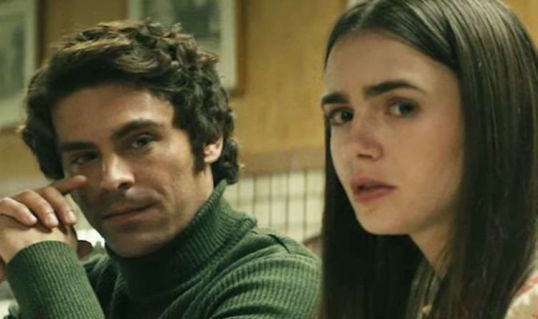
Early on in the new Netflix film, Extremely Wicked, Shockingly Evil, and Vile, there’s a scene in which Liz Kendall (Lily Collins) and her sister, Joanna (Angela Sarafyan) go to a bar.  Through some rather heavy-handed dialogue, we learn that Liz has just broken up with her boyfriend, that she has next to zero self-confidence, and that she’s a single mother.  She doesn’t think that there’s a man anywhere who would be interested in her.  Joanna responds by pointing out that there’s one man who appears to be very interested.  In fact, he hasn’t taken his eyes off of Liz since they entered the bar.

That man’s name is Ted (Zac Efron) and, at first, he seems like he’s too good to be true.  He’s charming.  He’s a law student.  He appears to love spending time with Liz’s daughter.  He looks like Zac Efron.  Perfect, right?

Of course, we know something that Liz doesn’t.  We know that Ted is Ted Bundy and that, eventually, he’s going to become one of America’s notorious serial killers, a symbol of evil so potent that, more than 30 years after he was executed by the state of Florida, he continues to get movies made about him.

Because we know who and what Ted is, we spend the first fourth of the movie cringing at everything that makes Liz happy.  For instance, Liz is shocked to discover that Ted apparently loves her daughter but we’re just like, “Oh my God, that’s Ted Bundy!  GET YOUR DAUGHTER AWAY FROM TED BUNDY!”  Liz thinks it’s romantic when Ted makes breakfast for her but we’re just staring at the big kitchen knife in his hand.  When Liz and Ted make love, only we notice the blank look on Ted’s face as he looks down at Liz and we find ourselves wondering what’s happening in his mind.

The film is told largely through Liz’s eyes and, with one exception, we never see Bundy actually committing any of his crimes.  (That’s a good thing, by the way.  We already know who Ted Bundy was and what he did.  There’s no need to sensationalize the very real pain that he caused.)  Like Liz, we find out about Bundy’s crimes through news reports and arrest records.  For instance, when Bundy is arrested for attempted kidnapping in Utah, Liz doesn’t find out about it until a story appears in the local Seattle newspaper.  When Liz demands to know why he didn’t tell her what was happening, Bundy gives her a bullshit story about how he’s being framed and how his lawyer is going to get the case thrown out.  We know that Ted’s lying but Liz believes him because …. what else is she going to do?  Is she going to believe that this perfect man who seems to love both her and her daughter is actually a sociopathic monster?

The film follows Bundy from one trial to another, as he’s charged with crimes across country.  It shows how this superficially charming law student became something of a media celebrity.  (When a reporter asks him if he’s guilty, Bundy grins and asks if the reporter is referring to a comic book that he stole when he was in the fifth grade.)  Bundy escapes.  Bundy is arrested.  Bundy escapes again.  Bundy eventually ends up being tried in Florida, where he revels in the attention.  When Liz loses faith in him, Bundy replaces her with an unstable woman named Carole Ann (Kayla Scodelario).  However, even while Carole Ann is dutifully delivering statements from Bundy to the press, Bundy is still calling Liz and begging her to believe that he’s innocent and he’ll soon be freed from prison.

Why is it so important to Bundy that Liz believe in him?  Is he just entertaining himself by manipulating her or, in his relationship with her, does he see the type of normalcy that he desires but knows he’s incapable of ever achieving?  Towards the end of the film, Liz comes close to asking Bundy if he was planning on killing her the first night that they met.  She doesn’t and it’s doubtful that Bundy would have given an honest answer but it’s still a question that hangs over every minute of this film (as does Liz’s physical resemblance to the majority of Bundy’s victims).

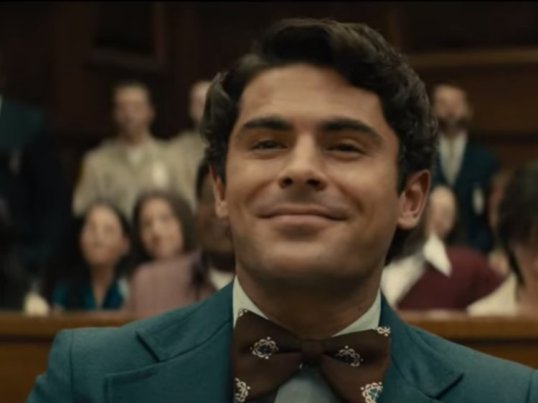
Though the film may be told from Liz’s point of view, she’s often comes across as just being a meek bystander, watching as the darkness of Ted Bundy envelops her world.  The film itself seems to be far more interested in Ted Bundy and his twisted celebrity.  Zac Efron plays Bundy as someone who knows how to be charming and who is good enough at imitating human emotions that he’s managed to keep the world from noticing that he’s essentially hollow on the inside.  Bundy has gotten so used to acting out a role that, even when he’s on trial for his life, he can’t resist the temptation to turn the courtroom into his own stage.  He demands to defend himself and, though he initially proves himself to be a good lawyer, his demands and his questions become progressively more flamboyant and self-destructive.  It’s as if he’s gotten so caught up in playing his role that he’s incapable of recognizing the reality of his situation.  He performs for the jury, the judge, and the television audience, treating the whole thing as if he’s just a character in a movie.  It’s only when he has no choice but to accept that he’s been caught and he’s never going to escape that Bundy finally shows some human emotion.  He cries but his tears are only for himself.  It’s a chilling performance and Zac Efron deserves every bit of praise that he’s received.

Unfortunately, the film itself doesn’t really tell us anything that we didn’t already know.  Director Joe Berlinger is best-known as a documentarian and he talks a “just the facts” approach to the story.  We don’t really get any insight into how a monster like Ted Bundy could come to exist.  Outside of Efron’s revelatory performance, there’s not much here that couldn’t be found in any of the other films that have been made about Ted Bundy.

(Interestingly enough, as I watched the film, it occurred to me that Ted Bundy was a monster who could have only thrived in a pre-Internet age.  For all the books and movies that portray him as being some sort of cunning genius, Bundy actually wasn’t that smart.  He approached two of early his victims in a public place and introduce himself as being “Ted,” usually within earshot of a handful of witnesses.  He was so brazen that the police even ended up with a sketch that pretty much looked exactly like him.  In all probability, the only way that Ted Bundy avoided getting arrested in Seattle was that he moved to Utah, where his crimes were unknown and the sketch wasn’t readily available.  Today, of course, that sketch and Ted’s name would be on Twitter and Facebook as soon as they were released by the police.  My friend Holly would probably retweet the sketch and say, “Do your thing, twitter!”  He would have been identified and arrested in just a matter of time.  Instead, Bundy committed his crimes at a time when news traveled slower and law enforcement agencies were not in constant communication with each other.)

The good news is that Extremely Wicked is not, as some feared, a glorification of Ted Bundy.  He’s a monster throughout the entire film.  Zac Efron proves himself to be a far better actor than anyone’s ever really given him credit for being.  It’s a flawed film but, at the very least, it’s also a disturbing reminder that sometimes, darkness hides behind the greatest charm.


Lisa Marie Does J. Edgar (dir. by Clint Eastwood)


On Friday, as I was watching the new Oscar contender from Clint Eastwood, J. Edgar, something rather odd happened.

Without giving out in spoilers, here’s what was happening on screen: Leonardo DiCaprio (playing J. Edgar Hoover, the first director of the F.B.I.) had just offered a job to Clyde (played by Armie Hammer).  Clyde — who we’ve been told has “no interest in women” — accepts on the condition that he and Edgar have lunch and dinner together everyday.  As soon as Clyde gave his condition, I heard it.

“UGGGGGGH!”

“EWWWWWW!”

“DAMN, UGGGGGGGGGGGGGGGGH!”

It was coming from several rows behind us so I glanced over my shoulder and, brushing a strand of my naturally red hair out of my eyes, I saw the source of all this commentary.  Two men, sitting on the top row.  Judging from their bull necks and the globby roundness of their bodies, they were former athletes-turned-movie-critics.  They both wore baseball caps and there was an empty seat between them which, as I know from years of observing the odd social rituals of the male species, probably meant that they had come to the film together but they were too scared of accidentally touching arms to actually sit next to each other.  (Seriously, what’s up with that?)  Anyway, I held my perfectly manicured middle finger to my lips, gave them a nice, long “shhhhhhhhhh!,” and then turned back to the movie.

A bit later into the film, Leonardo DiCaprio and Armie Hammer had a violent wrestling match which ended up with DiCaprio kissing Hammer.

And oh my God, you would have thought that the world was ending.

“EWWWWWWWWWW!” it started.

“GAWD, MAN!  GAWD!” it continued.

“UGGGGGGGGGGGHHHHHHHHHHHHHHHHH!”

“THAT’S SICK, MAN, SICK!  UGGGGHHHHHHHHHH!”

And it just kept going.  “EWWWWWWWWW!  GAWD, DISGUSTING!  EWWWWW!”

All of this from the same two idiots.  I again looked over my shoulder at them, gave them my little “shhhhh!” command but I doubt they noticed because one of them was staring at the ceiling while punching the chair in front of him while the other was staring at the floor, shaking his head and going, “DAMN, MAN!  DAMN!” 

And, I do not kid, this went on for like the next 15 minutes.

(Incidentally, this is only point in the film in which DiCaprio is seen to actually kiss anyone.)

Here’s a few random thoughts inspired by these two “gentlemen:”

1) Did the two gentleman not know which film they had bought tickets for?

2) Did they not know that J. Edgar is a biopic about J. Edgar Hoover, a man who most historians seem to agree was probably gay?

3) Were the two men illiterate or had they just not bothered to read any of the literally hundreds of reviews of J. Edgar, the majority of which mentioned that J. Edgar Hoover is assumed by many to have been gay?

4) Were these two guys — both of whom appeared to be a lot older than me — unaware that J. Edgar Hoover was gay?  Because, seriously, I knew he was gay before seeing the film and I’m a part of the notoriously ignorant Wikipedia generation that knows nothing and is proud of it.

5) Did not the fact that J. Edgar has been advertised as being “the latest film from the writer of Milk,” not clue them into the possibility that this film might feature at least one gay character?

6) Finally — is this not 2011?  I mean, did these two guys just wake up one day in pre-Project Runway America, found themselves a time machine, and then decided to transport themselves to 2011 just so they could see a movie? 

Seriously, guys, some people are gay.  Deal with it.

As for the movie itself, it’s definitely an improvement over Eastwood’s last film, the absolutely awful Hereafter.  It’s a long movie but it doesn’t drag and, even though it’s a bit too self-conscious in its attempts to be a “great film,” it still has its entertaining moments.  DiCaprio, Hammer, Judi Dench, Jeffrey Donovan and Naomi Watts all give excellent performances and DiCaprio’s “old age” makeup is actually a bit more effective than you’d guess from the trailer. 

That said, J. Edgar shares one major flaw with Hereafter and it’s a big one.  Both films attempt to use several different stories to paint one big picture and, in both cases, all of the different stories simply fail to come together.  The sequences in which J. Edgar is a young man searching for the Lindbergh Baby and railing against gangsters are exciting and consistently interesting.  However, the scenes in which Hoover — now an old, paranoid man — struggles to write his memoirs and attempts to blackmail Martin Luther King, are heavy-handed, predictable, and ultimately rather cartoonish. 

The end result is a film that is always watchable and frequently fascinating but also one that is also fatally uneven and ultimately frustrating.  It’s nowhere close to being the best film of the year but it is one of the more interesting.

Trailer: J. Edgar (dir. Clint Eastwood)


Every year since he retired from acting we seem to get one film from Clint Eastwood and this year it’s going to be one major prestige picture due this November. The film is J. Edgar and it’s a biopic detailing the life of the FBI’s founder and first director, J. Edgar Hoover.

This film will be the first time Leonardo DiCaprio and Eastwood will be working together. From the look of the cast assembled Eastwood has surrounded DiCaprio with some talented performers from Dame Judi Dench, Naomi Watts right up to Jeffrey Donovan, Geoff Pierson and Stephen Root.

The trailer shows just how much the film just screens “Awards Picture” from beginning to end. It’s not a suprise that J. Edgar has become one of the films this coming fall/winter to be a major frontrunner for the many film circles awards and, most likely, for the next Academy Awards. Here’s to hoping that this film will be a major bounce back for Eastwood after 2010’s very uneven and dull Hereafter.

J. Edgar is set for a limited release this November 9, 2011 before going worldwide a couple days later on November 11.