Film Review: Sully (dir by Clint Eastwood)


sully_xxlg

The new film Sully is about several different things.

Most obviously, it’s about what has come to be known as the Miracle on the Hudson.  On January 15th, 2009, US Airways Flight 1549 had just departed from New York’s LaGuardia Airport when it was struck by a flock of geese.  (They say that it was specifically hit by Canadian Geese but I refuse to believe that Canada had anything to do with it.)  With both of the engines taken out and believing that he wouldn’t be able to get the plane back to either LaGuardia or an airport in New Jersey, the flight’s plot, Chelsey “Sully” Sullenberger (played by Tom Hanks) landed his plane on the Hudson River.  Not only did Sullenberger manage to execute a perfect water landing but he also did so without losing a single passenger.

I’m sure that we can all remember that image of that plane sitting on the river with passengers lined up on the wings.  We can also remember what a celebrity Sully became in the days following the landing.  At a time of national insecurity and cynicism, Sully reminded us that people are still capable of doing great things.  It also helped that Sully turned out to be a rather humble and self-effacing man.  He didn’t use his new-found fame to host a reality TV show or run for Congress, as many suggested he should.  Instead, he wrote a book, raised money for the National Suicide Prevention Lifeline, and appeared in two commercials for St. Jude Children’s Research Hospital.

Wisely, Sully opens after the Miracle on the Hudson, with Sully still struggling to come to terms with suddenly being a celebrity.  (That said, we do get to see the landing in flashbacks.  In fact, we get to see it twice and it’s harrowing.  The “Brace! Brace!” chant is pure nightmare fuel.)  Tom Hanks plays up Sully’s modesty and his discomfort with suddenly being a hero.  Even while the rest of the world celebrates his accomplishment, Sully struggles with self-doubt.  Did he make the right decision landing the plane on the Hudson or did he mistakenly endanger the lives of all the passengers and crew members?

A lot of people would probably say, “What does it matter?  As long as he succeeded, who cares if he actually had to do it?”  Well, it matters to Sully.  Some of it is a matter of professional pride.  And a lot of it is because the soulless bureaucrats at the National Transportation Safety Board are investigating Sully’s landing.  If it’s determined that he could have made it back to airport and that he unnecessarily endangered the lives of everyone on the plane, he could lose his job and his pension.  As we see in a few scenes with Sully’s wife (Laura Linney, who is somewhat underused), the Sullenbergers really need that pension.

That brings us to another thing that Sully is about.  It’s a celebration of not only individual heroism but individuality itself.  The NTSB claims that they have computer-generated recreations that prove Sully had enough time and fuel to return to an airport but, as Sully himself points out, the NTSB has ignored the human element in their recreations.  As a result of their obsession with regulation and procedure, the bureaucrats have forgotten that planes are not flown by computers but individuals who have to make split-second decisions.

That’s one of the things that I loved about Sully.  In this time when we’re constantly being told that our very future is dependent upon always trusting the bureaucrats and following their rules and regulations, Sully reminds us that the government is only as good as the people who work for it.  And, far too often, the people are smug and complacent morons.

(For the record, Sullenberger has said that the real-life hearings were not as confrontational as the ones depicted in the film.  However, even taking into account the dramatic license, the overall message still rings true.)

And finally, Sully is a film about what America has become in the wake of 9-11.  Just as in real-life, the film’s Sully suffers from PTSD in the days immediately following the Miracle on the Hudson.  Even while the rest of the world celebrates him, Sully has nightmares about what could have happened if he hadn’t made the landing.  When we watch as Sully’s plane collides with a New York skyscraper, it’s impossible not to be reminded of the horrible images of September 11th.  Not only does it drive home what was at stake when Sully made that landing but it also reminds us that, regardless of what some would want us to beg, there are still heroes in the world.  Not every story has to end in tragedy.  People are still capable of doing great things.  Heroism is not dead.  With tomorrow being the 15-year anniversary of the day when 3,000 people were murdered in New York, Pennsylvania, and D.C., it’s important to be reminded of that.

Sully is a powerful and crowd-pleasing film.  (The normally cynical audience at the Alamo Drafthouse broke into applause at the end of the movie.)  Director Clint Eastwood tells this story in a quick, no-nonsense style.  During this time of bloated running times, Sully clocks in at 97 minutes and it’s still a million times better than that 150-minute blockbuster you wasted your money on last week.  Toss in Tom Hanks at his best and you’ve got one of the best films of the year so far.
What Lisa Watched Last Night #131: Bad Blood (dir by Adam Silver)


Last night, I watched a Lifetime film that originally aired in March, Bad Blood.

Lifetime-movie-Bad-Blood-March-2015

Why Was I Watching?

The main reason that I watched it was so I could get it off of my DVR.  I recorded Bad Blood when it originally aired in March, fully planning to promptly review it.  However, for whatever reason, I never got around to writing that review and Bad Blood sat, for 4 months, on my DVR.  Last night, I decided to rewatch Bad Blood, review Bad Blood, and finally erase Bad Blood!  (I need the space for all the shark movies that are going to be SyFy this week.)

What Was It About?

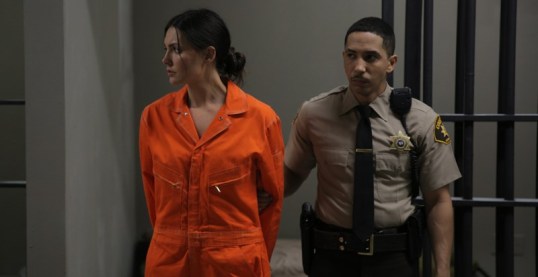
Bad Blood was a typical Lifetime mix of empowerment and exploitation.  Serial killer Oscar Marcus (Brett Rickaby) is dying of leukemia so he’s kidnapping, torturing, and murdering victims all across the southwest so that he can exchange his bad blood for their good blood.  (Or something like that — Bad Blood was not exactly an easy film to follow.)  However, because Oscar had a bone marrow transplant five years earlier, he’s not leaving his DNA behind at the crime scenes.  Instead, he’s leaving behind the DNA of his donor, Lauren (Taylor Cole).

And, since this is a Lifetime film, Lauren has both a mysterious past and a boyfriend involved in law enforcement.  However, when Lauren’s DNA starts to show up at crime scenes, that boyfriend is forced to arrest her.  (That’ll kill a relationship.)

However, Oscar rescues Lauren from the cops because he wants her blood.  And then Lauren escapes Oscar and teams up with her estranged father (Jeff Kober) to prove her innocence…

What Worked?

It’s strange.  I really didn’t like Bad Blood the first time I saw it but the second time, I discovered that it wasn’t as bad as I remembered.  There were a few strikingly atmospheric scenes towards the end of the film and there was something oddly charming about the film’s refusal to make any logical sense.

Jeff Kober was good as the irresponsible father and Brett Rickaby was a chillingly believable murderer.  The second time I watched the film, I better appreciated Taylor Cole’s performance as well.

What Did Not Work?

Bad Blood was not as bad as I remembered it being but it’s still not one of my favorite Lifetime films.  The pacing was off in a few key scenes and Lauren’s romance with the sheriff was pretty dull. As well, I didn’t care much for the film’s ending.  After what those people went through, everyone should have been a lot more traumatized.  Instead, it ended in a typically upbeat Lifetime sort of way.

“Oh my God!  Just like me!” Moments

I related to Lauren’s relationship with her dad.  Plus, Lauren’s a runner just like me!  (Lauren was also an auto mechanic, which was a totally “Oh my God!  Definitely not like me!” moment.)

Lessons Learned

DNA is a lot trickier than I thought.

Review: The Walking Dead S4E14 “The Grove”


TheWalkingDeadS4M

“Just look at the flowers, Lizzie. Just look at the flowers.” — Carol Peletier

The Walking Dead tv series has always diverged from the comic book source to keep fans of the books guessing. Some fans of the comic books have complained about this since it would mean discarding certain subplots and characters that they love but were really non-essential to the overall story being told for the tv series version. Yet, the writers of the show, through the comic book’s creator Robert Kirkman, have mined the comic book source for material that remains important to the show’s narrative.

The latest episode, “The Grove”, takes a disturbing but very important subplot from the comics and manages to adapt it for the tv series in a way that made it one of the series’ best.

A cold opening that manages to be both quaint, idyllic and disturbing which sets the tone for the rest of the episode sees the return of the group led by Carol. It’s a group that could almost be seen as a makeshift family unit. There’s Carol the loving, yet stern mother who wants to make sure her daughters learn how to survive in this dangerous, new world while Tyreese remains te compassionate and protective father. Lizzie, Mika and Rick’s baby daughter Judith make up the children who must now adapt to this new world or perish.

First off, Judith remains the blank slate in the show. She’s the first baby born after the world went to hell and thus will have to grow up in it’s new environs and new set of morals and principles. The old civilization is gone and while people try to hold onto what made that civilization tick only those willing to adapt to this new world seem to survive. Now, Lizzie and Mika were already forming their own personalities and sets of morals when the zombie apocalypse hit. We see the two Samuels girl go in differing paths in how they cope with this new world.

While seeing these two girls’ inability to adapt to the world post-zombie apocalypse was a nice theme to explore the episode really focused on the group’s maternal unit. This latest episode was a culmination of the new Carol Peletier that season 4 unleashed on an unsuspecting audience.

This was a character that we saw as being the meek victim of spousal abuse even before the zombies arrived. Her emotional trauma would continue with the loss of her young daughter Sophia in season 2 and almost dying during break in prison security in season 3. Yet, by the time season 4 rolled around we see her become a hardened survivor who has turned the corner and decided she will not remain a victim anymore and make sure those people see as being helpless (the young children in the group) learn how to defend themselves from zombies and humans alike.

The titular grove the group stumbles upon early in the episode has an almost mystical quality to it. An idyllic locale in the middle of literal hell on earth. There’s untainted well water to be had, a pecan grove for food and even a solitary deer that seems to come by at the most opportune time for meat. Hell, the cabin even has a working gas stove (probably a propane tank fed one) and a secure enough fence of barbed wire to fend off the random zombies that may wander by. It’s almost paradise in comparison to the different place Carol, Tyreese and the girls have had to call shelter.

It is no wonder that both Tyreese and Carol entertain the idea of maybe staying at the grove and making a life for themselves with the girls instead of continuing onto the unknown potential haven that is Terminus. But one thing this show has been consistent about when it comes to it’s characters seeming to find peace and tranquility is that it will pull the rug from under them to reveal that things are not ideal and that it’s just a veneer over the ugliness and brutality this new world has turned into.

The rug gets pulled out gradually from beneath Carol’s feet as both Mika and Lizzie continue to fail in heeding her teachings about survival. Mike remains adamant about not ever wanting to hurt anyone alive (she makes some headway in killing off some zombies during the episode) which Carol sees as dangerously naive of the young girl. Lizzie on the other hand begins to reveal an even more dangerous quality which would turn tragic by episode’s end.

By this time many will have written and discussed the events involving Lizzie and Mika that would add another emotional stone on Carol’s back. It’s a sequence that’s as disturbing as anything this show has put on the air in the last four years. It’s not often that children get killed in tv shows (well except for Law and Order: SVU) and yet The Walking Dead manages to do it twice in one night and both times it’s not gratuitous or meant to be entertaining. both Mika and Lizzie’s death become a sort of crucible Carol must go through to find a sort of equilibrium between the nurturing mother she was before season 4 and the cold, pragmatic survivor she has become this season. She still remains conscious to the fact that hard decisions need to be made for the greater good and she makes it ones again when Lizzie murders her younger sister Mika. It’s a murder not done in spite or malice. Lizzie truly believes that Mika will return and remember not to attack her friends and family.

In the end, the grove ceases to be the ideal haven Carol and Tyreese saw it as in the beginning and realize it’s just another place to leave behind with bad memories. It’s become another haunted place for the next people to find and wonder what happened to the previous inhabitants and what caused them to leave behind three small graves in the flower and pecan grove.

Notes

  • Tonight’s episode was written by showrunner Scott M. Gimple and directed by Michael Satrazemis.
  • The cold opening sequence was a nice touch using The Ink Spot’s “Maybe” song that was also used in the Bethesda post-apocalyptic game, Fallout 3.
  • Mika definitely came off as being the more intelligent of the two sisters. Though as many would probably point out, just as Carol did, her inability to hurt other people who will want to hurt her will get her killed sooner or later.
  • Lizzie’s personality matches very closely that of the comic book Carol who began to see the zombies as more her friends than a danger. I’m sure Kirkman had a hand in helping Gimple round out the character of the elder Samuels girl.
  • I noticed that the pistol that Mika carried with her was a Smith & Wesson M&P 9 (full-size one even) just for the fact that I also own one so it was very recognizable.
  • The different subplots involving the scattered groups of prison survivors seem to be following an uneven timeline within this midseason narrative. The fire and smoke seen by Carol, Tyreese and the girls would mean that they’re at least a day behind Daryl and Beth.
  • Gimple must’ve been a fan of Steinbeck because tonight’s episode had a very Of Mice and Men feel to it right up to the sequence with Carol and Lizzie in the end.
  • Talking Dead Guests: Melissa McBride of The Walking Dead, Yvette Nicole Brown from Community and WWE’s CM Punk.

Season 4


Review: The Walking Dead S4E13 “Alone”


TheWalkingDeadS4M

“Why hurt yourself when you can hurt other people.” — Joe

The Walking Dead has taken on a new narrative path since it’s return after this season’s mid-season break. One of the biggest complaints that some fans and critics have had about the show has been the lack of character development for many of the roles in the show. We’re not talking about people who show up for a scene or an episode or two. It’s for those who have become regulars through the show’s many season.

Well, it looks like from the show’s writers will be trying to rectify that flaw this second half of season 4.

Since the show’s return from it’s mid-season break it’s taken on an almost zealous attempt to show the audience more of who these people truly are. Each new episode in this second half has been more about exploring each surviving character’s backstory either through some sort of flashback (like we saw tonight with the cold opening showing Bob’s lonely existence before being found by Daryl and Glenn pre-prison attack) or some of the quieter moments of exposition between characters (last week’s episode between Daryl and Beth was a prime example of this). We’ve gotten to learn more about our favorite zombie apocalypse survivors. They’ve shown themselves to be more than what the previous seasons have made us to think of them.

Tonight’s episode continued to explore the growing relationship (whether romantic or platonic) between resident badass Daryl Dixon and bright-eyed optimist Beth Greene. We see him trying to teach the younger Greene girl how to become a better with the crossbow and be a better tracker. Throughout their section of tonight’s episoode we see Daryl become more protective of young Beth Greene. The false front he’s put up in the past to avoid getting closer to people has started to come down. In past season fans and writers have looked at Daryl Dixon as someone who probably would be better off being alone instead of trying to deal with a dysfunctional “family” unit of survivors. He’s the only one who seems to be ready-made for this zombie apocalypse.

Yet, as we’ve seen in the second half of this season being alone is something that he doesn’t want to ever return to. He may remain gruff and surly, but his need to be around those who care about him and people who he wants to belong with has made him a more well-rounded badass. The way the Daryl and Beth half of the episode ended it’s going to be interesting if his need to belong with a group will cause him to forget the humanity he has found while being with Rick’s group.

The theme of being alone continues, and actually began, with the Bob, Sasha and Maggie half of tonight’s episode which was aptly titled, “Alone”. Bob’s time being alone in the wilderness was the cold opening for tonight’s episode and revealed much about the enigmatic Bob. This was all done with Bob not speaking a line of dialogue in the first few minutes. He seemed able enough to survive on his own, but the moment Glenn and Daryl arrive and offers him sanctuary back in the prison he accepts with no questions asked.

It’s a theme that runs throughout tonight’s episode. Being alone may make it easier to survive. No one to worry about. Only have to keep one person alive. But for these survivors it’s the comfort of having others looking out for you which makes it all worth the headaches and drama that comes with being involved with other people. These lone wolf survivors may be great at surviving on their own, but they also want to be doing more than just survive. They want to live and being with others. It makes them feel more human and gives them a higher purpose than just trying to survive day to day.

Some fans may not be liking this more introspective turn of The Walking Dead this second half of the season. There’s still some gruesome scees to be had, but there’s also many more quiet scenes of just characters interacting with each other minus the violence and brutality inherent in a show about the zombie apocalypse.

Notes

  • Tonight’s episode was written by Curtis Gwinn and directed by Ernest Dickerson.
  • Some great genuinely scary moments in tonight’s episode: the fog sequence with the zombies involving Bob, Maggie and Sasha was shot and directed well by veteran director Ernest Dickerson (who has directed some of the best episodes in the series). Another was Daryl finding himself stuck in a room filling up with zombies and the only way out was going through them.
  • Tonight’s episode was the strongest of this season’s second half. We just didn’t get to learn about some of the things which motivates Bob, but also what made Sasha and Maggie such good survivors. Larry Gilliard, Jr. hasn’t been given enough chances to stretch his acting skills this season, but tonight he was allowed to do just that and he passed with flying colors.
  • Beth is really thirsting for some of Daryl and was really apparent in tonight’s episode. This should make Daryl/Carol shippers not very happy at all.
  • For Dead Rising fans tonight’s episode should bring a smile to their faces as we see Maggie become an expert in zombie killing just using a street sign pole and it’s very sharp squared steel sign.
  • The episode opened and ended with the song “Blackbird Song” by Lee DeWyze.
  • Jeff Kober returns as the leader of the small band of raiders we saw in the episode “Claimed”. His return may mean he’s the big baddie for this second half as the different groups make their way to Terminus.
  • Talking Dead Guests: Sonequa Martin-Green and Lauren Cohan, Sasha and Maggie of The Walking Dead.

Season 4