The Unnominated: Mean Streets (dir by Martin Scorsese)


Though the Academy of Motion Picture Arts and Sciences claim that the Oscars honor the best of the year, we all know that there are always worthy films and performances that end up getting overlooked.  Sometimes, it’s because the competition too fierce.  Sometimes, it’s because the film itself was too controversial.  Often, it’s just a case of a film’s quality not being fully recognized until years after its initial released.  This series of reviews takes a look at the films and performances that should have been nominated but were, for whatever reason, overlooked.  These are the Unnominated.

“Honorable men go with honorable men.” — Giovanni Cappa

1973’s Mean Streets is a story about Little Italy.  The neighborhood may only be a small part of the sprawling metropolis of New York but, as portrayed in this film, it’s a unique society of its very own, with its own laws and traditions.  It’s a place where the old ways uneasily mix with the new world.  The neighborhood is governed by old-fashioned mafiosos like Giovanni Cappa (Cesare Danova), who provide “protection” in return for payment.  The streets are full of men who are all looking to prove themselves, often in the most pointlessly violent way possible.  When a drunk (David Carradine) is shot in the back by a teenage assassin (Robert Carradine), no one bothers to call the police or even questions why the shooting happened.  Instead, they discuss how impressed they were with the drunk’s refusal to quickly go down.  When a soldier (Harry Northup) is given a party to welcome him home from Vietnam, no one is particularly shocked when the solider turns violent.  Violence is a part of everyday life.

Charlie Cappa (Harvey Keitel) is Giovanni’s nephew, a 27 year-old man who still lives at home with his mother and who still feels guilty for having “impure” thoughts.  Charlie prays in church and then goes to work as a collector for Giovanni.  Giovanni is grooming Charlie to take over a restaurant, not because Charlie is particularly talented at business but just because Charlie is family.  Giovanni warns Charlie not to get involved with Teresa (Amy Robinson) because Teresa has epilepsy and is viewed as being cursed.  And Giovanni particularly warns Charlie not to hang out with Teresa’s cousin, Johnny Boy (Robert De Niro).  Johnny Boy may be charismatic but everyone in the neighborhood knows that he’s out-of-control.  His idea of a good time is to blow up mailboxes and shoot out street lamps.  Charlie, who is so obsessed with sin and absolution that he regularly holds his hand over an open flame to experience the Hellfire that awaits the unrepentant sinner, finds himself falling in love with Teresa (though it’s debatable whether Charlie truly understands what love is) and trying to save Johnny Boy.

Charlie has other friends as well.  Tony (David Proval) runs the bar where everyone likes to hang out and he seems to be the most stable of the characters in Mean Streets.  He’s at peace with both the neighborhood and his place in it.  Meanwhile, Michael (Robert Romanus) is a loan shark who no one seems to have much respect for, though they’re still willing to spend the afternoon watching a Kung Fu movie with him.  Michael knows that his career is dependent on intimidation.  He can’t let anyone get away with not paying back their money, even if they are a friend.  Johnny Boy owes Michael a lot of money and he hasn’t paid back a single dollar.  Johnny Boy always has an excuse for why he can’t pay back Michael but it’s obvious that he just doesn’t want to.  Charlie realizes that it’s not safe for Johnny Boy in Little Italy but where else can he go?  Brooklyn?
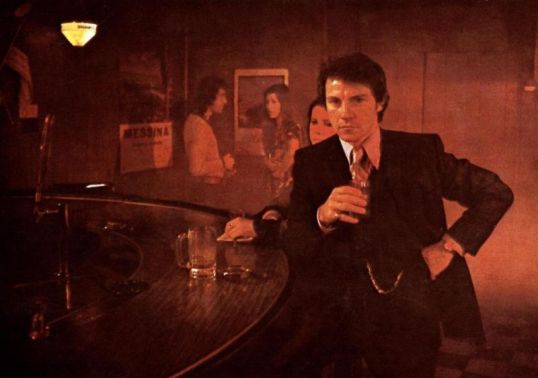
Mean Streets follows Charlie and his friends as they go about their daily lives, laughing, arguing, and often fighting.  All of the characters in Mean Streets enjoy a good brawl, despite the fact that none of them are as tough as their heroes.  A chaotic fight in a pool hall starts after someone takes offense to the word “mook,” despite the fact that no one can precisely define what a mook is.  The fights goes on for several minutes before the police show up to end it and accept a bribe.  After the cops leave, the fight starts up again.  What’s interesting is that the people fighting don’t really seem to be that angry with each other.  Fighting is simply a part of everyday life.  Everyone is aggressive.  To not fight is to be seen as being weak and no one is willing to risk that.

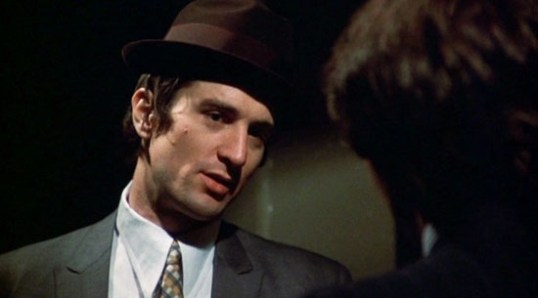
Mean Streets was Martin Scorsese’s third film (fourth, if you count the scenes he shot before being fired from The Honeymoon Killers) but it’s the first of his movies to feel like a real Scorsese film.  Scorsese’s first film, Who’s That Knocking On My Door?, has its moments and feels like a dry run for Mean Streets but it’s still obviously an expanded student film.  Boxcar Bertha was a film that Scorsese made for Roger Corman and it’s a film that could have just as easily been directed by Jonathan Demme or any of the other young directors who got their start with Corman.  But Mean Streets is clearly a Scorsese film, both thematically and cinematically.  Scorsese’s camera moves from scene to scene with an urgent confidence and the scene where Charlie first enters Tony’s bar immediately brings to mind the classic tracking shots from Goodfellas, Taxi Driver, and Casino.  One gets the feeling that Pete The Killer is lurking somewhere in the background.  The scenes between Keitel and De Niro are riveting.  Charlie attempts to keep his friend from further antagonizing Michael while Johnny Boy tells stories that are so long and complicated that he himself can’t keep up with all the details.  Charlie hold everything back while Johnny Boy always seems to be on the verge of exploding.  De Niro’s performance as Johnny Boy is one that has been duplicated but never quite matched by countless actors since then.  He’s the original self-destructive fool, funny, charismatic, and ultimately terrifying with his self-destructive energy.

Mean Streets was Scorsese’s first box office success and it was also the film that first brought him widespread critical acclaim.  However, in a year when the totally forgotten A Touch of Class was nominated for Best Picture, Mean Streets did not receive a single Oscar nomination, not even for De Niro’s performance.  Fortunately, by the time Mean Streets was released, De Niro had already started work on another film about the Mafia and Little Italy, The Godfather Part II.
Previous entries in The Unnominated:

  1. Auto Focus 
  2. Star 80
  3. Monty Python and The Holy Grail
  4. Johnny Got His Gun
  5. Saint Jack
  6. Office Space
  7. Play Misty For Me
  8. The Long Riders

Horror On TV: Kolchak: The Night Stalker 1.13 “Primal Scream” (dir by Robert Scheerer)


Tonight on Kolchak….

What happens when an oil company discovers new, undefined organic matter in the arctic circle?

Well, first off, they mishandle it and it ends up turning into a prehistoric, killer ape-man.

Secondly, it’s time for a corporate cover-up!

Fortunately, the world’s greatest (if unluckiest) journalist, Carl Kolchak, is on the case!

Anyway, this is an okay episode of Kolchak.  If I don’t seem as enthused about it as I’ve been about some of the previous episodes, it’s because a killer, prehistoric ape-man just isn’t as much fun as a Cajun demon or a killer robot.  Still, this episode has a nicely done, underground tunnel-set climax.  Seriously, you can’t go wrong with an underground tunnel.

This episode originally aired on January 17th, 1975.

Enjoy!

http://www.youtube.com/watch?v=osIun8gef6I

Cleaning Out The DVR Yet Again #40: Melinda (dir by Hugh A. Robertson)


(Lisa recently discovered that she only had about 8 hours of space left on her DVR!  It turns out that she’s been recording movies from July and she just hasn’t gotten around to watching and reviewing them yet.  So, once again, Lisa is cleaning out her DVR!  She is going to try to watch and review 52 movies by the end of 2017!  Will she make it?  Keep checking the site to find out!)

melinda

I recorded Melinda off of TCM on November 13th.

First released in 1972, Melinda is technically a murder mystery.  Frankie J. Parker (Calvin Lockhart, giving a brilliant performance) is a popular radio DJ in Los Angeles.  When we first see Frankie, he’s driving his expensive sportscar through a poor neighborhood.  It’s a neighborhood that he knows well but, as opposed to those around him, he’s made it out.  He’s handsome, slick, and more than a little arrogant.  When he arrives at a local gym, he looks at himself in a mirror and says, “I shouldn’t say it … but I am a pretty motherfucker.”  Frankie’s a student in a taekwondo class taught by Charles Atkins (Jim Kelly).  Charles gives Frankie a hard time about not giving back to the community.  Frankie blows off his concerns.  To be honest, we really should dislike Frankie but he’s so damn charming.  As played by Calvin Lockhart, Frankie has one of those irresistible smirks, the type of the lights up the screen.

One night, Frankie meets the mysterious Melinda (Vonetta McGee) and spends the night with her.  He thinks that it’s just going to be another one night stand but Melinda tells Frankie that he has the potential to be more than he realizes.  Touched, Frankie goes to work and resolves to be a better person.  Then he returns home and discovers that Melinda has been murdered!

The rest of the film deals with Frankie’s attempts to discover who murdered Melinda.  It turns out that Melinda had underworld connections and mob boss Mitch (Paul Stevens) is desperate to recover something that Melinda had in her possession when she died.  But honestly, the whole murder subplot is a MacGuffin (if you want to get all Hitchcockian about it).  Ultimately, Melinda is a character study of Frankie Parker and how, over the course of solving Melinda’s murder, he learns that there’s more to life than just looking out for himself.

Though Melinda was obviously made to capitalize on the blaxploitation craze of the early 70s, it’s actually far more low-key than most of the better known films in the genre.  (Or, at least it is until the karate-filled finale.)  Perhaps because it was directed by a black man and written by noted black playwright Lonne Elder III, Melinda is far more interested in exploring what makes its characters who they are, as opposed to just putting a gun in their hand and having them shoot up the screen.  Frankie Parker emerges as a fascinating character.

Mention should also be made of the performance of Rosalind Cash, who plays Terry, Frankie’s ex.  Cash gets an absolutely amazing scene where, while attempting to convince a bank employee that she’s Melinda so that she can get into Melinda’s safe deposit box, she tells off a rude teller.  It’s such a good scene and Cash delivers her lines with such fury that you find yourself forgetting that the teller was actually correct in her suspicion that Terry wasn’t actually who she said she was.

Melinda is probably one of the best films that hardly anyone has ever heard of.  Keep an eye out for it.

Cleaning Out The DVR Yet Again #26: The Muthers (dir by Cirio H. Santiago)


(Lisa recently discovered that she only has about 8 hours of space left on her DVR!  It turns out that she’s been recording movies from July and she just hasn’t gotten around to watching and reviewing them yet.  So, once again, Lisa is cleaning out her DVR!  She is going to try to watch and review 52 movies by the end of Tuesday, December 6th!  Will she make it?  Keep checking the site to find out!)

the-muthers

On November 13th, TCM Underground aired the 1976 Filipino women-in-prison film, The Muthers!  And I recorded it!

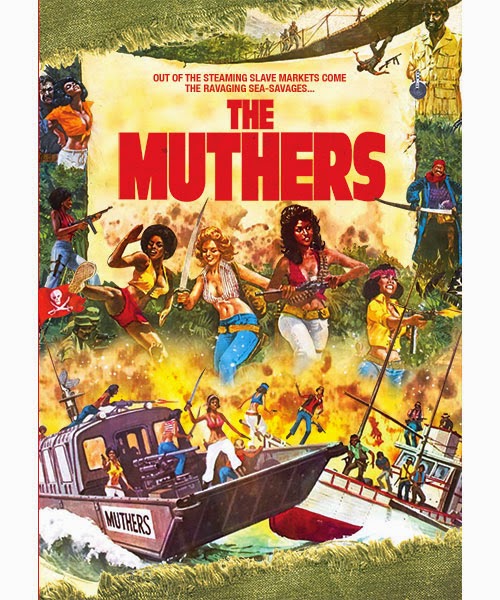
Before I say anything about the film itself, I want to acknowledge how much I love the poster above.  I mean, that poster promises a film full of actions, thrills, and a healthy dose of girl power.  You look at that poster and you think to yourself, “The Muthers must be one the greatest drive-in films ever made!”

You might also think that from reading about the film’s plot.  The Muthers opens with Kelly (Jeannie Bell) and Anggie (Rosanne Keaton) sailing the high seas. It turns out that they’re pirates!  They forcibly board yachts and rob decadent rich people.  They’re good at their job and they have fun, too!  Even better, they’re constantly fighting a rival pirate, a blowhard chauvinist named Turko (John Montomgery)!  Turko only has one eye, that’s how much of a pirate he is!

If the film had just been Kelly and Anggie fighting Turko, The Muthers probably would be a classic.  However, since this is a Filipino women-in-prison film, Kelly soon discovers that her sister has been imprisoned on Get Out If You Can Island.  (Seriously, that’s what they call the island.)  The island is run by the evil Montiero (played by Tony Carreon, a perennial villain in Filipino cinema) and, if they don’t rescue her, Montiero will sell her into prostitution.

Naturally, Kelly and Anggie go undercover and infiltrate the island.  Sadly, the film gets kind of boring after Kelly and Anggie reach the prison.  One reason why Filipino exploitation films are so respected and loved by aficionados of grindhouse cinema is because they frequently went totally and completely over the top.  There was a shamelessness to the best of the Filipino grindhouse films and it makes them fascinating to watch.  The Muthers starts out like a classic, with the pirates and Turko and all that, but once Kelly and Anggie reach the island, the film becomes oddly restrained.  There’s little violence, little sex, only one notable use of slow motion, and the film even lacks the radical political subtext that runs through many women-in-prison films.  One can’t help but wonder what the late Jess Franco would have done with the same material.

So, sadly, The Muthers failed to live up to the promise of that poster.

It happens.

muthers